On Friday, the U.S. Cybersecurity and Infrastructure Security Agency added four flaws to its Known Exploited Vulnerabilities (KEV) catalog, spanning Broadcom VMware vCenter, Cisco Expressway, Apache Roller, and SAP NetWeaver, and cited evidence of active exploitation. One of those flaws, the vCenter vulnerability CVE-2026-123890, has been tied to a suspected China-nexus espionage group that used it to plant custom backdoors for persistent access and data theft.
Federal civilian agencies now have until November 23, 2026 to patch all four under Binding Operational Directive 26-04. Private companies have no such mandate, and that is exactly the problem. The operators working these actively exploited vulnerabilities do not check whether a target is a federal agency or a regional manufacturer with a lean infrastructure team. They check whether the system is reachable and whether it is unpatched.
For US mid-market IT leaders, this KEV update is not only a patching event but also a test of whether the organization can detect, contain, and recover from an intrusion that may already be underway. This article breaks down what was added, what the exploitation data says about the speed of modern attacks, and a practical 72-hour plan that protects the business, not just the servers.
Four Actively Exploited Vulnerabilities, One Deadline, and a Clear Signal
CISA does not add entries to the KEV catalog on suspicion. The catalog exists to separate theoretical risk from confirmed attacker behavior, and its additions are the closest thing the industry has to an authoritative list of what is being used against real organizations right now. When four products from four different vendors land in the catalog on the same day, the message is about breadth. Attackers are working the virtualization layer, the collaboration edge, the web application tier, and the ERP backbone at the same time.
The deadline attached to this batch comes from BOD 26-04: Prioritizing Security Updates Based on Risk. The title is worth reading twice. Federal policy has moved past the idea that every patch is equal and that the patch queue should be worked in release order. Evidence of exploitation moves a flaw to the front of the line, regardless of when it was published or how routine the product seems.
Mid-market organizations should run the same play, and with more urgency than an agency. They typically operate with fewer security staff, flatter networks, fewer layers of compensating control, and far less tolerance for a week of unplanned downtime. A federal deadline is a reasonable outer boundary. For anything reachable from the internet, it is too generous.
What CISA Added, Flaw by Flaw
The four additions share one trait, evidence of active exploitation, but they differ sharply in how much public detail exists. That difference shapes how a mid-market team should prioritize, hunt, and communicate with leadership.
VMware vCenter: Espionage Operators at the Control Plane
The most consequential entry is CVE-2026-123890 in Broadcom VMware vCenter, the authentication bypass we examined in our recent 72-hour patch, hunt, and recovery plan on the IT Vortex blog. According to reporting from The Hacker News, exploitation of CVE-2026-123890 has been linked to a suspected China-nexus cyber espionage group tracked as Armory Castle, formerly UNC5221. The group reportedly weaponized the vCenter flaw in conjunction with a now-patched vulnerability in BeyondTrust Remote Support, CVE-2026-102764, which carries a CVSS score of 9.3, to deploy custom backdoors for persistent access and data theft.
Consider what vCenter is. It is the management plane for an entire VMware estate. It provisions virtual machines, moves workloads between hosts, manages snapshots, and effectively holds the keys to every guest running on the cluster. An attacker with administrative control of vCenter does not need to compromise servers one at a time. They can clone a domain controller, copy a database virtual machine to inspect offline, or power down production on their own schedule. For an espionage operator, it is the ideal vantage point: high privilege, low visibility, and rarely instrumented by the endpoint tools that protect individual guests.
An attacker who owns vCenter does not compromise servers one at a time. They inherit the entire estate.
The BeyondTrust pairing is equally instructive. Remote support tools exist to grant trusted technicians privileged access to systems they need to fix. When that trust channel is compromised alongside the hypervisor management plane, the attacker inherits two of the most privileged paths in the environment at once. This is not opportunistic ransomware spraying the internet for easy targets. It is a deliberate campaign against the infrastructure that IT teams use to manage everything else.
Apache Roller: Maintainers Confirm the Attacks
Apache Roller is a Java-based blog server that organizations use to run internal and public-facing publishing sites. Earlier in the week, its maintainers acknowledged that the issue is being actively exploited, though they did not reveal how it was being weaponized or who was behind it.
That silence is common in early disclosure, and it cuts both ways. Defenders get confirmation that the risk is real without the indicators of compromise needed to hunt for it. Web-facing applications like Roller often run on servers that sit closer to the internet than anything else in the environment, and they frequently share credentials, service accounts, or network segments with more valuable systems. A low-profile publishing platform becomes a foothold, and a foothold becomes a path inward. The lesson for mid-market teams is to treat every internet-facing application as a potential entry point, not just the ones that look important.
Cisco Expressway and SAP NetWeaver: The Edge and the Core
Cisco Expressway sits at the network edge, brokering video and collaboration traffic between internal users and the outside world. SAP NetWeaver is the application platform underneath SAP business systems, where finance, supply chain, and human resources data live. One is a door. The other is the vault. Both now appear in the KEV catalog in the same update.
Public detail is thinner for parts of this batch. As of the original report, there appear to be no public reports documenting active exploitation of CVE-2025-42884, one of the four added flaws. That does not lower its priority. CISA cited evidence of active exploitation when it added the set, whether or not that evidence has been published elsewhere. Waiting for a vendor blog post or a threat intelligence write-up before acting is how organizations end up patching after the breach rather than before it.
From Public Proof of Concept to Lateral Movement
The fourth thread in this story is the clearest illustration of how fast the window closes. CISA’s addition of CVE-2026-76466 follows a report from F6 that the vulnerability was exploited to breach a Russian organization after the release of a proof-of-concept exploit. The attackers used it to move laterally across the network and access sensitive data. The activity has not been attributed to any threat actor.
The sequence is the lesson: public proof of concept, then exploitation, then lateral movement, then data access. Once working exploit code is public, the skill required to use it collapses, and the pool of potential attackers expands from a handful of capable groups to anyone who can run a script. Organizations that treat proof-of-concept publication as a footnote rather than a trigger are betting their data on attackers being slow. The exploitation data says they are not.
What the Exploitation Data Says About Speed and Targeting
This KEV batch is not an anomaly. It fits a pattern that VulnCheck documented in its State of Exploitation report covering the first half of 2025. The first chart shows the vendors with the most newly exploited CVEs during that period. Read it against your own technology stack, because the vendors that dominate exploitation activity are the ones whose products are most widely deployed and most deeply trusted.
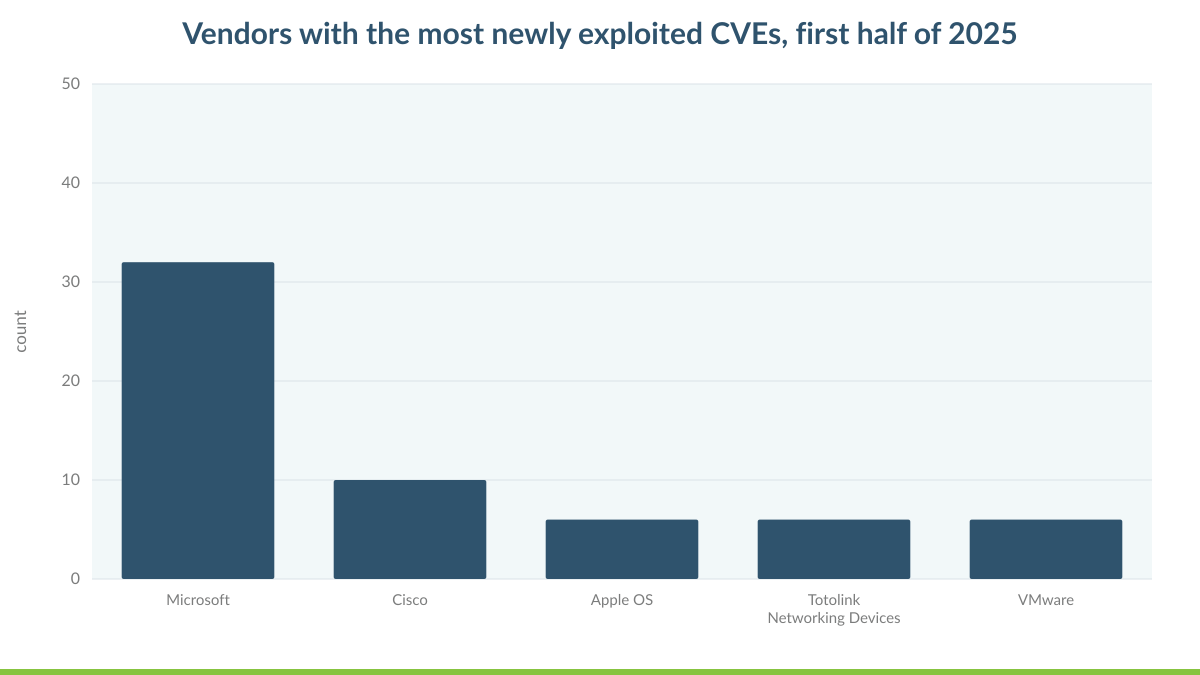
The point is not that any single vendor is careless. Attackers invest where the return is highest, and the return is highest in software that runs in nearly every enterprise and holds privileged access. Foundational platforms are attractive for the same reason they are foundational: they touch everything. For a mid-market organization, the practical takeaway is that vendor familiarity is not a security control. The products you rely on most are the products adversaries study most.
The second chart breaks newly exploited vulnerabilities down by product category, drawing on Infosecurity Magazine’s coverage of the same VulnCheck research.
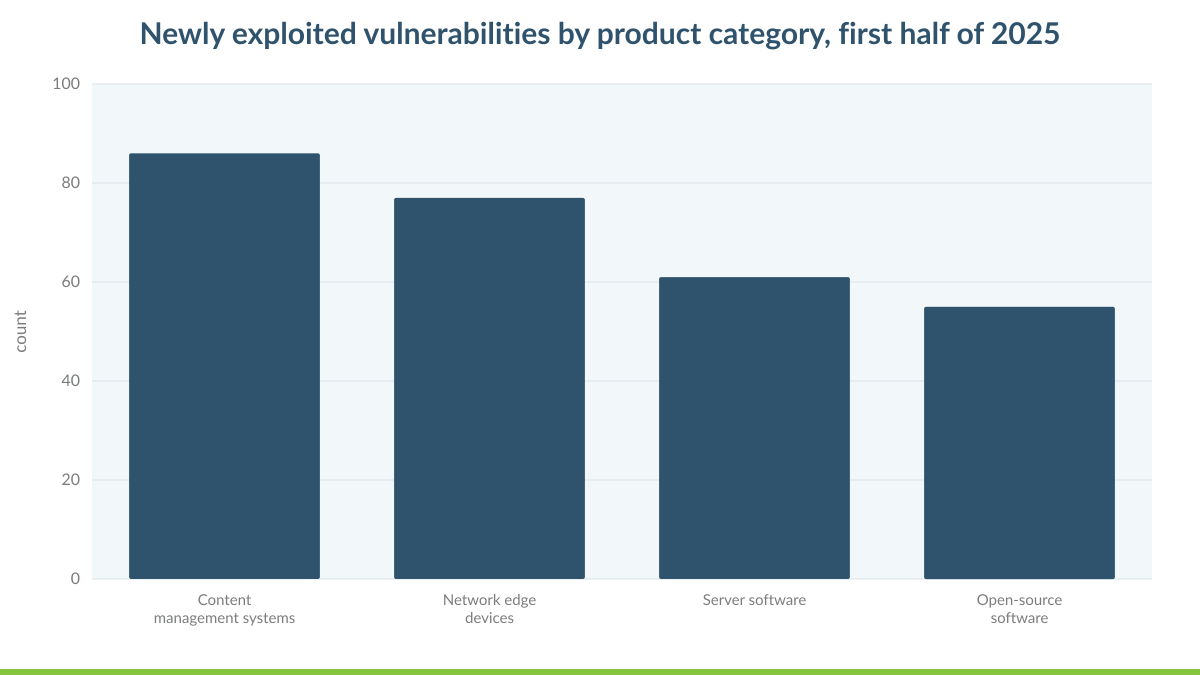
Category matters more than vendor for planning purposes. Edge devices, management consoles, and web-facing applications share common traits: they are reachable, they are privileged, and they are often patched on slower cycles than workstations because downtime is harder to schedule. This week’s KEV additions map directly onto those categories. Expressway is an edge gateway, vCenter is a management console, Roller is a web application, and NetWeaver underpins business-critical applications. Lay the category breakdown over your asset inventory, and the categories at the top of the chart should carry the shortest patch windows in your policy.
The third chart is the most sobering. It shows the share of known exploited vulnerabilities that were exploited on or before the day the CVE was publicly disclosed.
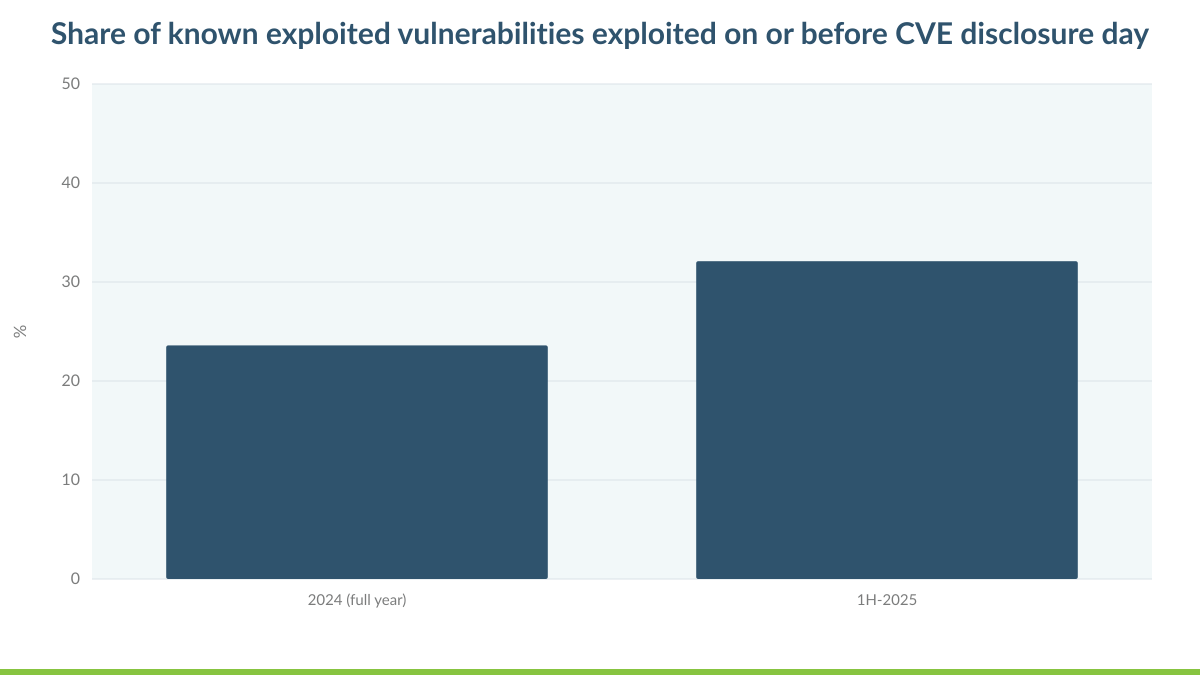
Every vulnerability counted in that bar breaks the traditional patch model. Monthly patch cycles assume a grace period between disclosure and attack. For those flaws, the grace period did not exist. The only effective controls were the ones already in place before anyone knew there was a problem: network segmentation, restricted privileged access, continuous monitoring, and the ability to restore clean systems quickly.
When exploitation arrives on disclosure day, the only controls that matter are the ones already in place.
Put the three charts next to this week’s KEV additions and the conclusion is straightforward. Attackers favor widely deployed infrastructure, they concentrate on reachable and privileged categories, and they often move before defenders have a patch to apply. A patching strategy alone cannot carry that load. It has to be paired with detection that assumes compromise and recovery that assumes the primary environment may not be trustworthy.
Why Espionage Changes the Risk Calculus for the Mid-Market
It is tempting for a mid-market firm to read the phrase China-nexus espionage group and conclude that the threat belongs to defense contractors and federal agencies. That conclusion is wrong for three reasons.
- You hold data someone wants. Mid-market firms manage customer records, intellectual property, pricing models, merger discussions, and regulated health and financial data. Espionage is about information, and valuable information is not limited to the Fortune 500.
- You are a path to someone bigger. Suppliers, law firms, accounting practices, and service providers connect mid-market companies to larger organizations. Compromising the smaller, less defended partner is a well-established route to the larger target.
- The tools do not discriminate. An exploit built for vCenter works against every unpatched, reachable vCenter instance. Once a campaign is underway and exploit code circulates, targeting tends to widen rather than narrow.
Espionage also changes what an incident looks like. Ransomware announces itself with encrypted files and a ransom note. Espionage operators work to stay invisible, and the custom backdoors attributed to the Armory Castle campaign are built for persistence. An organization can patch the vulnerability, close the ticket, and still have an adversary inside. The damage is measured in months of silent data loss, regulatory exposure, and an eventual disclosure conversation with customers, insurers, and, in regulated sectors, examiners.
That is why a KEV addition tied to espionage deserves a different response than one tied to commodity malware. The goal is not only to close the vulnerability but also to prove that nobody used it while it was open.
Business Impact Across the Five Pillars
Translating this KEV update into business terms means mapping the exposure to the outcomes leadership actually measures: cost, risk, performance, and continuity.
Security
The direct risk is privileged compromise of the systems that manage everything else. Security in this context means more than applying a vendor update. It means verified deployment across every instance, continuous detection on management interfaces, and a response capability that can act at 2 a.m. on a Saturday, because that is when well-resourced operators prefer to work.
Resilience
If vCenter is compromised, every virtual machine it manages is in question. Resilience depends on backups the attacker cannot reach or alter, and on a recovery environment that does not share credentials, networks, or management tooling with production. Without that separation, recovery becomes reinfection.
Performance
Emergency patching of vCenter, Expressway, or SAP systems usually means unplanned maintenance windows on systems the business depends on. Organizations with mature change processes and tested rollback absorb this without user impact. Organizations without them are forced to trade security for availability, or availability for security, and neither trade is acceptable.
Simplification
Four vendors, four advisories, four patch procedures, one week. Every additional platform and console in the environment adds coordination burden to the same small team. Consolidating infrastructure on a managed platform reduces the number of moving parts that internal staff must track, test, and patch under pressure.
Flexibility
Sometimes an on-premises system cannot be patched quickly because of an application dependency, a stalled upgrade path, or a licensing constraint. In those cases, options matter. The ability to shift a workload to a hardened hosted environment, or to fail over to a clean recovery site, buys time without forcing the business to accept exposure.
A 72-Hour Response Plan for Actively Exploited Vulnerabilities
The federal deadline is a useful benchmark, but mid-market organizations should move faster on anything internet-facing. The following plan assumes a lean team and sequences the actions that reduce the most risk earliest.
Hours 0 to 24: Inventory and Contain
- Confirm exposure. Identify every instance of vCenter, Cisco Expressway, Apache Roller, and SAP NetWeaver in the environment, including test systems, disaster recovery sites, and forgotten lab deployments. Shadow instances are where attackers land first.
- Restrict access to management planes. vCenter should never be reachable from the internet. Limit administrative access to a dedicated management network and require phishing-resistant multifactor authentication on every administrative path.
- Review remote support tooling. Given the BeyondTrust pairing in the Armory Castle campaign, confirm that BeyondTrust Remote Support and any similar tools are fully patched, that their access is logged, and that sessions are restricted to known technicians.
- Pull official vendor guidance. Use vendor advisories for fixed versions and interim mitigations, and record exactly what you applied and when. That record becomes evidence later.
Hours 24 to 48: Patch and Verify
- Patch internet-facing systems first. Expressway and any public-facing Roller instance move to the front of the queue, followed immediately by vCenter and SAP NetWeaver.
- Confirm recoverability before you change anything. Validate current backups and capture configuration exports. A failed update on vCenter or an SAP system should be a rollback, not an outage.
- Verify deployment. A patch that was scheduled is not a patch that was applied. Confirm build and version numbers on every instance after the change window closes.
Hours 48 to 72: Hunt and Harden
- Hunt for persistence. Review vCenter authentication logs, newly created accounts, unexpected role or permission changes, and unusual virtual machine clone or export activity. On Roller servers, look for web shells and unfamiliar files in application directories.
- Rotate credentials. Reset vCenter administrative passwords, service account credentials, and any secrets stored on or accessible from the affected systems. Assume anything the attacker could have read has been read.
- Document for leadership and insurers. Record what was exposed, when it was patched, and what the hunt found. Boards, cyber insurers, and auditors will ask for this evidence after any incident, and it is far easier to produce in real time than to reconstruct.
Patching Does Not Evict an Intruder
The most dangerous assumption in any KEV response is that patching ends the incident. A patch closes the door. It does nothing about someone who already walked through it. Custom backdoors deployed for persistent access, as reported in the Armory Castle activity, are engineered to survive exactly this moment: the vendor update lands, the ticket closes, and the implant keeps reporting home.
The patch closes the door. It does not evict anyone who already walked through it.
Effective post-patch hunting requires visibility that most mid-market teams lack internally: centralized logs from hypervisor management, network flow data, endpoint telemetry from guest operating systems, and analysts who know what normal looks like well enough to spot what is not. Building that capability in-house means hiring, training, and retaining analysts across three shifts, plus the tooling to support them. For most mid-market organizations, the math does not work.
A managed approach changes the economics. Security as a Service (SECaaS) from IT Vortex delivers continuous monitoring and response using technology from partners such as CrowdStrike and Fortinet, integrated and tuned by a team that also understands the VMware infrastructure underneath. That combination matters in a campaign like this one. Detecting misuse of vCenter requires people who know how vCenter is supposed to behave, not just people who know how to read an alert.
If the hunt turns up evidence of compromise, the question shifts from detection to recovery, and the quality of the answer depends entirely on decisions made before the incident began.
Recovery Is a Security Control
When the management plane is compromised, restoring from backup is only safe if the backups were beyond the attacker’s reach. An adversary with vCenter administrative access may be able to see backup proxies, delete snapshots, or reach backup repositories that share credentials with production. Recovery planning that assumes the backup system is clean, without proving it, is planning on hope.
Veeam-powered Backup as a Service (BaaS) keeps protected copies offsite and separated from production credentials, so a compromise of the primary environment does not automatically extend to the last line of defense. That separation is what turns a backup from a convenience into a control.
Disaster Recovery (DRaaS) extends the same principle to full environment recovery. Instead of rebuilding a compromised cluster in place while forensic work is still underway, organizations can fail over to a clean, isolated environment and keep the business running. The ability to reduce downtime risk with automated, tested recovery workflows is what separates a contained incident from a multi-week outage, and it gives investigators room to work without pressure to rush production back online.
Testing is the difference between a plan and a capability. If you have not validated recovery against a scenario in which the primary management plane is untrusted, now is the time to do it. The IT Vortex DR Readiness Assessment is a practical starting point for identifying gaps before an attacker finds them.
Shrinking the Attack Surface With Managed Infrastructure
There is a structural answer beneath the tactical one. Many mid-market organizations run vCenter, collaboration gateways, and application servers on-premises, with a small team responsible for everything from user tickets to hypervisor upgrades. Every KEV addition lands on that same small team, on top of everything else they already carry.
Moving workloads to Cloud Hosting (IaaS) on a managed VMware platform shifts responsibility for hypervisor management, patch cadence, and management-plane hardening to an operator whose core job is exactly that. As a Premier Broadcom VCSP Partner, IT Vortex runs VMware-powered managed cloud where administrative access to the management plane is restricted by design and patching is part of daily operations rather than a fire drill.
This is not about surrendering ownership. It is about placing the most privileged, most targeted layer of the stack in the hands of a team that monitors it continuously and patches it as a discipline. Your team keeps control of applications, data, and business priorities. The infrastructure underneath stops being a recurring emergency that pulls your best people away from the projects that move the business forward.
IT Vortex approaches this work as integrator, architect, and advisor. We map your current environment, identify which systems carry the most exposure, design a target architecture that aligns hosting, backup, recovery, and security, and then operate it alongside your team. The value is not only lower risk but also a smaller, more predictable operational burden on the people you already have. Enterprise-grade infrastructure, without enterprise complexity.
The Question Is No Longer Whether You Patched
Most organizations will patch this week’s KEV additions eventually. That is the wrong measure of success. The real questions are harder. Did you know within hours which of your systems were affected? Could an intruder have arrived before your patch did? Would you detect a backdoor designed to stay hidden? Could you restore clean systems if the management plane itself became untrusted?
Organizations that can answer yes to all four are running security as an operating discipline. Organizations that cannot are running it as a series of emergencies, and espionage operators are patient enough to wait in the gaps between them. The next KEV update is already coming. The only variable you control is which kind of organization you will be when it arrives.
If your team is looking at four advisories and a calendar, start with a conversation. Lou Corriero, VP Cloud at IT Vortex, works with mid-market IT leaders to assess exposure, prioritize remediation, and design infrastructure that turns the next KEV update into routine operations rather than a crisis. Schedule a working session with Lou and leave with a clear view of where your environment stands and what to fix first.