On Tuesday, security research firm Calif published details of a Java flaw it calls Java4Shell. The description reads like a worst-case checklist. According to Calif, an unauthenticated attacker can read Java heap memory, steal private keys, tokens, and session secrets, and reach remote code execution. The Java4Shell vulnerability is tracked as CVE-2026-114938. Calif scored it 9.2 (Critical) under CVSS 4.0, while Oracle rated it 8.1 (High) under CVSS 3.1, according to CSO Online’s November 18, 2026 report.
The bug lives in a narrow place: the OpenJDK x86-64 Base64 decoder. The exposure is much wider. Java runs inside application servers, vendor software, middleware, build pipelines, and desktop tools across nearly every mid-market estate. As CSO Online observed, most CISOs cannot see every instance of it in their environment. That gap, more than the decoder, is the real story for IT and business leaders.
For a mid-market organization, the question this week is not whether Oracle and the OpenJDK distributors will ship fixes. They will. The question is whether your team can produce, within hours, a defensible list of every Java runtime you operate. That list should show who owns each runtime, whether it faces the internet, and what secrets it holds in memory. If the list takes weeks to build, the vulnerability window stays open long after the patch exists.
This article covers five things:
- What Java4Shell exposes.
- Why the disagreement over its severity score changes patch priority.
- Where unmanaged Java tends to hide.
- Why the industry’s move away from Oracle Java makes the inventory problem harder.
- How to turn the next critical Java hole into routine maintenance rather than a weekend incident.
What the Java4Shell Vulnerability Actually Exposes
Java earned its place in the enterprise partly because of memory safety. The Java Virtual Machine manages memory on behalf of developers. It checks array bounds and reclaims unused objects automatically, which removes entire classes of bugs that have plagued C and C++ code for decades.
As CSO Online put it, Java is well known for safely handling memory. That is exactly why a flaw affecting memory management is so dangerous. Application teams assume the runtime underneath them keeps memory contained. When the flaw sits inside the runtime itself, that assumption fails for every application running on top of it, no matter how carefully those applications were written.
Consider what lives on a Java heap at any given moment. The heap is the working memory of a running application, so it holds whatever the application is processing:
- TLS private keys loaded from keystores.
- OAuth and API bearer tokens.
- User session identifiers.
- Database connection credentials.
- Fragments of customer data passing through business logic.
An attacker who can read heap memory does not need to break encryption or guess passwords. They read what the application already decrypted and loaded for its own use. Teams that handled the Heartbleed response in 2014 will recognize the pattern. A memory disclosure flaw becomes a credential problem, and a credential problem becomes an identity problem.
The Base64 detail matters too. Base64 encoding is one of the most common ways software moves binary data through text-based channels. Applications decode it constantly when they handle authentication headers, JSON Web Tokens, SAML assertions, email attachments, and encoded API payloads. Much of that input arrives from outside the organization before any user has logged in.
That puts the decoder very close to the edge of the application. Calif’s description of the attacker as unauthenticated reinforces the point. Internet-facing Java services belong at the top of the priority list.
In business terms, the Java4Shell vulnerability carries three escalating impacts:
- Confidentiality. Sensitive data and secrets leave memory.
- Impersonation. Stolen keys and tokens let an attacker act as your application, your users, or your services. This activity often looks legitimate to monitoring tools.
- Full compromise. Remote code execution gives an attacker a foothold to deploy ransomware, establish persistence, or move toward backups and domain controllers.
Each stage costs more than the last, and the response playbook has to cover all three.
Why a 9.2 Versus an 8.1 Changes Your Patch Window
Two credible parties scored the same bug differently. Calif rated Java4Shell 9.2 under CVSS 4.0, the newer version of the Common Vulnerability Scoring System. Oracle rated it 8.1 under CVSS 3.1, per CSO Online’s reporting. The two frameworks weigh factors differently, and vendors and researchers often make different assumptions about attack complexity and real-world exploitability. Neither score is necessarily wrong. But the gap has practical consequences that many organizations never notice until an auditor or insurer asks.
Most mature vulnerability management programs set patch deadlines by severity band. Critical findings get the shortest remediation window, and High findings get a longer one. Those windows are written into internal policy, client contracts, and cyber insurance attestations.
Scanning tools typically import a single score from a feed. If your tool imports Oracle’s 8.1, the finding lands in the High queue and inherits the longer deadline. If it imports Calif’s 9.2, it lands in Critical. The same vulnerability on the same server can carry very different deadlines depending on which number your tooling picked up.
The fix is a policy decision, not a tooling one. Write severity override rules that trigger on characteristics rather than raw scores. A flaw that is remotely reachable, requires no authentication, and exposes credentials or keys should be treated as Critical in your environment, whatever the vendor’s band. That rule protects you from scoring disagreements. It also gives your team a defensible answer when a board member, auditor, or underwriter asks why a High-rated finding was handled on an emergency timeline.
Severity scores decide your patch window. Inventory decides whether that window means anything.
The Enterprise IT Visibility Problem: You Cannot Patch Java You Cannot Find
CSO Online framed Java4Shell as an example of a broader issue. Java is all but ubiquitous in today’s enterprise, and CISOs lack visibility into every instance of it in their estate. That part of the story will outlast the CVE. Patches for runtime flaws arrive quickly. Finding every runtime that needs one takes far longer, and attackers operate in the gap between those two timelines.
Java resists normal inventory for structural reasons. The package manager tracks operating system packages, and most scanning tools report them cleanly. Java often slips past both:
- Many commercial applications ship their own private Java runtime inside their installation directory, so the vendor controls the version. That bundled runtime never registers with the operating system and rarely appears in a configuration management database. It often gets updated only when the vendor releases a new application build.
- Container images carry whatever JDK was in the base image when the image was built.
- Developers install several JDK versions side by side for different projects.
The result is an estate where the official Java count and the real Java count differ, sometimes dramatically.
Where Unmanaged Java Runtimes Tend to Hide
- Vendor applications with a bundled runtime. Management consoles, reporting engines, and ERP or line-of-business clients often ship a private JRE in their own install path. OS-level patching never sees it.
- Container images built months ago. A long-running container still carries the JDK from its original base image, even after the host underneath has been patched.
- CI/CD build agents and developer workstations. Build servers and engineering laptops commonly run several JDK versions at once. They often also hold code signing keys and deployment credentials.
- Virtual and physical appliances. Some appliances embed Java you cannot patch directly. Remediation depends entirely on the vendor’s firmware or image schedule.
- End-user desktops and published applications. Thick clients and legacy tools that need a local Java runtime multiply the problem across every endpoint that runs them.
- Orphaned servers. The application nobody owns anymore is still running, still reachable, and still on whatever Java version it shipped with years ago.
Each of those locations has a different patch owner:
- The infrastructure team owns the operating system.
- The application owner owns the bundled runtime.
- The vendor owns the appliance.
- The DevOps team owns the container pipeline.
When a critical Java flaw lands, the first hours often go to working out who is responsible for what. That is a governance failure dressed up as a technical one.
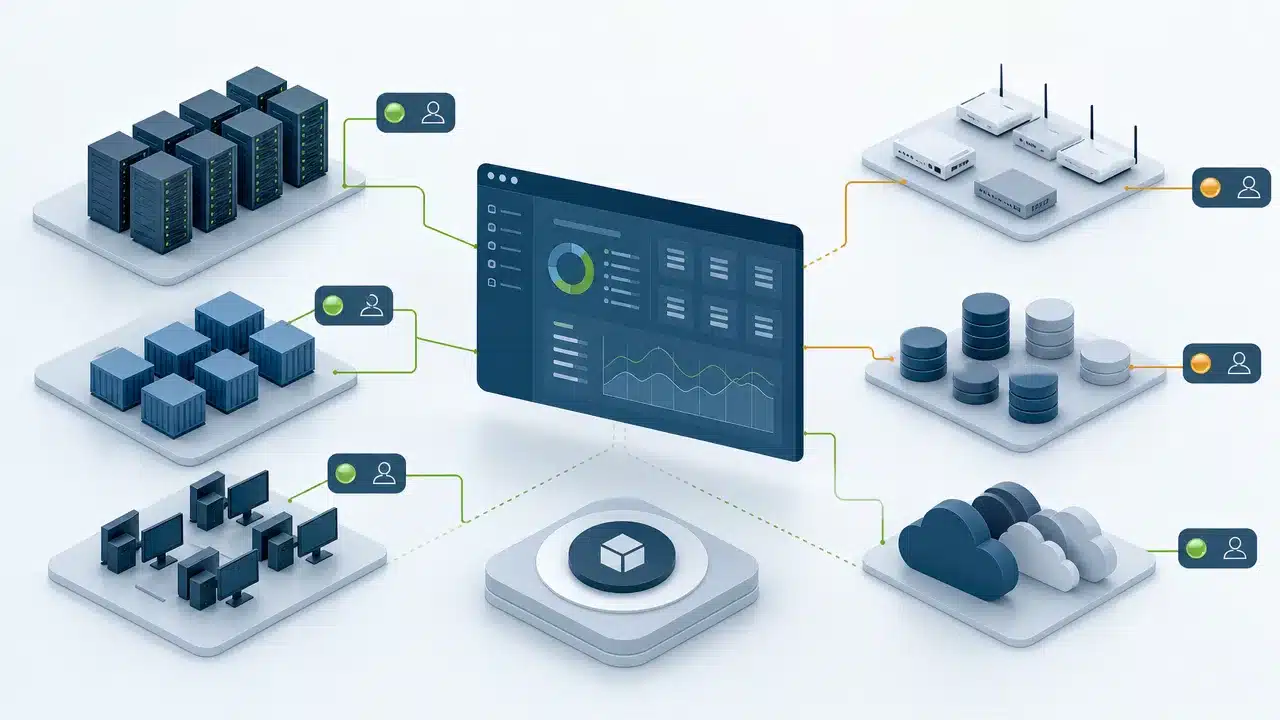
Closing the gap requires a runtime inventory, not just an asset inventory. A typical CMDB tells you that a server exists, what operating system it runs, and perhaps which application it supports. It rarely tells you which Java build, from which distributor, at which file path, a given process is running. For a flaw like Java4Shell, a useful inventory record includes:
- The host.
- The file path of the runtime.
- The distribution and vendor.
- The exact version.
- The CPU architecture.
- The owning team.
- The business service it supports.
- Whether it is reachable from the internet.
Architecture is not a trivial field here. Calif placed the flaw in the x86-64 Base64 decoder, so knowing which runtimes run on x86-64 hosts narrows your priority list immediately.
The inventory also has to be continuous. A spreadsheet assembled during an incident is out of date the moment someone redeploys a container or installs a vendor update. Runtime discovery belongs in the same continuous scanning cycle as operating system vulnerability management. Its results should feed directly into the ticketing workflow and the ownership map.
OpenJDK Sprawl Turns One CVE Into Many Patch Streams
Java4Shell sits in OpenJDK code, so the scope reaches well beyond Oracle’s own JDK. OpenJDK is the upstream source for many distributions, including:
- Eclipse Temurin.
- Amazon Corretto.
- Azul Zulu.
- The Red Hat build of OpenJDK.
- The Microsoft Build of OpenJDK.
- Oracle’s own builds.
Each distributor publishes fixes on its own schedule and through its own advisory channel. The safe operating assumption is simple. Treat every OpenJDK-derived runtime in your estate as in scope until its distributor confirms otherwise, and track each distributor’s advisory as a separate remediation stream.
That fragmentation is growing. Azul’s 2025 State of Java Survey and Report, released through Business Wire, found that 88% of enterprises are considering leaving Oracle Java for alternatives as costs and concerns continue to rise. The cost pressure is real. Oracle’s 2023 move to employee-based pricing for its Java SE subscription changed the economics of Java licensing for many mid-market organizations. Switching to an alternative distribution is often a sound financial decision.
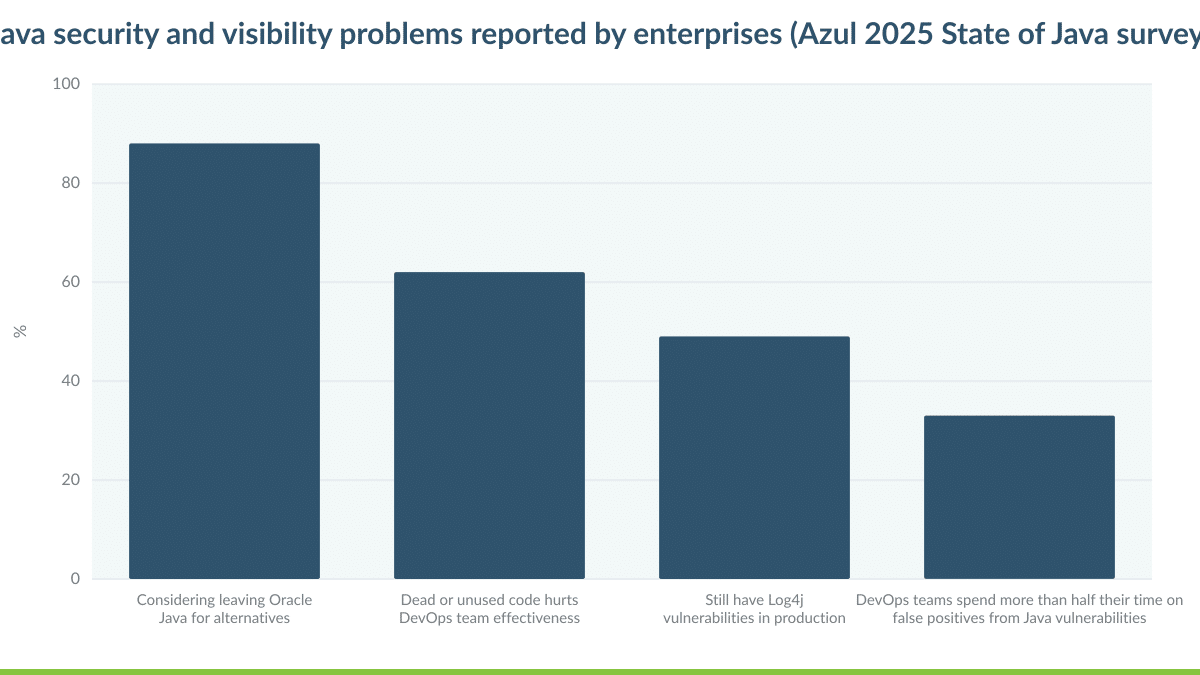
The chart above draws on the same Azul 2025 survey and breaks out the Java security and visibility problems enterprises reported. Read it alongside the 88% migration figure, and a pattern appears. Organizations are changing which Java runtimes they run faster than they are tracking where those runtimes live. Security and visibility concerns are not side notes in the Java conversation. They sit right next to licensing cost as reasons enterprises are rethinking their Java strategy.
Migration is where visibility often gets worse. A half-finished move from Oracle Java to an OpenJDK distribution leaves a mixed estate:
- Some workloads on the new runtime.
- Some still on Oracle.
- Some vendor applications on whatever they bundle.
- Some forgotten systems on versions nobody remembers deploying.
Every added distribution brings another advisory feed to watch and another patch schedule to coordinate. That is why a Java distribution choice is not only a licensing decision but also a security architecture decision. Some organizations pair their Java licensing review with a disciplined technology procurement and licensing process that records exactly what was replaced, where, and by whom. Those organizations finish the migration with a cleaner inventory than they started with.
Patching Is Not the Finish Line When Secrets May Already Be Gone
Memory disclosure flaws have a property that many patch programs overlook. Applying the fix stops future reads. It does nothing about data that was read before the fix landed.
Suppose an internet-facing Java service was reachable while it was vulnerable. The safe and correct assumption is that anything in its memory during that window may have been exposed. Calif specifically called out private keys, tokens, and session secrets. Those items keep working for an attacker long after the vulnerable code is gone.
A patch closes the hole. It does not invalidate the keys that may have already walked out through it.
For exposed services, the post-patch checklist should include these steps:
- Rotate TLS private keys and reissue certificates for any service whose keystore was loaded into a vulnerable runtime.
- Revoke and reissue OAuth client secrets, API keys, and bearer tokens that the application held or brokered.
- Invalidate active user sessions so stolen session identifiers stop working.
- Rotate database passwords and service account credentials that the application loaded into memory from configuration files or secrets stores.
- Review code signing and token signing keys on build systems and identity services that ran affected runtimes.
Rotation is where the visibility problem shows up a second time. Rotating a certificate is simple in principle. It gets painful when nobody knows which load balancers, partner integrations, and mobile apps depend on it. Organizations that already track secrets alongside the services using them can finish rotation in an afternoon. Organizations that do not end up discovering dependencies by breaking them.
The remote code execution path raises the stakes further. An attacker with code execution on a Java application server can stage ransomware, collect more credentials, or move toward backup infrastructure. At that point, resilience decides the outcome. Immutable, isolated backups and a recovery environment that has actually been tested decide whether an incident costs hours or weeks.
IT Vortex Backup as a Service (BaaS), built on Veeam, and Disaster Recovery (DRaaS) exist for the scenario where prevention fails. They let recovery start from a clean, verified point rather than a hopeful one.
A Practical Response Sequence for the Java4Shell Vulnerability
The sequence below is built for mid-market teams that need to move quickly without a dedicated vulnerability research staff. Adjust the timing to your own policy, but keep the order.
- First 24 hours: reduce exposure. Identify every internet-facing service built on Java, starting with login portals, APIs, and partner integrations. Where you can, pull nonessential services off the internet and tighten firewall policy at the perimeter. Confirm which of these services run on x86-64 hosts.
- Days one through three: find and fix. Run runtime discovery across servers, virtual machines, containers, build agents, and endpoints. Check what you find against each distributor’s advisory. Patch in priority order: internet-facing systems first, then systems holding high-value secrets, then everything else.
- Days three through ten: assume exposure and hunt. Rotate secrets for every service that was reachable while vulnerable. Use endpoint detection data to look for Java processes that launch shells or other unexpected child processes, a classic sign of remote code execution. Investigate outbound connections from application servers that do not normally initiate them.
- Weeks two through four: close the gap permanently. Turn the emergency inventory into a continuous one. Assign an owner to every runtime, write the severity override rule into policy, and standardize on as few Java distributions as practical.
Most organizations skip the last step, yet it is the only one that changes the outcome of the next incident. Emergency inventories built under pressure are valuable. If you let them decay into an outdated spreadsheet, you guarantee the same scramble the next time a critical Java flaw appears.
Mapping the Response to the Five Pillars
The Java4Shell vulnerability is a security event, but the work it creates touches every part of how infrastructure is designed and run. Mapping that work to the five pillars behind IT Vortex engagements shows where structural fixes beat heroic effort.
Simplification
Every distinct Java distribution, version, and bundling pattern adds a patch stream. Standardizing workloads on hardened, version-controlled templates reduces the number of places Java can hide. On VMware-based Cloud Hosting (IaaS), workloads are built from known templates, patched through consistent processes, and documented as part of normal operations. That turns a frantic hunt into a simple query.
Security
Visibility is a security control in its own right. Security as a Service (SECaaS) brings three capabilities into one managed program:
- Continuous vulnerability scanning.
- Endpoint detection and response powered by partners such as CrowdStrike.
- Perimeter enforcement with Fortinet.
Runtime discovery, severity triage, and threat hunting then run as an ongoing service, not a project launched after every headline.
Performance
Teams often delay Java patching because they fear breaking production applications. That fear is legitimate, since runtime updates can change application behavior. Three practices let teams patch on an emergency timeline without gambling on stability or user experience:
- Change windows backed by snapshots.
- Staged rollouts across clustered hosts.
- A tested rollback path.
Resilience
Prevention will eventually miss something. The real question is how quickly you recover when it does. Isolated, immutable backups and rehearsed failover give leadership a known recovery time instead of an estimate made mid-incident. That matters not only for operations but also for insurers, regulators, and customers who will ask how you responded.
Flexibility
Endpoints that need local Java are among the hardest to inventory and patch, especially across a distributed or hybrid workforce. Desktop as a Service (DaaS) built on Omnissa moves those applications onto managed golden images. A runtime update is applied once and published to every user, instead of being chased across hundreds of individual laptops.
Questions Every IT Leader Should Be Able to Answer This Week
Use these questions as a quick test of your organization’s Java visibility. If any answer is unknown, or depends on one person’s memory, close that gap first.
- How many Java runtimes are running in our environment right now, across servers, containers, endpoints, and appliances?
- Which of them are reachable from the internet, and which run on x86-64 hosts?
- Which Java distributions do we use, and who monitors each distributor’s security advisories?
- Which vendor applications bundle their own runtime, and what is each vendor’s committed timeline for a fix?
- Does our severity policy treat unauthenticated credential exposure as Critical, whatever the vendor’s score?
- If we had to rotate every certificate and token on our exposed Java services tomorrow, do we know every dependency that would break?
- When did we last restore a production Java application from backup into an isolated environment and confirm it worked?
None of these questions need new technology to answer. They need clear ownership, continuous discovery, and a willingness to treat inventory as a security control rather than an administrative chore.
The Next Java Hole Is Already on the Calendar
Java4Shell will be patched. Distributors will publish fixes, scanners will add detections, and the CVE will fade from the headlines. The underlying condition will not fade on its own. Java remains embedded across the enterprise. The number of distributions in production keeps growing as organizations move away from Oracle. Every new runtime flaw will test the same capability: how fast you can see what you run.
You cannot patch a Java runtime you do not know exists, and attackers do not need you to know.
That changes how this event should be measured. The useful metric is not how quickly your team patched CVE-2026-114938. It is how long it took to produce a complete, owned, prioritized list of everything that needed the patch.
If the answer was hours, your visibility program is working. If it was weeks, the next critical Java flaw will find the same blind spots this one did, and the one after that may arrive with a public exploit on day one.
IT Vortex works as integrator, architect, and advisor for mid-market organizations that want enterprise-grade infrastructure without enterprise complexity. As a Premier Broadcom VCSP Partner, we design environments where runtimes are inventoried, patch ownership is clear, secrets are tracked, and recovery is proven before it is needed.
Want a clear view of your Java exposure and a plan to make the next critical flaw routine? Schedule a working session with Lou Corriero, VP Cloud. Bring your hardest inventory question, and leave with a prioritized path to answer it.