
In November 2026, Broadcom shipped patches for 23 vulnerabilities across VMware ESX, vCenter, Workstation, Fusion, and Avi Load Balancer. The headline item is CVE-2026-123903, a vCenter authentication bypass rated 9.8 out of 10.0 on the CVSS scale. It landed only days after Broadcom patched CVE-2026-123890, another 9.8-rated authentication bypass in the same VMware Directory Service component. A suspected China-nexus espionage group tracked as Armory Castle had already exploited that earlier flaw as a zero-day.
For a mid-market IT leader, the sequence matters more than either CVE on its own. Two critical authentication bypasses in the same component within days should change how you think about your virtualization management plane. vCenter is not a peripheral application. It controls every host, datastore, virtual network, and virtual machine in a vSphere environment. An attacker who can walk past its authentication has not breached one server. That attacker is in position to touch all of them.
This article covers four things:
- What Broadcom fixed in this release.
- Why the VMware Directory Service keeps appearing in critical advisories.
- What the business exposure looks like when a vCenter authentication bypass is in play.
- A practical 72-hour plan that mid-market teams can execute without stalling the business.
It also makes a harder argument. Patching this flaw is necessary, but being patched is not the same thing as being defensible.
Why This vCenter Authentication Bypass Is Not a Routine Patch Cycle
Broadcom’s description of CVE-2026-123903 is short and unambiguous. In its advisory, the company states: “A malicious actor with network access to vCenter may exploit this issue to bypass authentication and gain unauthorized access to the system.” Every part of that sentence carries weight.
Network access is the only precondition. The attacker needs no credentials, no phishing campaign, and no stolen session token. Anyone who can reach the vCenter appliance over the network is a potential attacker. In a well-segmented environment, that group is small. Many mid-market environments look different. They have grown through acquisitions, flat VLANs, VPN pools that land on the server network, and contractors with broad access. In those environments, the group can be far larger than the security team assumes.
Authentication bypass means login controls never engage. The attacker does not have to guess a password or defeat multi-factor authentication. The control that every other control depends on simply does not apply. And unauthorized access to vCenter is not a minor foothold. It is the control plane.
The flaw sits in the identity layer. It resides in the VMware Directory Service, known internally as vmdir. vmdir is the LDAP-based directory behind vCenter Single Sign-On, the identity layer that decides who can log in to vCenter and what they can do once there. When that directory is subverted, everything downstream inherits the compromise: the permission model, role-based access control, and the audit trail. A bug in vmdir is not only a vCenter problem but also an identity problem for the entire virtual estate.
When the directory that defines identity in your virtual estate can be bypassed, every control that trusts it is bypassed with it.
Broadcom credited sglab of QiAnXin, Qi Qin of depthfirst, and VulTeam and XGTP from ThreatBook with independently reporting the flaw. Independent discovery by several research teams has a practical meaning: the bug is findable. Defenders should assume that well-resourced adversaries, who study the same components with the same techniques, can find it too. Some may already have.
What Broadcom Fixed: 23 Vulnerabilities Across Five Product Lines
The release addresses 23 vulnerabilities across VMware ESX, vCenter, Workstation, Fusion, and Avi Load Balancer. For most mid-market organizations, the vCenter fixes are the urgent ones. vCenter is the system an attacker most wants, and it is often reachable from places it should not be. The advisory covers five vCenter issues:
- CVE-2026-123903 (CVSS 9.8): authentication bypass in the VMware Directory Service, exploitable by an attacker with network access to vCenter.
- CVE-2026-123904 (CVSS 7.5): arbitrary file write while processing certain archives, which could be exploited to achieve code execution on the appliance.
- CVE-2026-123905 (CVSS 7.5): denial of service in the VMware Directory Service.
- CVE-2026-123906 (CVSS 7.5): denial of service in the VMware Directory Service.
- CVE-2026-123907 (CVSS 7.5): denial of service in the VMware Directory Service.
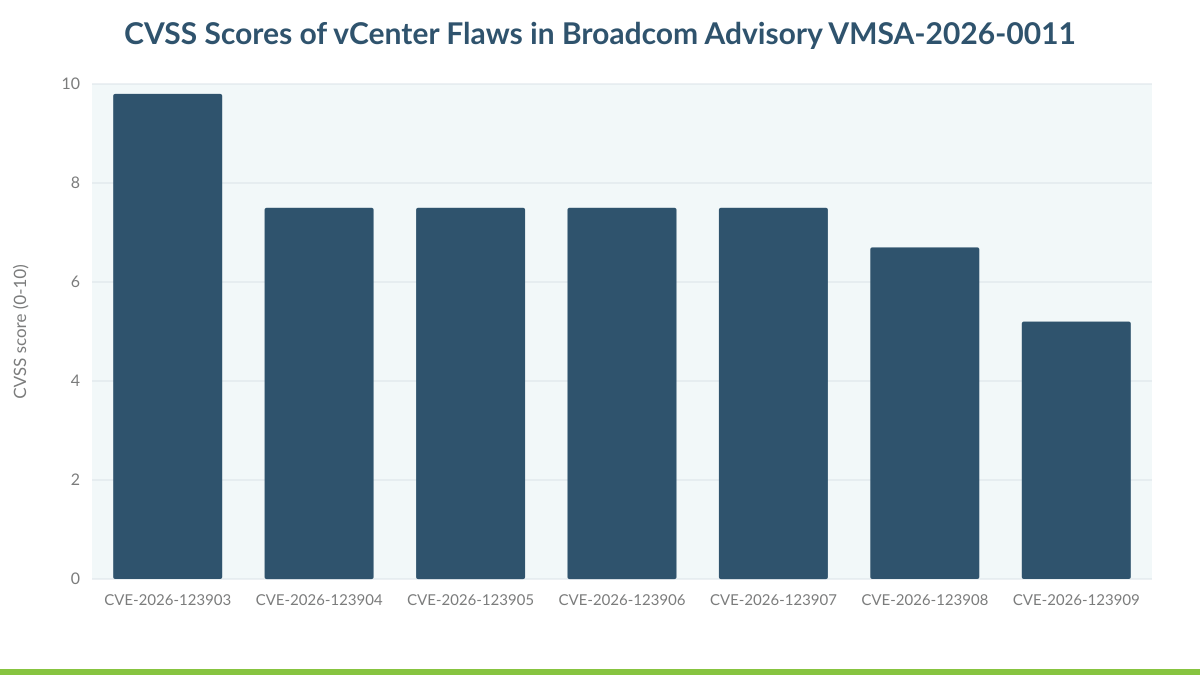
The chart above draws on GBHackers’ reporting on Broadcom advisory VMSA-2026-0011 and plots the CVSS scores of the vCenter flaws side by side. It shows one critical outlier sitting above a cluster of high-severity issues. The tempting response is to triage by the outlier and treat the rest as routine. That would be a mistake.
Look at how the flaws combine:
- Entry: the authentication bypass gets an attacker in.
- Persistence: an arbitrary file write that leads to code execution lets the attacker run their own tooling on the appliance, where defenders rarely look.
- Disruption: three denial-of-service bugs in the same directory service let the attacker knock identity offline, either as a distraction during an intrusion or as leverage during extortion.
Scored one at a time, four of these issues read as “high.” Chained by an operator who already has access, they cover the full intrusion lifecycle on the most privileged appliance in the data center.
Broadcom’s advisory lists the fixed builds for each affected release train. Version strings change as Broadcom issues follow-on builds, so this article does not reproduce them. Confirm the exact target build for your vCenter release against the advisory and release notes before you schedule the change.
If your vCenter version is no longer in general support, treat that as a separate, urgent finding. vSphere 7 reached end of general support in October 2025. Organizations still running it face a harder path to timely fixes on the most targeted layer of their infrastructure. Reviewing the cost of staying current, including the licensing questions raised by Broadcom renewals, belongs in the same conversation as the patch itself.
Two 9.8s in the Same Component, Days Apart
Timing is what turns this release from a patch note into a strategic signal. The fixes for CVE-2026-123903 arrived days after Broadcom shipped updates for CVE-2026-123890, another 9.8-rated authentication bypass in the VMware Directory Service. Armory Castle, the suspected China-nexus cyber espionage group, exploited that earlier flaw as a zero-day.
VMware has noted that CVE-2026-123903 is distinct from the earlier bug. Organizations that patched for the first flaw are therefore not covered for the second. Three implications follow for mid-market leaders.
First, the component is under active scrutiny. When a sophisticated espionage group invests in a zero-day against a specific service, it is signaling where it sees value. A second critical finding in the same service, reported independently by several research teams, shows that vmdir is being examined closely by both attackers and defenders. More findings in this area would not be surprising, and your planning should assume they are possible.
Second, patch speed now matters as much as patch completeness. Suppose your change management process treats vCenter as a quarterly maintenance item. You would have been exposed to an exploited zero-day, then handed a second critical flaw before your first maintenance window opened. Organizations that come through sequences like this cleanly can move vCenter from advisory to patched in days, not weeks.
Third, you need to look backward, not just forward. CVE-2026-123890 was exploited before a patch existed. Any vCenter that a capable adversary could reach during that window deserves a compromise assessment, not just an update. Patching closes a door. It does not remove anyone who already walked through it.
Two critical authentication bypasses in the same component, days apart, is not bad luck. It is a map of where attackers are aiming.
Why vCenter Is the Most Valuable Target in Your Data Center
Espionage operators and ransomware crews want vCenter for the same reason administrators rely on it: it centralizes control. An authenticated vCenter session can:
- power off virtual machines;
- take and delete snapshots;
- clone disks and attach virtual storage to other workloads;
- change virtual networking;
- push configuration to every connected ESX host.
For an espionage group, that means quiet access to the disks of domain controllers, database servers, and file servers, without touching the guest operating systems where endpoint agents run. For a ransomware crew, it means the ability to encrypt or destroy an entire environment at the hypervisor layer in one operation.
There is also a visibility gap. Endpoint detection and response tools run inside guest operating systems. Appliances like vCenter, and the hypervisors beneath them, usually do not run the same agents. Their logs are often not forwarded to a security operations team at all. An attacker working at the management layer can operate below the line of sight of the tools most organizations rely on to catch intrusions.
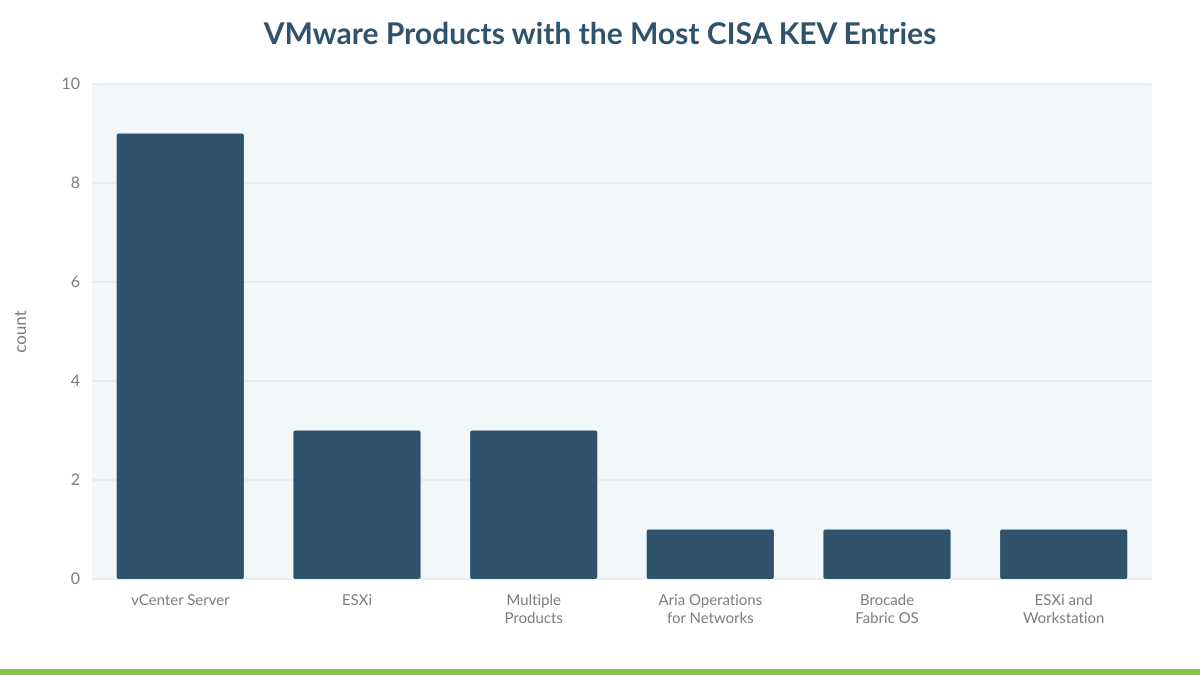
The chart above uses ZeroHunt data to rank VMware products by their number of entries in the CISA Known Exploited Vulnerabilities (KEV) catalog. The KEV catalog is not a list of theoretical risk. Every entry is a flaw that CISA has evidence was exploited in the wild, and Binding Operational Directive 22-01 requires federal civilian agencies to fix KEV entries by set deadlines. Read the chart as a record of where attackers have already succeeded. Find the products that run in your environment, then ask how quickly your team could patch each one when the next entry lands.
Many mid-market organizations still manage vCenter like a utility rather than a tier-zero asset. It sits on the same network as general server workloads, uses the same administrative accounts as other systems, and is patched on the same schedule as everything else. The two vmdir authentication bypasses make a clear case for moving it into the same protection tier as Active Directory domain controllers and backup infrastructure. Anything that can grant control over every workload deserves the controls you would give the crown jewels.
The Business Impact, Mapped to the Five Pillars
Severity scores are a starting point. Executives need to know what this class of flaw means for cost, risk, performance, and continuity. Mapping the exposure to the five pillars IT Vortex uses with clients shows where investment pays off.
Security
The direct risk is unauthorized access to the management plane, followed by data theft, persistence, or destruction. For regulated mid-market firms in healthcare, financial services, and legal, a vCenter compromise can trigger breach notification obligations, cyber insurance scrutiny, and disclosure questions, because the attacker may have had access to every workload’s disks. The investment that pays off is not only faster patching but also continuous monitoring of the management layer. That way, an authentication anomaly in vCenter is seen and investigated as it happens rather than discovered weeks later.
Resilience
If vCenter is compromised or knocked offline, how fast can you restore operations, and can you trust what you restore? The three denial-of-service flaws in this release are a reminder that identity infrastructure can be taken down as well as taken over. Resilience means recovery that does not depend on the compromised environment. That requires backups an attacker with vCenter access cannot reach, and a recovery site that can stand up cleanly if the primary cannot be trusted.
Performance
Emergency patching is disruptive when it is improvised. A vCenter upgrade requires planning for appliance downtime, checking compatibility with integrated products, and validating backup and replication jobs afterward. Teams that run this process rarely tend to run it slowly. Teams that have rehearsed it can patch quickly with minimal impact on production, since workloads keep running on their ESX hosts while vCenter is updated.
Simplification
Every extra vCenter instance, unmanaged lab, or forgotten appliance needs the same emergency attention. Consolidating management planes and keeping an accurate inventory reduces the number of places a flaw like CVE-2026-123903 can hurt you. Simpler environments patch faster, and they are easier to monitor and reason about during an incident.
Flexibility
Many leaders are now asking whether they should operate the management plane themselves at all. Running VMware on a provider’s platform shifts patching, hardening, and monitoring of the management layer to a team that does it at scale. The business keeps the flexibility to run workloads on private, hybrid, or multi-cloud infrastructure as needs change.
Zero-Days Are a Sustained Threat to Enterprise Infrastructure
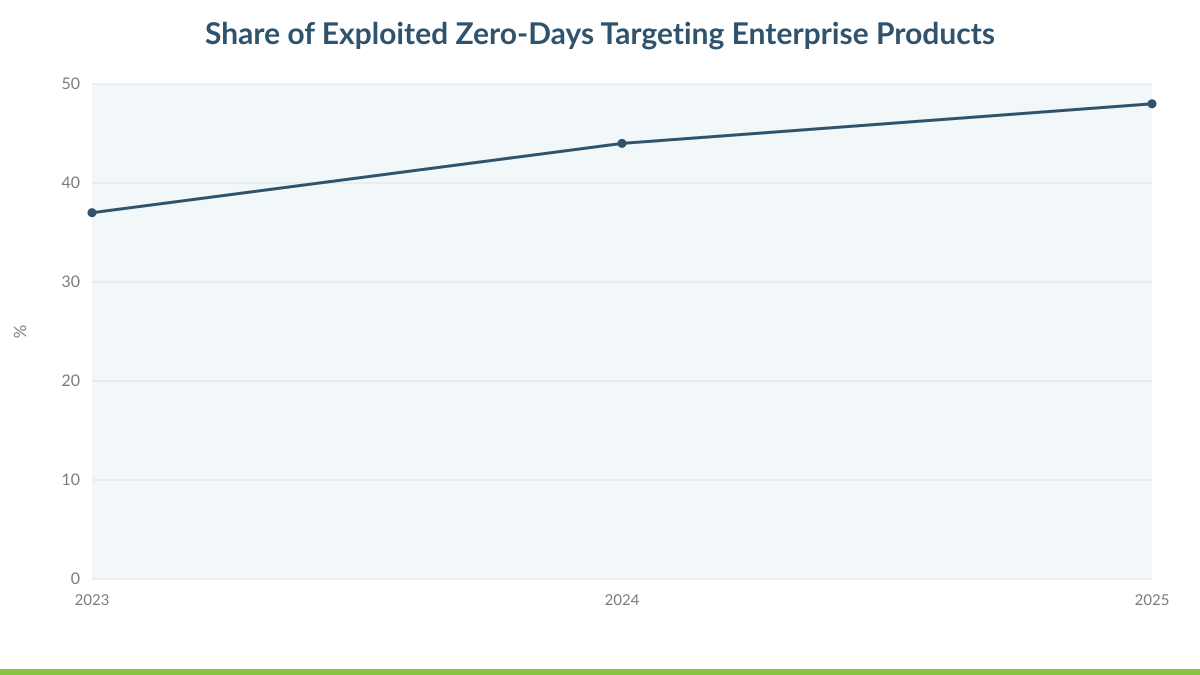
The chart above uses DeepStrike data to track what share of exploited zero-days targeted enterprise products. That category includes security appliances, networking gear, and virtualization platforms, as opposed to consumer browsers and mobile operating systems. The year-to-year movement matters less than the conclusion it supports: enterprise infrastructure is a sustained target for zero-day investment, not an occasional one.
The economics explain why. A zero-day in a browser gives an attacker one user at a time. A zero-day in a management appliance like vCenter can give them an entire organization. Appliances also tend to be patched more slowly than endpoints, monitored less closely, and exposed more broadly than their owners realize. Armory Castle’s exploitation of CVE-2026-123890 fits this pattern.
This overturns a long-standing assumption for mid-market organizations. The old view held that sophisticated zero-days were reserved for governments and the largest enterprises, and that smaller firms mainly needed to worry about commodity malware. That view no longer holds. Mid-market firms run the same vCenter, firewalls, and VPN appliances as the largest enterprises, often with a fraction of the staff to patch and monitor them. An exploit built for a high-value espionage target works just as well against a regional manufacturer or a mid-sized law firm on the same build. Shared technology means shared exposure.
A 72-Hour Response Plan for Mid-Market IT
The following sequence can be executed in three days. It closes the exposure first, then verifies that you were not already compromised, then reduces the blast radius for the next advisory.
Hours 0 to 24: Inventory, Exposure, and Patch Scheduling
- Inventory every vCenter instance, including lab, disaster recovery, and acquired-company environments. Record the version and build number for each.
- Map network reachability. Identify every network segment, VPN pool, and jump host that can reach each vCenter appliance. Anything that can reach it can attempt CVE-2026-123903.
- Restrict access immediately. Where possible, tighten firewall rules so only a small set of administrative hosts can reach vCenter until the patch is applied.
- Confirm fixed builds against Broadcom’s advisory and release notes for your release train. Verify compatibility with integrated tools such as backup, replication, and monitoring platforms.
- Take a file-based backup of the vCenter appliance before any change, and confirm that you can restore it.
Hours 24 to 48: Patch and Validate
- Apply the vCenter update, starting with the most broadly reachable instances.
- Validate core functions after patching: Single Sign-On login, host connectivity, backup jobs, and replication jobs.
- Schedule the rest of the release. Patch affected ESX hosts and other products on an accelerated but orderly schedule.
- Document every change as evidence for audit, cyber insurance, and, where relevant, regulators.
Hours 48 to 72: Hunt and Harden
- Review vCenter and SSO logs for unexpected authentication events, new local accounts, permission changes, or unusual API sessions. Pay particular attention to the period before CVE-2026-123890 was patched.
- Check the appliance for unexpected files or processes. CVE-2026-123904 enables arbitrary file writes that could lead to code execution.
- Audit snapshots, clones, and exported disks for activity that does not match change records.
- Rotate administrative credentials for vCenter and for service accounts integrated with it.
- Escalate anything suspicious. If something looks wrong, move to a full incident response engagement rather than continuing as routine maintenance.
To test your recovery steps under pressure, adapt our DR Failover Validation Plan Template to include an explicit vCenter loss scenario. Rehearsing the loss of the management plane shows quickly whether your recovery runbooks quietly assume that vCenter will be available.
Hardening Beyond the Patch: Shrinking the vCenter Authentication Bypass Blast Radius
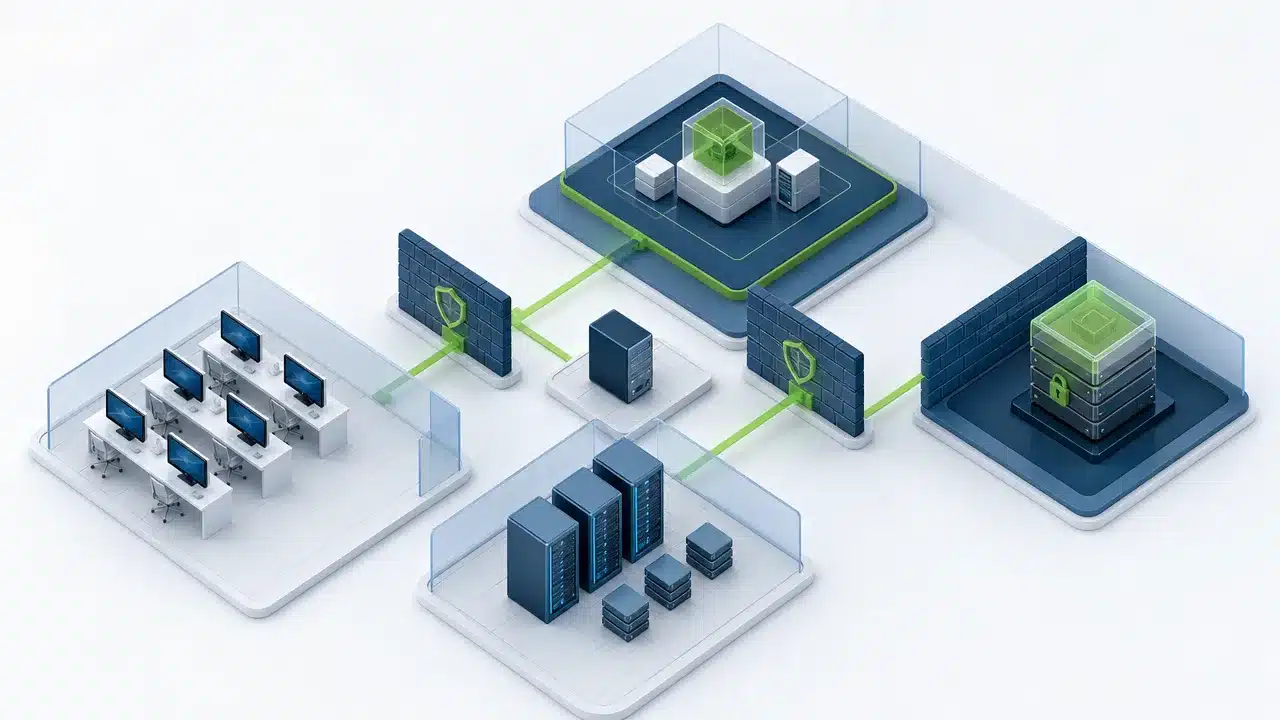
Patching fixes the flaw you know about. Architecture determines how much damage the next one can do. Five controls deserve priority.
Isolate the Management Plane
vCenter should live on a dedicated management network that is reachable only from hardened administrative workstations or jump hosts. It should never be exposed to the internet, and it should not be reachable from general user networks or broad VPN pools. Because CVE-2026-123903 requires only network access, the most effective compensating control is reducing who has that access.
Separate Administrative Identity
Do not give everyday domain accounts administrative rights in vCenter. Use dedicated privileged accounts, enforce multi-factor authentication through your identity provider where supported, and keep a documented break-glass account stored offline. Be clear about the limits. An authentication bypass in vmdir sidesteps login controls entirely, so against this class of flaw, network isolation and monitoring matter more than login hardening.
Forward and Watch Management-Layer Logs
Send vCenter, SSO, and ESX logs to a monitored security platform. Build detections for the behaviors that matter: new administrators, role changes, mass power operations, snapshot deletion, and access from unusual sources. Around-the-clock security monitoring turns those logs from forensic evidence into early warning.
Keep Backups Out of Reach of Hypervisor Administrators
If an attacker who controls vCenter can also delete your backups, your recovery plan has a single point of failure. Backup repositories should use separate credentials, a separate authentication domain, and immutable or air-gapped copies. Veeam hardened repositories and immutable object storage are common ways to enforce this separation.
Rehearse Recovery to a Clean Environment
A replica that mirrors a compromised environment can also mirror the compromise. Recovery plans should include the ability to restore into an isolated, known-clean environment, validate it, and only then reconnect it to production.
Patching closes the door you know about. Architecture decides how much the next door is worth to an attacker.
How a Managed VMware Platform Changes the Equation
Most mid-market IT teams do not lack skill. They lack the capacity to treat every critical advisory as a 72-hour project while also running the business. Two critical vmdir flaws within days is a test of capacity as much as a test of security.
IT Vortex is a Premier Broadcom VCSP Partner, and that shapes how we approach this problem. Our Cloud Hosting (IaaS) platform runs on VMware, and our team operates, patches, and monitors the management plane on clients’ behalf. Clients keep the VMware operating model their staff already knows. Responding to advisories like this one becomes the job of engineers who do it across many environments.
Three services cover the rest of the exposure:
- Security as a Service (SECaaS) protects the workloads themselves. It combines technologies from partners including Fortinet, CrowdStrike, and Proofpoint with monitoring that watches for the behaviors an attacker at the management layer would generate.
- Disaster Recovery (DRaaS) replicates workloads to an environment outside the primary blast radius.
- Backup as a Service (BaaS) is built on Veeam, with immutable copies that an attacker holding vCenter credentials cannot erase.
Many organizations intend to keep running vCenter on-premises. For them, we work as integrator, architect, and advisor rather than as a reseller. Through our Managed Services practice, we help teams inventory their VMware footprint, segment management networks, build log pipelines, and rehearse patch and recovery runbooks, so the next advisory is a scheduled event instead of a fire drill. Either way, the goal is not only closing today’s flaw but also building an environment where tomorrow’s flaw has less to reach.
The Real Question Is Not Whether You Patched
After an advisory like this, the instinct is to ask a yes-or-no question: are we patched? It is the right first question and the wrong final one. CVE-2026-123890 was exploited before a patch existed. CVE-2026-123903 arrived days later in the same component. The next vmdir finding, or the next flaw in another management appliance, will follow the same pattern: disclosure, exploitation, and a window in which only architecture and monitoring protect you.
A more useful set of questions for your next leadership meeting:
- Who can reach our vCenter today, and why?
- Would we know if someone had authenticated without credentials last month?
- If vCenter were compromised tonight, could we recover our critical systems to a clean environment, and how long would it take?
- Are our backups beyond the reach of anyone who controls our hypervisors?
- Can we move from advisory to patched in days, every time?
If your team can answer those confidently, this advisory is a maintenance event. If not, it is an early warning, and the time to act is before the next 9.8 arrives.
Lou Corriero, VP Cloud at IT Vortex, works with mid-market IT leaders to assess these exposures across VMware management, security monitoring, and recovery. Schedule a working session with Lou to review your vCenter exposure, patch speed, and recovery path. You will leave with a prioritized plan your team can start executing this week.