
On November 18, 2026, Microsoft identified a vulnerability in Azure API Management Classic tiers that let an unauthorized party read the secrets those gateways store. By the time Microsoft deployed a mitigation the following day, attackers had already used it. Norway’s National Security Authority has linked the intrusion to breaches at two energy companies and says organizations should assume any exposed credential is compromised, according to CSO Online’s reporting on the Microsoft warning.
That guidance changes the job in front of you. A vulnerability the vendor already fixed on its side sounds like good news, and in one narrow sense it is. Microsoft closed the hole. What Microsoft cannot do is reach into your backend systems, your identity tenant, and your partner integrations to invalidate every key that may have walked out the door. For a mid-market organization that routes partner APIs, mobile apps, and back-office integrations through Azure API Management, the Azure API Management flaw is not only a Microsoft platform problem but also a credential hygiene problem that lands directly on your team, your change windows, and your audit trail.
This article breaks down exactly what was exposed, why a compromised API gateway behaves like a compromised identity system, what the broader API threat data says about how often these surfaces are targeted, and a practical 72-hour plan to scope, rotate, hunt, and harden. It closes with how to restructure secrets so the next gateway advisory becomes an afternoon of routine work rather than a week of open risk.
What the Azure API Management Flaw Exposed
Microsoft notified affected customers through an Azure Service Health security advisory tracked as MZK9-GH0. In that advisory, the company stated that “an unauthorized party could have used the issue to access secrets stored in Azure API Management Classic instances.” Microsoft also acknowledged that the exposure began before it discovered the flaw, a detail first reported by BleepingComputer and summarized in CSO Online’s coverage of advisory MZK9-GH0. Read that carefully. The exposure window did not open on November 18. That is the date it was found. The window closed on November 19, and nobody outside the attackers knows precisely when it opened.
The categories of potentially exposed information are what make this incident serious for mid-market environments. According to the advisory as reported, they include:
- Secrets stored in Named Values. Named Values are the key-value pairs that API Management policies reference at runtime. Teams commonly use them to hold backend API keys, basic authentication passwords, shared secrets for downstream services, and connection details that policies inject into outbound calls.
- Client secrets for identity providers and OpenID Connect providers. These authenticate API Management’s developer portal and OAuth flows to Microsoft Entra ID, Azure AD B2C, or third-party identity platforms. A stolen client secret lets an attacker authenticate as the application registration it belongs to, with whatever permissions that registration holds.
- Subscription keys. These are the keys your API consumers, internal and external, present when they call published APIs. They gate access, and they often tie to rate limits, usage tracking, and partner billing.
- Tokens. The advisory also lists tokens among the exposed material, which means credentials the service held for active access should be treated as burned until reissued.
Why the Classic Tiers Matter
Azure API Management is offered in Classic tiers (Developer, Basic, Standard, and Premium) and in the newer v2 tiers. Many mid-market deployments were stood up years ago on Classic tiers and have run quietly ever since. That is exactly the profile of infrastructure that accumulates long-lived secrets nobody has rotated, because nothing broke and nobody was asked. If your organization deployed API Management before the v2 tiers were available, or launched a Developer tier instance for a proof of concept that slowly became production, assume you are in scope until you have proven otherwise through your own inventory.
The Norwegian findings make the risk concrete rather than theoretical. When a national security authority links stolen gateway secrets to breaches at two energy companies, it is signaling that the material was not merely accessible. It was used. That moves the question your leadership will ask from “were we exposed?” to “what could someone have done with our keys, and can we prove they did not?” Those are very different questions, and only the second one satisfies an auditor, a cyber insurer, or a board.
Why an API Gateway Breach Is an Identity Breach
An API gateway is a concentration point by design. That is its value. Instead of every application team managing its own authentication, throttling, and routing, the gateway centralizes those functions and enforces policy in one place. The tradeoff is that the gateway also centralizes the secrets required to make those calls. A single API Management instance can hold the credentials for your ERP connector, your payment processor, your EHR or practice management integration, your shipping and logistics partners, and the Entra ID app registration that signs your developers into the portal.
When those secrets leak, the blast radius does not stop at the edge of Azure. It extends to every system the secrets unlock. A backend API key stored in a Named Value works from anywhere on the internet unless the backend restricts source addresses, and many do not. An identity provider client secret can be used to request tokens for the application it represents. If that application registration was granted Microsoft Graph permissions during a hurried integration project years ago, the attacker inherits those permissions too. In hybrid environments, where API Management fronts services that reach back into on-premises systems through private connectivity, a stolen backend credential can become a path into infrastructure that never touches the public cloud directly.
When the gateway holds the keys, a gateway breach is an identity breach. Treat it that way from the first hour.
This is why Microsoft’s server-side mitigation, while necessary, does not end your incident. The mitigation prevents further extraction. It does nothing to invalidate a secret that has already been copied. A Named Value password that was read on November 10 still works on November 25 unless you change it at the source system. A subscription key that was exfiltrated still authenticates until you regenerate it. Static credentials have no memory of how they were obtained.
The business stakes follow directly. For healthcare organizations, a backend credential that unlocks patient data triggers a HIPAA risk assessment regardless of whether you can confirm misuse. For financial services firms and public companies, the SEC’s cybersecurity disclosure rules require a Form 8-K filing within four business days of determining that an incident is material, which means your ability to scope quickly and document what you rotated directly affects your disclosure posture. For every mid-market organization carrying cyber insurance, the carrier will want evidence that you acted on the vendor advisory promptly. The organizations that can produce a timestamped rotation log will have a far easier conversation than those reconstructing events from memory.
The API Attack Surface Mid-Market Teams Underestimate
It would be comforting to treat this Azure API Management incident as a rare event. The data on API attacks says otherwise. Akamai’s State of the Internet (SOTI) research, as summarized by Zuplo, found that 87% of organizations were hit by API attacks in 2025. The chart below shows the average number of daily API attacks per organization from that research, and the takeaway is not the specific figure but the cadence. API attacks are a daily operating condition, not an occasional headline.
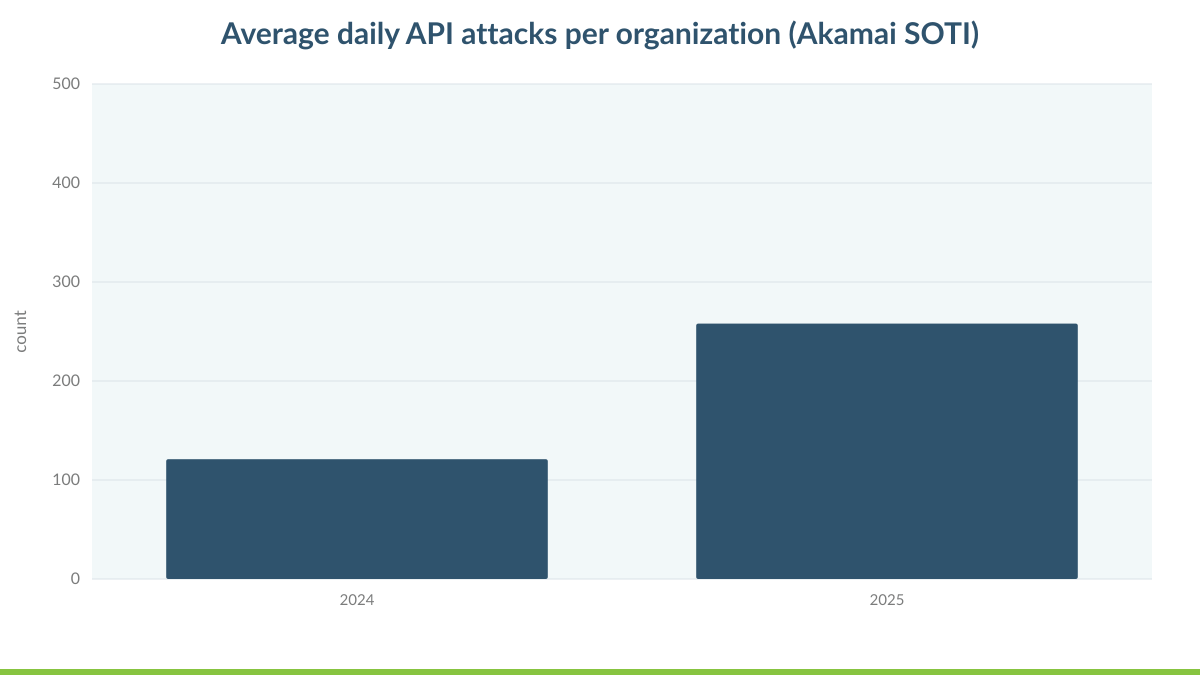
That cadence matters because most mid-market security programs were built around endpoints, email, and the network perimeter. APIs arrived later, often through application teams, integration partners, or a single developer who needed to expose a service quickly. The result is an attack surface that grew faster than the controls around it. Gateways like API Management were supposed to impose order on that surface, and they do, but they also became the place where attackers find the richest collection of credentials in one spot.
Salt Labs reached a similar conclusion from a different angle. Its Q1 2025 State of API Security Report found that 99% of respondents had experienced API security issues in the past 12 months. The chart below summarizes the survey findings from that report. When nearly every surveyed organization reports an API security problem in a single year, the operating assumption has to shift from prevention alone to rapid detection, rotation, and recovery.
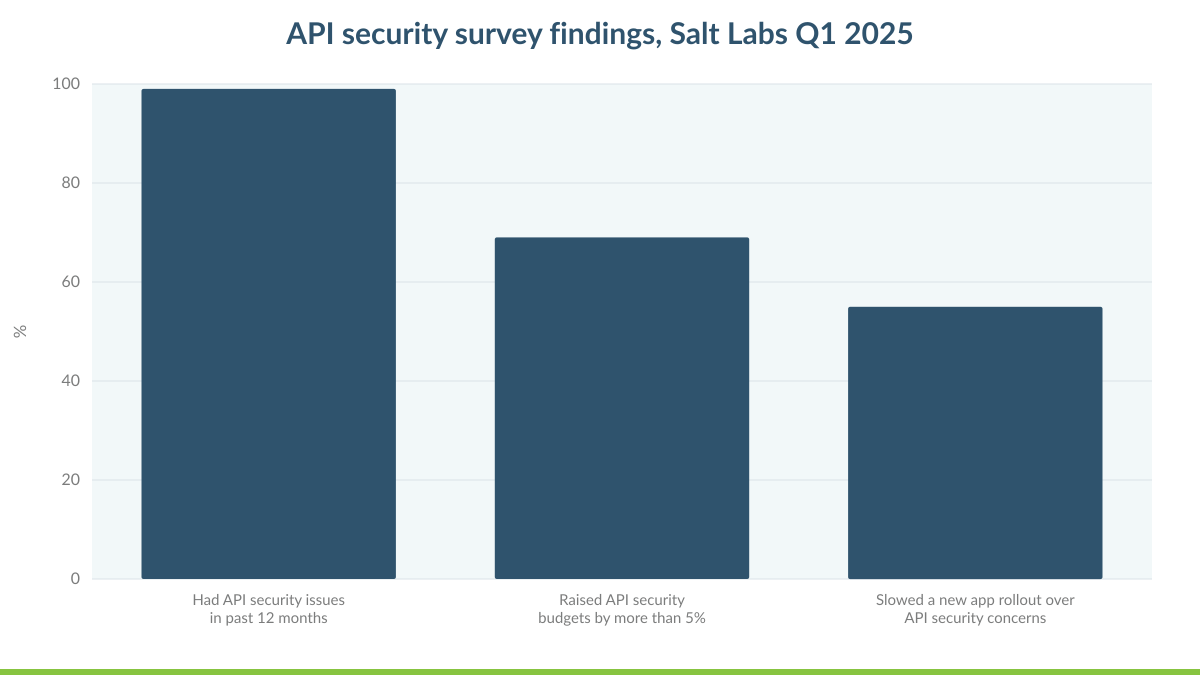
Put those two data points next to the Microsoft advisory and a clear pattern emerges. Attackers target APIs constantly. Most organizations have already had an API security issue. And now a managed gateway service from the largest cloud provider serving mid-market organizations has leaked stored secrets. None of this argues against using API Management. It argues against treating the gateway as a vault, and against assuming that a managed service relieves you of responsibility for the credentials you put into it.
Secrets Sprawl Is the Root Cause, Not the Gateway
Look past the specific vulnerability and the underlying weakness is familiar: long-lived static secrets, copied into too many places, rotated too rarely. The Azure API Management flaw exploited that weakness at the gateway layer. The same habit shows up everywhere else in the software lifecycle. Cybernews, citing GitGuardian research, reported that 23 million secrets were spilled on GitHub, and noted that developers naively assume no one will notice.
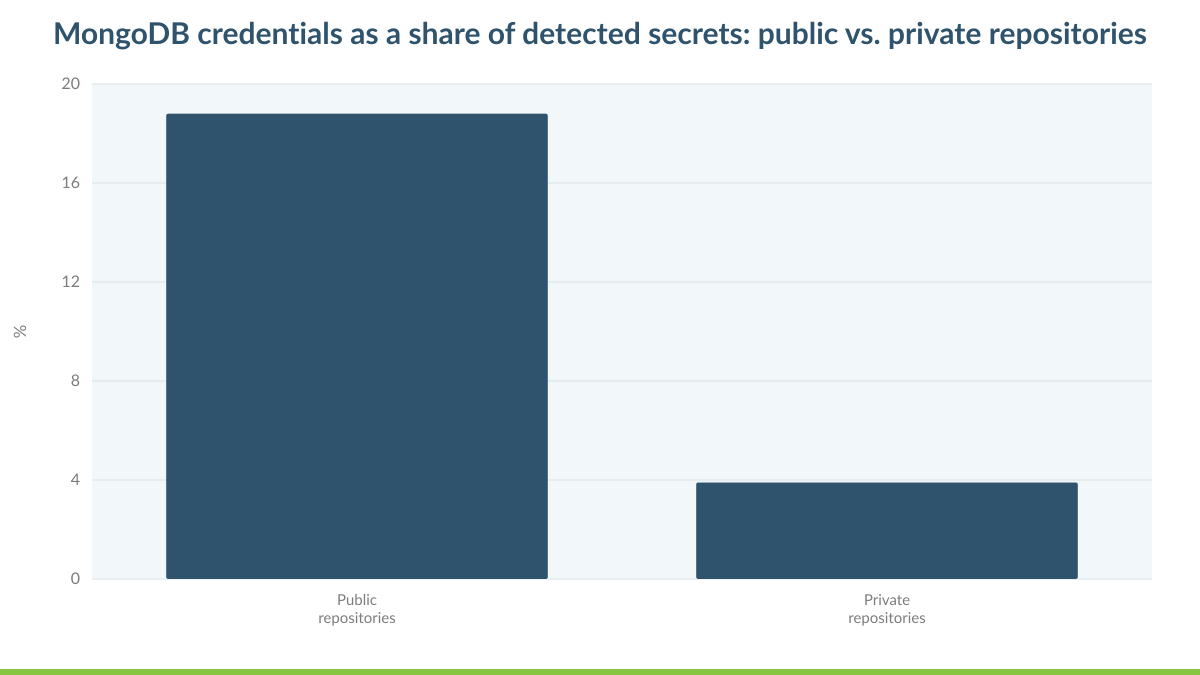
One detail from that research is especially relevant to private infrastructure. The chart below compares MongoDB credentials as a share of detected secrets in public versus private repositories. The point is not the database brand. The point is that private repositories are not a safe harbor. Teams relax their discipline when they believe a location is internal, and that relaxed discipline is precisely what makes an internal store valuable when it is breached. A Classic tier API Management instance that has been “internal” for five years is the gateway equivalent of a private repository full of hardcoded credentials.
The fix is architectural, and Azure API Management already supports it. Named Values can be stored as plain text, as secrets held by the service itself, or as references to Azure Key Vault retrieved through a managed identity. Key Vault references move the authoritative copy of the secret out of the gateway and into a service built for secret storage, access policy, and audit logging. Identity provider integrations can use certificates or federated credentials instead of client secrets where the provider supports it. Backend services can accept managed identity tokens instead of static keys. Each of these choices shrinks what a gateway compromise can yield and shortens the time it takes to rotate when one occurs.
Key Vault references deserve a candid caveat. Moving the secret to Key Vault does not make it immune to theft if an attacker can read the resolved value at runtime. What it does is give you one authoritative place to rotate, a clean audit trail of access, and the ability to rotate on a schedule without touching gateway configuration. That combination turns rotation from a project into a process, and process is what survives the next advisory.
A 72-Hour Response Plan for the Azure API Management Flaw
The plan below assumes you operate one or more Classic tier API Management instances and that you are following the guidance to treat exposed credentials as compromised. Adjust the hours to your staffing, but keep the sequence. The order matters more than the speed, because rotating credentials out of dependency order is how well-intentioned teams cause their own outages.
Hours 0 to 12: Scope and Assume Compromise
- Confirm the advisory. Check Azure Service Health in every subscription for tracking ID MZK9-GH0. Do not rely on a single administrator’s inbox, because advisories route to whoever is configured for service health alerts and those settings drift over time.
- Inventory every instance. Use Azure Resource Graph to enumerate all API Management services across subscriptions and record each instance’s tier. Shadow instances created by development teams or contractors are common, and they are rarely the best maintained.
- Export the secret map. For each Classic instance, list every Named Value and note whether it is plain, secret, or a Key Vault reference. List every configured identity provider and OpenID Connect provider. Enumerate subscriptions and the consumers who hold their keys.
- Assign owners. Every secret maps to a system, and every system has an owner. Identify who can rotate the credential at its source, whether that is an internal team, a SaaS vendor, or a partner.
- Open a formal incident record. Notify legal, compliance, and your cyber insurance contact. Start a timestamped log now. Every action you take in the next 72 hours is evidence.
Hours 12 to 36: Rotate in Dependency Order
Prioritize by privilege, not by convenience. The credential that can do the most damage gets rotated first, even if it is the hardest to coordinate.
- Identity provider and OpenID Connect client secrets first. In Microsoft Entra ID or your third-party provider, create a new client secret, update the API Management configuration, confirm sign-in works, and then delete the old secret. Creating a new secret without deleting the old one leaves the stolen credential valid. While you are in the app registration, review its API permissions and remove anything the integration does not actively need.
- Backend credentials in Named Values second. Rotate at the source system before updating the gateway. Changing the Named Value alone accomplishes nothing if the backend still accepts the old password. Where possible, convert the Named Value to a Key Vault reference during the same change.
- Subscription keys third. API Management issues a primary and secondary key for each subscription. Use that pair to avoid an outage: direct consumers to the secondary key, regenerate the primary, move consumers to the new primary, then regenerate the secondary. For external partners, communicate the window in advance and confirm cutover.
- Tokens last but not least. Revoke and reissue any tokens the service held. Where tokens are short-lived by design, confirm the issuing credential was rotated so new tokens cannot be minted with stolen material.
Microsoft closed the hole on November 19. Your exposure closes only when the last affected credential is rotated at its source.
Hours 36 to 72: Hunt, Validate, and Document
Rotation stops future misuse. Hunting tells you whether past misuse occurred, which is the answer your auditors, insurers, and executives will ask for. Focus the hunt where stolen credentials would leave traces.
- Entra ID service principal sign-ins. Review sign-in logs for the app registrations whose secrets were stored in API Management. Look for authentication from unfamiliar IP ranges, unusual times, or token requests for scopes the integration never uses.
- Persistence mechanisms. Check for newly created app registrations, new credentials added to existing service principals, new consent grants, and changes to role assignments. An attacker with a valid client secret will often try to add their own credential so they survive your rotation.
- Backend access logs. For every backend credential stored in a Named Value, ask the system owner to review authentication logs for use of that credential from sources other than your gateway’s known egress addresses.
- Gateway telemetry. If API Management diagnostics flow to Log Analytics or Application Insights, review call patterns for subscription keys hitting APIs they do not normally call or volumes that do not match the consumer’s history.
- Functional validation. Confirm every integration works after rotation. A broken partner feed discovered on day five is a business continuity incident layered on top of a security incident.
- Evidence package. Compile the inventory, rotation timestamps, hunt queries, and findings into a single record. This package supports a materiality determination, a HIPAA risk assessment, an insurance notification, or simply a clean answer to the board.
Close the 72 hours with a forward decision, not just a retrospective. Decide which Classic instances will migrate to v2 tiers, which Named Values will move to Key Vault references, and which integrations will move from static secrets to certificates, federated credentials, or managed identities. Put dates on those decisions. Remediation without a deadline becomes the next advisory’s starting point.
Business Impact Mapped to the Five Pillars
Technical teams will see this incident as a rotation exercise. Executives need to see it as a test of five capabilities that determine how expensive any cloud security event becomes.
- Simplification. The organizations that finish fastest are those with one inventory of gateways, one secret store, and one owner per credential. Every undocumented Named Value adds hours to the response and risk to the outcome.
- Security. Least privilege on app registrations limits what a stolen client secret can do. Centralized secret storage with access auditing limits how long a stolen secret stays useful. Both reduce the probability that an exposure becomes a breach.
- Performance. Rotation done out of order causes outages. Rotation done with the primary and secondary key pattern and coordinated partner cutovers preserves service levels while removing risk.
- Resilience. If a stolen credential reached a system that holds critical data, your ability to restore from clean, isolated backups determines whether a credential theft becomes a destructive incident. Recovery readiness is the safety net under every rotation plan.
- Flexibility. Organizations locked into a single gateway pattern, a single tier, or a single cloud have fewer options when a platform issues an advisory. Architectures that separate secrets, identity, and workloads let you respond on your schedule rather than the vendor’s.
The cost math is straightforward even without inventing figures. Every hour your team spends searching for an undocumented secret is an hour not spent hunting for misuse. Every partner integration broken by an uncoordinated rotation is revenue or service delivery interrupted. Every gap in your evidence package is a harder conversation with an insurer or regulator. The organizations that absorb this advisory cheaply are the ones that invested in inventory and secret architecture before November 18.
How IT Vortex Turns a Rotation Fire Drill Into Routine Operations
Most mid-market IT teams did not choose to become API security specialists. They inherited gateways from integration projects, acquired companies, and developers who have since moved on. IT Vortex works as integrator, architect, and advisor alongside those teams, not as a reseller handing over licenses and leaving.
Through Security as a Service (SECaaS), IT Vortex brings continuous monitoring and response that extends to identity signals, including the service principal activity that matters most after a gateway compromise. Built on partners such as CrowdStrike, Fortinet, Proofpoint, and Microsoft, the service gives mid-market organizations the detection coverage and response discipline that a 72-hour plan like the one above requires, without asking an already stretched internal team to staff a security operations function around the clock.
For organizations reconsidering where workloads and backend services should live, Cloud Hosting (IaaS) delivers VMware-powered infrastructure as a Premier Broadcom VCSP Partner, with network segmentation and access controls designed by architects who expect credentials to leak eventually. Many mid-market environments will keep Azure API Management in place while running sensitive backends elsewhere, and IT Vortex Hybrid Cloud Services are built for exactly that pattern: private connectivity, consistent policy, and a clear map of which credential reaches which system.
Resilience is where credential incidents are won or lost. If a stolen backend credential was used to alter or destroy data, you need recovery points that the attacker could not touch. Backup as a Service (BaaS) built on Veeam provides isolated, protected copies of critical data, and Disaster Recovery (DRaaS) reduces downtime risk with tested, automated recovery workflows that bring critical services back in a predictable order. If you are not sure how your current recovery posture would hold up against a credential-driven incident, the DR Readiness Assessment is a fast way to find the gaps before an attacker does.
The common thread is architecture. A managed service should not only reduce the work of responding to an advisory but also reduce the number of advisories that become incidents in the first place. That happens when secrets live in the right place, identities carry only the permissions they need, workloads are segmented, and recovery is tested rather than assumed.
Reframe: Your Gateway Was Holding More Than Traffic
The headline says attackers exploited an Azure API Management flaw. The more useful reading is that attackers found the place where your organization had quietly concentrated its most valuable credentials, and they took them. Microsoft fixed the vulnerability. It cannot fix the decision to store long-lived secrets in a gateway, and it cannot rotate the keys your partners, backends, and identity tenant depend on. That work belongs to you, and how fast you can complete it is a direct measure of your security architecture.
A secret you cannot rotate in an afternoon is not a control. It is a liability with an expiration date you do not get to choose.
So change the question your team asks. Instead of “were we affected by MZK9-GH0?”, ask “if every secret in our gateway leaked tomorrow, how many hours would it take to make all of them worthless?” If the honest answer is measured in days, the next 72 hours should rotate what was exposed, and the next 90 days should make sure you never face that answer again. Move secrets to a proper store, replace static credentials with managed identities and certificates where you can, map every credential to an owner, and back the whole design with recovery you have actually tested.
If you want a second set of eyes on your API Management footprint, your rotation sequence, or the secret architecture you are building next, schedule a working session with Lou Corriero, VP Cloud at IT Vortex. Bring your instance inventory, or bring the questions you cannot yet answer. Either way, you will leave with a prioritized plan that turns the next gateway advisory into routine maintenance instead of an emergency.