
CISA has warned federal agencies that attackers are now exploiting a recently patched, critical Cisco Expressway vulnerability in the wild, according to reporting from BleepingComputer. When the nation’s cyber defense agency moves a flaw from advisory to actively exploited, the window between disclosure and damage has already closed for some organizations.
For US mid-market organizations, the warning lands on a device class that rarely gets the attention it deserves. Cisco Expressway usually sits at the edge of the network, often in the DMZ. It is frequently maintained by a collaboration team that is measured on call quality rather than patch speed. It is not only a communications appliance but also an internet-facing server with a path into the internal network. Attackers understand that distinction even when asset inventories do not.
This article covers four things: what the CISA listing means, why edge infrastructure has become the preferred entry point, what a compromise costs in business terms, and a 72-hour plan to patch, hunt, and prove you can recover. The goal is a repeatable process. With one in place, the next Known Exploited Vulnerabilities alert becomes routine work instead of an incident.
What CISA’s Cisco Expressway Vulnerability Warning Actually Says
The key facts are few and clear. According to BleepingComputer, CISA has flagged a critical Cisco Expressway flaw that allows remote code execution and has confirmed that attackers are exploiting it in real attacks. Cisco has already released a fix. Security teams should treat this combination as an urgent, top-priority event: critical severity, remote code execution, a public patch, and confirmed exploitation.
Several details matter for executives who will be asked about this at the next leadership meeting.
- Remote code execution means the attacker can run their own commands on the device. On an edge appliance, that turns a nuisance into a foothold. The attacker does not need a password, a phishing email, or an insider.
- Recently patched flaws are among the most dangerous. Publishing a fix also tells attackers where to look. They compare patched and unpatched code to see exactly what changed. Organizations that patch on a monthly or quarterly cycle give them weeks to build and use an exploit.
- Exploitation is confirmed, not theoretical. CISA adds entries to its catalog only when it has reliable evidence that a vulnerability is being used in real attacks. This is the strongest signal the agency sends.
- The warning is addressed to federal agencies, but attackers do not check whether you are one. Mid-market companies run the same Cisco software and often patch it more slowly, which makes them attractive targets once exploitation is underway.
For the exact affected releases and fixed versions, go directly to Cisco’s published security advisory for Expressway. Compare it against the version running on every node in your environment. Do not rely on memory or on a spreadsheet last updated a quarter ago. The version actually running on the box is the only one that counts.
Why a KEV Listing Changes the Clock
CISA’s Known Exploited Vulnerabilities (KEV) catalog exists because far more vulnerabilities are published than any team can patch in a given week. The catalog narrows the field to flaws with evidence of real-world exploitation. Binding Operational Directive 22-01, issued in November 2021, requires federal civilian executive branch agencies to fix KEV entries within the deadlines CISA assigns. Private companies are not bound by the directive. Even so, the catalog has become a working priority list for insurers, auditors, and security teams across the private sector.
A KEV listing should change your internal deadline. Yesterday, this was an item for the next maintenance window. Today it belongs on this week’s schedule. The risk is no longer a probability estimate, because someone is already exploiting it.
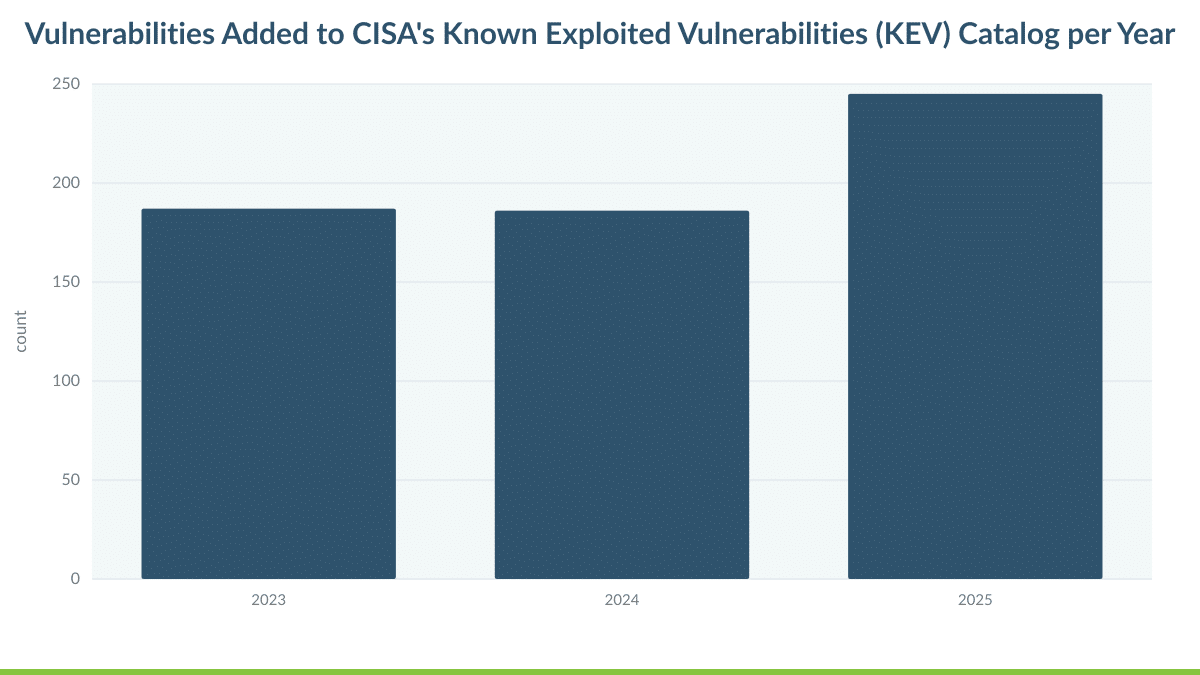
The chart above shows how many vulnerabilities CISA has added to the KEV catalog each year. The trend is the point. Cyber Security News reported that active exploitation surged 20 percent in 2025, and nothing in the current threat environment suggests the pace is slowing. For a lean mid-market IT team, every new KEV entry competes for the same limited hours as help desk tickets, infrastructure projects, audits, and vendor renewals.
This is the core operational problem. Most mid-market organizations are willing to patch. What they lack is the capacity to triage, test, schedule, execute, and verify across every device class at the speed the KEV catalog now demands. That makes this a Simplification problem as much as a Security problem, and it can be solved. The fix is to stop treating each alert as a one-off emergency and build a standing process that absorbs alerts the way a well-run operations team absorbs routine change.
The Collaboration Edge Is the New Front Door
To see why this flaw matters, it helps to know what Expressway does. The Expressway Series is Cisco’s collaboration gateway. Organizations commonly deploy it in pairs:
- An internal node (Expressway-C) that communicates with call control.
- An external node (Expressway-E) that sits in the DMZ and accepts connections from the internet.
Together, the pair lets remote employees use voice, video, and messaging without a VPN. It also supports business-to-business video calls and secure firewall traversal for collaboration traffic.
Every one of those functions requires the device to be reachable from outside your network. That reachability is what makes it useful. It is also what makes it a target.
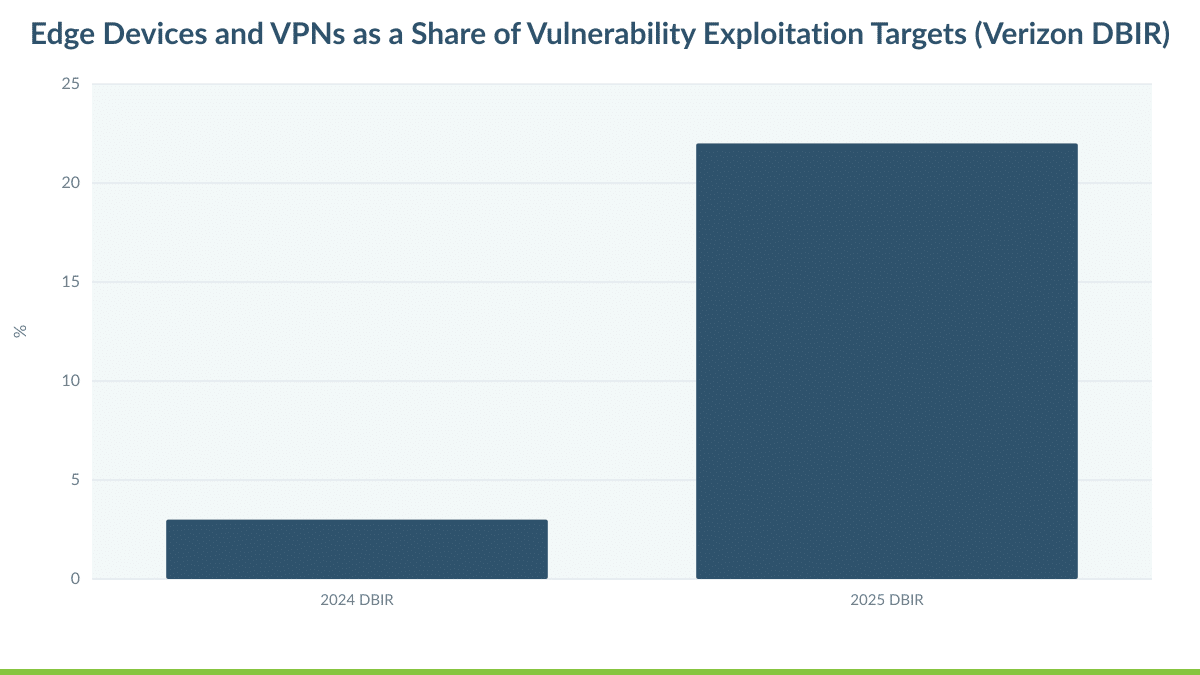
The Verizon 2025 Data Breach Investigations Report, summarized in the chart above, shows edge devices and VPNs taking a sharply larger share of vulnerability exploitation targets than in the prior year’s report. Attackers have adjusted to where defenses are weakest:
- Endpoints are increasingly covered by endpoint detection and response agents and managed detection services.
- Email passes through mature filtering gateways.
- Edge appliances, by contrast, are often closed systems. Security teams cannot install an agent, logs are not forwarded to a central platform, and every patch needs a change window that the business resists because the device carries live calls.
Three characteristics make edge appliances especially attractive to attackers:
- They are internet-facing by design. No one needs to be phished. The attacker scans, identifies the software version, and sends the exploit.
- The internal network trusts them. An edge gateway has firewall rules that let it reach internal systems. An attacker who compromises the gateway inherits those paths.
- They are under-monitored. Many organizations cannot answer a simple question: who logged into the Expressway admin interface last week, and from where?
The collaboration edge is especially prone to this blind spot because ownership is usually split. The network team manages the firewall rules around the device. The unified communications team manages the application. The security team may not know the device exists until an alert like this one arrives. When ownership is spread across three teams, patching falls through the gaps.
When everyone owns a device, no one patches it. Edge appliances fail in the gaps between teams long before they fail in the code.
What an Expressway Compromise Costs the Business
Severity scores describe how bad a flaw is in isolation. Executives need to know what it means for revenue, operations, and liability. Here is how an exploited edge gateway turns into business impact across the areas that matter most.
Security: a foothold inside the perimeter
Remote code execution on an internet-facing device gives an attacker a staging point. The usual next steps are:
- Harvesting credentials.
- Mapping internal systems.
- Moving laterally toward high-value targets such as identity infrastructure, file servers, and virtualization management consoles.
The first compromised device is rarely the attacker’s goal. It is the way in. A gateway already permitted to talk to call control and directory services offers a quiet route into systems that would otherwise be hard to reach from outside.
Resilience: the ransomware path
Many ransomware intrusions follow this exact pattern:
- An exposed edge device is compromised.
- The attacker spends a quiet period on reconnaissance.
- A coordinated encryption event hits production servers and backups at the same time.
Suppose your backups are reachable from the same network and protected by the same credentials an attacker can harvest. The attacker can then delete or encrypt them before launching the main attack. Resilience is not measured by whether you have backups. It is measured by whether those backups survive an adversary who is already inside.
Continuity: the patch itself has a cost
Patching an Expressway deployment can interrupt remote calling, mobile and remote access, and partner video sessions. Organizations that rely on these capabilities for sales, client service, or clinical communication need a plan for the change window. That plan should cover user communication and a fallback if the upgrade fails. A planned interruption is a minor cost compared with an unplanned outage caused by a compromise, but only if the plan exists before you need it.
Compliance and disclosure
For regulated organizations, an edge compromise is not only a technical incident but also a potential reporting event:
- Public companies face SEC disclosure obligations for material cybersecurity incidents.
- Healthcare organizations face HIPAA breach notification rules.
- Financial firms face examiner scrutiny of their vulnerability management programs.
Regulators, insurers, and outside counsel all ask the same questions. Did you know about the vulnerability? What did you do about it, and when? An unpatched flaw that CISA had already listed as actively exploited is very hard to defend in that conversation.
Exploited Flaws Cluster in Software You Already Own
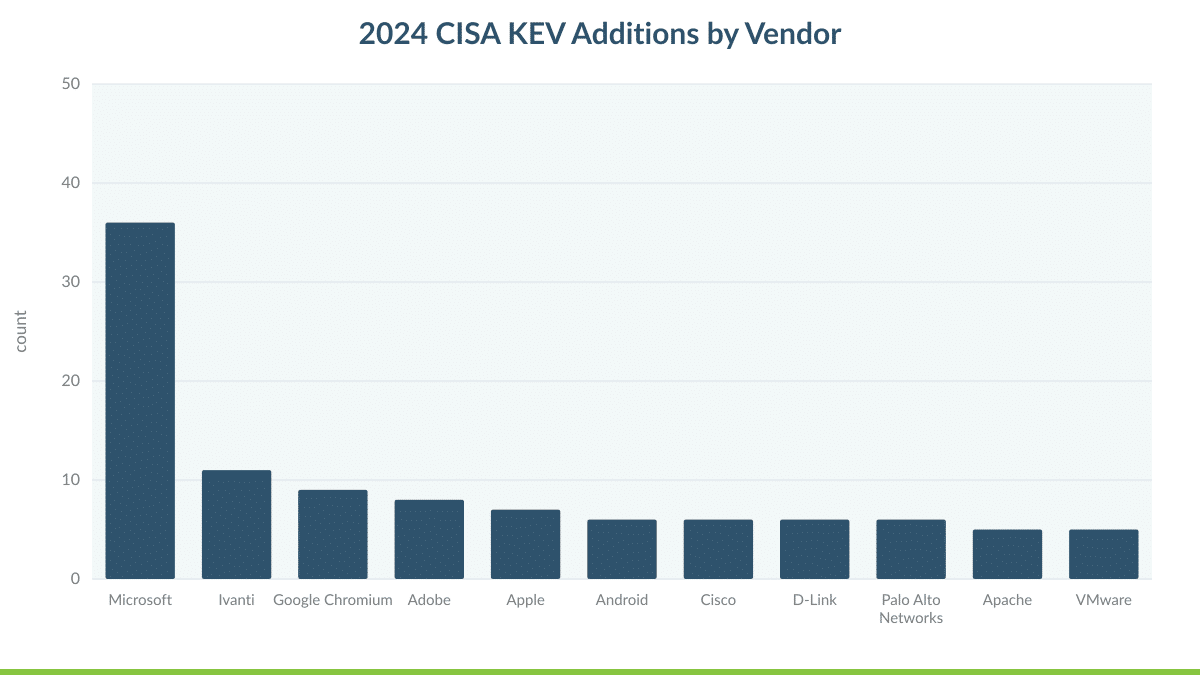
The chart above breaks down 2024 KEV additions by vendor, based on Cyble’s analysis, which counted 185 exploited vulnerabilities added to the catalog that year. The pattern is consistent. The vendors that appear most often are the ones whose products are most widely deployed: the operating systems, networking gear, and security platforms that form the backbone of nearly every mid-market environment. Cisco is a recurring name in the KEV catalog. That reflects the size of its installed base more than a unique failing, and the same logic applies to every major infrastructure vendor.
The lesson for executives is practical, not vendor-specific. Switching vendors does not remove exploitation risk. It only moves it somewhere else. What reduces risk is a program that does four things:
- Knows every internet-facing asset.
- Assigns each asset to an owner.
- Tracks each asset against the KEV catalog continuously.
- Applies patches on a defined schedule.
That program looks the same whether the next alert names Cisco, VMware, Microsoft, Fortinet, or anyone else. Organizations that build it once stop reacting to individual vendors and start running a consistent process.
A 72-Hour Response Plan for the Cisco Expressway Vulnerability
Below is the plan we recommend for mid-market organizations running Cisco Expressway. If you have the capacity, compress it. Do not stretch it. Each phase has a clear output, so leadership can track progress without needing to read firewall logs.
Hours 0 to 8: Find every node and confirm exposure
- Inventory every Expressway node. Include every Expressway-C and Expressway-E node, along with lab, disaster recovery, and forgotten pilot deployments. Review firewall NAT rules and external DNS records to catch internet-facing nodes that never made it into the asset database.
- Record versions. Note the running software version on each node and compare it against Cisco’s advisory for affected and fixed releases.
- Name one accountable owner. Assign the remediation to a single named person, not a team, and set a check-in time with leadership.
- Check admin exposure. Confirm whether the administrative interface can be reached from the internet. If it can, restrict it to management networks immediately while you prepare the patch.
- Back up configurations. Take a configuration backup of each node and store it off the device, so you have a reference point for later comparison.
Hours 8 to 24: Patch, in the right order
- Get and verify the fix. Download the fixed release directly from Cisco and verify its integrity against the hashes Cisco publishes.
- Follow Cisco’s upgrade sequence. If your nodes are clustered, use Cisco’s documented sequence so call services stay available during the change.
- Prioritize exposure. Within that sequence, schedule the internet-facing nodes first, since they carry direct exposure.
- Communicate the window. Tell users who depend on remote calling and partner video when the change will happen and what to expect.
- Verify every node. Confirm the post-patch version on each node directly. A change ticket marked complete is not verification.
Hours 24 to 48: Hunt for signs you were already hit
Patching closes the door. It does not tell you whether someone came through before you closed it. Exploitation was underway before many organizations could act, so assume a compromise is possible and look for evidence.
- Review admin logins. Check administrative login history on every node for unfamiliar accounts, source addresses, or login times.
- Compare configurations. Check current settings against your backup and against known-good baselines. Look for new accounts, changed passwords, new certificates, or altered traversal settings.
- Inspect outbound traffic. Review connections from Expressway nodes at the firewall. Investigate immediately if a gateway contacts unfamiliar external addresses or connects to internal systems it does not normally reach.
- Check connected systems. Review the internal systems Expressway can reach, including call control servers and directory services, for unusual authentication activity.
- Centralize logs. Forward Expressway logs to a central monitoring platform from now on, so the next hunt does not start from scratch.
If you find signs of compromise, treat the event as an incident, not a patching task:
- Preserve evidence.
- Isolate affected systems.
- Rotate every credential the device could access.
- Engage incident response.
Rebuilding from a clean image is often safer than trusting a device an attacker has controlled, even after it has been patched.
Hours 48 to 72: Prove you can recover
- Confirm backup isolation. Make sure backups of critical systems are current, protected against deletion, and separated from any credentials an attacker on the edge could harvest.
- Test a restore. Restore at least one critical workload. A backup you have never restored is a hope, not a control.
- Validate the DR runbook. Test your disaster recovery plan for the scenario where the network edge is compromised and production must fail over to a clean environment. Our DR failover validation plan template gives you a structured starting point.
- Document everything. Record what you did, when, and who approved it. That record is your answer to auditors, insurers, and the board.
Compensating Controls When You Cannot Patch Tonight
Some organizations will not be able to patch within 24 hours. Upgrades may need testing against specific call control versions, a change freeze may be in effect, or a third party may manage the device under contract. If that describes you, reduce exposure while you schedule the fix.
- Lock down admin access. Restrict administrative interfaces to a dedicated management network or jump host. Require multi-factor authentication on every administrative access path that supports it.
- Tighten firewall rules. Limit Expressway-E to the ports and sources the service actually needs, and block outbound connections that are not required for operations.
- Use intrusion prevention as a virtual patch. Enable your perimeter firewall’s intrusion prevention signatures for this vulnerability where your vendor has published them. Next-generation firewall platforms from vendors such as Fortinet can provide this interim protection while the real patch is scheduled.
- Watch what the gateway can reach. Increase monitoring on the internal systems Expressway connects to, since you may not be able to see inside the appliance itself.
- Set a hard deadline. Write down the date the real patch will be applied and assign an owner to it.
A compensating control without an end date is not a mitigation. It is the new permanent configuration.
Why Patching Is Not the Finish Line
Security teams tend to measure success by how fast they patched. Boards should measure it by how fast the business recovers if the patch came too late. Those are different metrics, and the second one is what protects revenue.
Consider the typical timeline of an edge exploitation campaign:
- A flaw is disclosed and patched.
- Attackers study the fix and begin scanning for unpatched systems.
- Exploitation starts before many organizations finish their change approval process.
- CISA confirms exploitation and adds the flaw to the KEV catalog.
By the time a mid-market IT team reads the alert, some exposed devices have very likely already been touched. Fast patching is necessary, but it does not undo anything that happened before the patch.
This is where Resilience turns a security alert into a business continuity conversation. Suppose an attacker used an edge gateway to stage a ransomware event. How fast you recover depends on three things:
- Whether you have clean, protected copies of your data.
- Whether you can restore them into an environment the attacker does not control.
- Whether you have practiced doing it under realistic conditions.
IT Vortex’s Backup as a Service (BaaS), built on Veeam, is designed for this scenario. It keeps offsite copies separate from your production credentials, so a compromised edge device does not also compromise your recovery. Our Disaster Recovery (DRaaS) service runs on VMware infrastructure that we operate as a Premier Broadcom VCSP Partner. It gives you a clean, pre-staged environment to fail over into while incident responders work on the original site. Together, these services reduce downtime risk with recovery workflows you have tested before you need them.
Patch speed measures how fast you closed the door. Recovery speed measures whether the business survives if someone was already inside.
Building an Edge Program That Does Not Depend on Heroics
Responding to this Cisco Expressway alert in 72 hours is achievable with focus. Responding to every KEV alert that way, all year, with the same lean team, is not. Organizations that handle these events calmly tend to share a few structural traits.
- A live inventory of internet-facing assets, checked against external scans rather than internal records alone.
- Named ownership for every edge device, with security accountable for the patch deadline even when another team runs the application.
- Continuous KEV monitoring that automatically matches new catalog entries to your inventory, so answering “are we affected?” takes minutes rather than days.
- Centralized logging and detection that covers appliances, not only endpoints and servers. Pairing endpoint detection from platforms such as CrowdStrike with firewall and appliance logs closes the blind spot at the edge.
- Pre-approved emergency change procedures for KEV-listed vulnerabilities, so urgent patching does not wait for the next scheduled change board.
- Tested recovery, with restore drills and failover checks on a regular schedule and results reported to leadership.
Each of these traits is simple to describe and hard to sustain with an internal team that also runs the help desk. That is the practical case for Security as a Service (SECaaS). The goal is not to replace your team. It is to give your team a standing capability for monitoring, triage, and response that does not depend on someone noticing a headline. Delivered alongside Managed Services, it turns KEV alerts into a workflow with an owner, a deadline, and a verification step.
Simplification also means reducing the number of internet-facing appliances you operate yourself. Moving workloads into Cloud Hosting (IaaS) with a managed, monitored perimeter, or delivering desktops through Desktop as a Service (DaaS) built on Omnissa, can shrink the set of edge devices your team must patch personally. Every device you no longer expose to the internet is one less KEV alert to chase.
Where IT Vortex Fits
IT Vortex works as an integrator, architect, and advisor, not a reseller handing over a license key. In a situation like this one, that means three things.
- Assess: identify every edge device, map its exposure, check it against the current KEV catalog, and rank remediation by business impact rather than by severity score alone.
- Remediate and harden: coordinate patching with your collaboration and network teams, put compensating controls in place through Security as a Service (SECaaS) with partners such as Fortinet and CrowdStrike, and close the logging gaps that kept the edge invisible.
- Recover: confirm that Backup as a Service (BaaS) and Disaster Recovery (DRaaS) can restore critical operations into a clean environment, and document the results for auditors, insurers, and the board.
The Real Question Is Not Whether You Patched
Most organizations will patch this Cisco Expressway flaw, log it, and forget it within a month. Another KEV entry will replace it, then another. Treating each one as a separate emergency almost guarantees your team will eventually miss one.
A better test is whether your organization can answer three questions in under an hour for any edge device, on any day:
- Is it exposed?
- Who owns it?
- Can we recover if it was already used against us?
If you cannot answer all three today, that gap is the real vulnerability. It will still be there after this patch is applied, waiting for the next alert.
If you want a second set of eyes on your edge exposure and recovery posture, schedule a working session with Lou Corriero, VP Cloud at IT Vortex. Together you will review your internet-facing infrastructure, map it against the current KEV catalog, and identify the recovery gaps that could turn an edge compromise into a business outage. Book a time with Lou here.