
A security library that has not been updated since December 2008 is now an active doorway into corporate web servers. Researchers are urging organizations to discontinue Idunno.AntiCsrf, a legacy ASP.NET anti-CSRF module, after a critical flaw tracked as CVE-2026-131914 was exploited in the wild with a CVSS score of 9.3 out of 10.0.
The number that should concern every mid-market IT leader is not the CVSS score. It is the number of requests an attacker needs. Google’s Mandiant division rates the flaw’s exploitability as “High,” and exploitation hinges on a single HTTP POST request with no prior authentication and no valid CSRF token. A module that organizations installed to protect their ASP.NET WebForms applications from forged requests has become the mechanism that lets an anonymous outsider execute code on the servers behind those applications.
There is no vendor patch on the way, because the open-source project is defunct. That makes CVE-2026-131914 more than another line in the patch queue. It is a test of three capabilities at once: whether you know what code is running inside your own applications, whether you can remove a dependency nobody remembers adding without breaking the business, and whether you can recover cleanly if an attacker got there first. What follows is the mechanism, the business exposure mapped to the five pillars, and a 72-hour plan your team can execute this week.
What CVE-2026-131914 Actually Does Inside an ASP.NET WebForms Application
Idunno.AntiCsrf is a third-party ASP.NET IHttpModule that was built to provide double-submit cookie Cross-Site Request Forgery (CSRF) protection for ASP.NET WebForms applications. According to the disclosure reported by The Hacker News, the affected versions are 0.9.1.0 and 0.9.1 Beta, and the vulnerable logic lives in the Idunno.AntiCsrf.AntiCsrfModule HTTP module, distributed as Idunno.AntiCsrf.dll.
The double-submit cookie pattern is a sensible defense on paper. The server writes a token into a cookie and into a hidden form field. On every POST, it checks that the two values match. A malicious site can trick a user’s browser into sending a request, but it cannot read that user’s cookie, so it cannot forge a matching form value. The concept is sound. The implementation is where it fails.
When the module processes incoming HTTP POST requests to WebForms endpoints (any page derived from System.Web.UI.Page), it deserializes the CSRF form token data using an unkeyed .NET System.Web.UI.ObjectStateFormatter instance, with no cryptographic MAC or signature verification. Put plainly, the module accepts a blob of attacker-controlled data, rebuilds .NET objects from it, and only afterward considers whether that data was legitimate. By then the damage is done.
Insecure deserialization is among the most dangerous bug classes in the .NET ecosystem because reconstructing objects can trigger code execution as a side effect, long before any validation logic runs. ObjectStateFormatter belongs to the same serialization machinery ASP.NET uses for ViewState, and ViewState abuse has been a well-documented path to remote code execution for years whenever integrity protection is missing or signing keys are exposed. Microsoft designed ViewState to rely on a machine key and a message authentication code precisely so the server rejects tampered payloads. Idunno.AntiCsrf skips that safeguard entirely, which is why the outcome is arbitrary remote code execution by a remote, unauthenticated attacker.
That code runs inside the IIS worker process (w3wp.exe), under whatever identity the application pool uses. On a server hardened to current standards, that is a low-privilege virtual account with tightly scoped file access. On many mid-market servers built a decade or more ago, it is a domain service account, a local administrator, or an identity that can read connection strings, reach file shares, and touch backup repositories. The vulnerability sets the entry point. Your server build decides the blast radius.
Why the Flaw Earns a 9.3
- It is reachable over standard HTTP POST, the same traffic every public form already accepts.
- No authentication is required, so login protections, MFA, and SSO offer no defense.
- No valid CSRF token is required, so the protection mechanism itself is the attack surface.
- Exploitation in the wild is confirmed, with a “High” exploitability assessment from Mandiant.
- There is no upstream fix, because the project has not been maintained since December 2008.
Why a Library Abandoned in 2008 Is Still Running in Your Environment
The reflexive response from many leadership teams will be, “We would never run something that old.” Some of them will be right. Many will be wrong, and they will not find out until someone looks.
ASP.NET WebForms applications built on the .NET Framework continue to run real business functions across the mid-market: customer portals, claims intake, vendor onboarding, dealer ordering, and internal HR and timekeeping tools. They work, they rarely draw attention inside the company, and the developers who built them have often moved on. The application stays in production because replacing it never rose to the top of the budget.
The deployment pattern of that era makes the problem worse. Before package managers became standard practice in .NET development, a developer added a third-party component by copying a DLL into the application’s bin folder and registering it with a line or two in web.config. There was no package manifest and no lock file. Many modern dependency scanners and software bill of materials (SBOM) tools build their inventories from package references and project files, so a manually copied assembly can sit outside the inventory entirely. The library is in production, but it is not on any list.
Templates and starter kits then carry the component forward. An internal project template from 2009 seeds a customer portal in 2012, which becomes the basis for a partner extranet in 2016. A contractor’s preferred toolkit lands in three different applications. Each copy is invisible for the same reason the first one was.
The component installed to stop forged requests is now the component that lets an unauthenticated stranger run code on your web server.
This is a visibility problem before it is a vulnerability problem. You cannot remove what you cannot find, and you cannot prioritize what your tooling does not report. CVE-2026-131914 rewards the organizations that already treat application inventory as a security control and punishes the ones that treat it as paperwork.
The Exploitation Clock Starts Before Your Change Window Opens
The fact that CVE-2026-131914 was exploited in the wild is not an anomaly. It fits a broader pattern that should change how mid-market teams think about their patch calendar.
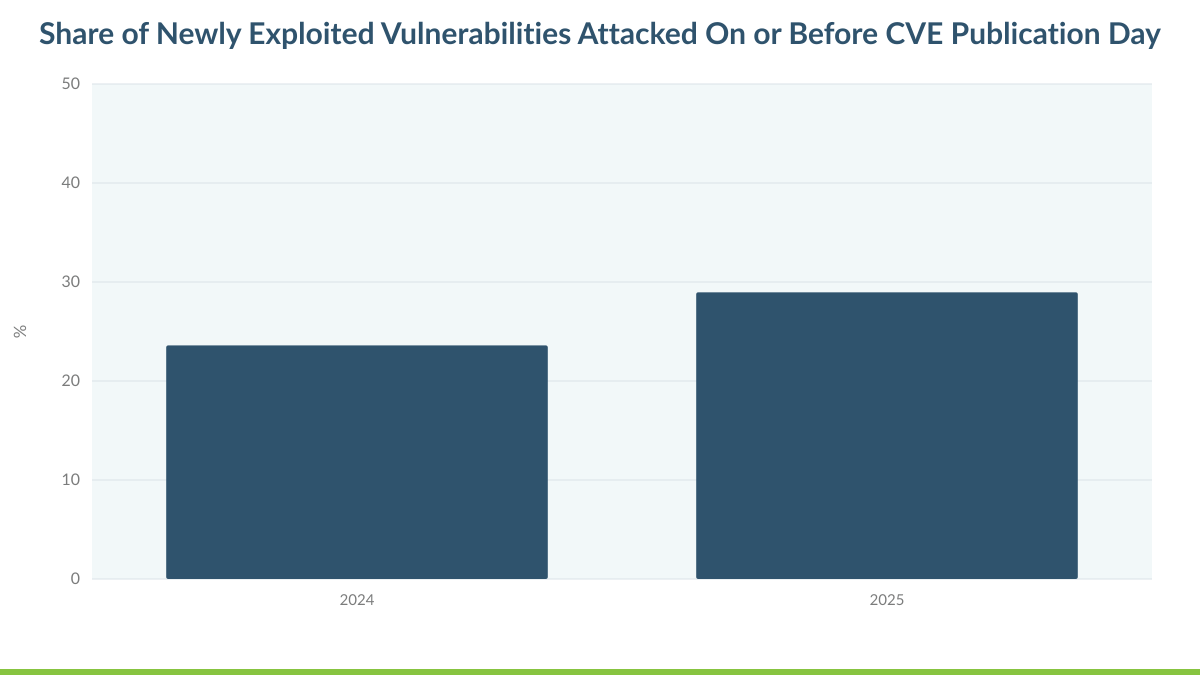
VulnCheck’s State of Exploitation 2026 research, shown in the chart above, measures the share of newly exploited vulnerabilities that attackers hit on or before the day the CVE was published. Read it as a statement about timing rather than technology. Every exploitation event counted in those bars happened before defenders had a published advisory to work from, which means a monthly maintenance window was never going to catch it.
For CVE-2026-131914 the timing problem is sharper still. A typical vulnerability starts a race between the vendor’s patch and the attacker’s exploit. A defunct library has no vendor and no patch, so the race runs until you remove the code yourself. Every day the module stays registered in web.config is a day the exposure is fully open.
The practical implication is governance, not tooling. Your change advisory process needs a pre-approved emergency path for removing or isolating a compromised dependency on a customer-facing application, with a named decision maker who can authorize downtime without convening a committee. If that authority does not exist today, CVE-2026-131914 is the reason to create it.
Internet-Facing Systems Are Where Attackers Spend Their Effort
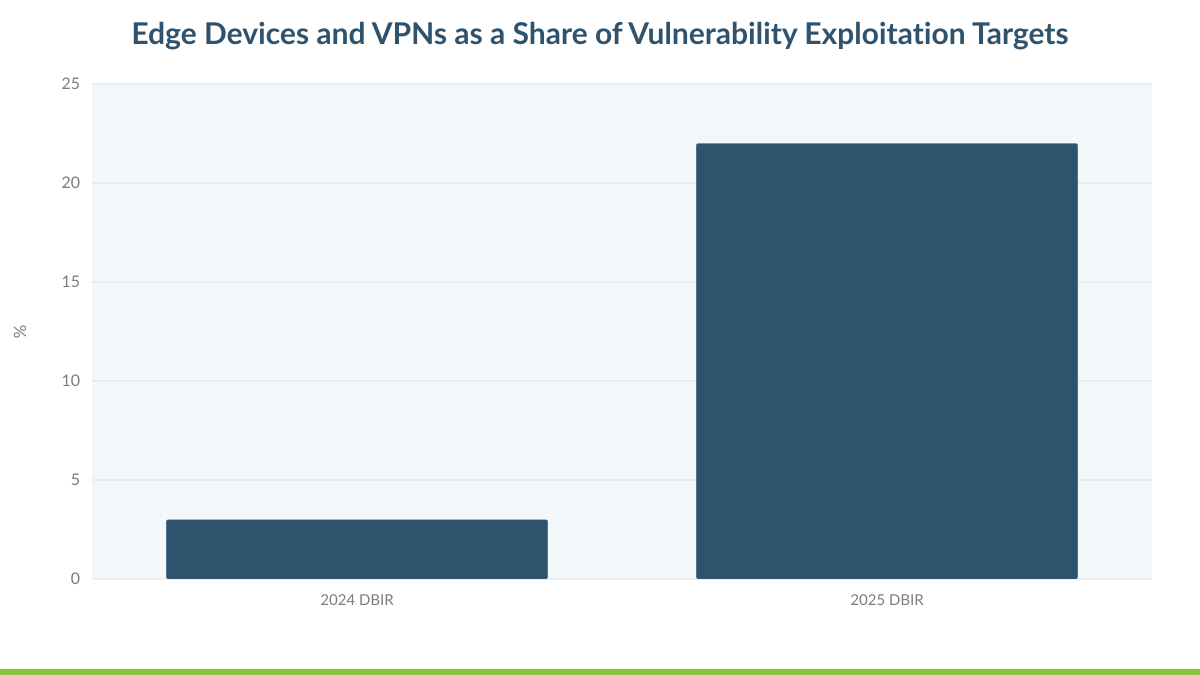
Verizon’s 2025 Data Breach Investigations Report tracks edge devices and VPNs as a share of vulnerability exploitation targets, and the chart above shows how prominently that perimeter layer features in attacker activity. A WebForms portal running on IIS is not a VPN appliance, but it shares every attribute that makes edge infrastructure attractive. It is reachable from the internet. It accepts unauthenticated input by design. It sits one network hop from internal systems. And in many mid-market environments, it receives less monitoring attention than the firewall in front of it.
That is the reframing your security program needs. Every public-facing web application is edge infrastructure and deserves the same discipline: a current inventory, a named owner, continuous vulnerability visibility, endpoint detection on the host, and logging that someone actually reviews. Organizations that already apply that discipline to firewalls and VPN concentrators but not to their legacy web servers have left a side door open and posted a sign pointing to it.
Old Code Is Not Retired Code
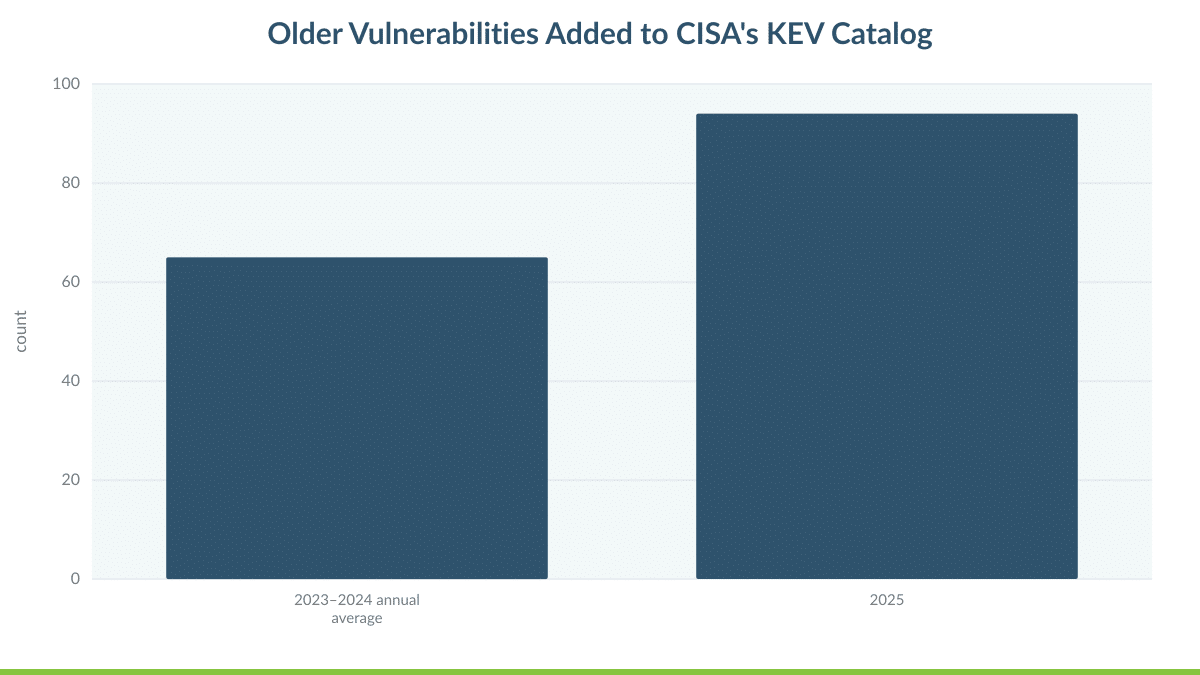
Cyble’s analysis, reported by The Cyber Express, tracks how many older vulnerabilities were added to CISA’s Known Exploited Vulnerabilities (KEV) catalog. The takeaway from the chart above is that age offers no protection. Attackers routinely return to old code, either because a new technique makes a dormant weakness usable or because a forgotten component suddenly becomes a valuable target.
Idunno.AntiCsrf is a vivid example. The library has not changed since December 2008, yet its critical flaw carries a 2026 CVE identifier and is being exploited now. The code did not get worse. Attackers simply looked at it.
In many mid-market risk registers, “legacy” quietly becomes a synonym for “accepted risk.” The application is old, it has been fine, and it is scheduled for replacement someday. That reasoning holds only until an attacker reads the source.
Treat every unmaintained dependency as a vulnerability whose CVE simply has not been assigned yet.
What CVE-2026-131914 Means for the Business, Pillar by Pillar
Technical severity matters, but executives fund responses based on business impact. Here is how this flaw maps to the five pillars that guide how IT Vortex evaluates infrastructure risk.
Security: An Unauthenticated Front Door
Remote code execution on a web server is initial access. From there, a typical intrusion follows a predictable sequence: drop a web shell for persistence, harvest credentials and connection strings from configuration files, enumerate the network, and move laterally toward data stores, domain controllers, and backup infrastructure. A WebForms application that processes customer, patient, or financial data turns that sequence into a breach notification scenario. The exposure is not only the compromised server but also everything that server’s identity can reach.
Resilience: Recovery Depends on What the Attacker Could Touch
If an attacker reached code execution, the question becomes whether you can return to a known-good state. That depends on backups the compromised identity could not alter or delete, restore points that predate the intrusion, and a recovery process that has been tested rather than assumed. Organizations running immutable, isolated copies through Backup as a Service (BaaS) can rebuild with confidence. Organizations whose backup repository sits on a share the web server’s service account can write to may discover that their safety net was inside the blast radius.
Performance: Unplanned Downtime on a Customer-Facing Application
Removing a CSRF module from a production application is a code change, and code changes on undocumented legacy applications break things. Forms stop submitting. Pages throw errors. A portal your customers rely on goes dark while developers who have never seen the code try to understand it. Planned, tested remediation protects revenue and service levels. Panicked remediation at 2 a.m. after an incident does not.
Simplification: Every Undocumented Dependency Is Complexity
CVE-2026-131914 is a symptom of accumulated complexity: components added without documentation, copied between projects, and forgotten. Each one is a liability that does not appear on any dashboard until it appears in the news. Simplifying the application estate, by consolidating platforms, retiring dead applications, and keeping a live inventory of what remains, shrinks the surface where the next defunct library can hide.
Flexibility: A Forcing Function for the Modernization Decision
Many WebForms applications survive because the modernization conversation keeps getting deferred. A critical, exploited, unpatchable flaw ends the deferral. The organization now has to decide whether each affected application will be remediated in place, rehosted on a hardened platform, rebuilt on modern .NET, or retired. Making that decision deliberately preserves options. Making it in the middle of an incident removes them.
A 72-Hour Response Plan for CVE-2026-131914
The following plan assumes a mid-market environment with a mix of on-premises and hosted IIS servers, limited in-house development capacity, and at least one legacy WebForms application. Adjust the timing to your scale, but keep the sequence: find, contain, hunt, recover.
Hours 0 to 24: Find Every Instance
- Search the file systems of every IIS server, including development, test, staging, and disaster recovery replicas, for Idunno.AntiCsrf.dll.
- Search every web.config file for references to Idunno.AntiCsrf in both the <system.web><httpModules> section and the <system.webServer><modules> section, since either can register the module.
- Search source control repositories, build artifacts, and deployment packages for the assembly name, so a cleaned server is not reinfected by the next release.
- Inspect VM templates and golden images, including those in your VMware environment, so newly provisioned servers do not inherit the component.
- Record each affected application’s internet exposure, business owner, data classification, and application pool identity.
By the end of the first day you should have a definitive list, not an estimate. If your team cannot produce one, that gap is itself the most important finding of the exercise.

Hours 24 to 48: Contain and Remove
- Unregister the module in web.config and remove Idunno.AntiCsrf.dll from the application’s bin folder, following the researchers’ guidance to discontinue use of the library.
- Replace the CSRF protection rather than simply deleting it. WebForms applications can use the ViewStateUserKey property combined with a per-session anti-XSRF token, the pattern Microsoft’s own WebForms project templates adopted, so that MAC-protected ViewState carries the defense.
- If an application cannot be changed immediately, remove it from direct internet exposure: restrict access by IP allowlist, place it behind a zero-trust access layer, or take it offline temporarily.
- Use web application firewall rules on the module’s token parameter as a short-term compensating control, treating them as a bridge to removal and never as the fix.
- Reduce the application pool identity to the minimum privileges the application needs, so any residual compromise has less to reach.
- Run regression tests on every form-driven workflow before returning the application to normal service.
Hours 48 to 72: Hunt, Rotate, and Recover
- Review IIS logs for unusual POST requests to .aspx endpoints, with attention to abnormally large or malformed form token values in the period before removal.
- Query endpoint detection telemetry for w3wp.exe spawning cmd.exe, powershell.exe, or other unexpected child processes, a strong behavioral signal of web server compromise.
- Look for newly created or modified .aspx, .ashx, and .asmx files in web roots, which are common web shell locations.
- Rotate every secret the application could read: database connection strings, service account passwords, API keys, and the machine key used for ViewState and authentication cookies.
- If you find indicators of compromise, rebuild the server from a known-good image and restore application data from a backup that predates the intrusion, rather than attempting to clean the host in place.
- Document the timeline, the evidence, and every decision for your cyber insurer, your auditors, and any regulators who may require notification.
Nothing in this plan requires exotic tooling. It requires an accurate inventory, endpoint visibility on web servers, clean backups, and someone with the authority to act. Those four things decide whether CVE-2026-131914 becomes a routine remediation task or a reportable incident.
Why “Just Remove It” Is Harder Than It Sounds
On paper the remediation is one line in web.config and one deleted file. In practice, mid-market teams hit friction quickly. Deleting the module without a replacement leaves every form in the application exposed to the forged requests it was meant to stop. Implementing a replacement means modifying code in an application that may lack automated tests, may target an older version of the .NET Framework, and may have no one left who understands its page lifecycle. When the business owner hears that the portal might break, the pressure to leave the module in place “for now” builds fast.
Resist that pressure, and use it as the input to a strategic decision instead. For each affected application, answer four questions. Does the business still need it? Can it be fixed in place with acceptable risk? Should it be rehosted on hardened, monitored infrastructure while a replacement is built? Or is it time to retire it? A structured cloud migration assessment turns those answers into a sequenced plan rather than a series of emergencies.
There is no patch for a dependency nobody maintains. The only fix is knowing it exists and having the authority to remove it.
The organizations that come through this cleanly will be the ones that treat the flaw as two problems on two timelines: an immediate containment problem measured in hours, and an application portfolio problem measured in quarters. Solving only the first guarantees a repeat the next time an abandoned component draws an attacker’s attention.
How IT Vortex Helps Mid-Market Teams Close This Class of Risk
IT Vortex is a Premier Broadcom VCSP Partner, and we work as architect, integrator, and advisor for organizations that need enterprise-grade infrastructure without enterprise complexity. For a flaw like CVE-2026-131914, that means connecting detection, hardening, and recovery into one operating model instead of three disconnected projects run by three different vendors.
Our Security as a Service (SECaaS) offering gives lean IT teams continuous visibility and response capacity they cannot staff on their own. We integrate CrowdStrike endpoint detection to watch for behaviors such as a web server process spawning command shells, Fortinet perimeter and web application controls to narrow the exposure of legacy applications, and Proofpoint protections for the email channel, which remains a parallel route into the same environment. The goal is not only to detect an intrusion but also to contain it before it reaches the systems that matter most.
When an application needs a safer home, our Cloud Hosting (IaaS) platform runs on VMware infrastructure built with hardened templates, segmented networks, and least-privilege service identities from day one. Rehosting a legacy WebForms application there will not make vulnerable code safe, but it does shrink the blast radius while the application is remediated or replaced, and it gives your team a monitored, documented environment instead of a forgotten server in a closet.
Recovery is where most incident plans are weakest. With Disaster Recovery (DRaaS) and Veeam-powered Backup as a Service (BaaS), we help clients maintain immutable, isolated restore points and documented failover procedures, then prove them with scheduled tests. If your team has never validated a full application recovery end to end, our DR Failover Validation Plan Template is a practical place to start.
The Real Question Is Not Whether You Patched, but Whether You Knew
CVE-2026-131914 will fade from the headlines. The condition that made it dangerous will not. Somewhere in your environment there is likely another component written years ago, copied into a bin folder, and forgotten, waiting for an attacker to read its source code. The organizations that handle this flaw well are not the ones with the fastest patching. They are the ones that already knew what was running, already had the authority to remove it, and already trusted their recovery.
So recast the problem. This is not a single CVE to close. It is a live test of whether your application inventory, your web server monitoring, and your recovery process would hold up against an unauthenticated attacker with a single POST request. Run the first 24 hours of the plan above this week, and you will know the answer.
If the answer is uncomfortable, work through it with someone who has done it before. Schedule a working session with Lou Corriero, VP Cloud at IT Vortex, to map your legacy application exposure, pressure-test your recovery plan, and build a remediation path that keeps the business running while the risk comes down.