
On Wednesday, F5 shipped out-of-band hotfixes for five critical BIG-IP vulnerabilities that let an unauthenticated attacker execute code remotely, and the company says there is no mitigation other than installing them. The flaws sit in BIG-IP Access Policy Manager (APM) and the iRules scripting engine, the exact components many mid-market organizations place at the front door of remote access, single sign-on, and application delivery.
Tracked as CVE-2026-121805, CVE-2026-120292, CVE-2026-120285, CVE-2026-116953, and CVE-2026-123637, the F5 BIG-IP RCE vulnerabilities are stack-based buffer overflows rated critical severity, according to BleepingComputer. F5 also released engineering hotfixes for CVE-2026-126822, a high-severity integer underflow in APM’s SAML handling that remote, unauthenticated attackers can use to knock the service offline. Meanwhile, the internet watchdog Shadowserver tracks more than 177,000 BIG-IP instances exposed online, including over 14,600 IP addresses carrying APM fingerprints.
This is not a routine maintenance-window line item. An edge appliance that brokers identity is not only a network device but also a trust anchor: it holds certificates, session state, and the authentication flow for every remote user who passes through it. When that appliance can be compromised without credentials, the blast radius is the entire environment behind it. This article breaks down what F5 disclosed, why the absence of a mitigation changes the response playbook, how exposure has behaved in prior BIG-IP episodes, and a concrete 72-hour plan mid-market IT teams can execute this week.
Why the F5 BIG-IP RCE Vulnerabilities Demand Action This Week
Mid-market IT leaders triage dozens of advisories a month. Most can wait for a scheduled maintenance window. This one should not, for three reasons that compound each other.
- Unauthenticated remote code execution. An attacker does not need a stolen password, a phished session, or a foothold inside the network. Reaching the vulnerable service is enough.
- No mitigation. F5 has stated it has no mitigation measures for these flaws. You cannot disable a feature, apply a configuration change, or lean on a compensating control and call the risk handled. The hotfix is the fix.
- Internet-facing by design. APM exists to accept connections from outside the perimeter. The exposure is not an accident of misconfiguration. It is the product working as intended.
F5 has not flagged any of these issues as exploited in attacks, and that is precisely the window worth using. Attackers routinely compare patched builds against vulnerable ones to locate the underlying flaw, which means a security release doubles as a map for anyone motivated to read it. The interval between a vendor patch for an edge appliance and working exploit code has repeatedly proven short. Organizations that treat the absence of active exploitation as permission to wait are betting their remote access tier on the attacker’s calendar rather than their own.
What F5 Disclosed, and What It Did Not
The facts in F5’s out-of-band release are narrow but consequential. Security teams should anchor their response to what has actually been disclosed, rather than to speculation about exploit availability or affected version ranges that F5 has not published in the reporting to date.
The Five Critical Flaws
All five CVEs are stack-based buffer overflows. In plain terms, the software writes more data into a fixed-size memory region than that region can hold, and a carefully crafted input can overwrite adjacent memory to redirect execution. On an appliance that terminates TLS, enforces access policy, and runs customer-defined scripting logic, the result is code execution in a highly privileged context, on a device that sees every request flowing into the applications it protects.
The affected components matter. BIG-IP APM is F5’s centralized access management proxy. Organizations use it to publish SSL VPN access, front SAML and OAuth single sign-on, enforce device posture checks, and broker access to internal web applications. iRules is the programmable scripting layer that lets administrators inspect and manipulate traffic in real time. Many mid-market environments inherited elaborate iRules written by a network engineer who left years ago, and that undocumented logic is one of the most common reasons BIG-IP upgrades get deferred.
The SAML Denial-of-Service Flaw
CVE-2026-126822 is rated high rather than critical, but it deserves attention in its own right. It stems from an integer underflow (a wraparound weakness) in APM’s SAML processing, and remote, unauthenticated attackers can abuse it to trigger denial of service. If APM is how your workforce reaches email, ERP, or clinical systems, a reliable way to crash it is a business continuity problem even if no data ever leaves the building.
Why No Mitigation Changes the Playbook
Most advisory responses follow a familiar sequence: apply a mitigation within hours, then schedule the patch within days. F5’s guidance removes the first step. There is no setting to toggle, no feature to disable without breaking the service it provides, and no published indicator to block at the firewall. That pushes the entire response into the patch process, which for BIG-IP means change control, high-availability failover planning, configuration backup, and post-upgrade validation of every iRule and access policy.
It also means the quality of your operational hygiene, rather than the sophistication of your security tooling, determines how quickly you are protected. Teams with a current asset inventory, a tested HA pair, and a known-good configuration archive can move in hours. Teams without them discover their gaps in the middle of an emergency change, under pressure, with application owners watching.
When a vendor says there is no mitigation, your patch process becomes your security control. Its speed is your exposure window.
The Exposure Math: 177,000 BIG-IP Instances on the Open Internet
Shadowserver’s numbers put the scale in perspective. The watchdog tracks more than 177,000 BIG-IP instances and over 14,600 IP addresses with BIG-IP APM fingerprints exposed online. BleepingComputer notes there is no information on how many of those are honeypots or already patched, so the raw count is an upper bound rather than a precise victim list. Even so, the order of magnitude is the point: this is one of the most widely deployed edge platforms in the enterprise world, and a large population of it is directly reachable.
For a mid-market organization, the relevant number is smaller and more uncomfortable: how many of those instances are yours, and do you know for certain? The BIG-IP that creates the most risk is often not the well-managed pair in the primary data center. It is the pair stood up during an acquisition, the Virtual Edition deployed in a cloud tenant for a single application, or the lab appliance that was supposed to be temporary and quietly became production.
Internet-wide scanning services see what attackers see. If an appliance shows up in Shadowserver’s data, it shows up in the target lists that automated exploitation tooling builds the moment a proof of concept appears. Treat any externally reachable BIG-IP management interface or APM virtual server as already enumerated, and plan accordingly.
A Vendor and a Product Line Under Sustained Pressure
This release does not arrive in isolation. In October 2025, F5 disclosed that a nation-state threat actor had maintained long-term access to parts of its environment, including the BIG-IP product development environment, and had taken source code along with information about undisclosed vulnerabilities. CISA responded with an emergency directive instructing federal agencies to inventory and update their F5 devices. Zscaler ThreatLabz’s analysis of the breach connected the activity to the threat cluster tracked as UNC5221 and the BRICKSTORM malware family.
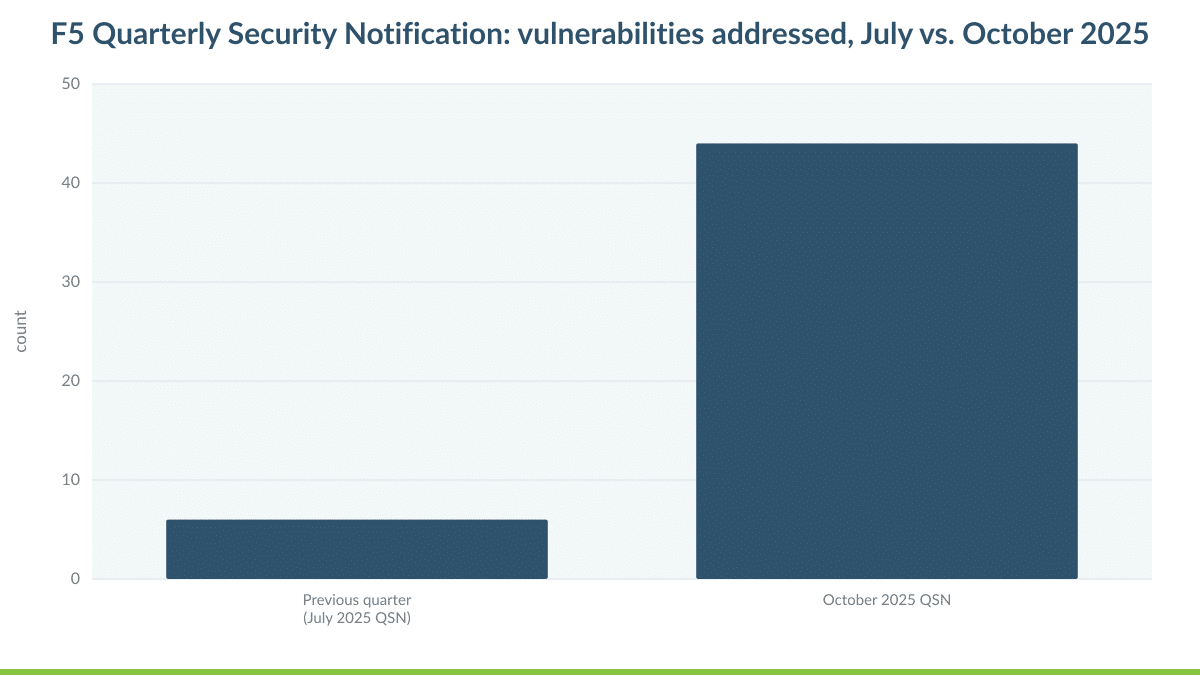
The chart above, drawn from Zscaler ThreatLabz’s analysis of the F5 breach, compares the number of vulnerabilities F5 addressed in its July 2025 Quarterly Security Notification with the October 2025 notification that followed the breach disclosure. The October release was markedly larger, reflecting the vendor’s effort to close issues an adversary may have learned about from stolen engineering data before those issues could be weaponized at scale.
For defenders, the lesson is not that F5 is uniquely unsafe. Every major edge vendor, from VPN concentrators to next-generation firewalls, has faced a run of critical flaws in recent years. The lesson is that edge appliances have become a primary target class, and the adversaries interested in them are patient, well-resourced, and capable of turning vendor intelligence into working exploits. When source code and vulnerability details have been in an adversary’s hands, the reasonable planning assumption is that new disclosures will keep arriving and that the time between disclosure and exploitation can compress without warning.
Edge appliances are no longer plumbing. They are the front door, the identity broker, and the first target, all at once.
The Prior Pattern: Exposure Lingers Long After the Patch
Patches only reduce risk once they are installed, and recent history suggests installation is slow. The second chart tracks Shadowserver’s count of internet-facing BIG-IP APM instances associated with CVE-2025-53521, an earlier APM flaw, as reported by BleepingComputer.
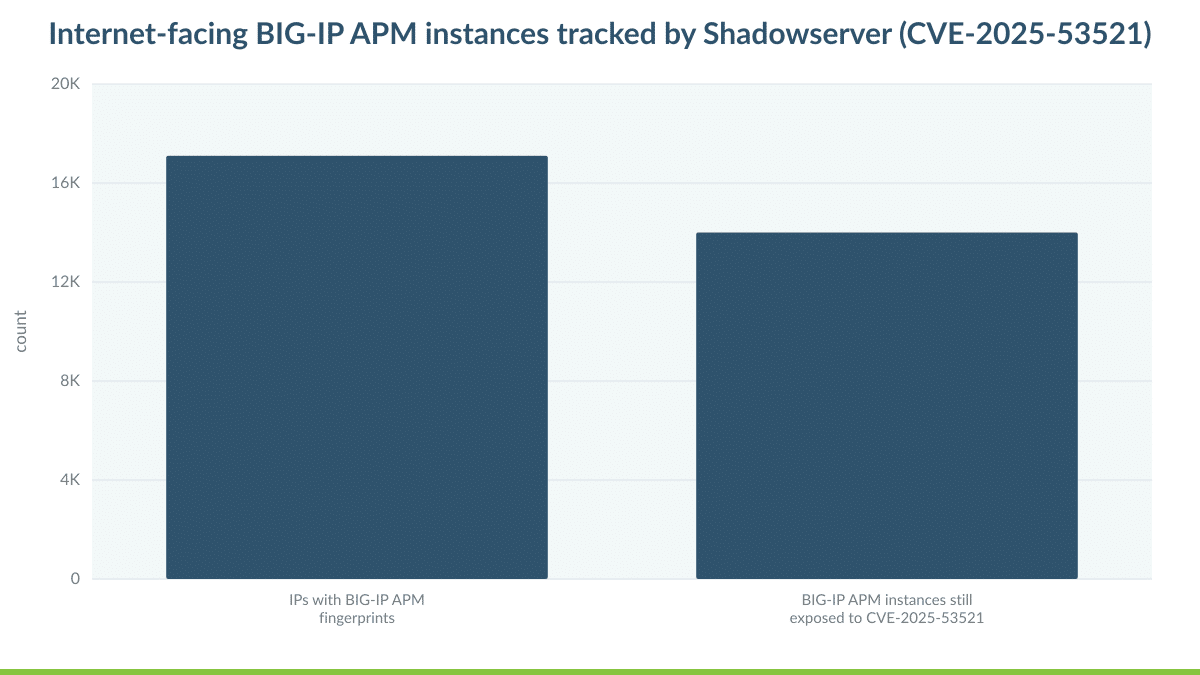
The pattern is the story. BleepingComputer’s coverage of that episode, built on Shadowserver’s tracking, found a large population of APM instances still exposed to remote code execution after the issue was public. The exposed population erodes gradually rather than collapsing once a fix ships. Every week that curve stays elevated is a week in which an attacker with a working exploit has a target-rich environment, and the current advisory lands on an APM footprint of comparable size.
Why does exposure linger? The reasons are operational rather than technical, and mid-market IT leaders will recognize every one of them:
- Fear of breaking production. BIG-IP often sits in front of revenue-generating or clinical applications, and a failed upgrade can take them offline in front of customers.
- Undocumented iRules and policies. Logic written years ago may depend on behavior that changes between software versions, and nobody on staff can say with confidence what it does.
- No tested high-availability path. If the standby unit has never been deliberately failed over to, administrators are understandably reluctant to try it for the first time during an emergency change.
- Ownership gaps. The network team owns the appliance, the security team owns the advisory, and the application team owns the outage risk. Nobody owns the decision.
- Licensing and support uncertainty. Lapsed support contracts or unclear entitlements can delay access to hotfixes at the worst possible moment.
None of these are reasons to stay exposed. All of them are reasons the exposure curve looks the way it does, and each one can be resolved before the next advisory rather than during it.
The Business Impact, Mapped to What Matters
Translating an advisory into business terms is the work that separates an IT function that reports vulnerabilities from one that manages risk. Here is how the F5 BIG-IP RCE vulnerabilities map to the five pillars mid-market leaders should be measuring.
Security
Unauthenticated code execution on an access proxy is a direct route to credential theft, session hijacking, and lateral movement. An attacker in control of APM can potentially observe or manipulate the authentication flows of every user who passes through it. Certificates, SAML signing keys, and private keys stored on the appliance become suspect. This is not only a perimeter breach but also an identity breach, and identity is what every downstream control trusts.
Resilience
The SAML denial-of-service flaw and the risk of a rushed emergency upgrade both threaten availability. If remote access fails, the business does not simply lose a tool. It loses the productivity of every employee, contractor, and partner who depends on that path. Resilience means having a tested failover path for the appliance itself and a recovery plan for the applications behind it.
Performance
Emergency changes performed without preparation often produce degraded performance afterward: iRules that misbehave under a new build, persistence profiles that reset, or SSL profiles that negotiate differently with older clients. Validating application performance after the upgrade is part of the patch, not an optional follow-up ticket.
Simplification
Every additional edge appliance is another product to track, another advisory feed to watch, and another upgrade cycle to staff. Organizations running BIG-IP alongside separate VPN concentrators, firewalls, and web application firewalls carry a compounding maintenance burden. Rationalizing that stack reduces the number of emergencies the team has to absorb each year.
Flexibility
Teams that can shift users to an alternate access path, such as a hosted virtual desktop environment or a secondary gateway, gain the freedom to take an appliance offline for patching without stopping the business. Flexibility is what turns an emergency into a scheduled change.
A 72-Hour Response Plan for F5 BIG-IP RCE Vulnerabilities
The following plan assumes a lean mid-market IT team and a production environment that cannot tolerate surprises. Adjust the clock to your risk tolerance, but do not adjust the sequence. Each phase builds the safety net the next phase depends on.
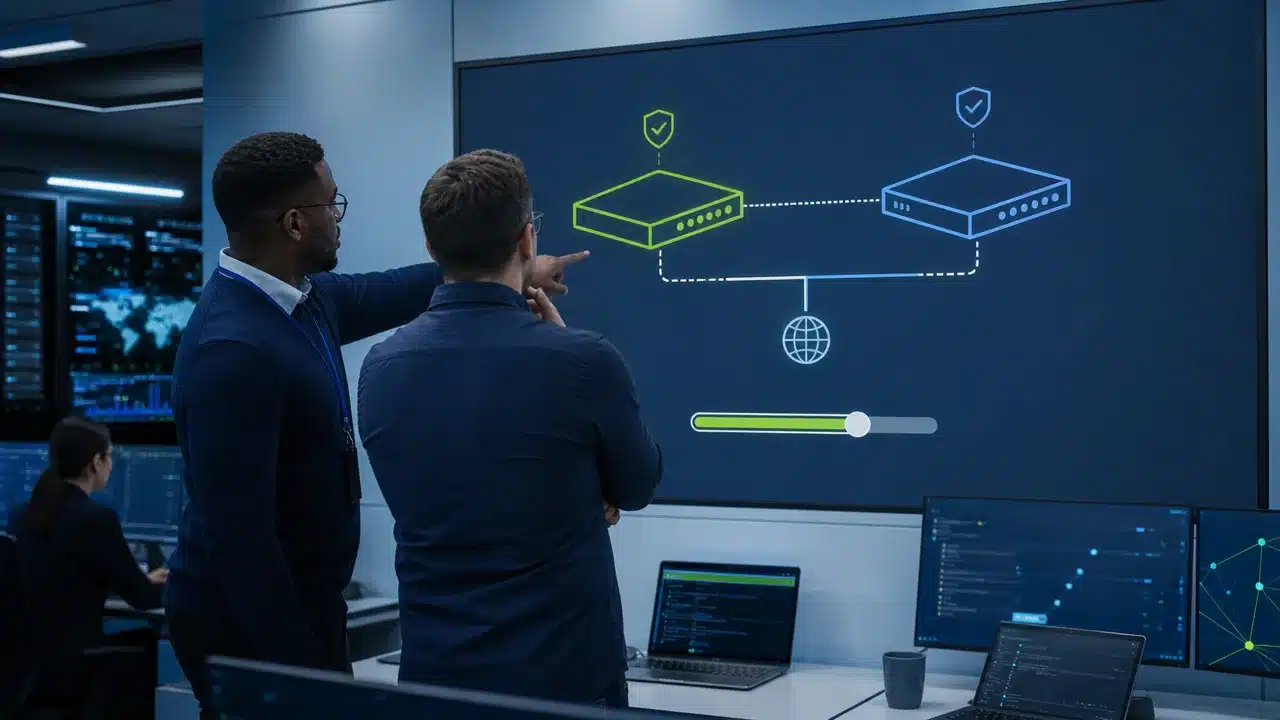
Hours 0 to 12: Find Every BIG-IP You Own
- Pull every BIG-IP hardware appliance, Virtual Edition, and cloud marketplace instance from your CMDB, virtualization inventory, and cloud accounts. Cross-check against purchase and support records to catch anything the CMDB missed.
- Identify which instances have APM provisioned and which run iRules on internet-facing virtual servers. Those are the priority targets.
- Run an external scan of your own public IP space, or review an attack surface management feed, to confirm what an attacker can actually reach. Reconcile the results with your inventory.
- Confirm support entitlement and portal access so the team can download the hotfixes without delay.
Hours 12 to 24: Shrink the Reachable Attack Surface
- Verify that the BIG-IP management interface and Configuration utility are not reachable from the internet. Restrict them to a dedicated management network or hardened jump host.
- Where the business allows, temporarily restrict APM virtual servers to known source ranges or geographies. This does not fix the flaw, but it narrows who can reach it while patching proceeds.
- Raise logging levels and forward BIG-IP logs to your SIEM or managed detection provider if they are not already flowing there.
- Brief application owners and the service desk on the change window and expected user impact.
Hours 24 to 48: Patch With a Safety Net
- Create a UCS archive of each device’s configuration and store it off-box. Snapshot Virtual Edition instances at the hypervisor level before any change.
- Patch the standby unit of each high-availability pair first, validate it, fail traffic over, and then patch the former active unit.
- Apply the out-of-band hotfixes F5 released for the critical CVEs, and the engineering hotfix for CVE-2026-126822 wherever APM SAML is in use.
- Test authentication flows, SAML assertions, VPN connectivity, and the most important business applications behind every patched virtual server.
Hours 48 to 72: Verify and Hunt
- Confirm that the running software on every instance matches the patched build, and document it for audit and cyber insurance purposes.
- Review logs from the exposure window for unexpected restarts, crashes in APM-related processes, unfamiliar administrative logins, and configuration changes nobody requested.
- Diff current iRules and access policies against your pre-patch archive and known-good baselines.
- If anything looks wrong, treat the device as compromised: rebuild from a trusted image, rotate administrative credentials, and reissue certificates and keys stored on it.
Seventy-two hours is aggressive for some environments. It is also entirely realistic for a team that prepared before the advisory landed, which is the strongest argument for doing that preparation now, while the pressure is still manageable.
Seventy-two hours is aggressive only for teams that start preparing after the advisory lands.
After the Patch: Confirm the Window Was Not Used
Patching closes the door. It does not tell you whether someone walked through it first. Because F5 has not reported exploitation of these flaws, most organizations will find nothing during their review. That is the outcome you want to confirm rather than assume, particularly given how much adversary attention F5 products have drawn since the October 2025 breach disclosure.
A credible post-patch review covers three areas. First, the appliance itself: integrity of system files, unexpected persistence mechanisms, and configuration drift. Second, the identity layer: anomalous logins through APM, unusual session durations, and authentication from unfamiliar locations, correlated against your identity provider’s logs. Third, the network behind the appliance: east-west connections originating from BIG-IP self IP addresses that do not match normal load balancing or health monitor behavior.
If your team does not have the hours or the tooling for that review, that is a staffing reality, not a failure. It is also exactly the gap a managed detection and response function exists to fill. Endpoint telemetry from CrowdStrike Falcon on the servers behind the appliance, combined with firewall visibility from Fortinet, can surface the lateral movement an edge compromise would produce, even when the appliance itself offers limited forensic depth. That correlated view is a core part of IT Vortex Security as a Service (SECaaS), where advisories like this one become tracked actions with an owner and a deadline rather than another unread item in a shared inbox.
Rethinking the Edge: Fewer Front Doors, Stronger Locks
Every emergency like this one raises the same strategic question: why does so much of the business depend on a single internet-facing appliance that must be patched under pressure several times a year? For many mid-market organizations, the honest answer is that the architecture accumulated over time rather than being designed.
Zero trust principles offer a better model. Instead of publishing internal applications through a broad access proxy, organizations can broker access per application, verify identity and device posture continuously, and keep management planes entirely off the internet. The Zero-Trust Remote Access Diagram for Manufacturing illustrates how that design looks in an environment with plant-floor systems and remote engineers, and the same principles carry across healthcare, legal, and financial services.
Virtual desktops change the equation as well. When remote users connect to hosted desktops delivered through Omnissa Horizon in a managed Desktop as a Service (DaaS) environment, sensitive applications and data stay in the data center, and the number of internal services that must be published to the internet shrinks. Secure gateways are still required, but they are concentrated into a smaller, professionally operated footprint that is patched on a rehearsed schedule.
Infrastructure location matters too. Running application delivery and access services on a managed VMware-based platform, rather than on self-maintained appliances in a server closet, moves the patching burden to a team whose job is to execute these changes on time. Cloud Hosting (IaaS) from IT Vortex is built on that model: enterprise-grade infrastructure without enterprise complexity, and without asking an internal team to become BIG-IP specialists overnight.
How IT Vortex Helps Mid-Market Teams Close the Gap
IT Vortex operates as integrator, architect, and advisor, not as a reseller handing over a SKU. As a Premier Broadcom VCSP Partner, we design and run VMware-powered managed cloud environments, and we bring the security and recovery disciplines that edge emergencies demand. For an event like the F5 release, that translates into four concrete capabilities.
- Security as a Service (SECaaS): continuous vulnerability tracking, managed detection and response, and integrations with Fortinet, CrowdStrike, and Proofpoint, so exposure is identified and owned within hours of an advisory.
- Disaster Recovery (DRaaS): replication and orchestrated recovery for the applications behind your edge, so a compromised or failed appliance does not become an extended outage. Learn more about Disaster Recovery (DRaaS) and how failover is validated before it is needed.
- Backup as a Service (BaaS): Veeam-powered, off-site copies of critical systems that let you restore known-good state if a compromise reaches the servers behind the appliance.
- Managed operations: day-to-day operation of infrastructure through IT Vortex Managed Services, including patch planning, high-availability testing, and change validation, so emergency changes run on a rehearsed process rather than improvised under pressure.
The goal is not to make F5 emergencies disappear. Edge vendors will keep publishing critical advisories, and some of them will arrive without a workaround. The goal is to make them routine: inventory current, failover tested, configurations archived, detection in place, and recovery proven before the next out-of-band release reaches your inbox.
The Real Question Is Not Whether You Patched F5
It is tempting to treat this advisory as a single task: download the hotfix, apply it, close the ticket. That framing misses the signal. Five critical, unauthenticated RCE flaws with no mitigation, on a product line an adversary studied from the inside, landing on more than 177,000 internet-exposed instances, is not a one-off event. It is a preview of how edge risk will arrive for the foreseeable future.
The better question for an IT leader is this: if a vendor publishes a no-mitigation critical flaw in your most exposed appliance tomorrow morning, how many hours until every instance is patched, verified, and reviewed for compromise, and who owns each of those hours? If the answer is unclear, the gap is not in your F5 configuration. It is in your operating model, and an operating model can be fixed deliberately, before the next release forces the issue.
Lou Corriero, VP Cloud at IT Vortex, works with mid-market teams to map that operating model: where edge exposure lives, how patching and failover are rehearsed, and which responsibilities belong with a managed partner. Schedule a working session with Lou to pressure-test your edge response plan against the next out-of-band advisory, not just this one.