On November 18, 2026, CSO Online reported that Nginx, the web server estimated to power a third of the internet, shipped fixes for multiple vulnerabilities, including a critical unauthenticated remote code execution flaw that puts millions of websites at risk. The most severe bug, CVE-2026-123007, affects every official Nginx release since version 1.9.5, the build that added HTTP/2 support in 2015. It has been sitting in production code for more than a decade.
The patch itself is routine. How the bugs were found is not. Researchers from several security firms independently uncovered some of the same flaws using AI agents, and CSO Online places the discovery in a string of recent AI-found vulnerabilities in PHP, Node, OpenSSH, and Java. For mid-market IT leaders, the Nginx HTTP/2 vulnerability is not only a patching event but also a preview of the tempo every future disclosure will run at.
This analysis translates the flaw into business risk, explains why your Nginx footprint is almost certainly larger than your asset register shows, and lays out a response plan that covers discovery, patching, containment, and recovery. It also maps each step to the five pillars IT Vortex uses to evaluate infrastructure decisions: Simplification, Security, Performance, Resilience, and Flexibility.
What the Nginx HTTP/2 Vulnerability Actually Does
According to the CSO Online report, CVE-2026-123007 lets an attacker manipulate flow-control windows in the Nginx HTTP/2 implementation to trigger an out-of-bounds memory copy. Researchers at Xint.io turned that memory corruption into command execution with Nginx worker privileges. The attacker does not need credentials. They need a network path to a listener with HTTP/2 enabled.
Strip away the protocol vocabulary and the mechanism is easy to follow. HTTP/2 multiplexes many streams over a single connection, and flow control is what stops a fast sender from flooding a slow receiver. Every stream and every connection carries a window that tracks how much data may be in flight. When an attacker can push that accounting into an inconsistent state, the server copies memory it should never touch. Memory corruption in a network-facing parser is the classic raw material for remote code execution, and in this case researchers have already demonstrated the full chain from malformed traffic to running commands.
Why “worker privileges” is not a comforting phrase
It is tempting to read “worker privileges” as a limitation. In practice it is a beachhead. Nginx worker processes handle every request the server receives, which places them directly in the path of session cookies, authentication headers, API tokens, and the upstream connections to your application tier. In many deployments the workers also hold TLS private keys in memory so they can terminate encrypted traffic. An attacker running commands in that context can read what passes through, pivot toward backend systems the proxy is trusted to reach, and look for a local privilege escalation to finish the job.
That last step follows a well-worn pattern. Attackers routinely chain a web-tier foothold with a kernel or service flaw to reach root, and the reverse proxy is often the most trusted host in the network path. It sits in the DMZ, it has firewall rules allowing it to talk to internal applications, and it is rarely monitored with the same rigor as a domain controller or a database server. For an attacker, that combination of trust and low visibility is ideal.
A decade of exposure changes the patching problem
Most critical vulnerabilities affect a handful of recent releases. This one reaches back to 2015. Every container base image, appliance firmware, vendor product, and hand-built server that pinned an Nginx version anywhere in the last decade is in scope unless it has been updated to a fixed release. The longevity is what turns a single CVE into an inventory exercise. The question is no longer whether you run a vulnerable version of Nginx. It is whether you can find every place Nginx runs, and whether you know who is responsible for updating each one.
Your Nginx Footprint Is Larger Than Your Asset Register
Nginx rarely announces itself. It is the default reverse proxy in countless reference architectures, the data plane inside widely used Kubernetes ingress controllers, and a common embedded component in commercial products. Teams that would never describe themselves as “running Nginx” frequently depend on it at the edge of their most important applications.
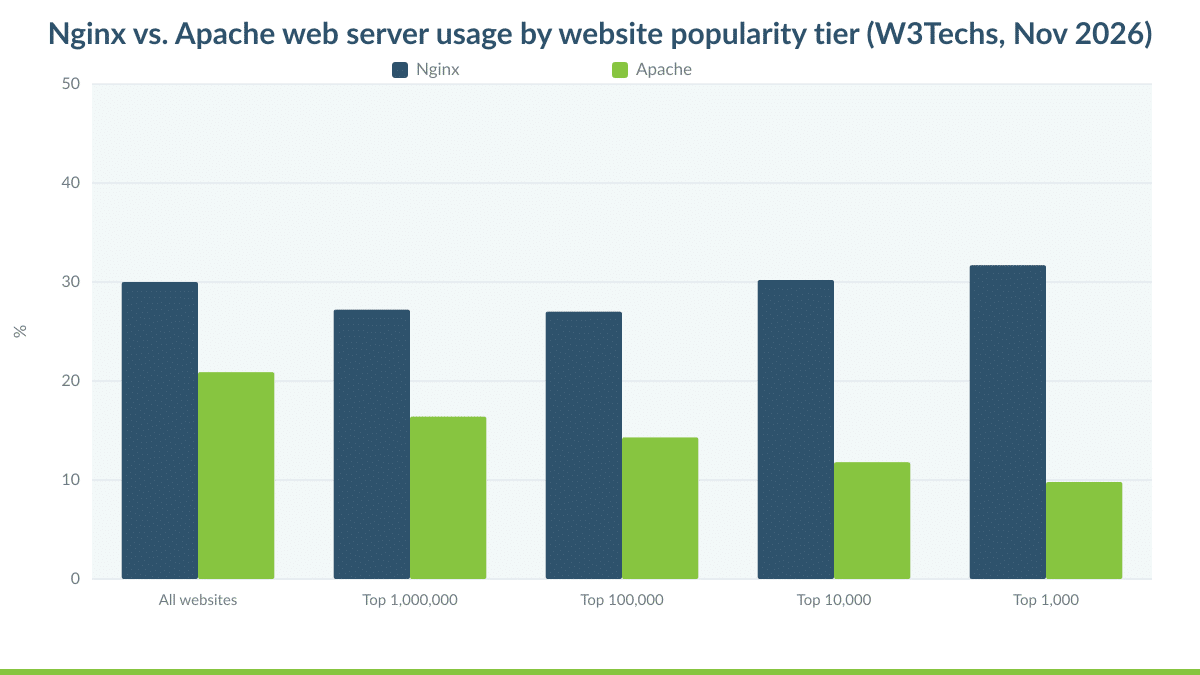
The W3Techs comparison above breaks out Nginx and Apache usage by website popularity tier as of November 2026. The takeaway for a mid-market IT leader is not which server leads in a given tier. It is that Nginx is a mainstream choice at every scale, from the busiest properties on the internet down through ordinary business sites. If your organization operates a customer portal, a marketing site, an API, or a partner extranet, the odds are strong that Nginx sits somewhere in the request path, either on infrastructure you manage or on infrastructure a vendor manages for you.
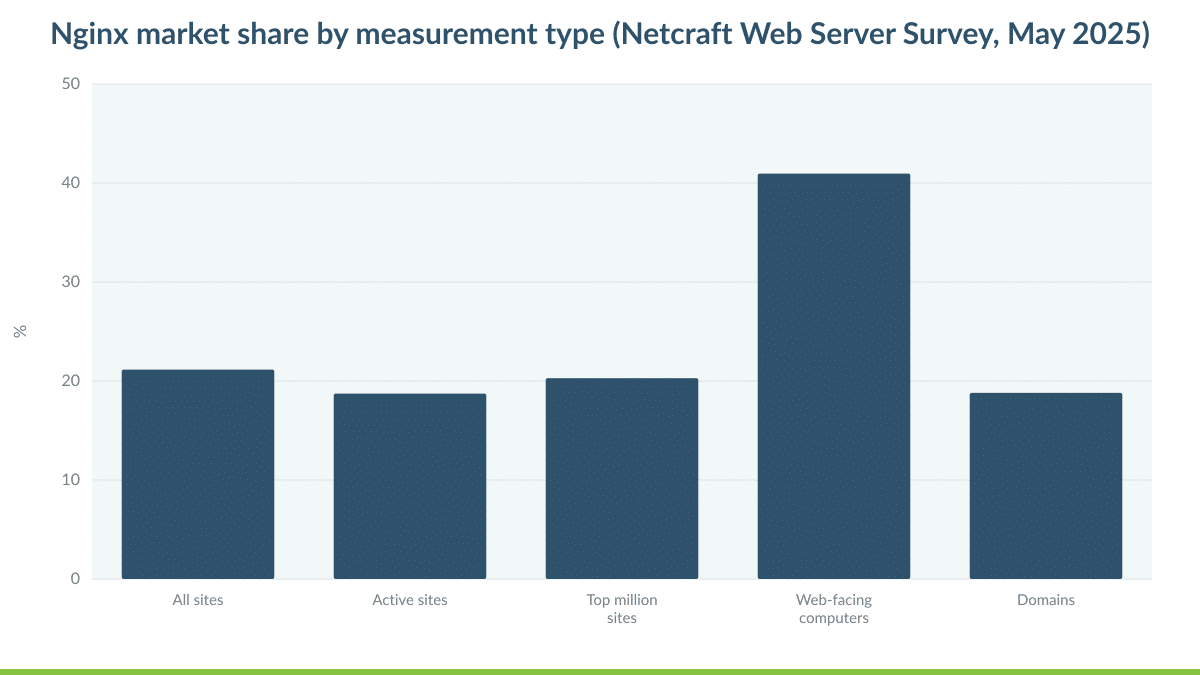
The Netcraft May 2025 Web Server Survey reinforces the point from a different angle by measuring Nginx share several ways rather than with a single headline number. The spread between measurement types is the lesson. A web server can be far more prevalent as frontline infrastructure than a simple count of hostnames suggests, because one proxy often fronts many sites and services, and one hostname can sit in front of an entire application estate. Exposure tracks where traffic enters, not how many domain names point at it.
Inside a typical mid-market environment, Nginx tends to hide in places like these:
- Reverse proxies and TLS terminators placed in front of Microsoft IIS, Java application servers, or Node services, often deployed years ago by a team member who has since moved on.
- Kubernetes ingress controllers, where Nginx is the data plane even if your engineers interact with it only through YAML manifests.
- Container base images and Helm charts pulled from public registries, which bundle whatever Nginx version was current when the image was built.
- Load balancers, API gateways, and web application firewalls that embed Nginx or an Nginx derivative under a vendor brand name.
- Commercial appliances and on-premises software, from management consoles to monitoring tools, that ship a web interface built on Nginx.
- SaaS platforms and hosting providers that run Nginx on your behalf, where the patch is not yours to apply but the risk is still yours to carry.
- Development, staging, and proof-of-concept servers that were exposed to the internet for a demo and never decommissioned.
Each category has a different patch owner, a different maintenance window, and a different way of reporting its version. That fragmentation, more than the vulnerability itself, is what makes Nginx exposure dangerous for lean IT teams. A security engineer can patch a server in minutes. Discovering that the server exists, and that it belongs to nobody in particular, can take weeks.
AI-Assisted Discovery Has Changed the Clock
The most consequential sentence in the CSO Online coverage is not about memory corruption. It is the observation that researchers from several security firms independently found some of the same flaws by using AI agents. A bug that survived more than ten years of human review in one of the most scrutinized open source projects on the internet fell to automated analysis from multiple directions at roughly the same time.
That has two implications. First, the population of people capable of finding critical bugs in mature, heavily reviewed code has expanded. AI agents can read protocol state machines, generate edge-case inputs, and reason about memory handling at a pace no human audit team can match. Second, independent discovery by multiple defenders is strong evidence that the same techniques are available to attackers who have no intention of reporting what they find.
When several research teams find the same decade-old bug with AI agents, assume someone without a disclosure policy found it too.
The pattern is already visible across the stack. CSO Online lists PHP, Node, OpenSSH, and Java among the widely used technologies with recent AI-discovered flaws. These are not niche components. They are the runtime, remote access, and web layers that mid-market businesses build on every day. When that much foundational software is being re-examined by tireless automated reviewers, the volume of critical disclosures will rise, and the time between disclosure and working exploit will shrink.
Traditional vulnerability management was designed around a monthly rhythm: a patch cycle, a change advisory board, a maintenance window, a verification scan. That rhythm still has value for routine updates. It is the wrong rhythm for an unauthenticated remote code execution flaw in an internet-facing component whose details became public the day the fix shipped. Organizations need a separate, pre-approved fast lane for edge infrastructure, with documented authority to patch or apply compensating controls within days rather than weeks. Building that lane before the next disclosure is far cheaper than negotiating it in the middle of one.
What the Exposure Data Shows, and What It Hides
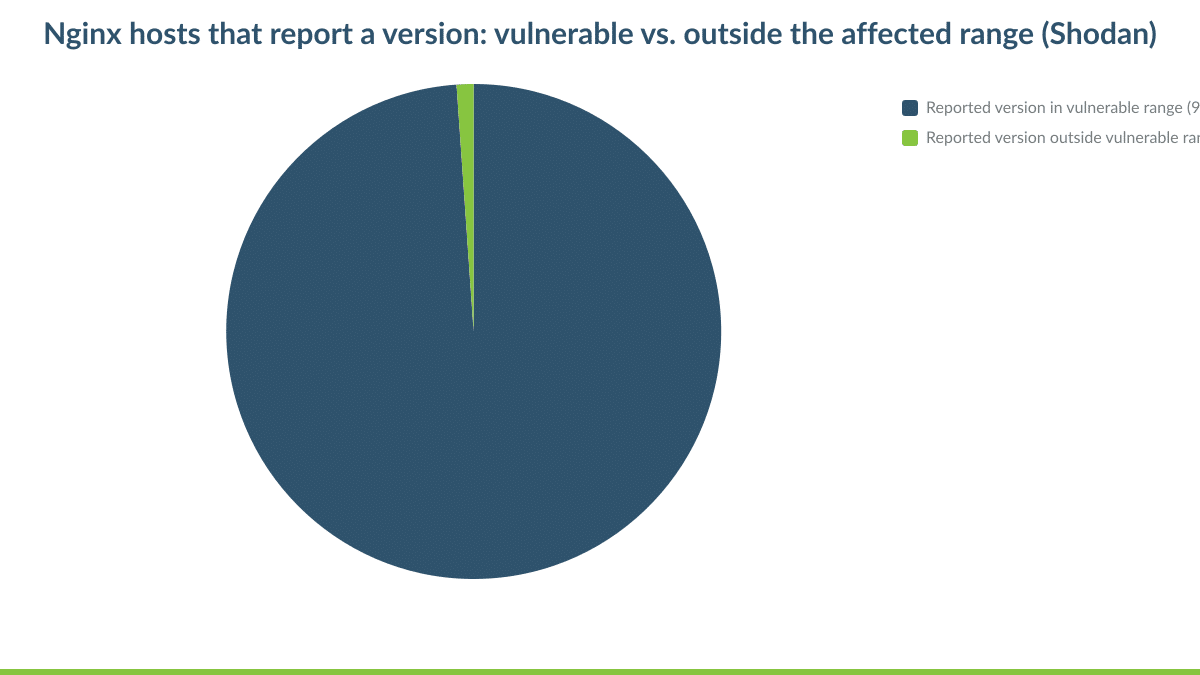
The Shodan breakdown cited in the CSO Online report divides internet-facing Nginx hosts that advertise a version number into those inside the affected range and those outside it. Because the range begins at 1.9.5 and runs through every official release up to the fix, the in-range slice represents servers that, on their face, need immediate attention. It is also a useful indicator of how slowly edge infrastructure gets updated across the internet as a whole, since any host still reporting a version from years ago has likely missed many other security updates along the way.
Banner data deserves careful interpretation, and the caveats cut both ways:
- Many administrators set server_tokens off, which suppresses the version string. Those hosts do not appear in any version-based count, so the full vulnerable population is not visible in the chart.
- Linux distributions frequently backport security fixes into older version numbers. A host that reports an in-range version may already be patched, and a scanner relying on the banner alone will flag it anyway.
- Forks, rebuilt packages, and vendor-embedded builds may report a version that does not map cleanly to upstream Nginx releases.
- External scans only see what is internet-facing. Internal reverse proxies and ingress controllers behind a VPN or on a flat internal network are invisible to Shodan and still reachable by an attacker who lands anywhere inside.
Treat public exposure data as a measure of the problem’s scale, not as an inventory of your own environment. Your inventory has to come from the inside: configuration management databases, container registries, cloud asset APIs, software bills of materials, and written vendor attestations. External scanning then becomes the verification step that confirms what the internal inventory claims.

A 72-Hour Response Plan for the Nginx HTTP/2 Vulnerability
The plan below assumes a lean team and a mixed environment of on-premises servers, cloud workloads, containers, and vendor-managed services. It prioritizes the hosts an unauthenticated attacker can reach first, then works inward toward internal systems.
Hours 0 to 24: Find every instance
- Query configuration management, container registries, and cloud inventories for Nginx packages, images, and running processes, including derivatives and ingress controllers.
- Run an authenticated scan of internal networks and an external scan of every public IP address and hostname your organization owns, including those registered by marketing or individual business units.
- Identify which instances have HTTP/2 enabled on internet-facing listeners. Those are the top tier for remediation.
- Open tickets with every vendor whose product or service embeds Nginx and ask for a written statement of exposure and a committed remediation date.
Hours 24 to 48: Patch what you own, pressure what you do not
Upgrade to a fixed release as listed in the official Nginx security advisories, or apply your distribution’s patched package. For containerized workloads, rebuild images from an updated base and redeploy rather than patching running containers in place. A container patched by hand drifts from its source of truth and reverts the next time it restarts. For Kubernetes ingress, confirm that your controller is still actively maintained and that its maintainers have published an updated image, then roll it through staging into production. Projects that have been retired or are in maintenance-only mode may never publish a fixed image, which turns this patch into a migration project.
For vendor products, escalate. A reseller that forwards a ticket and waits is not managing your risk. Push for a specific timeline, and if none arrives, apply compensating controls at the network layer while you wait. Document every vendor response, because auditors, insurers, and your own leadership will ask what you knew and when.
Compensating controls where patching must wait
- Disable HTTP/2 on exposed listeners. Because CVE-2026-123007 lives in the HTTP/2 implementation, falling back to HTTP/1.1 removes that code path from the attack surface. Expect some performance cost from losing multiplexing, and treat this as a bridge, not a fix.
- Restrict reachability. If an administrative interface or internal service does not need to be internet-facing, close it at the firewall today.
- Apply intrusion prevention or web application firewall signatures as security vendors publish them for this flaw.
- Raise logging verbosity on affected hosts and forward logs to a monitored platform so that anomalies surface in hours, not weeks.
Hours 48 to 72: Verify and hunt
Confirm the running build, not just the installed package, on every remediated host, then rescan externally to verify the attack surface actually changed. Review Nginx error logs for unexpected worker process crashes, since failed attempts to exploit memory corruption frequently crash the process before they succeed. On Linux hosts with endpoint detection and response, look for shells, interpreters, or network utilities spawned as children of Nginx workers, outbound connections from proxy hosts to unfamiliar destinations, and new files in web roots or temporary directories. If anything looks wrong, stop treating the event as a patch and start treating it as an incident.
Mapping the Response to the Five Pillars
Security
Patching closes the known flaw. Layered controls are what catch the attacker who arrived first. IT Vortex Security as a Service (SECaaS) brings together perimeter protection from Fortinet, endpoint detection and response from CrowdStrike that extends to Linux servers, and continuous monitoring, so that a compromised proxy generates an alert rather than a quiet foothold. The objective is not only to block exploitation but also to shorten the time from first anomaly to containment.
Resilience
Assume that a determined attacker will eventually find a gap. Resilience is the ability to restore clean, trusted systems quickly when that happens. Disaster Recovery (DRaaS) and Backup as a Service (BaaS) built on Veeam give you immutable copies of configurations, certificates, and application data, plus orchestrated recovery into a known-good environment if a web tier has to be rebuilt from scratch.
Simplification
Half the risk in this disclosure comes from not knowing where Nginx runs. Consolidating edge infrastructure onto a managed platform with a single inventory and a single patch process removes that uncertainty. Cloud Hosting (IaaS) on VMware gives mid-market teams standardized templates, documented builds, and one accountable team keeping the web tier current.
Performance
Disabling HTTP/2 as a stopgap trades speed for safety. A well-architected platform minimizes how long you need to make that trade by shortening the path from disclosure to tested, deployed patch. It also lets you load-test the fix before it reaches production, so that remediation does not create a customer-facing slowdown of its own.
Flexibility
Not every workload belongs in one place. Some web services run best in a private cloud, some in a public hyperscaler, some close to users at the edge. What matters is that each location follows the same security baseline and reports into the same inventory. IT Vortex designs for that consistency so that the next critical disclosure does not require a different response playbook for every environment you operate.
Contain the Blast Radius Before the Next Disclosure
The Nginx flaw will be patched. The next AI-discovered bug in another foundational component is already on its way. The durable defense is architecture that limits what any single compromised component can reach.
- Run Nginx workers under a dedicated, unprivileged account with no login shell, and confirm the user directive is not set to root anywhere in your estate.
- Segment proxies from the systems behind them so a compromised web tier can reach only the specific application ports it serves, not the broader internal network.
- Keep secrets off proxy hosts where possible. Store upstream credentials and API keys in a secrets manager, and scope them so a stolen token from one service cannot unlock others.
- Keep TLS private keys rotatable on short notice, with automation that can reissue and deploy certificates across every edge host in hours.
- Patch the kernel and operating system on proxy hosts with the same urgency as Nginx itself, since local privilege escalation is how a worker-level foothold becomes full control.
- Monitor proxy hosts like the tier-one assets they are, with endpoint telemetry and centralized logs rather than occasional manual review.
These controls do not depend on knowing the next CVE number. They reduce the consequence of any web-tier compromise, which is the only kind of protection that keeps pace with AI-accelerated discovery. They also make each future emergency patch less frightening, because a breach of the proxy no longer implies a breach of everything behind it.
Treat Recovery as Part of the Patch Plan
Organizations often treat patching as the finish line. For an unauthenticated remote code execution flaw that existed for more than a decade and is now publicly documented, it is closer to the starting line of an investigation. If any internet-facing instance ran a vulnerable build with HTTP/2 enabled, the patch alone cannot prove that nobody used the flaw before you closed it.
A patch closes the door. It does not tell you who walked through it while it was open.
A defensible recovery posture for this event includes three elements. First, the ability to rotate TLS certificates and upstream credentials for every affected proxy, on the assumption that worker memory may have been read. Second, the ability to rebuild web-tier hosts from known-good templates rather than cleaning them in place. Third, a tested failover path for customer-facing services, so that an incident response investigation does not turn into a multi-day outage. If your team has not exercised that path recently, the DR Failover Validation Plan Template is a practical starting point for scoping a test.
Recovery readiness also changes the conversation with leadership, auditors, and cyber insurers. A team that can say “we patched within days, rotated keys, and could rebuild the web tier from immutable backups if needed” is describing controlled risk. A team that can only say “we applied the update” is describing hope. The difference shows up in renewal questionnaires, board reporting, and the speed of every future incident.
Five Questions to Put to Your Team and Your Providers This Week
- Can we produce a complete list of every Nginx instance, ingress controller, and Nginx-based appliance we run, with version, owner, and exposure?
- Which of our vendors and hosting providers run Nginx in front of our data, and have they confirmed remediation in writing?
- Do we have a pre-approved emergency change path for internet-facing infrastructure that bypasses the monthly cycle?
- Would our monitoring detect a shell spawned by an Nginx worker on a Linux proxy host, and who would see the alert?
- If we had to rebuild our customer-facing web tier and rotate every certificate tomorrow, how long would it take?
If any of these questions produces silence, that silence is the actual vulnerability. Nginx simply exposed it.
The Nginx HTTP/2 Vulnerability Is an Inventory Test, Not a Patch Test
It is easy to file CVE-2026-123007 under “apply the update and move on.” That framing misses what this disclosure actually measured. A ten-year-old bug in software estimated to run a third of the internet was found by AI agents working in parallel. The organizations that respond well will not be the ones with the fastest patch button. They will be the ones that already knew where every instance lived, who owned it, and how to rebuild it.
AI did not create the risk in Nginx. It removed the time you had to find it.
That is the reframe for mid-market IT leaders. The work is not chasing individual CVEs. It is building an environment where edge infrastructure is inventoried, standardized, monitored, and recoverable, so that each new AI-discovered flaw becomes a scheduled task instead of a crisis. IT Vortex approaches that as an architect and integrator, not a reseller: we design the platform on VMware as a Premier Broadcom VCSP Partner, integrate security and recovery from partners including Fortinet, CrowdStrike, and Veeam, and operate it day to day through our Managed Services team.
If you want an outside view of your Nginx exposure and your ability to contain and recover from a web-tier compromise, schedule a working session with Lou Corriero, VP Cloud. Bring your inventory, or bring the gaps in it. Either way, you will leave with a prioritized plan for the next 72 hours and an architecture roadmap for the disclosures that follow.