On November 13, 2026, CSO Online published an analysis of how AI is changing the nature of cyberattacks that every mid-market IT leader should read before the next budget cycle. Its central finding is blunt: AI is helping attackers increase the speed and scale of their operations, but it is not yet changing their core objectives or the techniques they use across the attack chain.
That conclusion cuts both ways. The reassuring half is that phishing, malware, and vulnerability exploitation remain the main techniques in play, which means the controls that stop them still matter. The uncomfortable half is that the time those controls have to work is shrinking. Most mid-market security programs were designed around human-speed adversaries, human-speed triage, and patch cycles measured in weeks. AI cyberattacks break all three assumptions at once.
Consider the case CSO Online describes as the most high-profile example of an AI-powered attack to date: Chinese state-sponsored actors abused Claude Code, Anthropic’s AI coding tool, to mount an AI-orchestrated operation. It is a striking headline. Yet the larger lesson in the reporting is not that attackers have discovered an exotic new weapon. It is that the familiar sequence of reconnaissance, foothold, lateral movement, and objective can now be executed with far less human effort and far more parallelism than before.
This article breaks down what AI cyberattacks actually change, what they leave untouched, and where mid-market organizations should redirect effort and budget. The through line is practical. You do not need a new security philosophy. You need the defenses you already understand to run faster, verify more, and recover with certainty. That maps directly to three IT Vortex pillars, Security, Performance, and Resilience, with Simplification as the discipline that keeps the other three sustainable for a lean IT team.
How AI Cyberattacks Change Velocity, Not the Attack Chain
Ronald Lewis, director of cybersecurity governance at application security firm Black Duck, described the attacker lifecycle in terms any incident responder will recognize. “Attackers are still identifying targets, performing reconnaissance, establishing a foothold, moving laterally, achieving their objective, covering their tracks, and moving on to the next target,” he told CSO Online. “What’s changed is the volume and velocity that AI allows this process to happen.”
Read that list again from the defender’s side. Every stage historically carried friction. Profiling a target organization meant hours of manual research across professional networks, press releases, and job postings. Writing a convincing lure required fluency in the target’s language and industry vocabulary. Building or adapting tooling required programming skill. Moving laterally through an unfamiliar network required an operator to read output, make decisions, and try again. Each of those friction points bought defenders time, and each of them is exactly the kind of work large language models and agentic tools compress.
That friction was never part of anyone’s formal security architecture, but it was quietly load-bearing. Detection tools tuned to catch an intruder over days, change-approval processes that require a meeting before a server is isolated, and patch windows scheduled around month-end close all assume the adversary moves at roughly human speed. When the adversary does not, the gap between initial access and business impact narrows, and controls that look adequate on paper start losing races in practice.
What’s changed is the volume and velocity that AI allows this process to happen.
The strategic takeaway is reassuring in one specific way. Because the objectives and techniques are unchanged, the defensive blueprint is unchanged too. Identity protection, email security, endpoint detection, segmentation, patching, and recoverable backups remain the right answers. What changes is the required tempo of each one, and the degree to which each must be automated, monitored around the clock, and tested rather than assumed.
Cheaper Attacks Mean More Attackers, and the Mid-Market Feels It First
According to the CSO Online reporting, abuse of AI tools has made attacks easier to mount and cheaper for even relatively unskilled attackers. That single economic shift has outsized consequences for mid-market organizations.
For years, many mid-market firms benefited from a kind of security by economics. A skilled operator’s time was finite and expensive, so the most capable crews concentrated on targets large enough to justify the effort. Meanwhile, the long tail of regional manufacturers, professional services firms, healthcare practices, and financial advisors faced mostly commodity attacks. When the cost of reconnaissance, lure writing, and tooling falls, that calculation inverts. Profiling a 400-person company becomes as cheap as profiling a household name, and a single low-skill actor with capable AI assistance can run campaigns that once required a team.
The data supports the view that this is already mainstream rather than theoretical. The chart below, drawn from Gartner’s survey on generative AI attacks published September 22, 2025, shows the share of organizations that reported being hit by AI-related attacks in the prior twelve months.
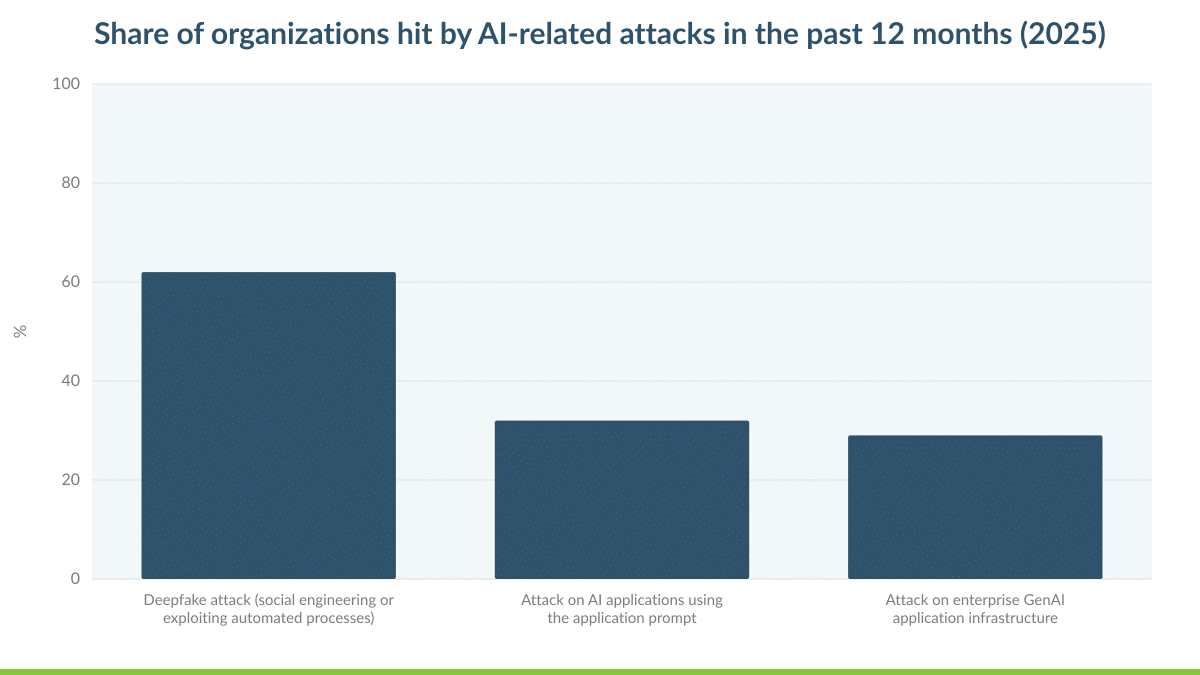
The planning lesson is not the precise percentage for any single attack type. It is that AI-enabled attacks are a routine experience across the organizations Gartner surveyed, not an edge case reserved for global enterprises. If your threat model still treats AI-assisted phishing or synthetic voice and video impersonation as a future concern, it is calibrated to a threat environment that no longer exists.
For business leaders, the impact lands on two pillars. On Security, the volume of credible attempts reaching your users and systems rises even if your industry profile has not changed. On Resilience, the probability that at least one attempt succeeds over a given year rises with that volume. That makes recovery capability a core business continuity requirement rather than an insurance policy you hope never to use.
Phishing Without the Tells
For two decades, security awareness training taught employees to spot the same red flags: misspellings, awkward grammar, generic greetings, and requests that did not quite fit the sender’s role. Generative AI removes most of those tells. A model can produce fluent, context-aware messages in any tone, reference a real vendor relationship or project gleaned from public sources, and generate dozens of variants so that no two recipients see identical text. Pattern-based filters that depend on repeated content have less to match against.
The chart below, built from Hoxhunt’s Phishing Trends Report 2026 as covered by Manufacturing.net on March 12, 2026, tracks AI-generated phishing as a share of reported attacks that made it past email filters across the Hoxhunt network.
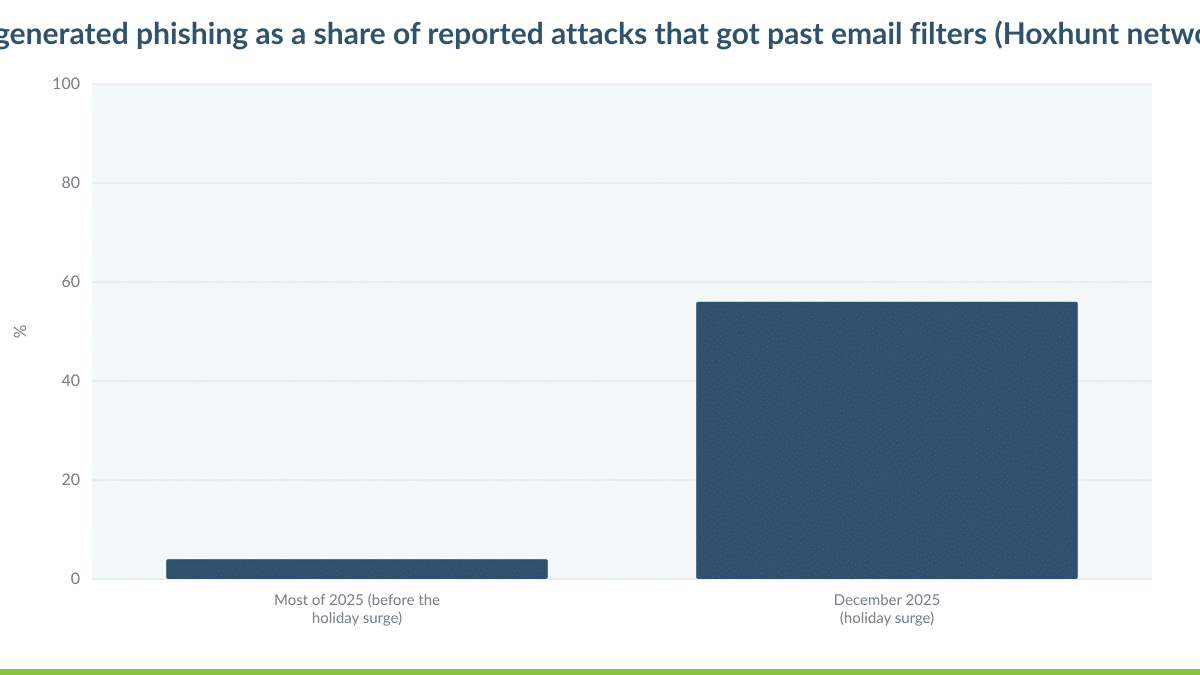
Note what that population represents. These are not blocked messages sitting in a quarantine folder. They are messages that cleared the filtering layer, landed in an inbox, and were reported by an employee who recognized something was off. The coverage headlined a sharp increase in AI-generated phishing within that group, which is precisely the population that tests your human and identity layers rather than your gateway.
Two conclusions follow. First, the email gateway is necessary but no longer sufficient as the primary phishing control. Second, training that centers on spotting sloppy writing is training for a threat that is fading. The more durable approach is to make a successful lure less valuable, by ensuring that a stolen password alone cannot unlock anything important and that high-risk requests require verification through a separate channel.
Controls that hold up against AI-written lures
- Phishing-resistant MFA. Move privileged and finance users to FIDO2 security keys or passkeys, which bind authentication to the legitimate site and resist credential relay, rather than relying on SMS codes or push approvals alone.
- Conditional access. Use Microsoft Entra ID conditional access to evaluate device health, location, and sign-in risk before granting access, so a valid password from an unmanaged device is not enough.
- Behavioral email security. Platforms such as Proofpoint analyze sender behavior, relationships, and intent rather than relying only on known-bad content, which matters when every lure is unique.
- Out-of-band verification for money and access. Any request to change payment details, release funds, or grant elevated access should be confirmed through a known phone number or ticketing workflow, never by replying to the requesting message.
- Training reframed around verification. Teach employees that a polished, plausible message is not evidence of legitimacy, and reward reporting even when the report turns out to be benign.
Each of these is not only a phishing control but also a business process decision. Finance teams own payment verification. HR owns how access requests are approved. The security function can design the guardrails, but leadership has to make them non-negotiable, because AI-written social engineering is designed to exploit exactly the exceptions people make for urgent, plausible requests.
When the Attacker Is an Agent
The Claude Code case highlighted by CSO Online matters less for its specific details than for the category it represents. Agentic AI does not simply write text on request. It can chain tasks together, take an action, read the result, and decide on the next step. Applied to offensive operations, that pattern can automate portions of reconnaissance, enumeration, and exploitation that previously required a human operator watching a terminal.
It is important not to overstate this. The CSO Online analysis is explicit that AI has not yet changed attackers’ core objectives or techniques, and agentic tooling does not grant capabilities that skilled human operators lacked. What it changes is scale. A single operator supervising multiple AI-driven workflows can probe more targets in parallel, iterate faster when something fails, and spend scarce human attention only on the most promising footholds.
The IBM Cost of a Data Breach 2025 research, as reported by Network World, offers a view into how this plays out in real incidents. The chart below breaks down how attackers used AI in breaches that involved AI tools.
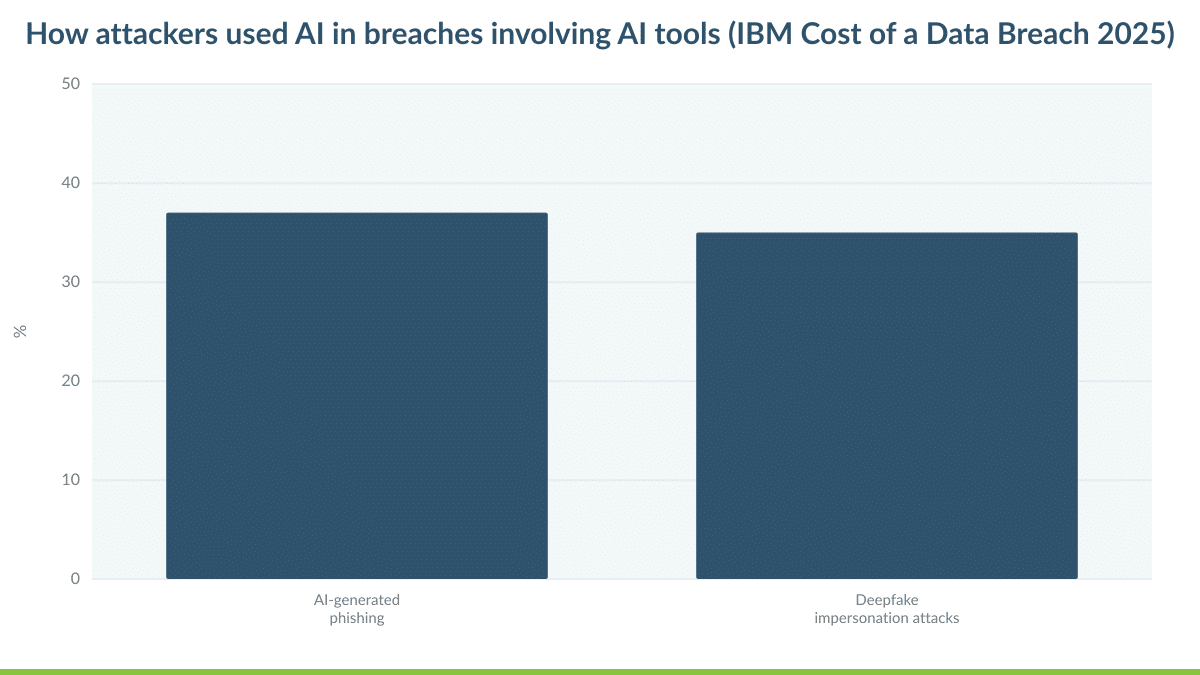
Read alongside the CSO Online analysis, the pattern is consistent. Attackers are applying AI to established techniques, particularly the human-facing stages of the attack chain such as phishing and impersonation, rather than inventing new categories of intrusion. That is good news for defenders who invest in fundamentals, and bad news for those who assumed that being a less interesting target would keep capable tooling away.
The shadow AI problem inside your own walls
Network World’s coverage of the IBM research also pointed to shadow AI as a compounding factor. Shadow AI is the unsanctioned use of AI tools by employees: pasting customer records into a public chatbot to draft a summary, connecting an AI browser extension to a corporate mailbox, or standing up an AI-enabled workflow tool without security review. Each one creates data exposure and a new integration point that your security team cannot see or govern.
The response is not a blanket ban, which tends to push usage further underground. It is governance: an approved set of AI tools with enterprise data protections, clear policy on which data classes may never leave sanctioned systems, data loss prevention controls on endpoints and email, and visibility into which SaaS applications are connected to corporate identities. This is Simplification in practice, because a short list of sanctioned, monitored tools is far easier to secure than an unknown sprawl.
Exploitation Windows Are Collapsing
Vulnerability exploitation remains one of the main techniques in play, according to CSO Online, and it is the area where speed matters most visibly. AI assistance can help an attacker interpret a vendor advisory, compare patched and unpatched code, and draft working exploit logic faster than before. It can also help automate the scanning that finds exposed, unpatched systems across the internet.
For mid-market IT teams, the implication is direct. A monthly patch cycle for internet-facing systems was always a risk trade-off. Against faster, more automated exploitation, it becomes a gamble. Edge devices such as firewalls, VPN gateways, and remote access portals deserve emergency treatment when a vulnerability appears in CISA’s Known Exploited Vulnerabilities catalog, because that listing confirms that real attackers are already using it.
Unsupported platforms compound the problem. VMware vSphere 7 reached end of general support in October 2025, which means environments still running it no longer receive the routine updates that general support provides. Every unsupported hypervisor, operating system, or appliance is a standing invitation to automated exploitation, and AI tooling makes it cheaper for attackers to find and accept those invitations at scale.
This is where operating model becomes a security decision. Organizations that run their virtualization layer on a managed platform such as IT Vortex Cloud Hosting (IaaS), delivered as a Premier Broadcom VCSP Partner, shift hypervisor lifecycle management, patching, and platform hardening to a team whose full-time job is keeping that layer current. That is not only a Performance and Simplification gain but also a direct reduction in exposure to the exact class of exploitation AI is accelerating.
Defense Has to Operate at Machine Speed Too
If attackers compress the time between foothold and objective, defenders have to compress the time between signal and response. That is difficult for a mid-market IT team of a handful of people who also own the help desk, projects, vendor management, and compliance. Alert volume grows, analysts triage what they can during business hours, and the overnight and weekend window becomes the attacker’s preferred working time.
Closing that gap requires three capabilities working together. Endpoint detection and response, such as CrowdStrike Falcon, provides the telemetry and the ability to isolate a compromised host automatically. Network security, such as Fortinet FortiGate next-generation firewalls, enforces segmentation that limits how far an intruder can move. And a 24×7 monitoring and response function, staffed and accountable, turns those signals into decisions in minutes rather than the next morning.
IT Vortex Security as a Service (SECaaS) is built around that model, combining managed detection, endpoint protection, email security, and continuous monitoring so that a lean internal team gains enterprise-grade coverage without building its own security operations center. If you want to see where your current triage process loses time, our Alert Triage Benchmark Report walks through how to measure the gap between alert generation and meaningful action.
Machine-speed defense also requires decisions made in advance. The most common delay in incident response is not technical. It is waiting for someone with authority to approve isolating a server, disabling an account, or blocking a vendor connection. Pre-approved response playbooks, agreed with business leadership before an incident, let defenders act at the speed the threat demands.
What machine-speed defense requires
- Continuous coverage. Monitoring and response that do not pause for nights, weekends, or holidays.
- Automated containment. Endpoint isolation and account suspension that trigger on high-confidence detections without waiting for a human to log in.
- Pre-authorized playbooks. Written agreements on which actions responders may take immediately and which require escalation.
- Correlated telemetry. Identity, endpoint, email, and network signals viewed together, since AI-assisted campaigns often touch all four.
- Tuned alerting. Fewer, higher-fidelity alerts, because a team that learns to ignore noisy alerts will eventually ignore a real one.
When attackers move at machine speed, a security program that only responds during business hours is not protection. It is a schedule for reading the postmortem.
Resilience Is the Control AI Cannot Talk Its Way Past
Every control discussed so far aims to stop or slow an attack. A mature strategy also assumes that, given enough volume and velocity, something will eventually get through. That is not pessimism. It is the logical consequence of the economics described above, and it is why recovery capability belongs at the center of any response to AI cyberattacks.
Recovery has a property that prevention lacks. Social engineering can fool a person, and an agentic tool can probe a misconfiguration, but neither can rewrite a backup copy that is immutable or logically isolated from the production environment. Ransomware operators understand this, which is why they hunt for backups and attempt to destroy them before encrypting production systems. The defense is architecture: copies that cannot be altered or deleted within their retention window, stored where compromised production credentials cannot reach them.
AI can write a more convincing lure. It cannot rewrite an immutable backup.

IT Vortex Backup as a Service (BaaS) is built on Veeam, with immutable and offsite copies designed so that a compromise of your production environment does not become a compromise of your recovery path. Disaster Recovery (DRaaS) extends that protection from data to operations, replicating critical workloads to IT Vortex infrastructure so the business can resume service from a clean environment rather than waiting to rebuild on systems that may still be compromised.
Neither matters if it has not been tested. Many organizations discover during an actual incident that their recovery runbook depends on a domain controller that was encrypted, a password stored in a vault that is offline, or a restore sequence nobody has rehearsed. Our DR Failover Validation Plan Template provides a structured way to prove, in advance, that failover works, how long it takes, and who does what. Tested recovery is not only a technical safeguard but also the evidence auditors, boards, and cyber insurers want to see.
Shrinking the Blast Radius With Identity and Desktop Architecture
When a phishing lure succeeds, the damage depends on what the compromised identity and device can reach. Two architectural choices sharply reduce that blast radius without adding burden to users.
The first is least privilege, enforced consistently. Administrative accounts should be separate from daily-use accounts, privileged access should be time-bound and approved, and service accounts should be inventoried and restricted. AI-assisted attackers move laterally by using whatever access the first foothold provides, so less standing access means fewer paths to the systems that matter.
The second is where data actually lives. With Desktop as a Service (DaaS) delivered on Omnissa Horizon, corporate applications and data stay inside a secured, centrally managed environment rather than being scattered across laptops. If an endpoint is phished, stolen, or infected, the organization can revoke the session, and the data never left the platform. Patching, image management, and security policy are applied once, centrally, rather than chased across hundreds of devices. That is Simplification and Flexibility working in service of Security: remote and hybrid staff get a consistent desktop from anywhere, and the IT team gets a far smaller surface to defend.
A 90-Day Plan to Counter AI Cyberattacks
The practical question for an IT director or CIO is where to start. The sequence below prioritizes the controls that address the specific acceleration AI brings, in an order a mid-market team can realistically execute alongside its day job.
- Days 1 to 15: Measure your response clock. Document how long it takes today to move from a high-severity alert to containment, including nights and weekends. That number, more than any tool inventory, tells you how exposed you are to faster attackers.
- Days 1 to 30: Harden identity for the people attackers target first. Move finance, executives, IT administrators, and HR to phishing-resistant MFA, and tighten conditional access for all users.
- Days 15 to 30: Close exploited exposures. Cross-reference internet-facing systems against CISA’s Known Exploited Vulnerabilities catalog, patch or isolate anything listed, and build a dated plan to retire unsupported platforms.
- Days 30 to 45: Lock down payment and access workflows. Require out-of-band verification for payment changes, wire releases, and privilege grants, and communicate the policy from leadership, not just IT.
- Days 30 to 60: Establish AI governance. Publish an approved AI tool list, define restricted data classes, and deploy data loss prevention controls where sensitive data moves.
- Days 45 to 75: Secure the recovery path. Confirm that backups are immutable, offsite, and inaccessible with production credentials, and that recovery does not depend on systems an attacker would encrypt first.
- Days 60 to 90: Prove it. Run a failover test and a tabletop exercise built around an AI-enabled phishing scenario that escalates to ransomware, then fix what the exercise reveals.
None of these steps requires predicting the next AI breakthrough. Each one shortens the time an attacker has to succeed or reduces what success is worth to them, which is exactly the right response to a threat defined by velocity and volume.
Reframe the Question: From Stopping AI to Outpacing It
It is tempting to frame AI cyberattacks as a new category of threat that demands a new category of product. The evidence in the CSO Online reporting points elsewhere. Attackers are running the same playbook. They are running it faster, more often, and against more targets, including organizations that once sat below their threshold of interest.
That changes the leadership question. The issue is not whether your organization can detect AI-generated content or out-innovate adversaries who have access to the same models you do. It is whether your existing defenses operate at the tempo the threat now sets: whether identity holds when a password is stolen, whether someone acts at 2 a.m. when an endpoint alert fires, whether a patch for an exploited flaw ships in days rather than weeks, and whether the business can recover from a clean copy when everything else fails.
Those are architecture and operating model questions, and they are the questions IT Vortex answers every day as an integrator, architect, and advisor, not simply a reseller of tools. As a Premier Broadcom VCSP Partner working alongside VMware, Veeam, Fortinet, CrowdStrike, Omnissa, Proofpoint, and Microsoft, we design environments where Security, Resilience, and Performance are built into the platform rather than bolted on after the fact.
If you want an outside view of where your response clock, recovery path, and identity controls stand against faster attackers, schedule a working session with Lou Corriero, VP Cloud at IT Vortex. Bring your current architecture and your hardest question. Leave with a prioritized plan to make your defenses move as fast as the threats aimed at them.