
In the span of a single fiscal year, the average enterprise environment went from a handful of service accounts to thousands of autonomous software agents that authenticate, request data, and trigger actions without a human in the loop. Microsoft, Salesforce, and a long line of platform vendors shipped agent frameworks into general availability across 2025, and the result is a population of non-human identities that now routinely outnumbers human employees by double-digit multiples. That shift did not arrive with a matching wave of identity governance, and attackers have already noticed.
The uncomfortable truth for US mid-market IT leaders is simple. Your security program was built to govern people. Agentic AI introduces actors that behave like people, hold credentials like people, and reach into systems like people, but live entirely outside the controls you spent a decade tuning for people. This is the agentic AI identity problem, and it is the fastest-growing gap in the mid-market attack surface today.
The numbers behind the shift are worth pausing on. Industry analysts have tracked machine identities outpacing human identities for years, but agentic AI accelerates the ratio in a way service accounts never did. A single human employee might be granted access to a dozen systems over a career. A single agentic workflow can spawn its own helper agents on demand, each minting credentials, each reaching into a different system, each disappearing or persisting based on configuration choices made in seconds by a developer who has long since moved on to the next sprint. The growth is not linear. It compounds.
The Agentic AI Identity Problem Is an Identity Problem First
An AI agent is not a chatbot answering questions. It is software granted the authority to act. It reads from your CRM, writes to your ticketing system, queries your data warehouse, calls external APIs, and increasingly spawns sub-agents that do the same. Every one of those actions requires authentication, which means every agent carries credentials: an API key, an OAuth token, a certificate, a service principal, or a secret stuffed into an environment variable.
Each of those credentials is a non-human identity. And unlike a human identity, a non-human identity rarely has an owner who rotates its password, a manager who approves its access during a quarterly review, or a multi-factor prompt standing between it and your data. The agent simply holds the key and uses it, often around the clock, frequently with privileges that were granted broadly at setup to avoid breaking the workflow during a demo.
That last detail is where the danger concentrates. When a developer wires up an agent under deadline pressure, the path of least resistance is to grant the agent more access than it needs, store the secret somewhere convenient, and move on. The agent works. The board sees a productivity win. Nobody returns to scope the permissions down. Multiply that pattern across dozens of teams and hundreds of agents, and you have built an identity attack surface that no human ever logs into and no quarterly audit ever sees.
Consider how this plays out in a typical mid-market finance department. A team adopts an AI agent to reconcile invoices against purchase orders. To do its job, the agent needs read access to the accounting platform, the procurement system, and the vendor master file. Under deadline pressure, it is granted a service account with full read and write scope across all three, because narrowing the permissions would require coordination across three system owners and a change ticket nobody wants to file. The agent ships. It saves the team fifteen hours a week. And it now holds standing write access to the systems that govern who gets paid, with a credential stored in a configuration file that three contractors can read. That is not a hypothetical. That is the default outcome of agent adoption without governance, repeated department by department.
Your security program was built to govern people. Agentic AI introduces actors that behave like people but live entirely outside the controls you tuned for people.

Why Attackers Love Agent Credentials
Attackers follow the path of least friction, and non-human identities offer three advantages that human accounts do not.
First, agent credentials usually bypass multi-factor authentication. MFA assumes a human is present to approve a prompt. A software agent runs unattended, so its credential is, by design, a single secret that works on its own. Steal the secret and you skip the strongest control most organizations deploy. An entire generation of security investment, the push notifications, the hardware keys, the conditional access policies, was built on the premise that a person sits behind the login. Agents quietly invalidate that premise across a growing share of your authenticated traffic.
Second, agent credentials are over-privileged and long-lived. A stolen employee password lasts until the next forced rotation or until the user notices something wrong. An API key buried in a configuration file may stay valid for months or years, with broad scopes, and nobody is watching the login history because nobody expects a person to log in with it. The window of usefulness for a stolen agent credential is measured in quarters, not hours, which changes the economics of the attack entirely. Patience pays, and attackers are patient.
Third, agent behavior is hard to baseline. Security tooling that flags a human logging in from a new country at 3 a.m. has nothing equivalent for an agent that, by its nature, fires thousands of requests at all hours from cloud infrastructure. The anomaly that should trigger an alert blends into the normal noise of automation. An attacker who compromises an agent identity does not have to evade detection so much as hide inside the expected pattern. When everything an account does is automated and high-volume, malicious automation looks like more of the same.
There is a fourth wrinkle unique to agentic systems: prompt injection and tool abuse. An agent that ingests untrusted content, an email, a web page, a support ticket, can be manipulated into using its legitimate credentials for illegitimate ends. The attacker never steals the key. They convince the agent to misuse the access it already holds. A customer service agent that reads inbound tickets can be fed a crafted ticket instructing it to export the contact database to an external address. A coding agent that reads issue trackers can be steered into committing a backdoor. This turns a permissions problem into a behavioral one, and it means least privilege is not optional. It is the only thing standing between a manipulated agent and the blast radius of everything it was allowed to touch.
| Control | Human identity | Non-human (agent) identity |
|---|---|---|
| Authentication | MFA prompt, a person approves each login | One static secret, runs unattended, no prompt to fail |
| Credential lifetime | Rotated on a schedule or on suspicion | Often valid for months or years, broadly scoped |
| Ownership | A named person, a manager, a quarterly review | Frequently none, the developer moved on |
| Anomaly detection | New country at 3 a.m. flags easily | High-volume automation hides the anomaly in the noise |
| Offboarding | Deprovisioned the day the person leaves | Persists until someone remembers it exists |
The Business Impact: Risk, Continuity, and Cost
For mid-market leaders, the agentic AI identity problem is not an abstract security concern. It maps directly to the outcomes the business cares about.
On risk, an over-privileged agent is a pre-staged breach. If its credential leaks, through a misconfigured repository, a compromised dependency, or a logging system that captured the secret, the attacker inherits everything that agent could do. In a mid-market environment where one agent often touches finance data, customer records, and operational systems all at once, the difference between scoped access and broad access is the difference between an incident and a catastrophe. Regulatory exposure compounds the risk. An agent with access to records covered by HIPAA, PCI DSS, or state privacy laws turns a credential leak into a reportable breach with notification obligations, regulatory scrutiny, and potential penalties attached.
On continuity, agents are now load-bearing. They reconcile invoices, route support cases, and update inventory. When an agent identity is compromised or revoked in a panic after a breach, the workflow it powered stops. Organizations that deployed agents without documenting what each one does and what it touches discover during an incident that they cannot safely turn the agent off, because nobody mapped the dependency. Resilience requires knowing what breaks when you pull a credential. The cruel irony is that the agents most worth automating are the ones embedded deepest in daily operations, which means they are also the ones whose sudden absence does the most damage. Revoking a compromised agent should be a controlled decision, not a guess made at 2 a.m. about whether payroll runs tomorrow.
On cost, the cleanup after a non-human identity breach is expensive precisely because the identities are undocumented. Incident responders spend days enumerating which agents exist, which secrets are valid, and which permissions are excessive, work that should have been done before the breach as routine governance. Spending on discovery during an active incident is the most expensive way to learn what you own. Add the cost of forced credential rotation across an unmapped estate, the legal review, the customer notifications, and the operational downtime while workflows are rebuilt under verification, and a single over-privileged agent can convert a contained event into a six-figure recovery. The governance that would have prevented it costs a fraction of that and produces a durable asset in the bargain.
An over-privileged agent is a pre-staged breach. The difference between scoped access and broad access is the difference between an incident and a catastrophe.
Treat Every Agent as a First-Class Identity
The fix is not to ban agentic AI. The productivity gains are real and the competitive pressure to adopt is intense. The fix is to extend the discipline you already apply to human identities so it covers non-human ones too. That means five practical moves, and each maps to a security pillar IT Vortex builds into every environment.
1. Inventory every non-human identity
You cannot govern what you cannot see. Build and maintain a live inventory of every agent, service account, API key, and token in your environment, including what system it authenticates to, what data it touches, and who owns it. This is the discovery work that incident responders otherwise do under fire. Doing it in advance converts a chaotic breach response into a controlled one. Assign every non-human identity a human owner accountable for its scope and lifecycle, the same way every server has an owner and every application has a sponsor. An identity with no owner is an identity with no one to notice when it goes wrong. Simplification starts here: a single, current map of your machine identities is worth more than any individual control bolted on later.
2. Enforce least privilege and short-lived credentials
Scope every agent to the minimum access its job requires, and prefer short-lived, automatically rotated credentials over long-lived static secrets. An agent that needs to read three tables should not hold a key that can write to the entire database. When a credential expires every hour and is minted just in time, a leaked secret is worth far less to an attacker. This is the single highest-leverage control against both stolen keys and manipulated agents, because it caps the blast radius regardless of how the credential is abused. Pair scoping with periodic access reviews. The permissions an agent needed at launch are rarely the permissions it needs six months later, and access that is never reviewed only grows. Treat agent entitlements the way you treat human entitlements during an offboarding: assume they expand silently and prune them deliberately.
3. Get secrets out of code and config
Secrets sprawl is the leading cause of non-human identity exposure. API keys hard-coded into repositories, dropped into environment files, or pasted into chat tools are credentials waiting to be harvested. Centralize secrets in a managed vault, reference them at runtime, and never let them touch source control. Pair this with monitoring that detects when a secret appears somewhere it should not. The discipline here is cultural as much as technical. Developers reach for the convenient option under deadline, so the secure option has to be the convenient one. A well-run vault that injects credentials at runtime makes doing the right thing easier than hard-coding a key, which is the only way a secrets policy survives contact with a real engineering team under pressure.
4. Monitor agent behavior, not just agent logins
Because agents authenticate once and then act continuously, login-based monitoring misses most of the activity that matters. Baseline what normal looks like for each agent, the systems it calls, the volume and timing of its requests, the data it reaches, and alert on deviation. An invoice-reconciliation agent that suddenly queries the customer database, or a support agent that begins exporting records in bulk, should trip an alert even though its credential is perfectly valid. This is where a managed Security as a Service (SECaaS) capability earns its place, pairing endpoint and identity telemetry from partners like CrowdStrike and Fortinet with the human expertise to interpret what an agent doing something unusual actually means. Tooling generates the signal. Experienced analysts decide whether a deviation is a model behaving oddly or an attacker behaving cleverly, and that judgment is what most mid-market teams cannot staff on their own.
5. Plan for the day an agent is compromised
Assume one of your agent identities will eventually be abused. Know how to revoke its credential instantly, how to isolate the systems it touched, and how to restore the workflows it powered without restoring the compromise. Run the drill before you need it. Walk through the steps to kill a specific agent, confirm the dependencies that break when you do, and verify that your restore path brings back the workflow without bringing back the malicious access that triggered the incident. This is resilience as engineering, not as a slogan, and it is where backup and recovery posture meets identity hygiene.
Where the Infrastructure Layer Comes In
Identity governance does not float above your infrastructure. It runs on it. The platform where your agents execute, store secrets, and reach your data determines how much of this you can actually enforce, and how cleanly you can recover when something goes wrong.
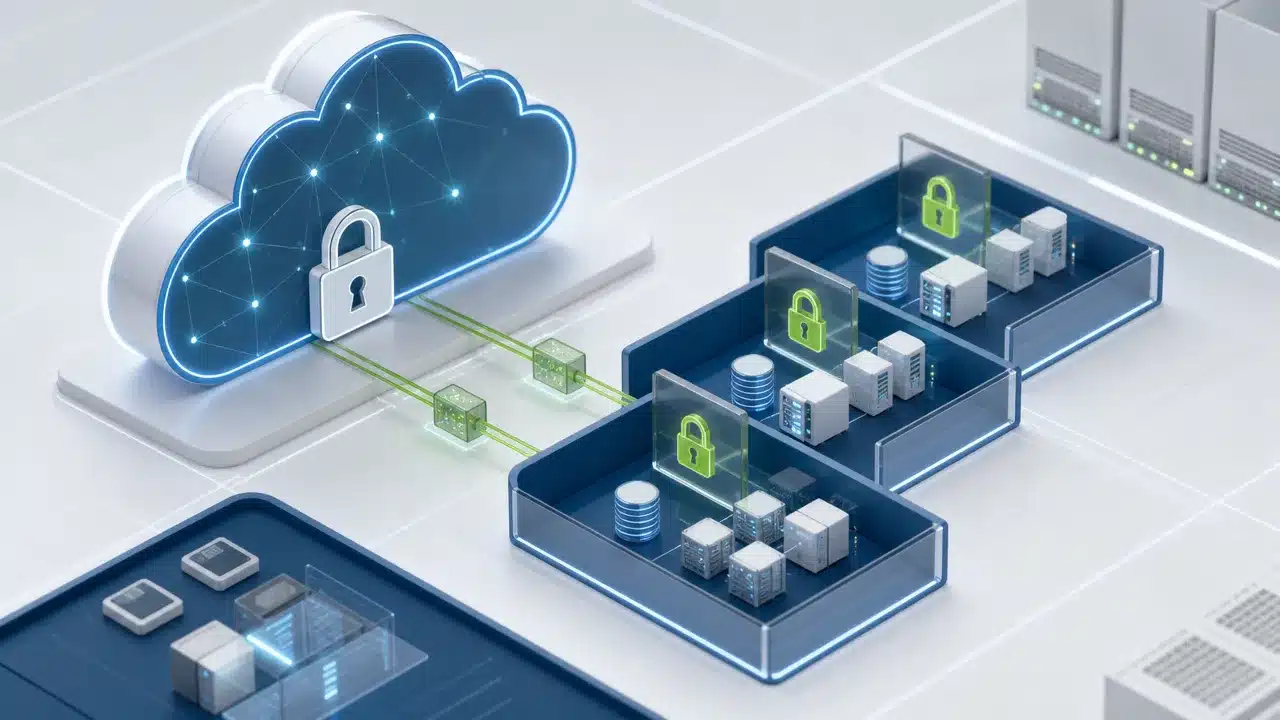
This is where the choice of cloud platform stops being a commodity decision. A VMware-powered Cloud Hosting (IaaS) environment gives you the network segmentation, micro-segmentation, and isolation controls that let you wall an agent off from systems it has no business reaching. When agents run in a flat network with broad reachability, a single compromised identity roams freely. When they run in a properly segmented environment, the same compromise hits a wall. Segmentation is least privilege expressed in the network, and it is one of the most underrated defenses against agentic abuse. A compromised agent confined to its own zone can damage only what that zone contains, which turns a potential breach of the whole estate into a contained event in one segment.
Recovery is the other half. If an agent identity is compromised and used to corrupt or exfiltrate data, your ability to restore quickly to a known-good state decides whether the incident is a disruption or a disaster. This is why a tested Disaster Recovery (DRaaS) capability and immutable Backup as a Service (BaaS) posture belong in any serious conversation about agentic AI. Attackers increasingly target backups precisely because they know recovery is your escape hatch. An agent with write access to your backup repository is a worst-case identity, and treating backup infrastructure as a protected, separately governed tier is no longer optional. Immutability matters here in a way it does not for routine backup hygiene: if an agent can be manipulated into overwriting or deleting your recovery points, your last line of defense becomes part of the attack. Backups that cannot be altered, even by a valid credential, are what keep an agent-driven incident recoverable. Partners like Veeam build immutability into the backup tier precisely so that a compromised identity, human or non-human, cannot reach back and destroy the means of recovery.
The pattern across all of this is consistent. Agentic AI does not introduce a brand-new category of threat so much as it dramatically multiplies an old one. The controls are familiar: inventory, least privilege, secrets management, behavioral monitoring, segmentation, and recovery. What has changed is the scale and the stakes. You are no longer applying these controls to a few dozen service accounts. You are applying them to a growing population of autonomous actors that touch your most sensitive systems and never sleep. The organizations that treated identity as an afterthought when it meant a few service accounts will find the same neglect far more expensive when it means a thousand agents.
The Mid-Market Advantage and the Mid-Market Trap
Mid-market organizations face a particular version of this challenge. You have the same agentic capabilities a Fortune 500 enterprise has, often the same SaaS platforms and the same cloud providers, but rarely the same dedicated identity security team. The agents arrive through individual SaaS subscriptions, embedded copilots, and developer experiments, accumulating faster than any single owner can track. By the time leadership asks how many agents are running and what they can reach, the honest answer is often unknown.
That is the trap. The advantage is that mid-market environments are still small enough to get under control before the sprawl becomes unmanageable. A focused effort to inventory, scope, and monitor your non-human identities is achievable in a quarter for most mid-market organizations, where the same effort at hyperscale enterprise can take years. The window to do this cleanly is open now, and it narrows with every agent you deploy without governance. The math is in your favor only as long as you act early. Each ungoverned agent you add does not just raise risk by one increment, it adds to the discovery burden you will eventually have to pay, with interest, either during a planned cleanup or during an unplanned breach.
Agentic AI does not introduce a brand-new threat. It multiplies an old one. The controls are familiar. The scale and the stakes are not.
The organizations that win here will be the ones that treat agent identity governance not as a compliance afterthought but as a core operating discipline, the same way they eventually learned to treat patching, backup, and MFA. Those controls all felt like overhead until the first incident proved their worth, and identity governance for agents is on the same trajectory. The ones that lose will be the ones that discover, during an incident, that they granted a piece of software broad access to their crown jewels and then forgot it existed. The difference between the two outcomes is not budget or headcount. It is whether you decided to make agent identities accountable before an attacker decided to make them useful.
Make Your Agents Accountable Before an Attacker Makes Them Useful
Every AI agent you deploy is a new employee you never interviewed, never background-checked, and never assigned a manager. It holds keys, it acts on its own, and right now most organizations cannot say how many of them are working, what they can reach, or who is watching. Attackers can. They have already concluded that the easiest way into a modern environment is not the human with MFA and a security awareness badge, but the unattended agent with a long-lived credential and permissions nobody scoped down.
You close that gap not by slowing down adoption but by building governance into the platform your agents run on. IT Vortex designs VMware-powered managed cloud environments where segmentation, secrets management, behavioral monitoring, and tested recovery are part of the architecture, not add-ons you bolt on after the breach. As an integrator and architect, our role is to make your agentic ambitions safe to pursue, not only to secure what you have today but also to give you a platform that stays governable as your agent population grows. The goal is not to hold back the productivity agents deliver. It is to make sure that productivity does not arrive with a standing liability attached.
Lou Corriero, VP Cloud at IT Vortex, works directly with mid-market IT leaders to map their non-human identity exposure and build the controls that keep agentic AI an asset rather than a liability. Schedule a working session with Lou Corriero to inventory your agent identities and pressure-test your environment before someone else does.
Agentic AI Identity Security: Frequently Asked Questions
What is a non-human identity?
A non-human identity is any credential used by software rather than a person: an API key, an OAuth token, a certificate, or a service account. Every AI agent carries one so it can authenticate and act. Unlike a human identity, it usually has no owner rotating its password, no manager approving its access, and no multi-factor prompt standing between it and your data.
Why do AI agent credentials bypass multi-factor authentication?
MFA assumes a human is present to approve a prompt. An agent runs unattended, so its credential is by design a single secret that works on its own. Steal that secret and you skip the strongest control most organizations deploy. That is why agent identities need least privilege, short-lived credentials, and behavioral monitoring rather than a login prompt.
What is the biggest agentic AI security risk for mid-market companies?
Over-privileged, undocumented agents. Under deadline pressure a team grants an agent broad access, stores the secret somewhere convenient, and never scopes it down. Multiply that across departments and you have an identity attack surface no human logs into and no audit ever sees. If one credential leaks, the attacker inherits everything that agent could reach.
How do you secure AI agent credentials?
Treat every agent as a first-class identity: inventory every non-human identity and give it a human owner, enforce least privilege with short-lived credentials, keep secrets out of code and config in a managed vault, monitor agent behavior rather than just logins, and rehearse how you revoke and recover before an agent is compromised. Segmentation and immutable backups cap the blast radius when one is.