
There is no software patch for trust, and that single sentence explains why business email compromise remains one of the most expensive cyber threats facing US mid-market companies right now. Year after year the FBI’s Internet Crime Complaint Center ranks BEC among the costliest categories of cybercrime by reported dollar losses, far outpacing the headline-grabbing ransomware events that dominate the press. The attacks that drain six and seven figures from mid-market bank accounts rarely involve a zero-day exploit. They involve a convincing email, a plausible request, and a finance employee who did exactly what they were trained to do: respond quickly to leadership.
That is the uncomfortable truth at the center of this problem. Business email compromise succeeds not because mid-market defenses are unsophisticated, but because the attack deliberately sidesteps the technical controls those defenses are built around. No malware to detect. No malicious attachment to sandbox. No suspicious binary for endpoint detection to flag. Just words, identity, and urgency, weaponized against the people your business depends on most.
Why Business Email Compromise Defeats Conventional Security
To understand why business email compromise keeps winning, you have to understand what it is not. It is not a virus. It is not a ransomware payload. It is not a brute-force login attempt that a firewall can throttle. BEC is social engineering delivered over email, and in its purest form it carries no technical signature at all. An attacker sends a message that says, in effect, please change the bank account we wire payments to, or please process this urgent payment before the close of business. The email looks legitimate because, in many cases, it genuinely originates from a real, compromised mailbox.
This is the mechanism that frustrates traditional security stacks. Secure email gateways were engineered to catch malicious links and weaponized attachments. They are very good at that job. But a clean text email from a trusted vendor’s actual account contains nothing to catch. The content is plausible, the sender is authentic, and the request is the kind your accounts payable team processes dozens of times a week. The control fails not because it is broken but because it is solving a different problem than the one the attacker presents.
Consider how this plays out across the technical layers a mid-market company typically relies on. The spam filter scores the message as clean because it carries no blacklisted URL and no flagged attachment. The endpoint agent never activates because no process runs and no file is written. The firewall sees ordinary outbound SMTP traffic. The data loss prevention rules, tuned to catch credit card numbers and Social Security formats, see nothing matching their patterns because the fraudulent request contains no regulated data at all. Every layer you paid for performs exactly as designed, and the fraud sails through every one of them because it was never the kind of threat those layers were built to stop.
Business email compromise succeeds because it attacks the trust between your people, not the code on your servers. You cannot patch a relationship.
There are several recognized flavors of the attack, and each exploits a slightly different seam in your operation. CEO fraud impersonates an executive to pressure a subordinate into an unusual payment. Vendor email compromise hijacks a real supplier’s mailbox and quietly redirects invoice payments to an attacker-controlled account. Payroll diversion targets HR with a request to change an employee’s direct deposit details. Attorney impersonation invokes the urgency and confidentiality of a legal matter to short-circuit verification. What unites all of them is the absence of conventional malware and the presence of a believable human story.
Vendor email compromise deserves special attention because it is the variant that most often defeats even security-conscious teams. In this scenario the attacker does not impersonate anyone. They sit inside a legitimate supplier’s mailbox, read the real invoice thread, learn the real payment cadence, and then reply to your accounts payable team from the genuine address at exactly the moment a payment is expected. The grammar is correct, the invoice number matches, the project reference is accurate, and the only altered detail is the routing and account number on the remittance. Your team has no reason to doubt a message that arrives in an existing thread from a known contact. That is precisely why this variant produces the largest individual losses.

The Mid-Market Is the Sweet Spot for Attackers
Mid-market organizations occupy a particularly dangerous position in the BEC threat landscape. They move enough money to make the attack worthwhile, with wire transfers and vendor payments routinely running into the tens or hundreds of thousands of dollars. Yet they often lack the layered fraud controls, dedicated security operations staff, and rigid out-of-band verification processes that large enterprises have built over years. The result is a high-value target with a softer perimeter, which is precisely the profile an opportunistic fraud operator looks for.
Consider the structural realities. A mid-market finance department might be three to eight people, several of whom wear multiple hats. The CFO is reachable and visible, which makes impersonation easy to research and easy to make plausible. Payment approval chains are shorter, which speeds legitimate business but also removes the friction that would otherwise catch a fraudulent request. Vendor relationships are personal and trust-based, which is exactly the trust an attacker hijacks when they compromise a supplier’s mailbox. None of these traits are flaws. They are the operational characteristics that make a mid-market company efficient. The attacker simply turns that efficiency against you.
There is also a reconnaissance advantage attackers exploit against mid-market firms. So much of the information needed to build a convincing pretext is publicly available. A company press release announcing a new partnership, a LinkedIn profile broadcasting that the controller is on vacation, an out-of-office reply confirming the CFO is at a conference, a vendor logo on the customer page of a supplier’s website. Each of these is harmless in isolation. Stitched together, they let an attacker craft a request that lands at the moment of maximum plausibility, when the usual approver is unreachable and the substitute is eager to keep things moving. Larger enterprises bury this signal under layers of approval and centralized communications. Mid-market companies broadcast it.
This is where the business impact comes into focus, and where the IT Vortex pillars of Security and Resilience meet the balance sheet. A single successful wire fraud is not a nuisance to be cleaned up. It is a direct, often unrecoverable cash loss, frequently compounded by the time-sensitive nature of wire transfers. Once the money leaves and clears, recovery odds drop sharply with every passing hour. The financial damage is immediate, the reputational damage with the defrauded vendor lingers, and the internal trust damage between finance and leadership can be just as corrosive.
The secondary costs rarely make the headline number but they compound the wound. There is the legal expense of pursuing recovery and notifying affected parties. There is the forensic engagement to determine whether the mailbox compromise extended into other systems. There is the strained vendor relationship, because the supplier whose account was hijacked is now entangled in your loss whether or not they were negligent. And there is the quiet but real productivity cost of a finance team that, having been burned once, now second-guesses every legitimate payment for months afterward. A single incident reshapes how an entire department operates, and not for the better.
Why More Awareness Training Alone Has Not Solved It
The standard response to business email compromise has been to train employees harder. Awareness training matters, and a workforce that knows what BEC looks like is unquestionably more resilient than one that does not. But training alone has not closed the gap, and it is worth being honest about why.
Attackers iterate faster than annual training cycles. They study your industry, your vendors, and your executives. They time their requests to coincide with travel, quarter-end, or a known acquisition when unusual payments feel normal. They craft messages with correct names, accurate project references, and the right internal vocabulary, often harvested from a mailbox they have already compromised and read for weeks. Against that level of preparation, a once-a-year training module and a quarterly phishing simulation are necessary but nowhere near sufficient. You are asking a busy human, under deadline pressure, to be the last line of defense against a professionally researched deception. That is a fragile place to put your money.
The arrival of generative AI has widened this gap further. The grammatical errors and awkward phrasing that once tipped off a careful reader are gone. Attackers now produce flawless, on-brand prose at scale, in any language, perfectly matched to the tone of the executive or vendor they impersonate. Some campaigns even mimic the writing style harvested from a compromised mailbox so the fraudulent message reads exactly like the person it claims to be from. The visual and linguistic tells your training program taught employees to spot are precisely the tells that no longer exist. Defenses anchored to spotting the obvious mistake are defending against an attacker who stopped making mistakes.
Putting a busy employee under deadline pressure as your last line of defense against professional fraud is not a security strategy. It is a hope.
The deeper issue is that training tries to fix a process gap with a behavior change. If the only thing standing between your company and a fraudulent wire is one person remembering one lesson at exactly the wrong moment, the system is engineered to fail eventually. Resilience comes from making the right action the default and the wrong action structurally difficult, not from relying on perfect human vigilance under stress.
The Layered Defense That Actually Moves the Needle
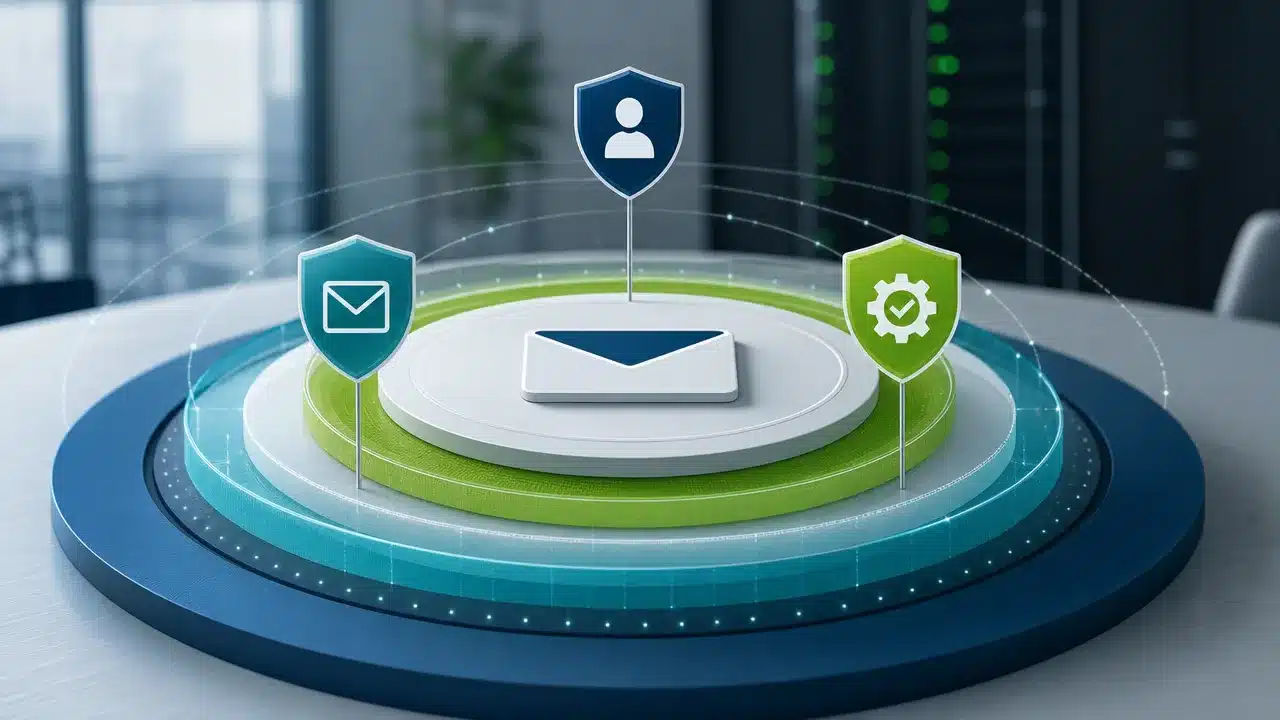
Closing the business email compromise gap requires defense in depth, where each layer assumes the previous one might fail. No single control stops BEC, but stacked together they turn a likely loss into a contained near-miss. The approach maps directly to the IT Vortex pillars of Security, Resilience, and Simplification, because a defense that is too complex to operate is a defense that quietly decays.
Layer one: harden the identity and the inbox
The most damaging BEC attacks begin with a genuine account takeover, which is why identity hardening is the foundation. Multi-factor authentication on every mailbox is non-negotiable, and it should be phishing-resistant where possible rather than relying on codes that can be relayed in real time. Conditional access policies that flag impossible travel and unfamiliar locations catch the attacker who has already stolen a password. Advanced email security that inspects not just attachments and links but sender behavior, display-name spoofing, lookalike domains, and anomalous language patterns adds a detection layer that a legacy gateway cannot. This is the heart of what Security as a Service (SECaaS) delivers as a managed capability rather than a product you bolt on and forget.
Phishing-resistant authentication deserves emphasis because the most common form of MFA, a one-time code, is increasingly defeated by real-time relay attacks. An attacker tricks the user into entering their code on a fraudulent page, then replays it to the legitimate service within the seconds it remains valid. Hardware security keys and modern passkey-based authentication close that window entirely because the credential is cryptographically bound to the real domain and cannot be relayed. Moving a mid-market workforce from code-based MFA to phishing-resistant methods is not only a security upgrade but also a simplification, because it removes the friction of typing codes while raising the bar attackers cannot clear.
Properly enforced email authentication standards belong here too. DMARC, DKIM, and SPF, configured and monitored correctly, make it materially harder for an attacker to spoof your own domain against your employees and your customers. These are not exotic technologies. They are widely supported and yet frequently misconfigured or left in a permissive monitoring mode that does nothing to block forged mail. A DMARC policy set to none reports on abuse but blocks nothing, and far too many domains sit in exactly that state for years. Getting them to a true enforcement posture, where forged mail claiming to be from your domain is rejected outright, is exactly the kind of detail an integrator and architect attends to that a reseller does not.
Layer two: build process friction where money moves
Technology cannot finish the job alone, and this is where many mid-market programs underinvest. The single most effective control against wire fraud is mandatory out-of-band verification for any change to payment details or any payment above a defined threshold. If a vendor emails to say their bank account has changed, the policy must require a callback to a known, previously verified phone number, never a number supplied in the email itself. If an executive emails an urgent payment request, the policy must require a second channel of confirmation before funds move. This friction is intentional. It is the structural defense that does not depend on anyone remembering a training slide.
The genius of process friction is that it does not need to be perfect to work. It only needs to introduce one mandatory verification step that the attacker cannot complete from inside an email thread. The fraudster who controls the mailbox cannot answer the verified phone number that belongs to the real vendor’s accounts receivable team. That one phone call is where most BEC schemes die, and it costs nothing but discipline.
The reason this control is so often missing is cultural, not technical. Verification feels like distrust, and in a fast-moving mid-market company nobody wants to be the person who slows down a payment to a key supplier or questions an instruction from the CFO. The fix is to make verification a policy that applies to everyone equally, so that calling to confirm is not an accusation but a routine step, the same way a pilot runs a checklist before takeoff regardless of how many times they have flown the route. When the second phone call is simply what your company does, the social awkwardness that attackers count on disappears.
- Mandatory callback verification to a known number for any bank detail change
- Dual approval for wire transfers above a defined dollar threshold
- A standing rule that urgency is itself a red flag worth a second look
- A clear, blameless escalation path so employees feel safe pausing a suspicious request
- Written vendor onboarding that captures verified contact details before the first payment
Layer three: assume compromise and contain it
Mature defense assumes that at some point an account will be compromised, and it plans for fast detection and containment. This means monitoring for the telltale signs of a hijacked mailbox: newly created inbox rules that auto-delete or forward messages, logins from unexpected geographies, and a sudden change in a user’s sending patterns. Attackers frequently set up hidden forwarding rules so they can read a conversation thread for weeks while preparing the perfect fraudulent moment. Catching that rule early is the difference between a contained incident and a cleared wire.
Detection only matters if someone is watching, which is the gap most mid-market companies cannot close on their own. The mailbox audit logs that record a suspicious forwarding rule are generated by default in most modern email platforms, but they sit unread unless a team is actively monitoring and correlating them. A managed security operation watching those signals around the clock turns a silent compromise into an alert within minutes rather than discovering it weeks later when the wire has already cleared. This continuous vigilance is the operational difference between owning a security product and operating a security program.
Containment also depends on the broader infrastructure being resilient and recoverable. When an account compromise turns into a wider intrusion, the ability to restore clean data, isolate affected systems, and continue operating matters enormously. This is where Backup as a Service (BaaS) and Disaster Recovery (DRaaS) earn their place in the conversation. BEC is often the opening move of a longer campaign, and an organization that can detect, contain, and recover quickly denies the attacker the time they need to convert a foothold into a catastrophe. Resilience is not only about surviving the ransomware encryption event but also about limiting the blast radius of every quieter intrusion that precedes it.
The Business Case: What This Costs Versus What It Saves
Mid-market executives rightly ask whether the investment in layered email defense is proportionate to the risk. The math is rarely close. A single successful wire fraud can exceed an entire year of a managed security program, and unlike a ransomware payment, fraudulent wires are frequently uninsured or recovered only in part. The cost of prevention is predictable and operational. The cost of a successful BEC is a sudden, unbudgeted cash loss that hits at the worst possible time.
There is an insurance dimension worth naming as well. Cyber insurers have grown markedly stricter about social engineering and funds-transfer fraud, frequently capping payouts on BEC losses far below the limits that apply to other incidents, and increasingly requiring documented verification controls as a condition of coverage. A company without enforced multi-factor authentication and out-of-band payment verification may find that its policy excludes the exact loss it most fears, or that a claim is denied because the required controls were not in place. The layered defense that prevents the fraud is, in many cases, the same set of controls that keeps your coverage valid.
There is a Performance dimension too, easy to overlook. Every hour your team spends manually scrutinizing emails they are unsure about, every payment delayed by uncertainty, every after-the-fact investigation into a near-miss, is drag on the business. A well-architected defense does not only reduce risk but also restores speed, because employees can act with confidence inside a system that has guardrails instead of relying on gut feel. Simplification and Performance are not in tension with Security here. Done well, they reinforce one another.
A single fraudulent wire can cost more than a year of managed defense, and unlike a ransom, you rarely get it back.
The Flexibility pillar matters as well. A managed approach scales with the business. As you add vendors, open new offices, onboard staff, or integrate an acquisition, the email and identity controls extend without you rebuilding the program from scratch. That adaptability is the difference between security that grows with you and security that becomes a bottleneck the moment the business changes shape. An acquisition is itself a classic BEC trigger, because the unfamiliar payment flows and new banking relationships of a freshly merged entity create exactly the ambiguity attackers exploit. A defense designed to flex through that transition protects you at your most vulnerable moment.
Where IT Vortex Fits
IT Vortex approaches business email compromise the way an integrator and architect should, not as a box to ship but as a layered system to design, operate, and continuously tune. As a Premier Broadcom VCSP Partner, we build managed cloud and security around the people, processes, and platforms our mid-market clients actually run. That means hardening identity with enforced multi-factor authentication and conditional access, deploying advanced email protection from partners like Proofpoint and Microsoft, getting DMARC, DKIM, and SPF to a real enforcement posture, and pairing all of it with the verification processes that stop fraudulent payments at the point of money movement.
It also means designing for the day a control fails. With Cloud Hosting (IaaS) as the foundation and Backup as a Service and Disaster Recovery layered on top, we make sure a compromised mailbox does not become a compromised business. The goal is enterprise-grade defense without enterprise complexity, which is the entire reason IT Vortex exists: to eliminate IT complexity while raising the floor on security and resilience.
Just as important, we treat email defense as a living program rather than a one-time deployment. Threat patterns shift, new vendors enter your payment flows, executives change, and the controls that fit your company a year ago drift out of alignment with how the business runs today. A managed relationship means the configuration is reviewed, the monitoring is staffed, the verification policy is reinforced, and the gaps that open quietly over time are found and closed before an attacker finds them first. That continuity is what separates a defense that holds from one that looks good on the day it was installed and erodes from there.
Lou Corriero, VP Cloud at IT Vortex, frames the BEC problem as a discipline problem more than a technology problem. The technology is necessary, but the organizations that defeat business email compromise are the ones that combine strong identity controls with non-negotiable verification habits, monitored continuously by a team that treats email as the high-value attack surface it has become.
Stop Treating BEC as an Email Problem
The reason business email compromise keeps succeeding is that too many organizations still file it under email security and stop there. It is not an email problem. It is a money-movement problem that happens to travel over email, and the companies that reframe it that way are the ones that stop losing wires. The fix is not a single product or a single training session. It is a deliberate stack of identity hardening, advanced email protection, enforced verification at every point money changes hands, and a containment plan for the day an account is compromised anyway.
Look at your own organization and ask one concrete question: if a real vendor’s real mailbox emailed your accounts payable team tomorrow asking to change their bank account, what would actually stop the payment? If the honest answer is one alert employee remembering one lesson, you have a gap that a professional fraud operator will eventually find. Close it before they do.
For the financial back-offices and fintech firms along the Jersey City waterfront, one redirected wire is not only a loss but also a conversation with the SEC or FINRA. That is why our managed IT and security work in Jersey City pairs phishing-resistant identity with documented payment-verification controls that hold up in an exam.
Schedule time with Lou Corriero, VP Cloud, to map your current email and identity defenses against the way BEC attacks actually unfold, and to build the layered, managed defense that turns a likely loss into a contained near-miss. Book a conversation at https://kb.theitvortex.com/meetings/lou-corriero.
Business Email Compromise: Frequently Asked Questions
What is business email compromise (BEC)?
BEC is a social-engineering attack delivered over email. The attacker uses a plausible, urgent request from a trusted identity, such as an executive, a vendor, or HR, to trick an employee into wiring money or changing payment details. It carries no malware, which is why conventional security tools have nothing to detect.
Does multi-factor authentication stop BEC?
MFA is essential and stops many account takeovers, but standard one-time-code MFA can be defeated by real-time relay attacks. Phishing-resistant MFA, meaning hardware security keys and passkeys, closes that gap. MFA alone is not enough, because BEC also exploits process gaps, so out-of-band verification of payment changes matters just as much.
How is BEC different from phishing?
Classic phishing casts a wide net with malicious links or attachments. BEC is targeted social engineering with no malicious payload, often sent from a genuinely compromised mailbox, which is exactly why it sails past secure email gateways and endpoint detection.
What is the most effective defense against BEC?
Defense in depth: harden identity and the inbox with phishing-resistant MFA and advanced email security, build process friction where money moves so payment changes require out-of-band verification, and assume compromise so you can contain it quickly. No single control is enough, but stacked together they turn a likely loss into a contained near-miss.