
In its 2025 State of Ransomware study, security vendor Sophos surveyed thousands of organizations and found that the average recovery bill, before you count any ransom payment at all, reached $1.53 million. That figure covers the cleanup, the overtime, the lost revenue, the rebuilds, and the consultants, and it lands squarely on mid-market balance sheets that were never sized to absorb it. The more disturbing shift underneath that number is strategic: attackers are no longer content to encrypt production. They go after the one thing that is supposed to save you.
Source: Ransomware takes aim at enterprise resilience, CSO Online.
Ransomware has stopped being a data problem and become an enterprise resilience problem. The modern playbook opens by hunting your backups, deleting your snapshots, corrupting your replication targets, and only then detonating the encryption payload. When the recovery plan is the primary objective, the question for every mid-market IT leader stops being “can we restore” and becomes “can they stop us from restoring.” That is a different design conversation, and it maps directly to the pillars that keep a business running: Resilience, Security, Performance, Simplification, and Flexibility.
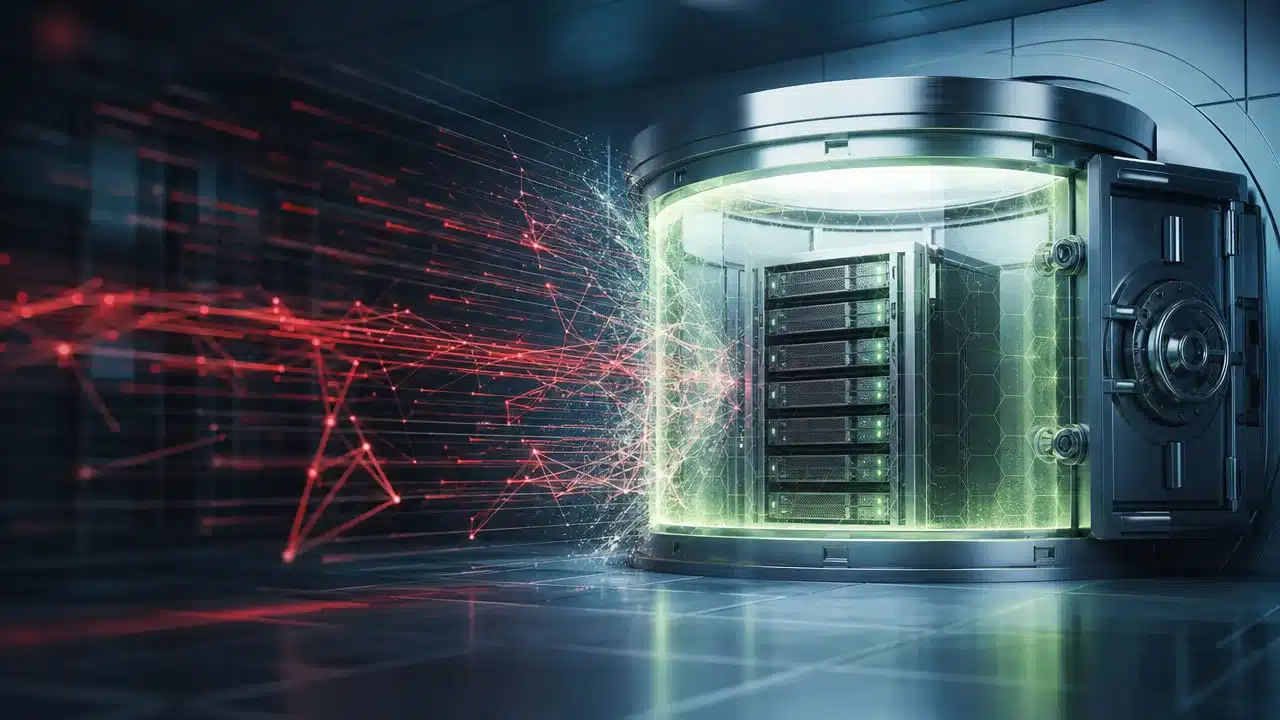
The economics of ransomware enterprise resilience have inverted
For years the ransom demand was treated as the headline cost. It no longer is. According to Sophos, recovery expenses excluding the ransom have become the dominant line item, and they have moved in a direction no CFO wants to see. The chart below tracks that trajectory across recent years.
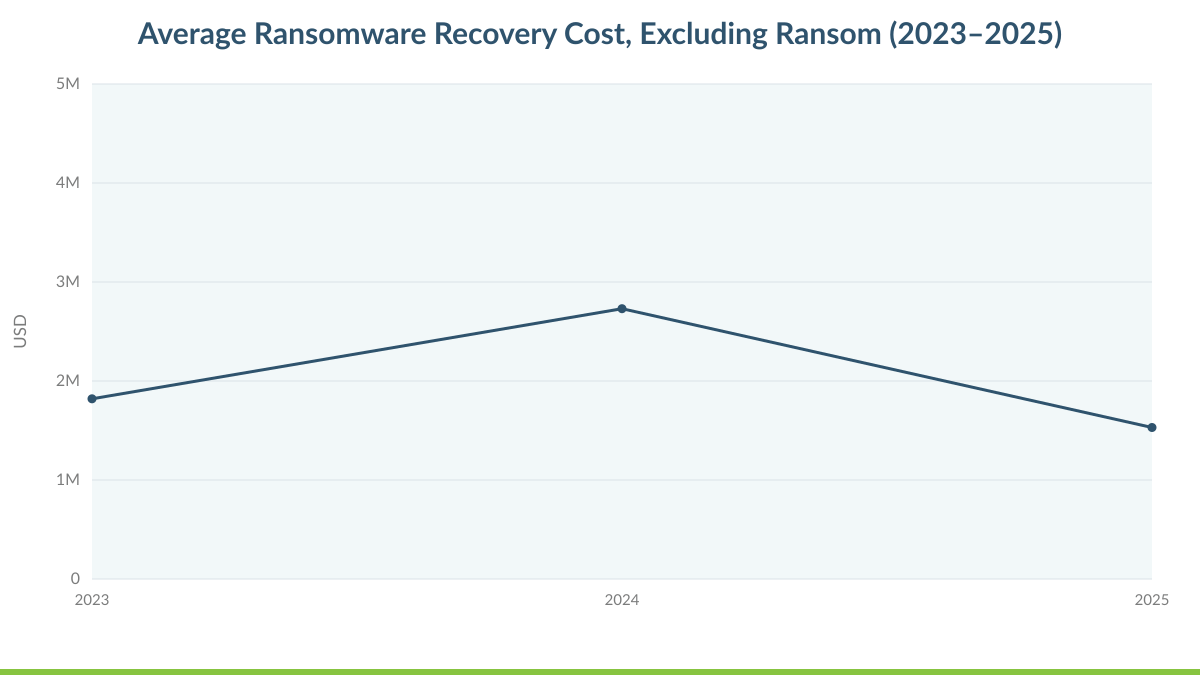
Read that trend line as a business signal, not a security statistic. Every dollar of recovery cost is a dollar spent while systems are down, revenue is stalled, and customers are watching. The recovery number is really a downtime number wearing a different label. When a distribution firm cannot ship, when a healthcare practice cannot pull charts, when a law office cannot access matter files, the meter runs whether or not a ransom is ever paid.
Consider the anatomy of that $1.53 million figure. It is not one invoice. It is incident response retainers billed by the hour, forensic investigators reconstructing the attack path, legal counsel managing breach notification obligations, and internal staff pulled off revenue-generating work for weeks. It is the temporary infrastructure spun up to keep the business limping along, the premium freight to replace goods that could not ship, and the customer credits issued to retain accounts that watched you go dark. For a mid-market firm running on lean margins, a single event of this size can erase a full quarter of profit and force decisions about headcount that have nothing to do with performance and everything to do with a preventable outage.
The ransom demand is the number that makes headlines. The recovery cost is the number that closes businesses.
Cost is not evenly distributed, either. Different sectors carry different blast radii depending on how tightly their operations depend on continuous data access and how heavily they are regulated. The next chart breaks mean recovery cost down by sector, and the spread should shape how you budget resilience rather than treating it as a flat line item.
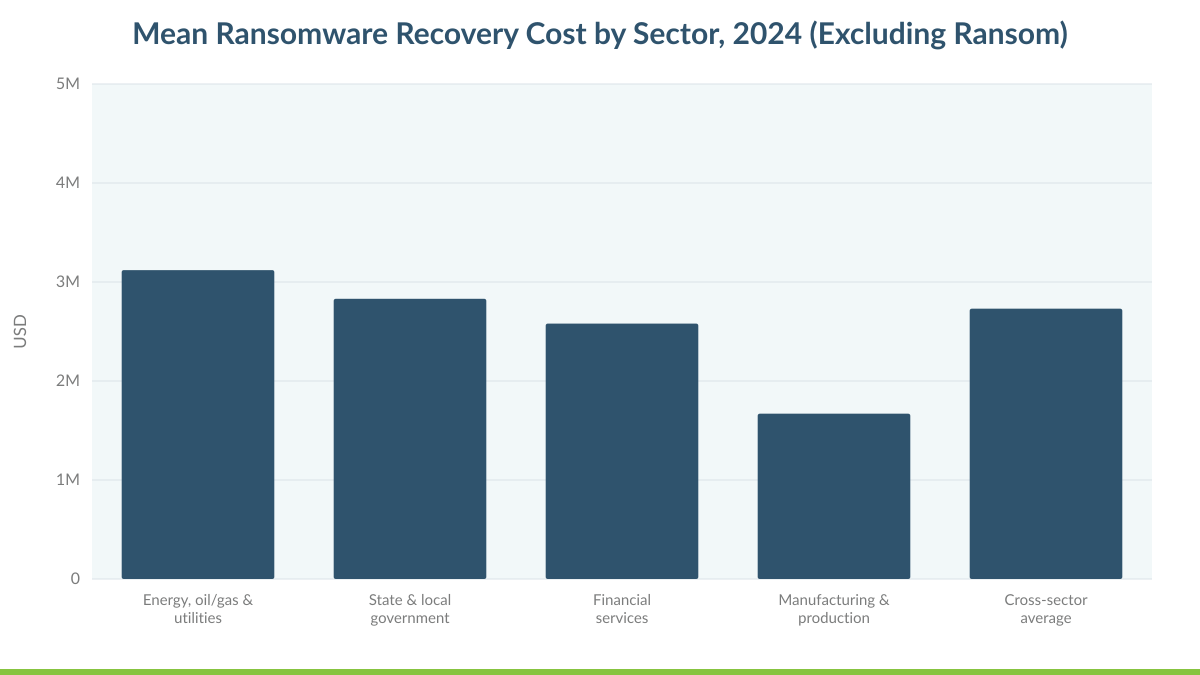
Sectors with heavy compliance exposure and continuous operational dependence pay the most, because their downtime is not only expensive but also legally consequential. A healthcare provider facing a breach is managing patient safety, HIPAA obligations, and revenue interruption at the same time. A financial services firm is fielding regulator inquiries while trying to reassure clients that their money is safe. A manufacturer with a compromised environment cannot run the machines that generate cash. That is why we build recovery readiness around specific regulatory realities rather than generic checklists, and why resources like our HIPAA Recovery Readiness Checklist exist as a starting point for regulated teams.
The budgeting lesson is direct. If your organization sits in a high-cost sector, a flat percentage of the IT budget allocated to backup is the wrong model. The right model sizes recovery investment against what an hour of downtime actually costs your specific operation, which for many mid-market firms is a number nobody has ever calculated. That calculation, revenue per hour multiplied by realistic recovery time, is the single most useful input to a resilience strategy, and it almost always justifies more than teams initially assume.
Why attackers hunt your backups first
The logic is brutal and simple. A victim with clean, isolated, tested backups has leverage. They can refuse to pay, restore, and move on. A victim whose backups are gone has none. So the attack economy adapted. Before triggering encryption, intruders now spend time inside the environment enumerating backup infrastructure, harvesting backup admin credentials, deleting repositories, and turning off replication jobs. Sophos research on the impact of compromised backups found that when attackers attempted to compromise backups, they frequently succeeded, and the success rate varied dramatically by sector.
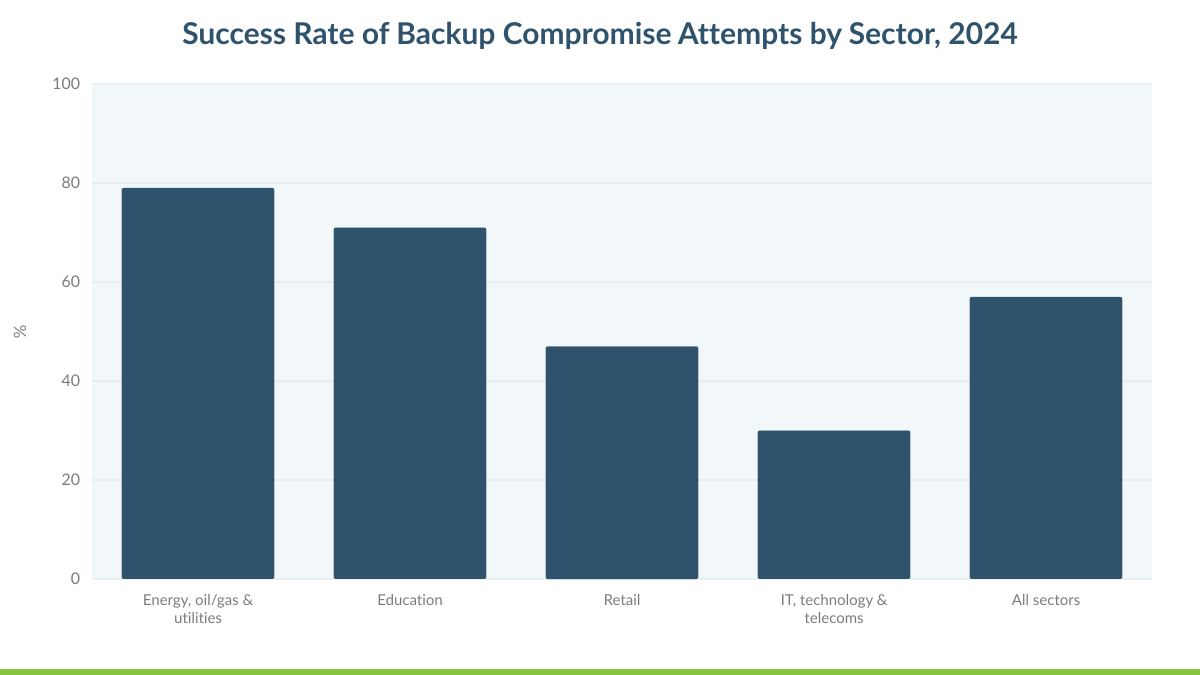
Those success rates are the quiet crisis inside the ransomware story. When a backup compromise succeeds, the downstream consequences compound: ransom demands rise, payment likelihood rises, and recovery time stretches from days into weeks. Sophos found that organizations whose backups were compromised were far more likely to pay the ransom and faced markedly higher overall costs than those who could restore on their own terms. The backup is no longer the safety net. In too many environments, it is the softest target on the network.
Understanding the mechanics makes the defense obvious. Modern ransomware operators typically dwell in an environment for days or weeks before detonation, a period the industry calls dwell time. During that window they move laterally, escalate privileges, and study your architecture. When they reach a domain administrator account, they inherit the keys to almost everything, including the backup console if it authenticates against the same directory. From there, deleting repositories or altering retention policies is a few clicks. This is why a backup system that trusts the same identity provider as production is not really a separate system at all. It is an extension of the blast radius wearing a different name.
A backup you cannot prove is recoverable is not a backup. It is a hope with a storage bill.
This is where many mid-market organizations discover an uncomfortable gap. They bought backup software, they see green checkmarks on the dashboard, and they assume they are protected. But a backup that shares credentials with production, sits on writable storage the ransomware can reach, and has never been restored end to end is exactly the target the attacker is counting on. Resilience is not the presence of backups. It is the demonstrated ability to recover on a timeline the business can survive.
There is a second, subtler failure mode worth naming: silent corruption. Backups can complete successfully every night and still be unrecoverable because of a missing application dependency, an unquiesced database, or a bit-level corruption that no one notices until a restore is attempted under pressure. The green checkmark reports that data moved, not that the data will reconstitute a working system. Attackers do not even need to touch a backup to defeat it if the restore was never going to succeed in the first place. Verification is the only thing that closes that gap, and it is the step most organizations skip.
Immutability, isolation, and the architecture that fights back
The countermeasure is architectural, not a single product purchase. Three properties separate a backup that survives an attack from one that does not: immutability, isolation, and verification. Get all three and the attacker’s backup-hunting phase fails, which changes the entire negotiation.
- Immutability. Backup data written in a write-once, read-many state cannot be altered or deleted for a defined retention window, even by an administrator whose credentials were stolen. Ransomware cannot encrypt what it cannot rewrite.
- Isolation. Backups held on separate credentials, separate networks, or an air-gapped tier are not reachable from the compromised production domain. The attacker who owns your Windows domain does not automatically own your recovery data.
- Verification. Automated recovery testing proves that a restore actually works before you need it, catching corruption, dependency gaps, and missing systems while there is still time to fix them.
The 3-2-1-1-0 rule is the discipline that operationalizes those three properties. Keep three copies of your data, on two different media types, with one copy offsite, one copy immutable or air-gapped, and zero errors verified by testing. That final zero is the one most teams never reach, because it demands the recurring work of actually restoring and confirming. A partner who runs that verification for you turns an aspirational rule into a documented practice.
This is the core of modern data protection, and it is why we build our Backup as a Service and Veeam data protection offerings around immutable, isolated repositories rather than simple file copies. The goal is not only to store your data but also to guarantee that a stolen domain admin account cannot reach across and destroy your last line of defense. When the recovery tier lives outside the attacker’s reach, the encryption payload becomes an expensive inconvenience instead of an extinction event.
Immutability without recovery speed is only half the answer, though. Being able to restore is not the same as being able to restore fast enough. That is the difference between Backup as a Service and true Disaster Recovery (DRaaS), where standby infrastructure and orchestrated failover collapse recovery time from days to a target measured in hours or minutes.
Recovery time is the number that actually matters
Executives fixate on whether the data survived. Operations lives and dies by how long the business was down. Those are two different metrics, and resilient design plans for both: a recovery point objective (how much data you can afford to lose) and a recovery time objective (how long you can afford to be dark). A backup that restores perfectly over four days does not help a business that loses six figures for every day offline.
Consider the arithmetic of a traditional restore. A mid-size environment might hold tens of terabytes across dozens of servers. Streaming that volume back from a backup repository, rebuilding operating systems, reinstalling applications, reconfiguring networking, and validating each system in sequence can consume days even when everything goes right. Multiply that by the reality that the first restore attempt often surfaces a missing dependency or a corrupted image, and the four-day estimate becomes optimistic. Every hour of that timeline is an hour the business generates no revenue while still paying its fixed costs.
DRaaS built on VMware and orchestrated replication changes that equation. Instead of rebuilding servers from scratch and streaming terabytes back over the wire, you fail workloads over to warm standby infrastructure and keep operating while the primary environment is rebuilt and cleaned. As a Premier Broadcom VCSP Partner, IT Vortex runs this on enterprise-grade VMware infrastructure, so the failover target is not a bargain-bin copy of your environment but a genuine operational twin. That is Resilience and Performance working together instead of trading off against each other.
Orchestration is the part that turns a pile of replicated virtual machines into an actual recovery. Systems rarely come back in isolation. A domain controller has to be running before applications authenticate, a database tier has to be live before the front end will function, and network routing has to be correct before anyone can reach anything. Orchestrated failover encodes that boot order and those dependencies so the environment comes up in the right sequence automatically, rather than an engineer improvising under pressure at two in the morning. That sequencing is the difference between a recovery time objective you can commit to and one you merely hope for.
Attackers have made recovery the battlefield. So make recovery the thing you engineer, test, and prove, not the thing you assume.
Testing is where most plans quietly fail. A DR plan that has never been exercised is a document, not a capability. We treat failover validation as a recurring discipline, which is why we publish a DR Failover Validation Plan Template that gives teams a structure for proving recovery on a schedule rather than discovering the gaps during an actual incident. The organizations that recover fastest are not the ones with the most expensive tools. They are the ones who rehearsed.
Regular testing also produces something an untested plan never can: evidence. When you fail over on a schedule and document the recovery time achieved, you accumulate proof that your objectives are real. That evidence satisfies auditors, reassures a board, and, increasingly, is exactly what cyber insurers demand at renewal. A tested plan is both a technical safeguard and a business asset you can put in front of a stakeholder who asks the hard question.
Security and resilience are one system, not two budgets
Many organizations still treat prevention and recovery as separate programs owned by separate people. Ransomware exploits exactly that seam. The intrusion that reaches your backups is a security failure; the inability to restore is a resilience failure; and the attacker chains them together on purpose. Defending enterprise resilience means closing the seam so the two disciplines reinforce each other.
Prevention still matters enormously because the fastest recovery is the incident that never fully lands. Endpoint detection from vendors like CrowdStrike, network enforcement and virtual patching from Fortinet, and email defense from Proofpoint reduce the number of intrusions that reach detonation. Our Security as a Service (SECaaS) practice integrates those controls with monitoring so that the reconnaissance phase, the part where attackers quietly map your backups, gets caught before the payload fires. Every intrusion stopped early is a recovery you never have to run.
The integration matters more than any single tool. An attacker enumerating backup infrastructure generates signals: unusual queries against the backup server, credential use at odd hours, replication jobs being disabled. Those signals are invisible if endpoint detection, network monitoring, and backup telemetry live in separate consoles nobody correlates. When they feed one monitoring practice, the backup reconnaissance that precedes an attack becomes a detectable pattern instead of background noise. That is the practical payoff of treating security and resilience as one system: you get to intervene during the hours the attacker is preparing, not during the minutes after the encryption starts.
The pillars connect here. Security shrinks the attack surface. Resilience guarantees a floor under the worst case. Simplification matters because a fragmented stack of disconnected tools creates the blind spots attackers live in. When your managed cloud hosting, backup, disaster recovery, and security controls are architected as one system by one accountable partner, there are fewer seams to exploit and fewer handoffs to fumble during an incident.
What the numbers demand of mid-market IT leaders
Put the three charts together and a strategy emerges. Recovery costs are climbing, they are concentrated in regulated and operationally dependent sectors, and attackers succeed at compromising backups often enough that you cannot assume yours will survive contact. That is not an argument for despair. It is an argument for designing recovery as a hardened, tested, isolated capability rather than a backup job nobody has restored since it was configured.
Here is what that looks like in practice for a mid-market organization:
- Move recovery data to immutable, isolated storage that cannot be reached with production credentials.
- Define real recovery time and recovery point objectives per workload, tied to what the business actually loses per hour offline.
- Stand up DRaaS for the workloads whose downtime is measured in dollars per minute, not just backup for everything else.
- Test failover on a schedule and document the results, so the plan is a proven capability rather than an assumption.
- Integrate security monitoring with the recovery stack so backup reconnaissance is detected before encryption.
- Consolidate the moving parts under one accountable partner to eliminate the seams attackers exploit.
Notice that this list is a sequence, not a menu. There is no value in fast failover for data an attacker can delete, and no value in immutable storage you have never proven you can restore from. The properties compound only when they are built together. A mid-market team working through this list will often find that the first item, moving recovery data out of the production credential domain, delivers the largest risk reduction for the least cost, which makes it the right place to start.
Regulated firms carry an extra layer. Cyber insurers now scrutinize backup immutability and recovery testing as conditions of coverage, and boards face disclosure obligations when incidents hit. If your organization is navigating renewal requirements or insurance scrutiny, our practical resources such as the 2026 Cyber Insurance Renewal Requirements for Law Firms translate underwriting expectations into concrete technical controls. The controls that satisfy an underwriter are the same ones that defeat a ransomware operator, which is a rare case of compliance and security pointing in the identical direction.
The role of a partner who owns the outcome
There is a meaningful difference between buying backup licenses and buying a recovery outcome. A reseller hands you software and wishes you luck. An integrator and architect designs the immutability, engineers the isolation, orchestrates the failover, tests it on your behalf, and stands behind a service level agreement when it counts. IT Vortex operates as the second kind of partner. Our approach is captured in our Service Level Agreement, which commits to the outcomes rather than just the tools.
The distinction shows up most clearly in the hour of crisis. When production is encrypted and the phones are ringing, a license key is useless and a vendor support queue is worse. What matters is whether someone who already knows your environment, your dependencies, and your recovery runbook is executing a tested failover while you manage the business response. That is the operational reality behind the word “managed.” It is not a product tier. It is a commitment that the people who designed your recovery are the same people accountable for running it when the moment arrives.
Lou Corriero, VP Cloud at IT Vortex, frames the shift plainly: the ransomware conversation has moved from “how do we keep them out” to “how do we guarantee we recover when they get in.” Both matter, but only one is survivable when prevention fails, and prevention eventually fails somewhere for everyone. Designing for the day after the breach is what separates an organization that has a bad week from one that has a going-concern event.
That design work spans our full stack: enterprise-grade Cloud Hosting (IaaS) on VMware, immutable Backup as a Service, orchestrated DRaaS, and integrated SECaaS, delivered as one coherent environment rather than a pile of point products. When the recovery tier, the production tier, and the security controls are architected together, the attacker’s backup-hunting strategy runs into a wall instead of a welcome mat.
Reframe: stop defending the perimeter, start guaranteeing the recovery
The uncomfortable truth in the Sophos data is that the industry spent a decade optimizing to keep attackers out and attackers responded by targeting the thing we relied on to survive them getting in. The perimeter was never going to be perfect. Your recovery capability can be. An immutable, isolated, tested, orchestrated recovery architecture takes the attacker’s most powerful leverage off the table, because a business that can restore on its own terms does not negotiate.
There is a strategic dividend hiding in that shift. When recovery is guaranteed, the entire risk posture of the business changes. Ransomware stops being an existential threat and becomes a managed operational risk, the kind boards understand and insurers price rationally. Leadership can make decisions about growth, acquisition, and digital transformation without a quiet fear that a single intrusion unravels everything. Resilience, engineered properly, is not just a defensive cost. It is the confidence that lets a business move.
So the action is not to buy more prevention and hope. It is to treat recovery as the engineered, verified capability that decides whether ransomware is a headline or a footnote in your year. That is a design decision you can make now, before the meter starts running, and it is exactly the work IT Vortex does with mid-market leaders every day.
Ready to pressure-test whether your backups would actually survive a targeted ransomware attack? Schedule a working session with Lou Corriero, VP Cloud, to map your recovery time objectives, review your immutability and isolation posture, and build a plan that holds under attack: book a meeting here.