
On the day Google merges a security fix into the open-source Chromium codebase, the patch is public, the code diff is readable, and the vulnerability is documented in commit history for anyone who cares to look. On the day that fix actually reaches every Chrome browser inside your organization, days or weeks may have passed. Attackers live in that gap, and they have industrialized the practice of turning a public Chromium commit into a working exploit before your endpoints ever restart.
Source: Attackers are weaponizing the gap between Chromium fixes and Chrome patches, CSO Online.
This is the Chromium patch gap, and it is not a theoretical concern. Chrome, Microsoft Edge, Brave, Opera, Vivaldi, and dozens of embedded browser components all draw from the same Chromium engine. When Google publishes a fix upstream, every one of those downstream products becomes a target until it ships and installs its own build. For mid-market IT leaders running hundreds or thousands of browsers across a hybrid workforce, that window is where breach risk concentrates. Understanding why the window exists, and how to shrink it, is now a core discipline of endpoint security rather than a footnote in a patch calendar.
Why the Chromium patch gap exists at all
The browser is the single most exposed piece of software on any corporate device. It renders untrusted content from the entire internet, executes JavaScript from strangers, parses images, fonts, video, and PDFs, and does all of it inside a sandbox that attackers spend enormous effort trying to escape. To manage that surface at web scale, Google develops Chrome on top of Chromium, an open-source project that is public by design. Transparency is a security strength in most respects. It is also the origin of the gap.
When a security researcher or Google’s own team fixes a memory-safety bug in Chromium, that fix is committed to a public repository. The bug may be embargoed with restricted details, but the code change itself is often visible, and skilled adversaries have become expert at reverse-engineering a patch to understand the flaw it repairs. This practice, sometimes called patch-gapping or n-day exploitation, lets an attacker build a working exploit for a vulnerability that is technically already fixed upstream but not yet deployed on real machines. The vulnerability is a zero-day to your users even though a fix exists somewhere in a source tree.
The downstream story makes it worse. Google ships a stable Chrome update, then Microsoft rebuilds Edge on the same Chromium base, then other vendors follow, then enterprise deployment tooling stages the update, then devices download it, then users finally relaunch the browser to apply it. Every one of those steps adds hours or days. A device that has not restarted its browser in a week may be running a build that is publicly known to be exploitable. Multiply that across a distributed workforce and the exposure window is not a moment, it is a continuous condition that IT has to actively manage down.
A browser vulnerability stops being a zero-day the instant it is fixed upstream, but it stays a zero-day on your endpoints until every device restarts. Attackers are paid to exploit that difference.

The Chromium patch gap in the numbers
The scale of in-the-wild zero-day exploitation is documented, and browsers sit near the center of it. Google’s Threat Intelligence Group tracks zero-days exploited in the wild every year, and the multi-year trend shows that state-backed groups, commercial spyware vendors, and financially motivated criminals continue to invest heavily in exploiting flaws before defenders can patch them. The chart below shows the count of tracked in-the-wild zero-days across recent years.
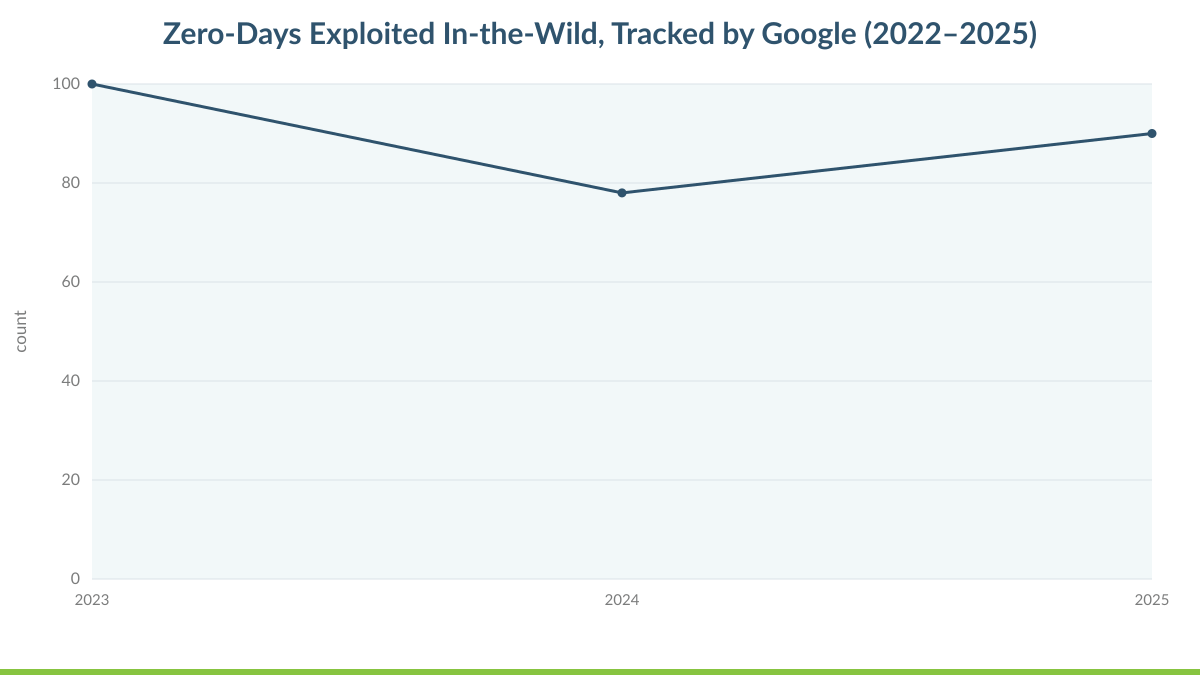
The takeaway for a mid-market IT leader is not the raw number. It is what the number represents: a mature market for exploiting the exact interval between a fix existing and a fix being deployed. Every one of these zero-days had a moment where the fix was known to attackers but not yet applied on victim machines. The browser is a repeat participant in that story because it is both universally deployed and constantly rendering hostile input.
Chrome specifically has faced a steady cadence of actively exploited zero-days. Google has repeatedly shipped emergency stable-channel updates for Chrome flaws that were already being used in attacks at the time of disclosure, several of them in the browser’s JavaScript engine and rendering pipeline where a single malicious webpage can trigger code execution. The chart below shows Chrome zero-days disclosed per year over recent history.
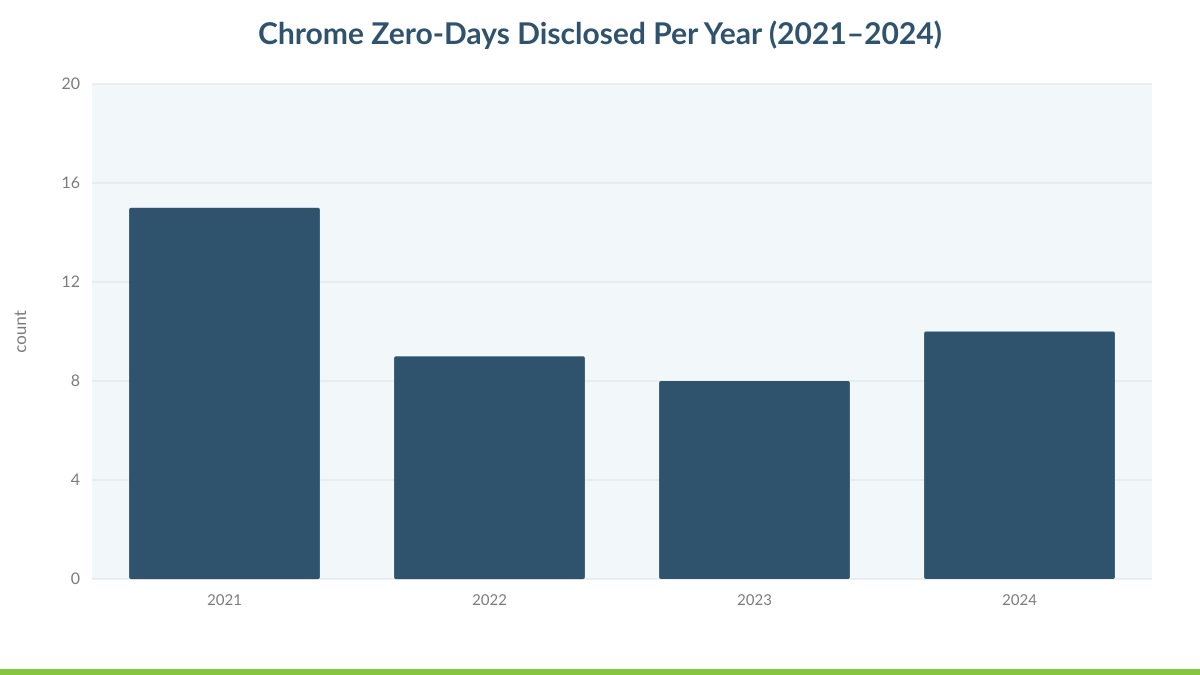
Notice the pattern. These are not obscure edge cases. They are high-severity flaws, frequently rated critical, that Google confirms are under active exploitation when it publishes the fix. That means for every one of these, the clock started ticking on your organization the day the update landed in the stable channel, and the only variable you control is how fast you close the gap between availability and deployment.
There is a hopeful signal in the data as well, and it points directly at what works. When vendors invest in faster patching, tighter default configurations, and harder-to-exploit architectures, attackers shift their effort elsewhere. The chart below contrasts the decline in browser zero-day exploitation with the movement in mobile targeting between 2023 and 2024.
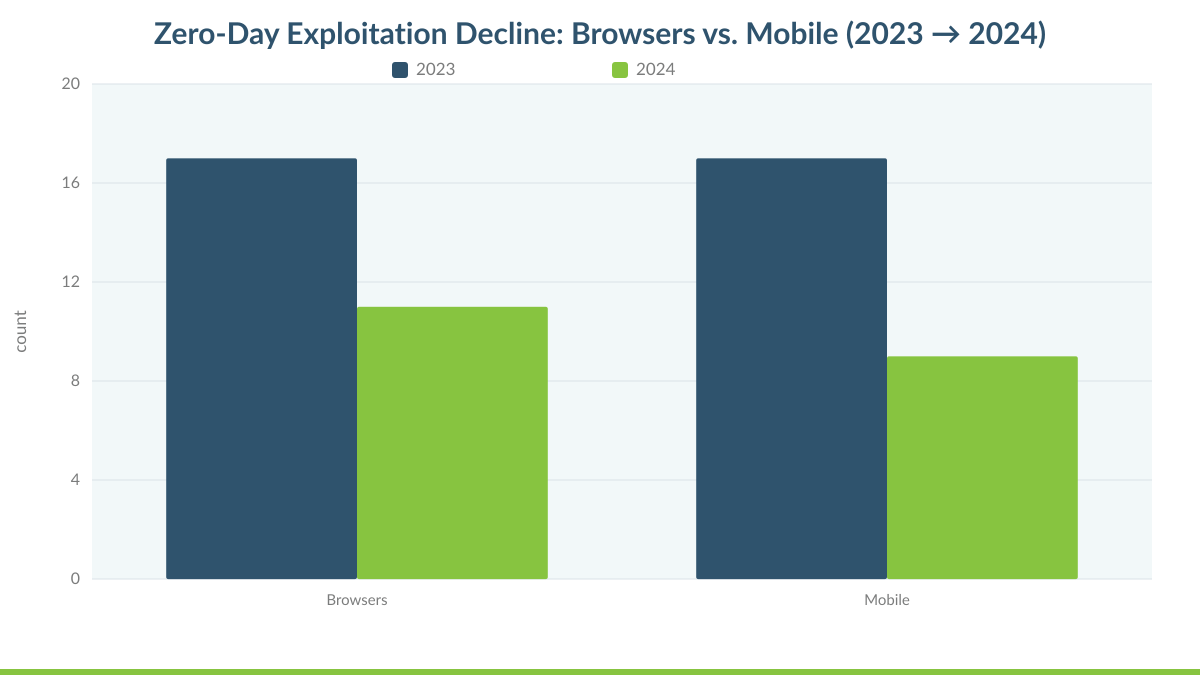
The lesson embedded in that shift is the central argument of this article. Exploitation follows the path of least resistance. Organizations that make the browser patch gap small and predictable become expensive targets, and expensive targets get skipped in favor of easier ones. Shrinking the window is not only a technical win but also an economic deterrent that changes an attacker’s calculus about whether you are worth the effort.
What the Chromium patch gap costs the business
Translate the technical exposure into business terms and the stakes become concrete. A browser exploit is rarely the end goal. It is an entry point. A successful drive-by compromise of a single endpoint gives an attacker a foothold inside your network, from which they pursue credential theft, lateral movement, data exfiltration, and ultimately ransomware or extortion. The browser is the front door, and a stale build props that door open.
The costs map cleanly onto the pillars that govern every infrastructure decision. On Security, an unpatched browser undermines every other control you have invested in, because a compromised endpoint sits behind your perimeter with a legitimate user’s session. On Performance and Resilience, a browser-borne intrusion that escalates to ransomware can take down the systems your revenue depends on, and recovery timelines are measured in days of lost productivity. On Simplification, a fragmented estate of self-managed laptops, each updating on its own schedule, turns a solvable patch problem into an unbounded one that no small IT team can fully track.
The browser is the front door to your business. A build that is a week behind is a door left unlocked in a neighborhood where the criminals read the locksmith’s public notes.
For regulated mid-market firms, the compliance dimension raises the stakes further. Healthcare organizations subject to HIPAA, financial firms with disclosure obligations, and law firms bound by client confidentiality all face reporting and liability consequences when a preventable browser flaw becomes the root cause of a breach. Cyber insurers now scrutinize patch cadence directly, and a documented failure to deploy an available fix in a reasonable window can complicate a claim. Closing the Chromium patch gap is therefore not only a security task but also a governance and insurability requirement. Firms preparing for renewal should review our 2026 cyber insurance renewal requirements for law firms to see how patch discipline factors into coverage.
Why traditional endpoint patching struggles here
Most mid-market organizations manage browser updates the same way they manage operating system patches: a management console pushes updates on a schedule, and compliance reporting shows how many endpoints are current. That model has three structural weaknesses when applied to a Chromium-based browser.
First, browser updates require a relaunch to take effect. A user who keeps a browser open for days, which is nearly everyone, is running the old build no matter what the management console reports as installed. The patch is technically present and functionally absent. Second, the modern workforce is distributed. Laptops that spend their days on home networks and coffee shop Wi-Fi are not sitting on a corporate LAN where you can guarantee update delivery and reboot enforcement. Third, the sheer variety of Chromium-based software means a single upstream flaw can require coordinating updates across Chrome, Edge, and any embedded browser frameworks inside line-of-business applications, each with its own release cadence.
The result is a persistent tail of exposed endpoints that no dashboard fully captures. You can report ninety-something percent compliance and still have the exact devices attackers want, the ones belonging to busy executives who never close their browsers, running vulnerable builds. Closing the gap requires rethinking where the browser runs and who controls its lifecycle, not just tightening the same patch cycle you already have.

Shrinking the window with centralized control
The most durable way to close the Chromium patch gap is to stop treating hundreds of independently managed endpoints as the unit of control and instead centralize the browsing environment where you can patch it once and govern it completely. This is precisely the value of Desktop as a Service (DaaS). When user desktops run in a managed cloud environment rather than on scattered physical laptops, the browser lives on infrastructure you control end to end. A single patch operation on the golden image or the running desktop pool updates every user session, and enforcing a relaunch becomes an administrative action rather than a hope that users cooperate.
Centralization delivers on multiple pillars at once. It advances Simplification by collapsing a sprawling patch problem into a managed operation. It advances Security by ensuring the browser that renders hostile web content runs in a hardened, monitored environment rather than on a device that also stores personal files and roams untrusted networks. It advances Flexibility because the same managed desktop reaches any device the employee happens to be using, without extending your exposure to that device’s local browser. The endpoint becomes a display, and the risky software runs where you can defend it.
Centralized desktops pair naturally with layered defense. Even with fast patching, no organization eliminates the gap entirely, which is why detection and response has to backstop prevention. Our Security as a Service (SECaaS) practice brings network filtering, endpoint detection, and threat monitoring together so that a browser exploit that lands during the exposure window is caught at the behavior stage, before it escalates to lateral movement or ransomware. Combining a small patch window with strong detection is not only more effective than either alone but also the model insurers and auditors increasingly expect.
The infrastructure underneath matters
A centralized browsing environment is only as good as the platform it runs on. If your managed desktops sit on the same unpatched, sprawling infrastructure you were trying to escape, you have relocated the problem rather than solved it. This is where the discipline of the underlying cloud platform becomes decisive. IT Vortex delivers managed cloud hosting on VMware-powered infrastructure as a Premier Broadcom VCSP Partner, which means the desktops, the virtual networks, and the security controls beneath them are maintained to a consistent standard rather than assembled and forgotten.
The platform discipline extends past the browser. A hardened Cloud Hosting (IaaS) foundation gives you the segmentation to contain a compromised session, the monitoring to see anomalous behavior, and the operational cadence to apply upstream fixes across the whole environment quickly. When Google ships an emergency Chrome update, closing the gap should be a single coordinated action across your estate, not a scramble across every laptop in the field. That difference in operational tempo is the difference between an exposure window measured in hours and one measured in weeks.
Because IT Vortex acts as integrator, architect, and advisor rather than a reseller, the browser patch problem gets addressed as part of an overall security and resilience architecture rather than as an isolated tool purchase. That means mapping your specific browser estate, identifying where the gap is widest, and designing controls that fit how your people actually work.
When prevention fails: recovery is the other half
Assume, correctly, that no patch program is perfect. A browser exploit will eventually succeed against some organization on some day inside the window. The mid-market firms that survive that reality are the ones that treated recovery as a first-class capability rather than an afterthought. A browser compromise that leads to ransomware becomes survivable when clean, immutable backups exist and when a tested failover plan can restore operations quickly.
This is why the browser patch conversation connects directly to data protection. Our Backup as a Service (BaaS) and Disaster Recovery (DRaaS) practices exist so that the worst-case outcome of a browser breach is a controlled recovery rather than a business-ending event. Immutable backups mean an attacker who lands through a browser flaw cannot encrypt or delete your last good copy. Tested failover means you can bring critical systems back on your timeline rather than the extortionist’s. Prevention shrinks the odds, and recovery caps the damage. You need both.
Shrink the patch window so fewer attacks land, and build recovery so the ones that do land cannot end the business. Neither half is optional.
Organizations that want to pressure-test their readiness can start with our DR failover validation plan template, which turns recovery from an assumption into a documented, exercised capability. A recovery plan that has never been tested is a hypothesis, and a browser breach is a poor time to discover it was wrong.
A practical checklist for closing the gap
For IT leaders who want to act now, the path forward is concrete. The following steps move an organization from a passive patch schedule to active management of the Chromium patch gap.
- Inventory every Chromium-based product in your environment, including Chrome, Edge, and any application that embeds a browser framework, so no update path is invisible.
- Measure your real exposure window: the time between a stable-channel Chrome release and the moment your last vulnerable endpoint has relaunched with the fix applied.
- Enforce browser relaunch after updates rather than reporting installation and assuming the fix is active.
- Centralize high-risk browsing on managed desktops so a single patch operation covers the whole estate and reboot enforcement is administrative.
- Layer detection and response beneath prevention so an exploit that lands during the window is caught before it escalates.
- Maintain immutable backups and a tested failover plan so a successful breach becomes a recovery event rather than a catastrophe.
- Document your patch cadence for auditors and insurers, because demonstrable discipline protects both your systems and your coverage.
Each of these steps is achievable for a mid-market team with the right platform and the right partner. None of them requires enterprise complexity, which is precisely the point. Enterprise-grade browser security should not demand an enterprise-sized security team, and with a managed cloud foundation it does not.
Stop treating the gap as inevitable
The Chromium patch gap looks like a fact of nature because the browser is open source, the fixes are public, and the workforce is distributed. It is tempting to accept that the window will always exist and attackers will always exploit it. That belief is half right and dangerously incomplete. The window will always exist. Its size is entirely up to you.
The data on browser zero-day exploitation makes the case plainly: when defenders make the window small and unpredictable, attackers move on to easier prey. The organizations still running week-old browser builds on roaming laptops are not unlucky, they are choosing to be the easy target. Reframe the browser from an app you patch on a schedule to an exposed surface you actively govern, put it on infrastructure you control, back it with detection and recovery, and you convert your firm from prey into a place attackers skip.
Lou Corriero, VP Cloud at IT Vortex, and our team work with mid-market IT leaders to map the browser exposure window, centralize control with Desktop as a Service (DaaS), and back it with the security and recovery layers that make the remaining risk survivable. To measure your exposure and design a plan to shrink it, schedule time with Lou Corriero and turn the patch gap from a standing liability into a managed, defensible edge.