
A security researcher recently demonstrated that a patch shipped to fix a Microsoft Defender weakness could itself be bypassed, allowing an attacker to defeat the very control organizations trust to catch malicious code and, in the demonstrated scenario, seize control of the protected system. That is not a theoretical footnote. It is a live reminder that a patched product is not the same as a protected environment, and that the security tool sitting at the center of millions of Windows estates is a target, not a guarantee.
Source: Researcher bypasses Microsoft Defender security patch, seizing control, CSO Online.
For US mid-market IT leaders, the uncomfortable takeaway is simple: if the fix for a flaw in your primary endpoint control can be worked around, then the assumption that “we are patched, so we are covered” is the assumption most likely to fail you in an incident review. The right response is not panic and it is not to abandon Microsoft Defender. It is to stop treating any single product as a perimeter and to build layered defense, tested recovery, and continuous monitoring into the architecture itself.
Why a Microsoft Defender bypass changes the risk math
Microsoft Defender is the default endpoint protection across a huge share of Windows devices, from a two-person accounting office to a hospital billing department. When a researcher shows that a released patch can be bypassed, the news matters for three reasons that go beyond the specific technique.
First, the fix-the-fix cycle is real. Vendors ship a patch, attackers and researchers probe it, and sometimes the patch closes one door while leaving a window open. A bypass means the clock that you thought stopped when you applied the update is still running. Second, monoculture amplifies impact. Because so many organizations rely on the same default control, a reliable bypass has an enormous blast radius. Third, the attacker’s goal in these scenarios is rarely just to slip past detection. It is to disable, blind, or manipulate the security tool so that everything that follows, ransomware, data theft, lateral movement, happens in the dark.
Consider what a blinded endpoint control actually costs in operational terms. When Defender flags a suspicious process, that alert typically fires a chain of automated and human responses: isolation of the host, a ticket to the security team, sometimes an automatic rollback. A bypass removes the first domino, so none of the rest ever fall. The malicious process runs with the same silence as a legitimate one. In a mid-market environment where the average dwell time for an undetected intrusion is measured in weeks, that silence is exactly what an attacker needs to map your network, locate your backups, and stage encryption across every reachable share before triggering it all at once on a Friday evening.
A patched product is not a protected environment. The gap between “the update installed” and “the risk is gone” is exactly where modern breaches live.
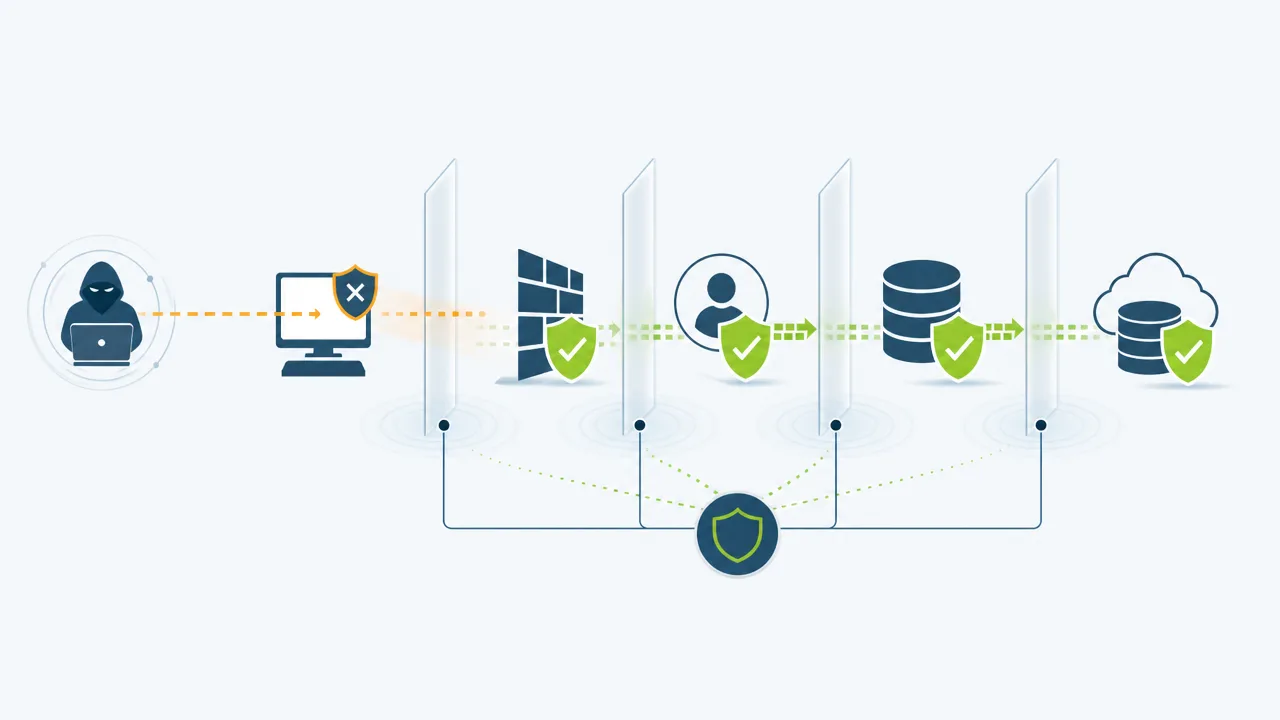
This is where the pillars we build around, Security, Resilience, and Simplification, stop being marketing words and start being engineering decisions. If your defense collapses to a single agent on a single vendor’s roadmap, you have inherited that vendor’s every bad week. Layering is not redundancy for its own sake. It is the refusal to let one bypass become one breach.
The wider pattern: zero-days are being exploited faster and more often
A Defender bypass does not happen in a vacuum. It arrives during a multi-year climb in the number of vulnerabilities that attackers exploit in the wild before, or immediately after, a fix exists. The trend line is the story, and the trend line is going the wrong way for defenders who rely on patch-and-pray.
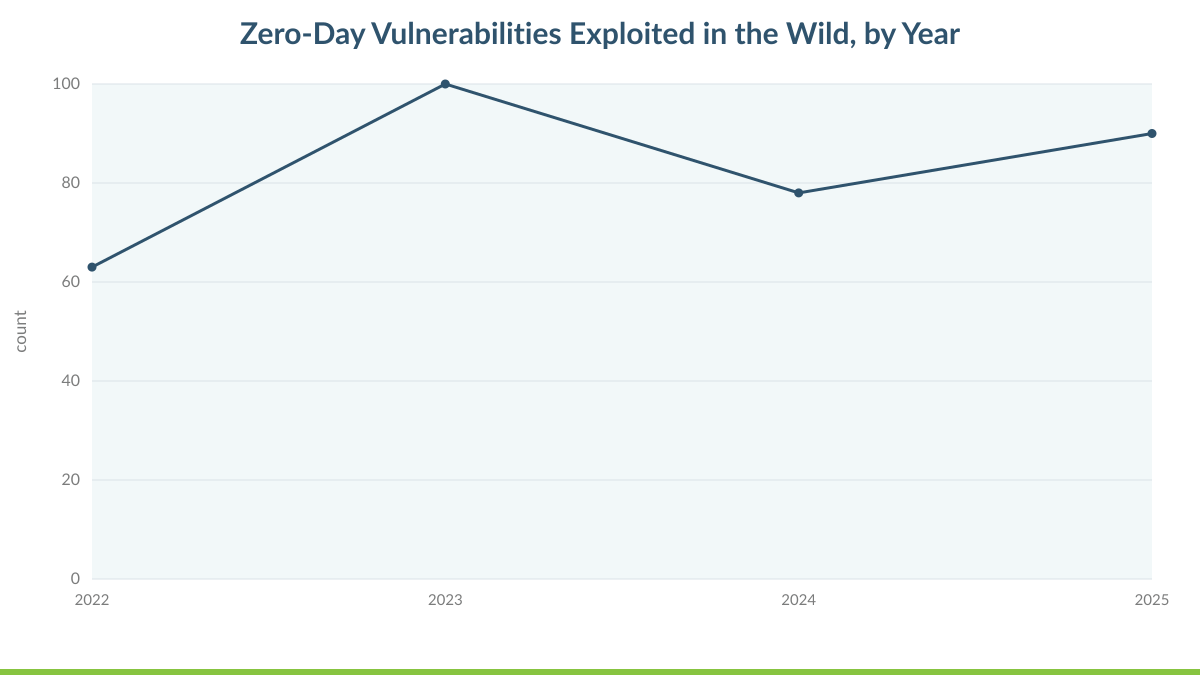
Google’s Threat Intelligence Group tracked dozens of zero-day vulnerabilities exploited in the wild in a single year, a figure reported by BleepingComputer in its coverage of the group’s annual review. The count moves year to year, but the direction of travel is unmistakable: adversaries increasingly weaponize flaws before the broad population of organizations has tested and deployed the fix. When the fix itself can be bypassed, as with the Defender case, that window widens further.
What changed structurally is the economics of exploitation. A decade ago, weaponizing a zero-day demanded rare skill and time. Today, a mature marketplace of exploit brokers, ransomware-as-a-service affiliates, and state-aligned research shops compresses the interval between disclosure and mass exploitation from months to days, sometimes hours. Enterprises with 24/7 security operations can react inside that window. A mid-market IT team that patches on a monthly change cycle cannot. The Defender bypass sits precisely in that gap: even a diligent shop that applied the fix on schedule was, in the demonstrated scenario, still exposed, because the fix did not hold.
The operating system layer carries a disproportionate share of that exposure. Windows sits under the majority of mid-market endpoints and servers, which makes it the highest-value target surface for both criminal and state-aligned actors.
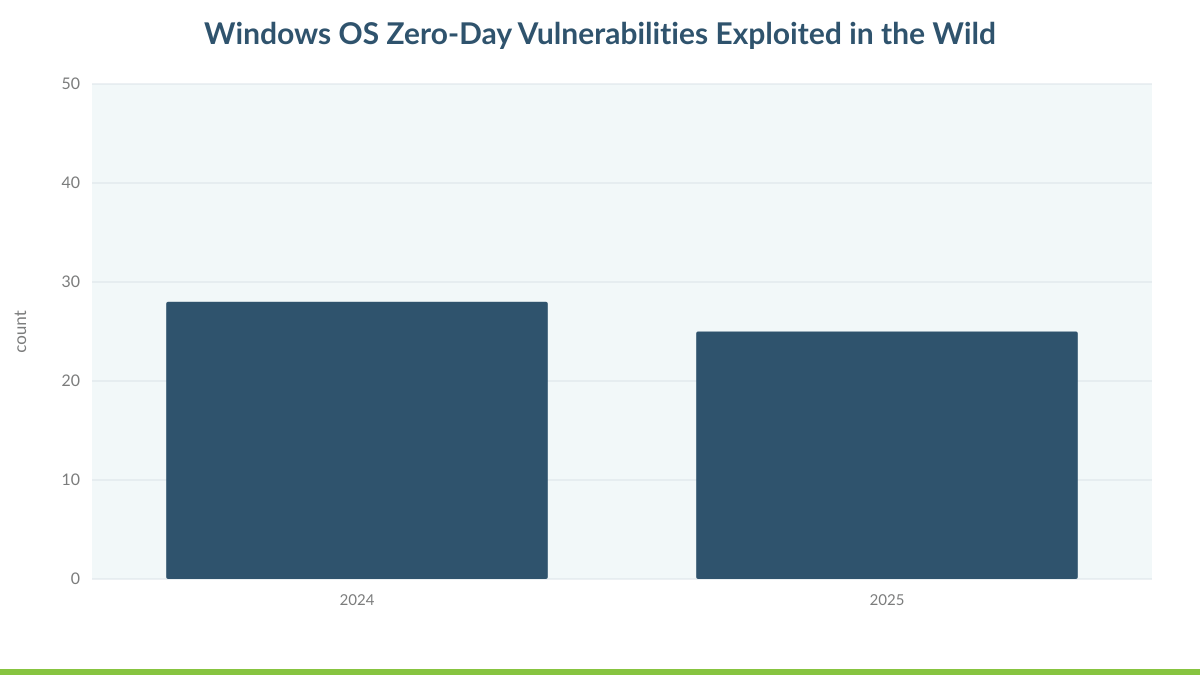
HP Wolf Security’s review of zero-day vulnerabilities exploited in malware campaigns, summarized in the chart above, underscores how frequently Windows OS-level flaws show up in real attack chains rather than lab demonstrations. For an IT leader, that reframes the Defender bypass: it is one instance of a broader reality in which the platform and its security tooling are under continuous, well-resourced attack. The lesson is not to distrust a single vendor but to design as though any single layer will eventually fail, because at this cadence of exploitation, one of them will.
What Patch Tuesday actually tells us about your exposure
Every month, Microsoft’s Patch Tuesday releases fixes for scores of vulnerabilities. Reading the mix by impact type is more useful than counting the raw total, because it tells you which risks dominate your monthly exposure and which you cannot afford to leave unpatched.
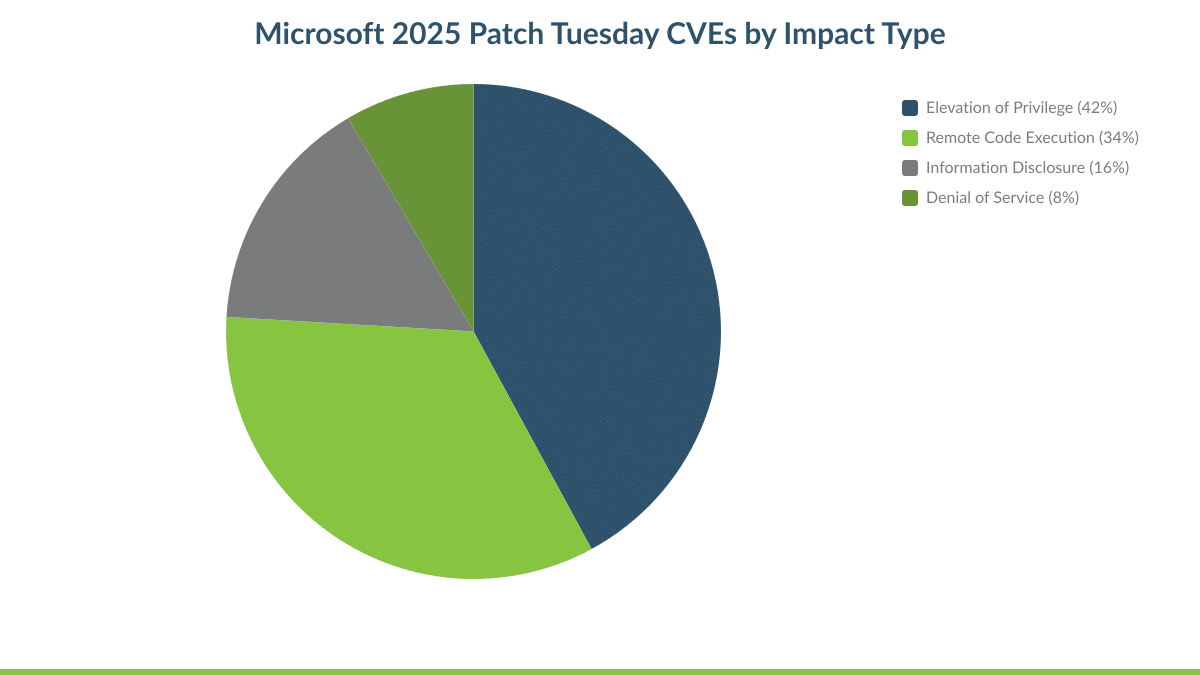
Tenable’s year-in-review of Microsoft Patch Tuesday, reflected in the breakdown above and detailed in Tenable’s analysis, shows that remote code execution and elevation of privilege consistently make up a large share of what Microsoft fixes. Those two categories are precisely the ones that let an attacker run their own code and then climb to administrative control. A Defender bypass is dangerous specifically because it removes the tripwire that would otherwise flag that code before it runs.
Picture the chain concretely. An elevation-of-privilege flaw lets an attacker who already has a foothold move from a standard user account to SYSTEM on a single machine. A remote code execution flaw lets them plant that foothold in the first place, often through a malicious document or a vulnerable service reachable from the network. Chain the two together and you have the classic breach kill chain: initial access, then privilege escalation, then lateral movement to a domain controller. At every one of those steps, endpoint detection is supposed to raise a flag. A bypass of that detection turns a noisy, catchable sequence into a quiet one. That is why the impact-type breakdown matters more than the headline count.
Here is the business translation. If elevation of privilege and remote code execution dominate your monthly patch load, and if your primary endpoint control can be bypassed, then two of the three legs of your defense stand on the same shaky assumption: that the patch got applied everywhere, on time, and that it held. In a mid-market environment with lean staff, patch coverage is rarely 100 percent and rarely instant. That is not a criticism of your team. It is the reality of finite hours against an infinite backlog. Every unpatched or lagging endpoint is a candidate entry point, and every candidate entry point that relies on a single, bypassable detection layer is a breach waiting for the right week.
Counting patches tells you how busy your month was. Reading them by impact type tells you how exposed your business actually is.
The mid-market gap: same threats, fewer hands
Enterprises absorb a Defender bypass differently than mid-market firms do. A Fortune 500 security operations center has a threat-hunting team, a dedicated patch program, and layered detection from multiple vendors already deployed. When a bypass surfaces, they have compensating controls that catch what the failed control missed. They also have the budget to run tabletop exercises, retain incident-response firms on standby, and staff a rotation that watches alerts overnight and on weekends, when attacks are most often timed to land.
The mid-market faces the same adversaries with a fraction of the staff. A 300-person manufacturer or a regional law firm typically runs the default endpoint agent, a firewall, and a backup product, often managed by a small internal team wearing several hats. When the primary control is bypassed, there may be no second set of eyes and no second layer to catch the intrusion. The same IT lead responsible for patching is also fielding help-desk tickets, provisioning laptops, and keeping the ERP system running. Continuous threat monitoring is not something a two- or three-person team can realistically deliver around the clock, and attackers know it. That is the exposure a layered, managed approach is built to close.
This is why we position Security as a Service (SECaaS) not as a single tool but as a coordinated stack. It combines endpoint detection from vendors like CrowdStrike, network enforcement from Fortinet, and email and identity protection from Proofpoint and Microsoft, all monitored so that a failure in any one layer is caught by another. A Defender bypass is survivable when it is one alarm in a system of alarms, not the only alarm in the building. The monitoring matters as much as the tooling: a stack no one is watching after 6 p.m. is a stack that fails silently, which is the same outcome as having no stack at all.
Defense in depth, translated into architecture
“Defense in depth” gets said so often it has lost its edge. Made concrete, it means an attacker who defeats one control still has to defeat several more, each of a different kind, before they reach data or control. Here is how that maps to the layers a mid-market environment should have in place.
- Endpoint: More than one detection philosophy, so a bypass of signature or behavioral detection on one agent does not blind the whole estate.
- Network: Segmentation and intrusion prevention, so code that runs on one host cannot move freely to the domain controller or the file server.
- Identity: Multi-factor authentication and least privilege, so elevation of privilege on one machine does not translate into domain-wide control.
- Data: Immutable, tested backups that an attacker cannot alter even after gaining administrative rights.
- Recovery: A rehearsed path to restore operations in hours, not days, if prevention and detection both fail.
Each layer buys time and forces error. An attacker who bypasses the endpoint agent still trips network intrusion prevention when they scan for reachable hosts. If they evade that, least-privilege design means the credential they stole opens one door rather than the whole building. If they escalate anyway, immutable backups deny them the one prize that makes ransomware pay: the ability to destroy your ability to recover. Every added layer does not just reduce probability, it multiplies the number of independent capabilities an attacker must possess, and few campaigns are equally skilled at all of them.
The Defender bypass attacks the first layer. A well-built architecture ensures that defeating it is not the same as winning. That is the whole point of layering, and it is why we run workloads on Managed Cloud Hosting where security, segmentation, and monitoring are built into the platform rather than bolted onto it after the fact. Segmentation designed into the hosting fabric is far harder for an attacker to flatten than segmentation retrofitted onto a flat network that grew organically over a decade.

When prevention fails, recovery is the business continuity plan
Assume the bad day. A bypass lets malicious code run, it disables detection, and it encrypts or corrupts production data before anyone notices. In that scenario, prevention has already lost. The only thing standing between your organization and a multi-week outage is how fast and how completely you can recover.
This is where Disaster Recovery (DRaaS) earns its place in the budget. Not only does it give you a tested failover to clean infrastructure, but it also compresses recovery time from the guesswork of ad hoc restores to a defined, rehearsed workflow. Paired with immutable Backup as a Service built on Veeam, it means an attacker who seizes control of production still cannot reach the copies you will rebuild from.
The financial arithmetic makes the case plainly. A mid-market firm that loses its production environment for two weeks is not just paying for remediation. It is losing revenue every day systems are down, paying staff who cannot work, absorbing contractual penalties for missed deliverables, and spending months rebuilding customer trust. Weigh that against the cost of a DRaaS subscription and a quarterly failover test, and the recovery capability pays for itself the first time it is needed. The organizations that fare worst in ransomware incidents are almost never the ones that spent too much on recovery. They are the ones that discovered, mid-crisis, that their backups were reachable, incomplete, or untested.
Immutability is the point most often missed. If a bypass grants administrative control, the attacker will try to delete or encrypt your backups first, because they know that a company with clean backups does not pay the ransom. Backups that cannot be altered for a defined retention window neutralize that move. Recovery stops being a hope and becomes a schedule. Modern ransomware playbooks explicitly hunt for backup servers and cloud storage credentials early in the intrusion precisely because destroying recovery options is what converts a nuisance into a payday.
An attacker who seizes control of production should still find your recovery copies out of reach. Immutability is what turns a ransom demand into an inconvenience.
The measure of readiness is not whether you own a DR product. It is whether you have run a failover recently enough to trust it. A recovery plan that has never been tested is a document, not a capability. Restores fail in practice for mundane reasons: a missing dependency, a service account whose password rotated, an application server that assumed a network path that no longer exists in the recovery site. You want to discover those gaps during a scheduled drill, not at 3 a.m. during an actual encryption event. Our DR Failover Validation Plan Template exists precisely to turn that document into a proven, repeatable drill.
The patch gap and why managed operations close it
Return to the core problem the Defender bypass exposes. The vendor released a fix. The fix could be bypassed. Even setting aside the bypass, most organizations do not apply fixes the day they ship. Testing, change windows, and legacy application compatibility all add days or weeks. During that interval, the vulnerability is public, exploit code often circulates, and the organization is exposed.
Managed operations shrink that gap in two ways. First, patch deployment becomes continuous and instrumented rather than periodic and manual, so coverage climbs toward complete and the window between disclosure and deployment closes. Instrumentation is the underrated half of that: knowing precisely which of your 400 endpoints received the update and which three failed silently is the difference between real coverage and assumed coverage. Second, when a patch is bypassable or not yet applied, virtual patching and network-level controls, such as Fortinet intrusion prevention, can block the exploit path even before the endpoint fix lands. That is a compensating control doing exactly what layered defense promises.
Virtual patching deserves particular attention in the Defender context. When a fix is either unavailable, unapplied, or, as in this case, bypassable, a network-level signature that recognizes and blocks the exploit attempt buys you protection independent of the endpoint entirely. The attacker’s traffic is dropped before it reaches the vulnerable component, regardless of whether the endpoint control would have caught what ran afterward. For a lean team, that is protection that does not depend on being fast enough to win a race against exploit developers.
Our Managed Services practice is built around that discipline. The goal is not only to apply patches faster but also to ensure that no single failed or bypassed patch leaves the environment defenseless while the next fix is prepared. For teams stretched thin, that shift, from reactive patching to instrumented, layered operations, is the difference between reading about a bypass and being victimized by one.
What this means for regulated and revenue-critical workloads
The stakes rise sharply in regulated sectors. A healthcare provider whose Defender-protected billing servers are compromised faces not only downtime but also potential exposure of protected health information and the regulatory scrutiny that follows. A law firm faces client-confidentiality obligations and, increasingly, cyber insurance requirements that demand demonstrable layered controls and tested recovery before they will pay a claim. A manufacturer running just-in-time production faces a supply chain that stops moving the moment its systems go dark, with downstream partners feeling the outage within hours.
For those organizations, a bypass of the primary endpoint control is not just a technical event, it is a compliance and insurability event. Underwriters now ask whether you run multi-factor authentication, endpoint detection and response, immutable backups, and a tested recovery plan. “We rely on the built-in antivirus” is no longer an answer that keeps premiums down or claims paid. Increasingly, insurers reserve the right to deny a claim outright if the controls attested on the application were not actually in place at the time of the incident, which turns a checkbox on a renewal form into a material financial risk. Firms preparing for renewal should review their posture against the concrete expectations we outline in our 2026 Cyber Insurance Renewal Requirements for Law Firms.
The Simplification pillar matters here too. Assembling multi-vendor security, immutable backup, segmented networking, and tested DR yourself is complex, and complexity is where mistakes hide. Every integration seam between products is a place where an alert can be dropped, a log can go uncollected, or a responsibility can fall between two teams. Consolidating that stack onto a single accountable partner reduces the number of seams an attacker can exploit and the number of vendors you have to chase during an incident. When something breaks at 2 a.m., you want one number to call and one team that owns the outcome, not a finger-pointing exercise between an endpoint vendor, a backup vendor, and a firewall vendor. Enterprise-grade protection without enterprise complexity is not a slogan when it is delivered as an integrated platform.
A practical response plan for the next bypass
There will be another Defender bypass, and another flaw in another vendor’s flagship control after that. Treat this incident as a rehearsal for the pattern rather than a one-off headline. Here is the sequence we recommend to mid-market IT leaders.
- Confirm coverage, not just deployment. Verify that the relevant Microsoft updates are actually installed across every endpoint and server, and identify the machines that lag.
- Add a second detection layer. Do not rely on a single agent. Pair the built-in control with independent endpoint detection and response so a bypass of one is caught by the other.
- Deploy compensating network controls. Use intrusion prevention and segmentation so an exploit that beats the endpoint cannot spread to critical systems.
- Make backups immutable and test restores. Ensure recovery copies cannot be altered by an attacker with administrative rights, and prove you can restore within your recovery-time objective.
- Rehearse failover. Run a DR drill so that if prevention and detection both fail, the business is back online in hours.
None of these steps depends on the specific technique the researcher used. That is deliberate. The value of layered defense is that it holds regardless of which single control fails next. You are not defending against one bypass. You are building an environment where any single bypass is contained. Work the list in order of leverage: confirming coverage and adding a second detection layer are the fastest wins, while immutability and rehearsed failover are the controls that determine whether a worst-case day is a bad afternoon or a company-threatening month.
Reframe: the question is not whether your control can be bypassed
The researcher already answered the question of whether a Microsoft Defender patch can be bypassed. It can. So the useful question for your organization is different: when a control you depend on fails, and it will, does the rest of your architecture catch the fall? If the honest answer is that a single bypassed agent would let an attacker run code, elevate to administrator, and reach your data and your backups uncontested, then the exposure is not Microsoft’s roadmap. It is your architecture.
Fixing that is a design decision you can make now, before the next bypass makes it for you. Layered detection, segmented networks, immutable backups, and tested recovery turn a single point of failure into a single caught intrusion. That is the shift from hoping the patch holds to knowing your environment does. The firms that will look prepared a year from now are the ones treating this bypass not as a story to skim but as a prompt to audit their own single points of failure while there is still time to close them calmly.
Lou Corriero, VP Cloud at IT Vortex, works with mid-market teams to build exactly that kind of layered, tested resilience on VMware-powered managed cloud. To pressure-test your own posture against the Defender bypass scenario and map the gaps, schedule a working session with Lou Corriero. IT Vortex acts as your integrator, architect, and advisor, not a reseller handing you another tool to manage alone.