On October 29, 2026, CSO Online reported that the PHP2Shell saga had entered a more dangerous phase: attackers are now chaining the critical PHP2Shell vulnerability with a high severity Linux kernel privilege escalation flaw to go from a foothold on a web server all the way to root. The US Cybersecurity and Infrastructure Security Agency (CISA) has warned that the kernel flaw, identified as CVE-2026-46300, is being exploited in the wild alongside PHP2Shell bugs that impact millions of organizations worldwide.
For mid-market IT leaders, this is not an abstract research curiosity. It is a documented, in-the-wild pattern that turns a single exposed web application into a total server compromise. The pairing, reported as PHP2Shell plus Fragnesia, removes the comfortable assumption that a web shell is a contained, user-level problem. Once an attacker reaches root, every control you built on top of that server is negotiable.
What PHP2Shell plus Fragnesia Actually Does
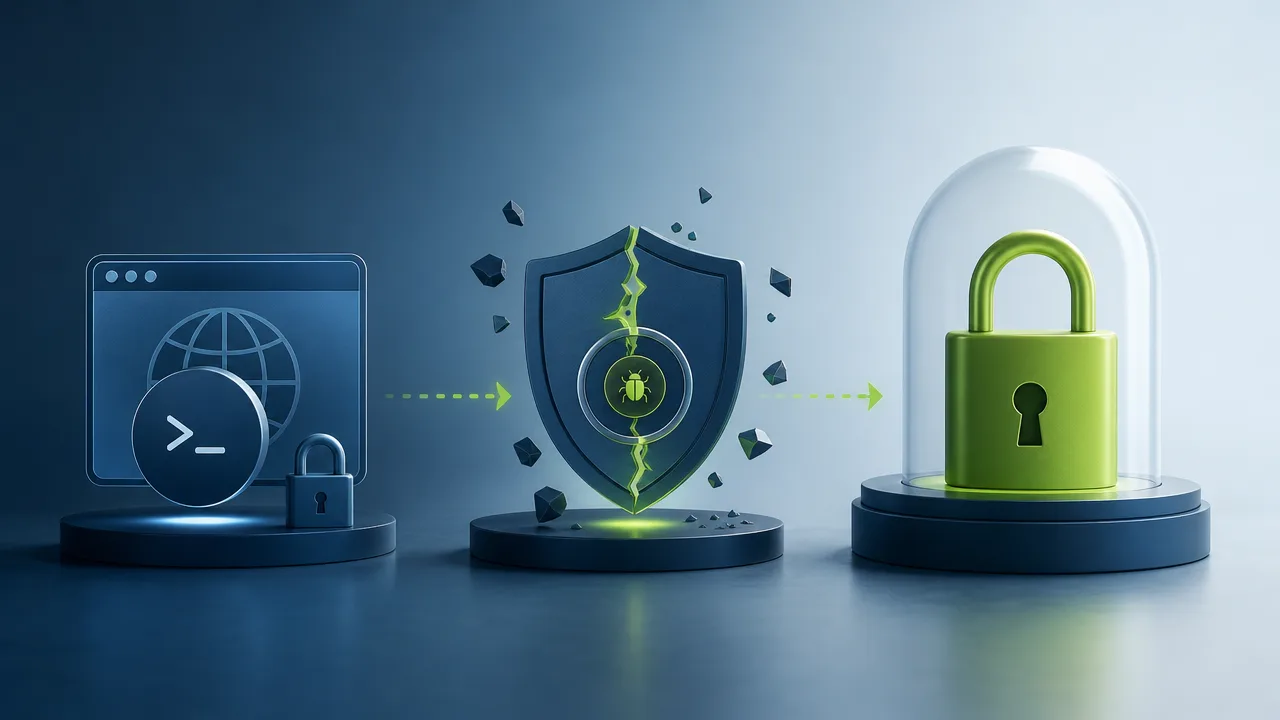
The attack unfolds in two stages. The first stage is the PHP2Shell vulnerability itself, which gives an attacker remote access to a vulnerable web server. That access, on its own, typically runs with the limited permissions of the web server process. In a well-configured environment, that limitation is what stops a web application compromise from becoming a server compromise. The attacker can read what the web user can read and write what the web user can write, and not much else.
The second stage breaks that boundary. By chaining the initial PHP2Shell access with the Linux kernel privilege escalation flaw CVE-2026-46300, the attacker elevates from the constrained web user to root. As Scott Miserendino, CTO at security and compliance platform DataBee, explained to CSO Online, once attackers establish root access they can perform any action on a server including, but not limited to, disabling the server, creating accounts, removing accounts, connecting to other servers, and adding or removing software.
A web shell is a door into one room. Root access is the master key to the entire building, including the rooms you forgot you had.
The business translation is stark. PHP2Shell allows for remote access, but that access is only as dangerous as the permissions behind it. Fragnesia removes the permission ceiling. An attacker who can disable a server destroys availability. An attacker who can create and remove accounts destroys identity controls. An attacker who can connect to other servers turns one breach into lateral movement across your estate. This is why the chain matters more than either flaw does in isolation.
Why the Mid-Market Sits Squarely in the Blast Radius
PHP remains a common foundation for the web applications mid-market companies actually run: content management systems behind marketing sites, customer and vendor portals, intranet tools, and custom line-of-business applications written years ago by a contractor who has long since moved on. Many of these systems are internet-facing by design, and few have a named owner who tracks their security posture with the rigor applied to email or ERP.
That ownership gap is the real exposure. A staging server spun up for a website redesign, a legacy portal kept alive for a single customer, a Linux virtual machine that nobody has rebooted since its kernel was installed: each is a plausible first link for PHP2Shell and a plausible second link for Fragnesia. Large enterprises fund dedicated vulnerability management teams to find these orphaned assets. Mid-market organizations usually rely on a small infrastructure team juggling help desk tickets, projects, and vendor renewals at the same time. Attackers chaining exploits at scale do not care about company size. They scan for the vulnerable combination and take whatever answers.
Consider a hypothetical but representative example. A regional distributor runs a dealer ordering portal written in PHP on a Linux virtual machine that shares a network segment with its file servers. The portal is exposed to PHP2Shell, the host kernel is unpatched against CVE-2026-46300, and the database connection string sits in a readable configuration file. The attacker moves from portal to root to database to file server in a sequence where no single team made a mistake that was visible on its own dashboard. The failure lives in the gaps between teams, and that is exactly where chained exploits are designed to operate.
Why Chained Exploits Beat Single-Point Defenses
Most mid-market security programs are built to stop single events. A firewall rule blocks a port. A patch closes a CVE. An endpoint agent flags a known binary. These controls work well against isolated attacks, and they fail quietly against chains. The PHP2Shell plus Fragnesia route is dangerous precisely because each link looks survivable on its own. A web application flaw feels like an application team problem. A kernel flaw feels like an operating system patch cycle problem. Neither team necessarily sees the combined risk until the two are stitched together on a live server.
This is the same pattern we have written about before. In our coverage of exploited vulnerability prioritization, the lesson was consistent: defenders who rank vulnerabilities by real-world exploitation close the specific doors attackers actually use, rather than drowning in an undifferentiated backlog of theoretical risk. CVE-2026-46300 is not theoretical. CISA has confirmed active exploitation, which moves it to the top of any sane prioritization list.
The defensive implication is that you cannot rely on a single control to break the chain. You need defense in depth that assumes any one layer may fail. If the web application is compromised, the operating system should be patched against escalation. If the operating system is compromised, the network should limit lateral movement. If the network is breached, your backups should be clean, isolated, and recoverable. Each layer buys time and limits blast radius. This is where Security as a Service (SECaaS) earns its place, by coordinating controls that individual teams tend to manage in silos.
The Root Access Problem: Resilience Under Fire
Once an attacker holds root, your incident response changes character entirely. You are no longer investigating a suspicious file in a web directory. You are facing an adversary who can alter logs, disable monitoring agents, create persistence mechanisms, and cover their tracks with the same authority your own administrators have. The usual question, how do we remove the malicious code, becomes the much harder question, can we trust anything on this server at all.
The honest answer in most root-compromise scenarios is no. A server that has been owned at the root level cannot be reliably cleaned in place, because the tools you would use to verify the cleanup run on the same compromised kernel the attacker controls. The defensible recovery path is to rebuild from a known-good state and restore data from backups that the attacker never touched. That requirement is exactly why ransomware operators and sophisticated intruders now go after backups first, a pattern we detailed in our analysis of why backups have become the primary target.
Root access also exposes every secret stored on the host. Database connection strings in application configuration files, SSH private keys, API tokens for payment or shipping integrations, and cached service account credentials all become readable. Containment therefore extends well beyond the server itself. Every credential that lived on the compromised host must be treated as stolen and rotated, and every system those credentials could reach must be reviewed for follow-on access. Teams that skip this step often rebuild the server cleanly, then watch the attacker walk back in with a password harvested during the first intrusion.
A root compromise is not a cleanup project. It is a rebuild. The only question that matters afterward is whether your backups survived the same attack that took the server.
This is where resilience stops being a slogan and becomes an architecture. Backup as a Service (BaaS) built on immutable, air-gapped storage means that even an attacker with root on a production server cannot reach back and corrupt your recovery points. Immutability is the property that matters here: a backup that cannot be altered or deleted for a defined retention window survives exactly the privilege level that Fragnesia grants. Pair that with Disaster Recovery (DRaaS) and you convert a catastrophic root compromise into a measured, tested failover rather than an improvised scramble.
Patch Velocity and the Kernel Problem
The first line of defense against the Fragnesia half of this chain is patching the kernel. That sounds simple and it is operationally hard. Kernel patches frequently require a reboot, and reboots on production workloads mean scheduled maintenance windows, change approval, and coordination with application owners who do not want their systems down. The result, in too many mid-market environments, is that kernel updates lag behind application patches by weeks or months. Attackers know this. The lag between a CISA warning about active exploitation and the completion of a full patch cycle is the exact window the PHP2Shell plus Fragnesia chain exploits.
Closing that window is a performance and simplification problem as much as a security one. When your infrastructure is spread across aging physical servers and ad hoc virtual machines, patching is slow because every system is a little different. When your workloads run on a standardized, VMware-powered managed cloud platform, patch orchestration, rolling reboots, and live migration let you update the underlying hosts without the long outages that make teams defer the work. That is one of the practical reasons organizations consolidate onto managed cloud hosting: not only to reduce hardware sprawl but also to make security maintenance fast enough to matter.
As a Premier Broadcom VCSP Partner, IT Vortex operates the VMware stack that makes this cadence realistic for mid-market teams. Live migration moves running workloads off a host so the host can be patched and rebooted, then moves them back, with the application owners none the wiser. The kernel flaw at the center of CVE-2026-46300 is a concern for every Linux system in the chain, and the platform that lets you schedule and execute updates quickly is a direct risk reducer. Patch velocity is a measurable control, the kind your auditors understand, and the organizations that recover cleanly are the ones that treated it that way before the incident.
Detecting the Chain Before It Finishes
Patching closes the door. Detection tells you whether someone already walked through it. Because the chain has two stages, there are two distinct moments to catch it. The first is the web foothold, which tends to leave behavioral traces: new or modified script files in upload and cache directories, and the web server process launching command shells or network utilities it has no business running. A PHP application that suddenly spawns a shell is one of the clearest signals in infrastructure security.
The second moment is the escalation itself and what follows. Watch for processes running as root whose lineage traces back to the web server user, new local accounts or changes to privileged groups, unfamiliar kernel modules, altered scheduled tasks, and monitoring agents that stop reporting. That last signal matters most, because an attacker with root will try to blind you. Endpoint detection from a partner such as CrowdStrike, combined with centralized log collection that lives off the host, means the evidence of tampering survives the tampering. Fortinet network controls add a third vantage point, flagging connections from a web server to internal systems it would never normally contact.
The business value is time. Catching the chain at the foothold stage means a contained application incident. Catching it after escalation but before lateral movement means a single server rebuild. Missing it entirely means discovering the breach when systems start failing and customers start calling.
Mapping the Threat to the Five Pillars
The PHP2Shell plus Fragnesia chain touches every pillar that defines enterprise-grade infrastructure. Walking through them turns a scary headline into a concrete action plan.
Security
The chain is a privilege escalation story at its core, so the security response is layered. Harden the web application to reduce the chance of the initial PHP2Shell foothold. Patch the kernel to remove the escalation path. Deploy endpoint detection that can flag root-level anomalies before an attacker finishes covering their tracks. A coordinated Security as a Service (SECaaS) program integrates these controls with partners such as Fortinet and CrowdStrike so that a compromise at one layer triggers visibility at the next.
Resilience
Because a root compromise means a rebuild, resilience is non-negotiable. Immutable backups and tested failover are what turn a worst-case server compromise into a recoverable event. If you have never validated a restore from an isolated backup copy, you do not actually know whether you are resilient. Our DR Failover Validation Plan Template exists to make that testing routine rather than aspirational.
Performance
Patch velocity is a performance question. The faster you can update hosts without disrupting workloads, the smaller the exposure window. A platform with live migration and rolling updates lets you close kernel vulnerabilities on a schedule measured in hours, not weeks.
Simplification
Standardized infrastructure is easier to patch, monitor, and recover. Every one-off server is a one-off risk. Consolidating onto a managed platform reduces the number of distinct systems your team must track against each new CVE.
Flexibility
A hybrid approach lets you place workloads where they are most defensible and most recoverable. Hybrid cloud services give you the option to isolate sensitive applications, segment network zones, and keep recovery environments separate from production so that a compromise cannot follow you into your backups.
A Practical Response Playbook for Mid-Market IT
Headlines create urgency but rarely create a plan. Here is a sequence a mid-market IT team can act on this week in response to the PHP2Shell plus Fragnesia chain.
- Inventory every internet-facing web server and confirm which run PHP applications that could be exposed to PHP2Shell. You cannot defend an asset you have not catalogued.
- Prioritize CVE-2026-46300 for immediate kernel patching on any host that could be reached from a compromised web application, treating the CISA active-exploitation warning as the deadline it effectively is.
- Verify that your backups are immutable and isolated from production credentials, so that root access on a server cannot reach your recovery points.
- Run a restore test. A backup you have never restored is a hypothesis, not a control.
- Segment your network so that a compromised web server cannot freely connect to other servers, directly countering the lateral movement that root access enables.
- Enable root-level anomaly detection and ship logs off the host, so an attacker with root cannot simply delete the evidence of their activity.
Each of these steps maps to a capability you can either build in-house or source from a managed provider. For teams stretched thin, the appeal of a managed approach is not only the tooling but also the operational discipline of someone who does this every day. Our managed services model is designed to carry exactly this kind of continuous vulnerability and recovery work so that your internal team can focus on the business.
Treat the CISA active-exploitation warning as a deadline, not a suggestion. The window between warning and compromise is where the whole chain lives.
The Compliance, Insurance, and Cost Dimension
A root compromise on a server that handles regulated data triggers obligations that extend well beyond IT. If the host processed cardholder data, protected health information, or personal information covered by state breach notification laws, the question is no longer purely technical. Legal counsel, forensic investigators, and potentially regulators and customers become involved, and every one of them will ask the same thing: what could the attacker reach, and can you prove what they did not reach. Root access makes that proof much harder, which tends to widen the scope of any investigation and any notification.
Patch discipline is also an explicit compliance expectation. PCI DSS v4.0 calls for critical security patches to be installed within one month of release, and federal civilian agencies operate under CISA Binding Operational Directive 22-01, which sets remediation deadlines for vulnerabilities listed in the Known Exploited Vulnerabilities catalog. Private companies are not bound by that directive, but it is a sensible benchmark for how seriously to treat confirmed exploitation. Cyber insurance underwriters increasingly ask about the same controls this chain tests: endpoint detection, immutable backups, network segmentation, and documented patch timelines. An organization that can demonstrate those controls is not only harder to breach but also easier to insure and faster to recover with its carrier’s support.
Why the Platform Choice Changes the Math
The deeper point behind the PHP2Shell plus Fragnesia story is that your infrastructure platform determines how expensive this class of attack is to survive. On fragmented, self-managed infrastructure, every element of the response above is harder. You patch slower because reboots are painful. You recover slower because backups were never tested. You detect slower because logging was inconsistent across systems that grew up independently. The cost of a root compromise scales with the disorganization of the environment it hits.
On a standardized managed cloud platform, the same attack is bounded. Hosts patch on a predictable cadence through live migration. Workloads sit behind consistent network segmentation. Backups are immutable by policy and tested on schedule. Recovery is a documented failover rather than an improvisation. The attacker may still reach root on a single server, but the blast radius is contained and the recovery is measured in the service levels you agreed to in advance. That contractual certainty is why mid-market leaders increasingly want recovery commitments written down, which is exactly what our Service Level Agreement is built to provide.
IT Vortex operates as an integrator, architect, and advisor, not a reseller of parts. The value is in assembling VMware, Veeam, Fortinet, CrowdStrike, and the rest into a coherent posture where the PHP2Shell plus Fragnesia chain meets a prepared defender at every step. That is the difference between an enterprise-grade response and an enterprise-grade bill.
From Headline to Hardened Posture
The PHP2Shell saga will keep evolving, because attackers keep finding new ways to chain the critical vulnerability into deeper compromise, and CVE-2026-46300 is the latest link. The right response is not to chase each new technique as it appears in the news. It is to build an environment where the generic attack pattern, from web foothold to privilege escalation to attempted destruction, meets a defender who has already closed the escalation path, isolated the backups, and rehearsed the recovery. That posture turns the next variant of this chain from an existential event into a Tuesday.
If you do not know whether your kernels are current, whether your backups would survive an attacker with root, or whether your recovery plan has ever been tested, those are the questions to answer before the next CISA warning lands. Schedule time with Lou Corriero, VP Cloud at IT Vortex, to review your exposure and your recovery readiness: book a working session here. Walk in with the headline. Walk out with a plan that makes the headline survivable.