
Sophos published The State of Ransomware 2025 in the spring of 2025, and the headline number for US mid-market leaders is not the ransom demand. It is the recovery bill. Across surveyed organizations, the mean cost to recover from a ransomware attack, excluding any ransom paid, climbed into the seven figures, while the share of victims who fully restored operations inside a week shrank year over year. For a 200-person manufacturer or a regional healthcare group, that is the difference between a bad quarter and an existential event.
The attackers changed their math, and most mid-market firms did not change theirs. The same Sophos research found that backup repositories themselves are now a primary target, because operators learned that a company without clean, isolated copies will negotiate faster and pay more. That single behavioral shift is why backup and disaster recovery readiness, not the firewall and not the ransom decision, has become the deciding factor in 2025-2026.
Why Ransomware Recovery Costs Are Surging for Mid-Market Firms
The surge in ransomware recovery costs is not a single line item. It is the compounding of several costs that arrive at the same time: forensic investigation, emergency staffing, hardware replacement, lost revenue during downtime, regulatory exposure, and the slow tax of rebuilding customer trust. Sophos data in The State of Ransomware 2025 shows recovery costs scaling with organizational complexity, and mid-market firms sit in the worst position of all. They run enterprise-grade application stacks but staff them with lean teams and consumer-grade recovery assumptions.
Walk through what each of those line items actually costs a 200-seat firm. Forensic investigation alone routinely runs into six figures, because incident response retainers bill premium rates and the investigation has to run before the business can trust any system enough to bring it back online. Emergency staffing means weekend and overnight engineering at multiples of normal labor cost, often supplemented by outside specialists who do not know the environment and must learn it under duress. Hardware replacement looks straightforward until you discover that the firmware on compromised systems can no longer be trusted, that supply lead times for server-class equipment stretch into weeks, and that the replacement gear still has to be configured, patched, and integrated before a single workload returns. None of these costs appear on a budget line before the attack, and all of them arrive at once afterward.
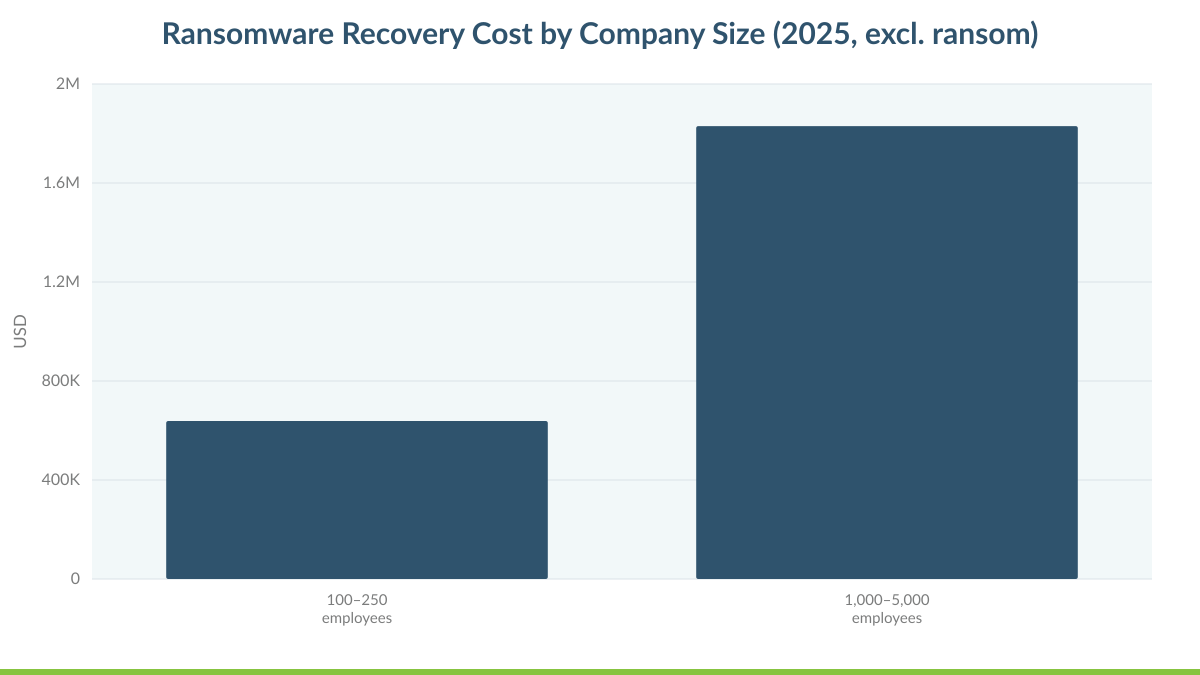
The chart above, drawn from Sophos, The State of Ransomware 2025, shows recovery cost rising with company size and excludes any ransom payment. The interpretation that matters for a US mid-market CIO is this: the cost curve is driven by how many interdependent systems must be rebuilt and validated, not by how big the ransom note is. A firm with sprawling, undocumented infrastructure pays more to recover regardless of whether it negotiates. That ties directly to the pillar of Simplification. Complexity is not just an operating annoyance. It is a recovery liability with a dollar value.
Consider why complexity multiplies cost during recovery specifically. Every undocumented integration, every server whose dependencies live only in one engineer’s memory, and every snowflake configuration becomes a separate puzzle that must be solved before the dependent systems can come back. A company running forty interdependent workloads with no current dependency map does not recover those forty workloads in parallel. It recovers them in a fragile sequence of trial and error, where bringing back an application server before its database, or restoring identity services after the systems that depend on them, triggers cascading failures that send engineers back to the start. The firms that simplified their estate before an incident, consolidating onto a documented, standardized platform, recover in a fraction of the time because the sequence is known and the surface is smaller.
The second cost driver is time. Downtime converts to lost revenue, missed SLAs, contractual penalties, and idle payroll. When recovery stretches from days into weeks, the business impact stops being an IT problem and becomes a board problem. A regional distributor that cannot process orders for two weeks does not simply lose two weeks of revenue. It loses customers who route their purchasing to competitors and do not fully return, it triggers penalty clauses in supply contracts, and it carries the fixed cost of payroll and facilities while generating nothing. This is where Disaster Recovery (DRaaS) earns its place, because the metric that controls cost is not whether you have backups but how fast you can resume operations from them under pressure.
The cost of a ransomware event scales with complexity, not with the size of the ransom note. Firms that simplified their recovery architecture pay less to recover, every single time.
Recovery Is Getting Slower, Not Faster
You would expect a decade of investment in backup tooling to make recovery faster. The data points the other way. Comparing the 2024 and 2025 editions of the Sophos research, the share of organizations recovering within a week declined, and the share taking a month or longer to fully restore grew. The reason is not weaker tools. It is smarter attackers who now corrupt, encrypt, or delete backups before they trigger the visible encryption event.
This dwell-time tactic deserves attention because it inverts the assumption most recovery plans are built on. The plan assumes that when ransomware fires, you reach for backups that are intact because they predate the attack. The modern attacker spends days or weeks inside the environment first, mapping the backup infrastructure, harvesting the credentials that protect it, and quietly poisoning or removing recovery points. By the time the encryption payload runs, the most recent clean backups may already be gone or tampered with, forcing the victim to restore from older copies that lose days of data and require painstaking validation. That is why a backup that completed successfully last night is not the same thing as a recovery point you can trust this morning.
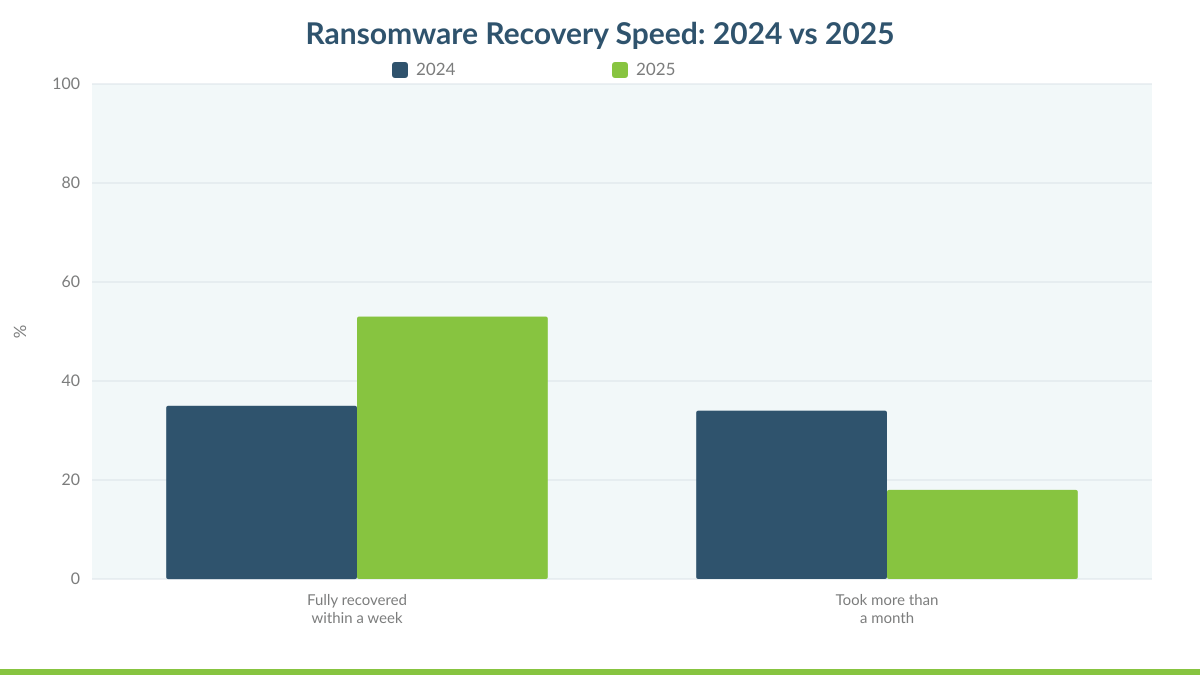
The comparison above, summarized from Sophos State of Ransomware 2025 via Cyber Security Asia, shows recovery speed moving in the wrong direction year over year. For an executive, the operational lesson is blunt: a backup you cannot restore quickly and cleanly is not a recovery plan. It is an archive. The pillar at stake here is Resilience, and Resilience is measured in recovery time objective (RTO) and recovery point objective (RPO), not in the existence of a backup job that completes overnight.
Slower recovery also exposes a quiet failure mode in mid-market environments: backups that were never tested under failover conditions. A backup that has never been restored end to end is a hypothesis, not a guarantee. The firms that recover in hours rather than weeks are the ones that rehearse failover on a schedule, validate that applications come back in the correct dependency order, and document the steps so recovery does not depend on one heroic engineer. Our DR Failover Validation Plan Template exists precisely because untested recovery is the most common and most expensive gap we find.
The gap between a backup that completes and a recovery that succeeds is wider than most leaders realize. We routinely find environments where the nightly job reports green for months, yet the first real restore attempt reveals that a database was backed up in an inconsistent state, that a critical application server was excluded from the job by a forgotten exception, or that the restore target lacks the capacity to bring everything back at once. Each of those discoveries adds hours or days to recovery, and each is discovered for the first time during the worst possible moment unless it was found earlier through disciplined testing. Rehearsing failover quarterly is not bureaucratic theater. It is the only way to convert an assumed RTO into a measured one the business can actually plan around.
Backup Is Now the Primary Target
The strategic shift that defines 2025-2026 is that backup infrastructure has moved from afterthought to front line. The Veeam 2025 Ransomware Trends Report documents that attackers attempt to compromise backup repositories in the overwhelming majority of incidents, and that a meaningful share succeed at least partially. When the backup is reachable from the same domain, the same credentials, and the same network as production, it is not a safety net. It is a second copy of the target.
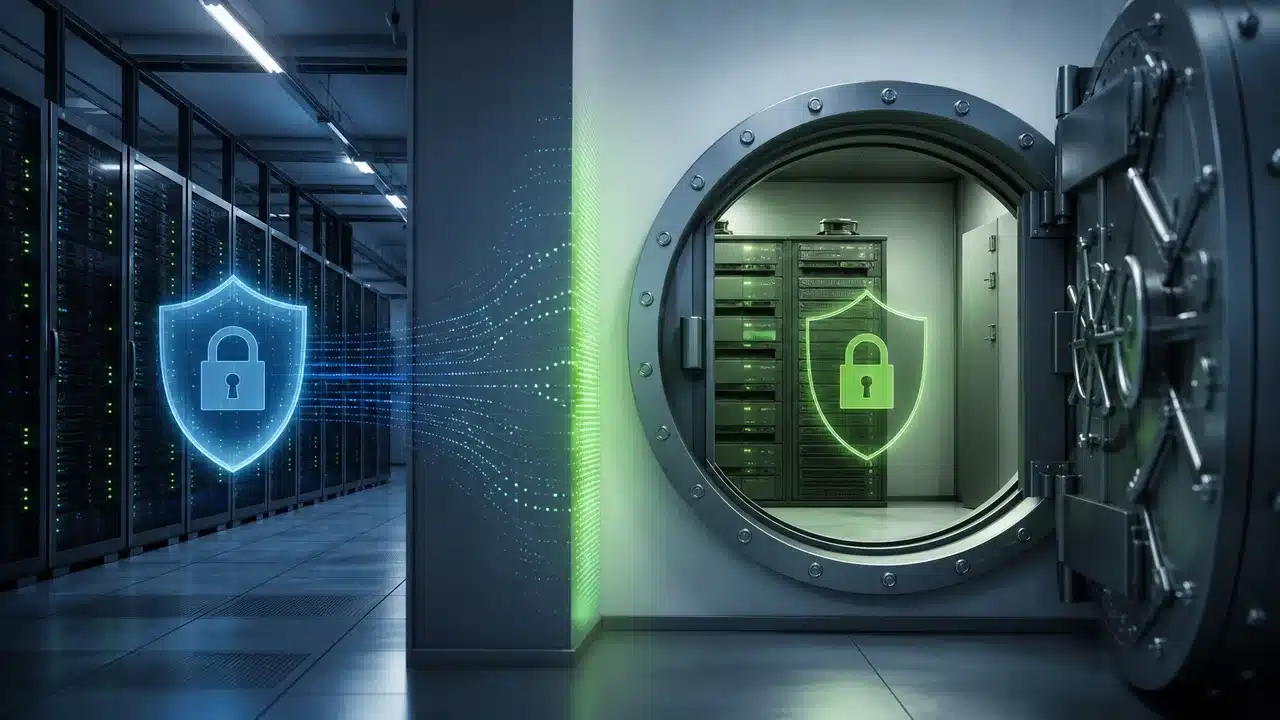
This is why immutability and isolation have become non-negotiable. Immutable backups cannot be altered or deleted within their retention window, even by an administrator with valid credentials, which neutralizes the attacker’s favorite move. Air-gapped or logically isolated copies ensure that compromising production does not automatically compromise the recovery set. Backup as a Service (BaaS) built on Veeam modern data protection delivers both as managed defaults rather than as configuration projects the customer must remember to finish.
The distinction between a managed default and a configuration project is where most mid-market recovery plans quietly fail. Immutability and isolation are achievable with the tooling most firms already license, but they require deliberate setup that competes with every other demand on a small team. The repository has to be placed outside the production domain, separate credentials have to be provisioned and protected with multi-factor authentication, retention locks have to be configured and verified, and the whole arrangement has to be maintained as the environment changes. In a lean shop, these tasks slip to the bottom of the queue until an incident proves they were the most important work on the list. Delivering them as a managed service removes that failure mode entirely, because the protective properties are operated and verified continuously rather than configured once and forgotten.
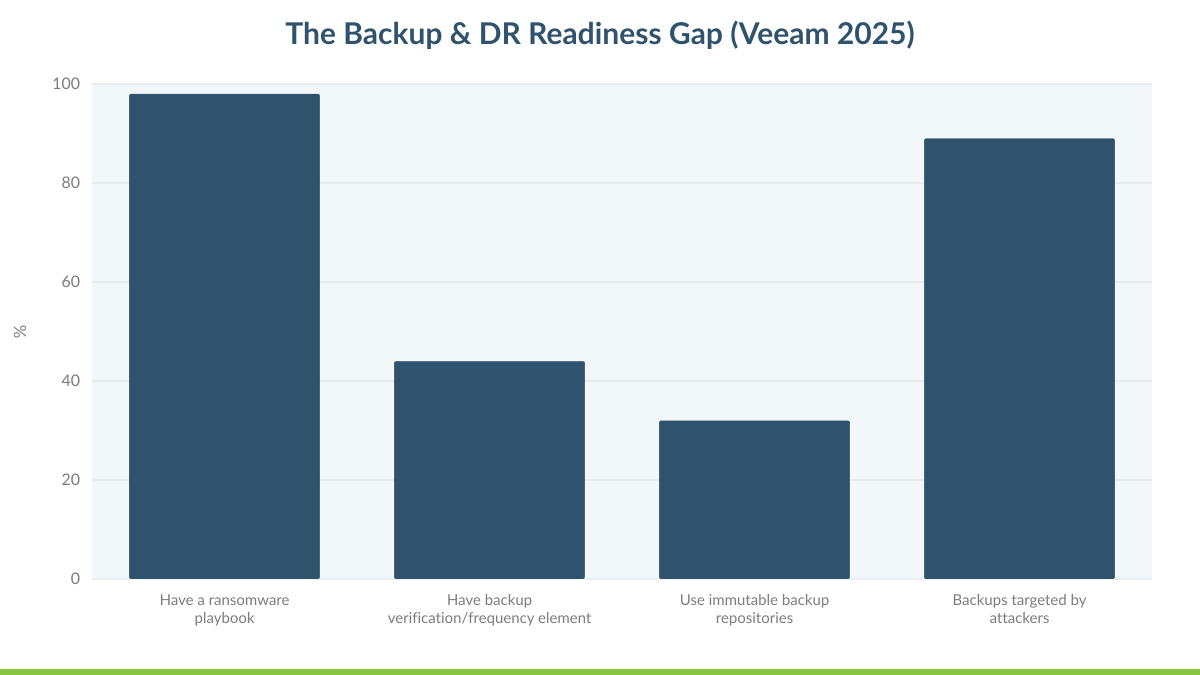
The readiness gap above, drawn from the Veeam 2025 Ransomware Trends Report via Object First and Veeam’s own release, captures the distance between confidence and capability. Many organizations believe they are protected while lacking immutable copies, tested recovery procedures, or isolated repositories. That gap is where recovery cost goes from manageable to catastrophic. Closing it is a Security pillar exercise, because protecting the recovery set is as critical as protecting production. The work that Security as a Service (SECaaS) and managed backup do together is to make the backup the one asset the attacker cannot reach.
Pairing SECaaS with managed backup closes the loop in a way neither does alone. SECaaS narrows the dwell time attackers rely on to find and poison backups, using endpoint detection from partners such as CrowdStrike and perimeter controls from Fortinet to surface intrusions before they reach the recovery infrastructure. Managed backup ensures that even when detection fails and an attacker does reach production, the recovery set sits behind a boundary the compromised credentials cannot cross. The first discipline buys time and visibility. The second guarantees a clean fallback. Together they convert backup from the attacker’s secondary objective into the one asset that stays out of reach, which is exactly the property that collapses the recovery-cost curve.
A backup that shares credentials and network with production is not a safety net. It is a second copy of the target, waiting to be encrypted.
The Mid-Market Disadvantage and How to Erase It
Mid-market firms occupy an awkward middle. They are large enough to be worth attacking and small enough that a single multi-week outage threatens the business, yet they rarely staff a dedicated recovery engineering team. The result is recovery readiness that exists on paper and collapses under real conditions. Three patterns recur in the environments we assess.
- Backups complete every night, but no one has performed a full application-level restore in the last twelve months, so RTO is unknown and probably optimistic.
- The backup repository sits inside the same Active Directory domain as production, meaning one set of compromised domain admin credentials reaches both.
- Disaster recovery is assumed to be the backup vendor’s job, when in reality orchestrating failover across networking, DNS, identity, and application dependencies is the hard part nobody owns.
That third pattern is the most dangerous because it hides behind a reasonable assumption. A backup product copies data faithfully, and leaders conclude that recovery is therefore handled. But restoring a list of virtual machines is not the same as resuming a business. The recovery set has to come back into a network that has been rebuilt, with DNS resolving correctly, identity services online and trusted, and applications started in an order that respects their dependencies. That orchestration is engineering work that no backup license performs on its own, and in most mid-market firms no single role owns it. When the incident hits, the gap surfaces as paralysis: the data is there, but nobody has the runbook that turns that data back into working systems.
Erasing the disadvantage does not require an enterprise budget. It requires an architecture decision: treat recovery as a managed service with clear ownership, immutable storage, tested failover, and a contractual SLA, rather than as a collection of jobs and hopes. Moving production into managed cloud hosting on VMware-powered infrastructure does more than simplify operations. It places workloads where automated recovery workflows can be designed, rehearsed, and held to a written standard. Our Service Level Agreement is published precisely so recovery commitments are documented, not implied.
The economics favor the managed approach for a reason mid-market leaders often miss. Building equivalent recovery readiness in-house means hiring or retaining specialized engineers, standing up a second isolated site, licensing and operating the orchestration tooling, and committing to a rehearsal cadence that a busy team will struggle to protect. Those are fixed costs carried every month against an event that, with luck, never comes. A managed model converts that fixed burden into a predictable operating cost while delivering the rehearsed, owned, and contractually backed recovery that an internal team rarely achieves under real-world workload pressure. The firm gets enterprise recovery posture without enterprise complexity, which is the entire point of removing IT complexity in the first place.
The Flexibility pillar matters here too. A mid-market firm should not have to choose between keeping a sensitive workload on private infrastructure and protecting it with cloud-scale recovery. Hybrid cloud services let you keep regulated or latency-sensitive systems where they belong while replicating them to an isolated recovery environment, so the recovery posture is uniform even when the production footprint is not. A clinical application bound by data residency rules can stay on private infrastructure while its protected copies replicate to an isolated recovery target, giving the firm a single, consistent recovery standard across a deliberately mixed estate.
What Good Recovery Readiness Actually Looks Like
Readiness is not a product you buy once. It is a set of properties you can verify on any given Tuesday. When we architect Disaster Recovery (DRaaS) for a mid-market client, we hold the design to the following standard, and we recommend every IT leader apply the same test to whatever they have today.
- Immutable, retention-locked backups that no credential, including domain admin, can alter or delete within the protection window.
- Logical or physical isolation between production and the recovery repository, so a production breach cannot propagate to the recovery set.
- A documented, rehearsed failover that brings applications back in correct dependency order, with a measured RTO and RPO the business has approved.
- Clear ownership of every recovery step, written down, so resumption does not depend on one person being reachable at 2 a.m.
- A contractual SLA that turns recovery expectations into commitments with consequences.
This standard delivers value across every pillar at once. Simplification reduces the surface that must be rebuilt. Security protects the recovery set itself. Performance ensures the restore happens fast enough to matter. Resilience guarantees the business resumes inside a known window. Flexibility lets the design fit the firm’s real footprint rather than forcing a migration nobody wanted. That is not only a technical posture but also a financial one, because every property on that list directly lowers the recovery cost the Sophos data warns about.
The test these five properties pass is deliberately practical. Any IT leader can sit with their team and ask, in plain terms, can we prove each one today. Can we show that the retention lock would survive a domain admin compromise. Can we point to the last full failover rehearsal and the RTO it measured. Can we name the owner of each recovery step without anyone reaching for a guess. The questions are simple, but the answers separate firms that will recover in hours from those that will spend weeks discovering what they assumed but never verified. The value of the standard is that it converts a vague sense of being protected into specific, falsifiable claims, and falsifiable claims are the only kind worth betting a business on.
Regulated industries carry an additional layer. Healthcare organizations face HIPAA breach obligations the moment patient data is exposed, and the recovery timeline interacts with notification deadlines. A recovery that drags on does more than cost revenue. It can extend the period of unauthorized access that determines the scope of a reportable breach, and it can collide with the clock running on patient notification. Our HIPAA Recovery Readiness Checklist maps recovery readiness to those regulatory realities so the recovery plan and the compliance plan are the same plan, not two documents that contradict each other during a crisis.
The Cyber Insurance Pressure Most Firms Underestimate
Recovery readiness is no longer just an internal best practice. It is increasingly a condition of coverage. Underwriters reviewing 2026 renewals are asking whether backups are immutable, whether failover has been tested, and whether multi-factor authentication protects the backup console specifically. Firms that cannot answer those questions affirmatively face higher premiums, lower limits, or declined coverage. The recovery posture that lowers your Sophos-style recovery cost is the same posture that keeps your policy affordable. For firms navigating that pressure, our work on 2026 cyber insurance renewal requirements shows how technical controls map to underwriting questions.
The convergence is worth making explicit because it changes the budget conversation. An IT leader asking the board to fund immutable storage and DR rehearsal is no longer making a purely technical case that competes with feature work. The same investment that shrinks the recovery bill also satisfies the controls underwriters now require, which means it protects the firm’s ability to obtain coverage at a workable price. A declined policy or a doubled premium hits the same income statement as the recovery cost, and the same architecture defuses both. Framing the spend that way moves it from a discretionary IT line to a risk-transfer enabler the finance function understands and supports.
The recovery posture that lowers your ransomware recovery cost is the same posture that keeps your cyber insurance affordable. They are not two projects. They are one.
IT Vortex sits at the intersection of these pressures as an integrator, architect, and advisor, not a reseller handing over a license and walking away. As a Premier Broadcom VCSP Partner running VMware-powered infrastructure, and working with Veeam, Fortinet, and CrowdStrike across the stack, we design the recovery environment, isolate the backup set, rehearse the failover, and hold the result to a written SLA. Lou Corriero, VP Cloud at IT Vortex, leads these engagements with a single bias: recovery you have tested is the only recovery that counts.
From Recovery Cost to Recovery Confidence
The Sophos and Veeam data converge on one uncomfortable conclusion: in 2025-2026, the firms paying the largest recovery bills are not the ones that lacked backups. They are the ones whose backups were reachable, untested, or too slow to matter when the encryption hit. The deciding factor was never the ransom decision. It was the state of the recovery architecture on the day the attack landed.
That reframes the work in front of every mid-market IT leader. The question is not whether your premiums are rising or whether attackers are getting better, because both are true and neither is in your control. The question is whether, on an ordinary Tuesday, you can prove your recovery set is immutable, isolated, and restorable inside a window your business can survive. If you cannot prove it today, you do not have a recovery plan. You have an assumption, and assumptions are exactly what the recovery-cost curve is built to punish.
That proof is now a renewal requirement, not only a best practice. Cyber insurers ask for evidence of immutable, tested backups before they quote, and for Newark’s insurance, healthcare and logistics organizations that evidence decides both the premium and the recovery. Our Newark managed IT and disaster recovery team builds the documentation into the design from day one.
Turn the assumption into proof. Schedule time with Lou Corriero to pressure-test your backup and disaster recovery readiness against the 2025-2026 threat reality and walk away with a concrete plan: book a working session here. Bring your current backup design, and we will tell you exactly where the recovery cost is hiding before an attacker finds it for you.