
In March 2025, Broadcom disclosed three actively exploited VMware ESXi zero-day vulnerabilities in advisory VMSA-2025-0004, and within days security researchers counted more than 37,000 internet-exposed ESXi instances still vulnerable to CVE-2025-22224 alone. That was not an isolated bad week. It has become the rhythm of running VMware since Broadcom completed its acquisition: a steady cadence of security advisories, several rated critical, striking the exact layer that runs your production workloads, your databases, and your backups.
The uncomfortable part is that these are not flaws in some peripheral plugin. They are flaws in the hypervisor itself, in vCenter, in the tools that mount virtual machines and move data between guest and host. When Broadcom patches vulnerabilities all over VMware, it is patching the foundation nearly every mid-market data center still stands on. The question for IT leaders is no longer whether the next critical VMware advisory is coming. It is how fast you can act when it lands.
Why Broadcom VMware Vulnerabilities Keep Landing Where It Hurts Most
Virtualization concentrated risk on purpose. That was the whole business case. Instead of one workload per physical server, you pack dozens of virtual machines onto a single ESXi host, and you orchestrate hundreds of hosts through vCenter. The efficiency is real. So is the blast radius. A vulnerability that lets an attacker escape a guest virtual machine and execute code on the host does not compromise one server. It threatens every workload sharing that hardware.
Consider what sits on a single well-utilized ESXi host in a typical mid-market environment: a domain controller, a line-of-business application server, a SQL database, a file share, and perhaps the very backup proxy that is supposed to protect all of it. Consolidation ratios of 20 to 40 virtual machines per host are now routine. That density is exactly what makes the hypervisor the highest-value target in the building. An attacker who reaches ring zero on that host does not need to move laterally across a network the way older intrusion playbooks demanded. The lateral movement already happened when your team consolidated for efficiency.
The March 2025 zero-days made that abstract danger concrete. The three vulnerabilities in VMSA-2025-0004 formed a chain: a heap overflow in the VMX process, an arbitrary write, and an information disclosure flaw. Together they gave an attacker who already had administrative access inside a guest virtual machine a path to break out onto the hypervisor. That is the nightmare scenario for multi-tenant and consolidated environments, because the isolation boundary between virtual machines is the one promise virtualization has always made.
It is worth naming why a chained exploit is so much more dangerous than a single flaw. Each link lowers the bar for the next. The information disclosure leaks the memory layout an attacker needs to make the heap overflow reliable. The arbitrary write turns that overflow into controlled code execution. On its own, any one of these might have earned a moderate rating and a leisurely patch schedule. Chained, they collapse the distance between a compromised guest and a fully owned host, which is why Broadcom flagged them as actively exploited rather than theoretical. Attackers had already assembled the chain before most defenders had read the advisory.
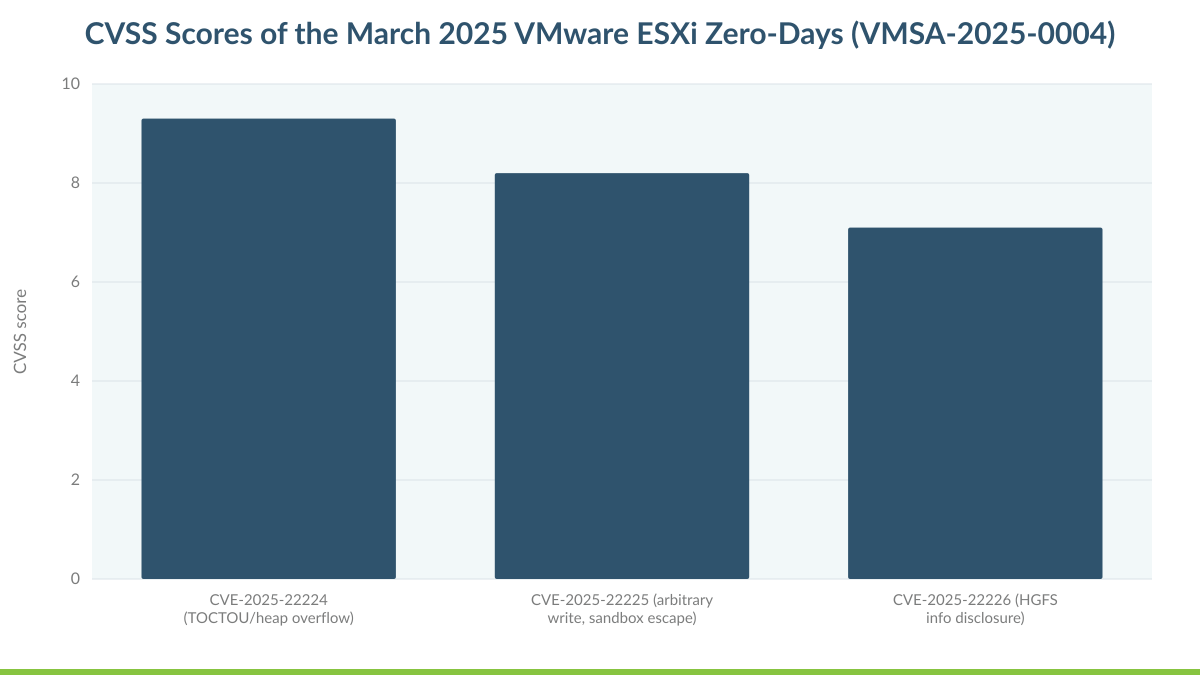
The CVSS scores tell the story of severity. As Rapid7 detailed in its analysis of VMSA-2025-0004, the flaws carried scores high enough to demand emergency patching, and the fact that they were already being exploited in the wild removed any luxury of a slow maintenance window. When a vulnerability moves from theoretical to actively exploited before you have even scheduled the patch, your patch cadence is your security posture.
When a VMware flaw moves from theoretical to actively exploited before you schedule the patch, your patch cadence is your security posture.
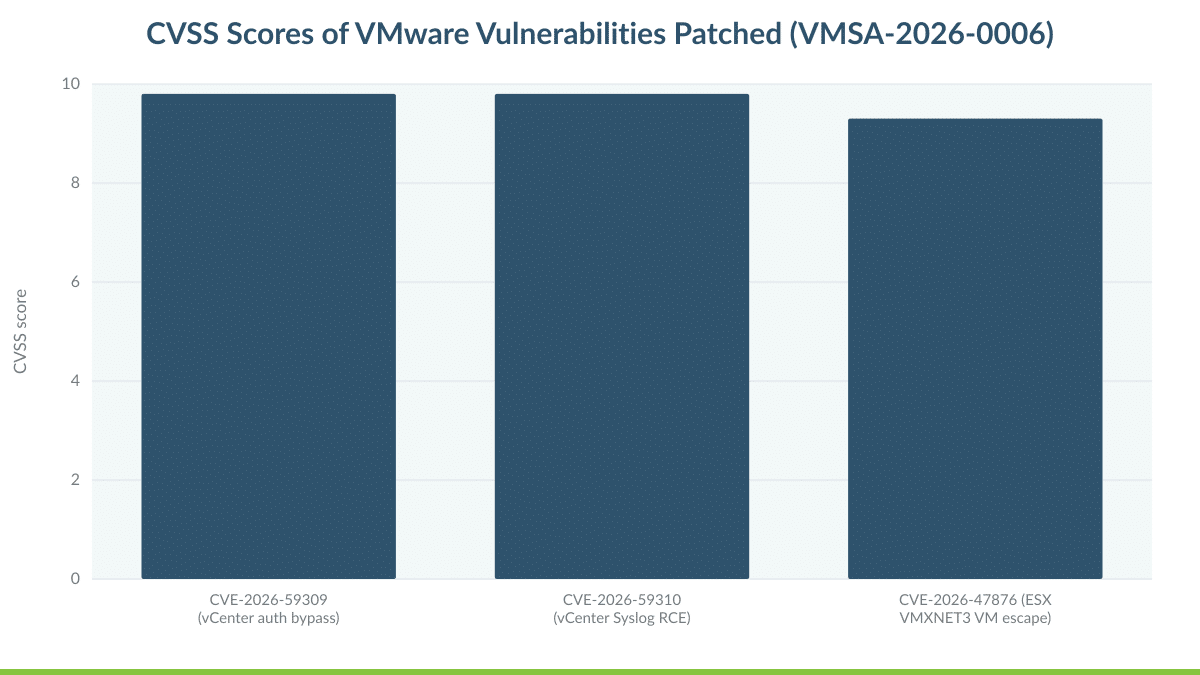
This pattern did not stop in March. Broadcom continued issuing VMware Security Advisories through the year, including advisories addressing ESXi host code execution. The prepared data from Security Affairs on VMSA-2026-0006 shows the same profile: critical CVSS scores, hypervisor-level impact, and a clear vendor signal that patching is not optional. The message across advisory after advisory is consistent. The VMware stack is under sustained scrutiny from both researchers and attackers, and Broadcom is shipping fixes at a pace that outstrips how quickly most mid-market teams can absorb them.
There is a structural reason the advisories keep coming. Broadcom did not just acquire VMware, it acquired one of the most widely deployed pieces of infrastructure software on the planet, and it has poured research attention into hardening that code base. More scrutiny surfaces more flaws. That is healthy for the ecosystem over the long run, but in the near term it means the disclosure rate is climbing precisely as the customer base is under financial and operational pressure from the licensing transition. The security velocity and the business disruption arrive together, and mid-market teams feel both in the same quarter.
The Exposure Window Is the Real Vulnerability
Here is the math that should keep IT leaders awake. Attackers now weaponize a newly disclosed VMware flaw in days, sometimes on the day of disclosure. Meanwhile, the typical mid-market organization takes weeks to inventory affected hosts, test the patch against production workloads, schedule downtime, and apply the fix across the fleet. That gap between disclosure and remediation is the exposure window, and it is where breaches happen.
Break the window into its component delays and you can see where the days leak away. First comes discovery: someone has to notice the advisory, which for an understaffed team may not happen the same day Broadcom publishes it. Then comes scoping: matching the affected builds against your actual host inventory, which is only fast if that inventory is current. Then comes testing: validating that the patch does not break a critical application, which for regulated or fragile workloads can consume a week by itself. Then comes change control: securing an approved maintenance window, which in many organizations means waiting for the next scheduled slot. Only then does remediation begin. Each stage is defensible in isolation. Stacked together, they hand attackers the head start they need.
The 37,000 exposed ESXi instances counted after CVE-2025-22224 were not counted on day one. They were counted, and re-counted, over the days and weeks that followed, and the number came down slowly. Every server still on that list was a live target running a known, publicly documented, actively exploited flaw. As BleepingComputer and SecurityWeek reported, the decline in vulnerable instances was gradual, which is exactly the problem. Attackers do not wait for your maintenance calendar.
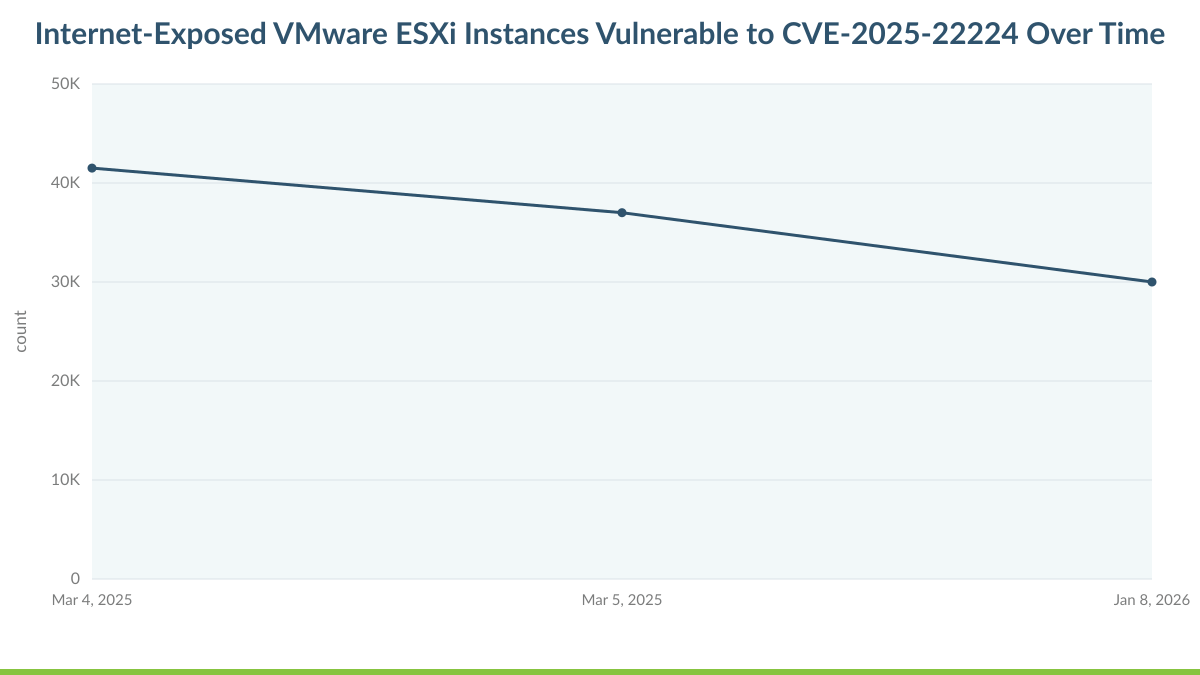
Look at that curve and you see the anatomy of collective risk. Each day an ESXi host stays unpatched, it is not only exposed to opportunistic scanning but also to ransomware groups that specialize in hypervisor-level encryption. When attackers reach the hypervisor, they can encrypt every virtual machine at once, bypassing in-guest defenses entirely. That is why ESXi has become a favorite target for ransomware crews. One compromised host is a data center’s worth of leverage.
The economics from the attacker’s side explain why. Groups running ESXi-targeting ransomware have industrialized the process, shipping purpose-built Linux encryptors that run directly on the hypervisor and terminate running virtual machines before encrypting their disk files. Encrypting at the datastore level is faster and more devastating than encrypting inside each guest, and it neatly sidesteps the endpoint agents most organizations rely on, because those agents live inside the guests the encryptor has already shut down. When a defender’s entire detection strategy assumes the operating system is running, an attack that kills the operating system first is a strategy with no counter. That is the leverage a single unpatched host now represents.
Attackers do not wait for your maintenance calendar. Every day an ESXi host stays unpatched is a day a ransomware crew gets to choose the timing instead of you.
This is where the Broadcom era changes the calculus for mid-market teams specifically. The shift to subscription licensing, the consolidation of the portfolio, and the compressed advisory cadence all raise the operational bar. Teams that ran VMware comfortably for a decade on a slow, careful patch rhythm now face a supplier whose security velocity assumes a mature, well-staffed operations practice. Not every mid-market shop has that. The result is a widening gap between the pace Broadcom expects and the pace most internal teams can sustain.
The staffing math is unforgiving. A mid-market IT team of five or six people rarely has a dedicated VMware specialist. Instead, one or two generalists carry virtualization alongside networking, identity, backup, and the help desk queue. When a critical VMSA lands, that same person is expected to drop everything, scope the exposure, test the fix, and coordinate a change window, all while the ordinary work does not pause. The single point of human failure is not a hypothetical. It is the person who was already at capacity before Broadcom published the advisory, and who is one vacation or one resignation away from a patch program that stalls entirely.

Mapping the Response to the Five Pillars
Reacting to each VMware advisory as a fire drill is exhausting and, worse, unreliable. The better approach is to build an operating model that shrinks the exposure window structurally. That is where the discipline maps cleanly onto our five pillars: Simplification, Security, Performance, Resilience, and Flexibility.
Simplification: Fewer Places for a Flaw to Hide
You cannot patch what you cannot see. The 37,000 exposed hosts were exposed partly because organizations lost track of them. A simplified, well-inventoried environment turns patching from an archaeology project into a routine. When your VMware footprint runs on a managed platform with a single pane of visibility, applying a critical fix stops being a scavenger hunt across forgotten hosts. Our Managed Cloud Hosting approach exists to collapse that complexity, so the patch that matters reaches every host that needs it.
Simplification also attacks the discovery delay directly. Much of the exposure window in mid-market environments is spent simply figuring out what you have. A management-server that lost track of hosts, a remote-office ESXi box that a departed admin stood up years ago, a test cluster that quietly became production, each one is a place a critical patch never reaches because no one remembers it exists. A consolidated platform with authoritative inventory removes those blind spots, which is the difference between a patch cycle measured in hours and one measured in weeks of uncertainty.
Security: Close the Window, Then Watch It
Patching is necessary but not sufficient. Between disclosure and remediation, you need compensating controls: network segmentation that isolates the hypervisor management plane, restricted access to vCenter, and detection that flags the behaviors an exploit produces even before the patch is applied. This is the logic behind virtual patching and layered defense. Our Security as a Service (SECaaS) practice pairs vendor tools from partners like Fortinet and CrowdStrike with continuous monitoring, so a known VMware flaw does not become a silent open door while you finish testing the fix.
The specific controls matter because ESXi ransomware defeats the obvious ones. Since in-guest agents go dark the moment the encryptor terminates the virtual machines, detection has to watch the layer below, monitoring hypervisor management traffic, SSH access to hosts, and anomalous activity against datastores. Segmentation that keeps the vCenter and ESXi management interfaces off any network reachable from a compromised guest removes the attacker’s easiest path. Multi-factor authentication on management access closes another. None of these replace the patch. All of them buy time during the window when the patch is not yet everywhere, and buying time is the entire game.
Performance: Patch Without Punishing the Business
One reason teams delay VMware patches is fear of the maintenance window. Rolling a critical ESXi fix across a cluster while workloads stay online demands live migration, spare capacity, and careful orchestration. When that capacity and orchestration are engineered in from the start, you patch on the attacker’s timeline instead of waiting for a quiet weekend that never comes. Enterprise-grade infrastructure should let you apply an emergency fix without a service outage, and that is precisely the standard our Cloud Hosting (IaaS) platform is built to hold.
The mechanism is straightforward but only works if the headroom exists. To patch a host without downtime, you evacuate its virtual machines to other hosts in the cluster using live migration, patch the now-empty host, and then rebalance. That choreography requires enough spare compute to absorb a host’s worth of workload with none left running on the target. Mid-market clusters sized tightly to save on licensing often lack that headroom, which is exactly why their teams default to the weekend outage. A platform provisioned with rolling-patch capacity as a design requirement turns emergency patching into a background task the business never notices, and that non-event is the whole point.
Resilience: Assume the Window Will Sometimes Be Missed
No patch program is perfect, and hypervisor-targeting ransomware is exactly the threat that punishes a missed window hardest. The answer is recovery you have actually tested. Immutable backups that an attacker cannot encrypt, plus a rehearsed failover to clean infrastructure, turn a hypervisor compromise from an extinction event into a bad day. This is where Disaster Recovery (DRaaS) and modern Backup as a Service built on Veeam earn their keep. Not only do they protect the data but they also protect your ability to restore it to a known-good state after an ESXi-level incident.
The word immutable is doing heavy lifting here, and it deserves emphasis. Sophisticated ESXi ransomware crews do not just encrypt production. They hunt for the backups first, because a victim with clean, recoverable backups has no reason to pay. Backups stored on the same fabric an attacker reaches after compromising a host are not backups, they are additional targets. Immutable storage that cannot be altered or deleted for a defined retention period, held off the production fabric, is what breaks the extortion leverage. Pair that with a documented recovery runbook and a failover you have rehearsed within the last quarter, and a host-level compromise becomes a restore operation with a known duration rather than an open-ended catastrophe.
Flexibility: Do Not Get Cornered by One Vendor’s Cadence
The Broadcom transition has taught mid-market leaders that supplier decisions, whether about licensing, packaging, or security velocity, can change the cost and effort of running VMware overnight. Flexibility means designing an environment where you are not trapped. A hybrid or multi-cloud posture gives you options for where workloads run and how you absorb change. Our Hybrid Cloud Services exist so that a shift in one vendor’s roadmap does not dictate your entire operating budget.
Flexibility is not a call to abandon VMware, which remains the most capable virtualization platform available and the one your applications are already tuned for. It is a call to hold your options open so that no single vendor decision forces a rushed migration under duress. When your architecture can place a given workload on managed VMware, in a public cloud, or in a hybrid arrangement, you negotiate from strength rather than reacting to whatever the next licensing or advisory cycle brings. The organizations most rattled by the Broadcom transition were the ones with no plan B. Flexibility is simply the discipline of always having one.
What a Disciplined VMware Patch Program Actually Looks Like
Turning the pillars into practice means answering a handful of hard operational questions before the next advisory drops, not during it. A disciplined program has clear answers to each of these, written down and rehearsed.
- Do you have a live, accurate inventory of every ESXi host, vCenter instance, and VMware Tools version in your environment, including the ones in remote offices and dormant test clusters?
- When Broadcom publishes a VMSA rated critical, who owns the decision to patch, and what is your target time from disclosure to full remediation?
- Can you apply a hypervisor patch across a cluster without taking production workloads offline, or does every fix require a business-hours outage?
- Is your vCenter management plane isolated from general network traffic, so a guest-to-host escape has nowhere useful to go?
- Are your backups immutable and off the same fabric an attacker would reach after compromising a host, and have you tested a full restore this quarter?
- Do you have detection tuned for the behaviors an ESXi exploit produces, so you catch activity in the exposure window before the patch is fully deployed?
Each question maps to a number you can measure and improve over time. Inventory accuracy is a percentage of hosts under authoritative tracking. Disclosure-to-remediation is a clock you can drive down advisory after advisory. Rolling-patch capability is a yes or no that reveals whether your cluster is sized for safety or squeezed for savings. Immutable, tested recovery is a date on a calendar, the last time you actually restored. Turn these from opinions into metrics and the patch program stops being a matter of heroics and becomes a matter of engineering, which is the only version that survives staff turnover and a rising advisory cadence.
If any of those answers is uncertain, that uncertainty is your exposure. The organizations that stayed off the 37,000 list were not lucky. They had inventory, they had a patch decision path, and they had the capacity to act on it fast. The organizations that stayed on it were not negligent in the moral sense. They simply lacked the operating model to move at the speed the threat demanded.
The organizations that stayed off the exposed-host list were not lucky. They had the operating model to move at the speed the threat demanded.
The Business Case for Not Doing This Alone
Consider what a single hypervisor-level ransomware incident costs. It is not just the ransom. It is the downtime across every virtual machine on the affected hosts, the forensic investigation, the customer notifications, the regulatory exposure, and the days or weeks of rebuilding to a state you trust. For a mid-market firm, that can eclipse a year of infrastructure budget. The economics of prevention and rapid recovery are not close.
Break the cost down and the picture sharpens. Downtime alone, for a firm whose operations depend on the applications riding those virtual machines, accrues by the hour in lost revenue and idle payroll. Forensics and incident response carry their own professional fees, often billed at premium emergency rates. Regulatory exposure varies by industry, but for firms handling health, financial, or personal data, a breach that touches protected information triggers notification obligations and potential penalties that dwarf the technical recovery cost. Then there is the reputational tax, the customers and partners who quietly reassess whether your infrastructure can be trusted with their business. Against that stack of consequences, the cost of an operating model that keeps you off the exposed-host list is not an expense, it is insurance with a return you can calculate.
This is the argument for treating VMware operations as a managed discipline rather than a spare-time responsibility for an already stretched internal team. When patching, monitoring, and recovery are delivered as a service against a written commitment, the exposure window stops depending on whether your one VMware expert is on vacation the week a critical advisory drops. Our Service Level Agreement exists to make that commitment explicit, so uptime and response are contractual, not aspirational.
IT Vortex is a Premier Broadcom VCSP Partner, which means we run VMware environments professionally at scale and absorb the advisory cadence as part of the service rather than as a recurring emergency. We are an integrator, architect, and advisor, not a box vendor. That distinction matters here. Anyone can sell you a license. Far fewer can operate the platform so that the next round of Broadcom VMware vulnerabilities becomes a routine patch event instead of a crisis. Lou Corriero, VP Cloud at IT Vortex, spends much of his time helping mid-market teams turn exactly that reactive posture into a repeatable operating model.
The scale advantage is not abstract. A provider running many VMware environments sees each new VMSA once and applies the response across every tenant with the same tested procedure, spreading the analysis and testing effort that would otherwise fall entirely on each individual internal team. The spare capacity for rolling patches, the immutable backup infrastructure, the round-the-clock detection, all of it is amortized across the customer base rather than carried alone on a mid-market balance sheet. That is how enterprise-grade operational discipline becomes available without enterprise-grade headcount, which is precisely the complexity IT Vortex exists to eliminate.
For teams weighing whether to keep VMware in-house, move it to a managed platform, or restructure licensing entirely, the decision should start from risk and recovery, not from list price. If you want to see how other mid-market organizations approached the transition, our case studies walk through the before and after.
Reframe: The Advisory Is Not the Emergency, the Gap Is
It is tempting to read each new Broadcom VMware advisory as the problem to solve. It is not. The advisory is a gift. It tells you exactly what to fix and how. The real problem is the gap between the moment Broadcom hands you that knowledge and the moment your last vulnerable host is patched, monitored, and recoverable. Attackers live inside that gap. Ransomware crews budget their operations around it.
So stop measuring your VMware security by whether you eventually patch. Measure it by how narrow you can make that window, advisory after advisory, without burning out your team or gambling on a quiet weekend. Narrow the window with visibility, close it fast with capacity, guard it with detection, and survive the times you miss it with tested recovery. That is a program, not a scramble.
If your honest answer to any of the six questions above was a shrug, that is the place to start, and it is worth a conversation before the next VMSA lands. Schedule time with Lou Corriero, VP Cloud, to map your current VMware exposure window and the fastest path to shrinking it. Bring your inventory questions. We will show you what a patch cadence that keeps you off the exposed-host list actually looks like.