
In its State of Ransomware 2025 research, Sophos found that in 56 percent of the incident response and managed detection cases it worked in 2024, adversaries did not break in at all. They logged in, using valid credentials, and moved through environments that treated a legitimate login as a legitimate user. That single statistic quietly dismantles the assumption underneath most corporate ransomware playbooks: that containment is a technical event, triggered by an alert, owned by whoever is on call. It is not. Containment is a business decision made under extreme time pressure, and in most mid-market organizations the people holding the pen have neither the authority nor the mandate to make it.
This is the containment paradox. The person who first sees a ransomware incident unfold, usually a systems administrator or a security analyst, is the person least positioned to decide whether to isolate a revenue-generating system, sever a customer-facing application, or take a production database offline. Those are decisions about money, contracts, regulatory exposure, and continuity. Yet the playbook hands them to a technician at 2 a.m. because that is who was watching the console. The result is hesitation, escalation loops, and the slow accumulation of dwell time that turns a contained incident into an enterprise crisis.
The ransomware containment paradox, defined
The paradox has two halves that pull in opposite directions. The first half is speed. Every hour an intruder holds credentials inside your environment is an hour of lateral movement, privilege escalation, and staged exfiltration. Containment that happens in minutes changes the outcome. Containment that waits for a conference bridge to fill up does not. The second half is consequence. Pulling a segment offline, disabling a service account, or blocking an authentication path is not free. It can halt order intake, break a clinical workflow, or trip a service level penalty. So the people who can act fastest are told to wait for approval, and the people who can approve are asleep, unreachable, or unaware that the decision is theirs to make.
Most playbooks paper over this with an escalation matrix and a phone tree. That works for a database that ran out of disk space. It fails for a credential-based ransomware intrusion, because the attacker is exploiting the exact gap between detection and decision. The Sophos finding that adversaries increasingly log in rather than break in matters here for a specific reason: a login does not trip the alarms an organization built its response plan around. There is no exploit signature, no malware detonation, no obvious perimeter breach to rally the team. By the time the anomaly is understood as an attack, the intruder has already been inside long enough to map the environment and identify what to encrypt.
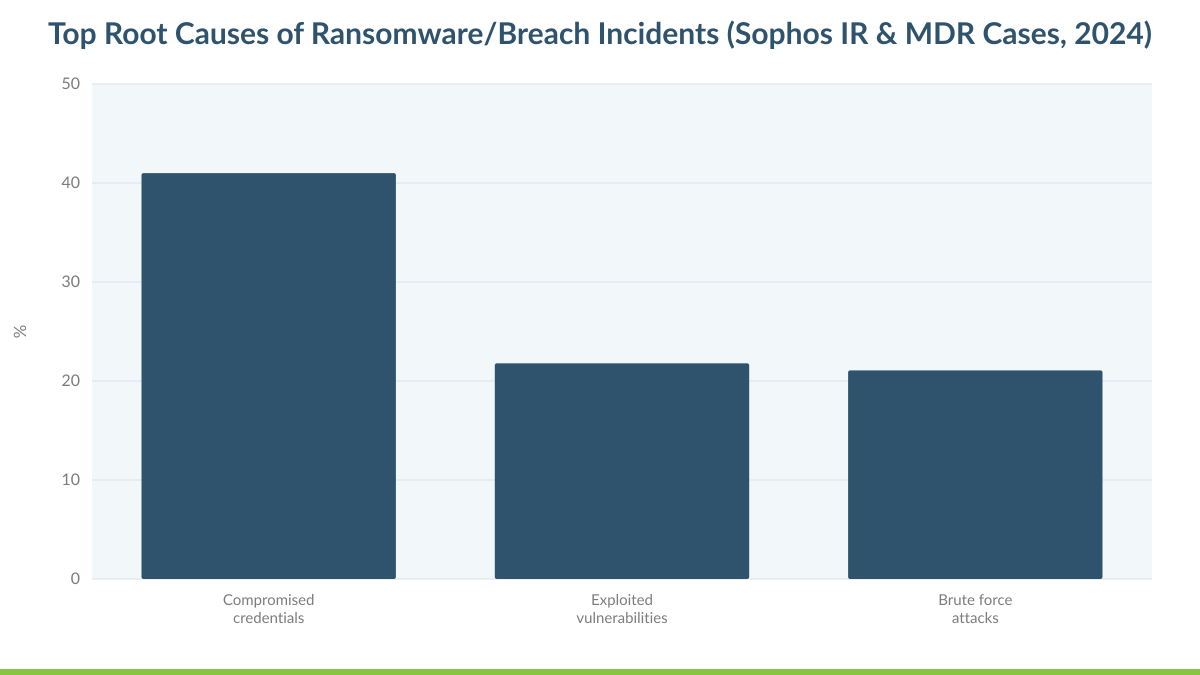
The chart above, drawn from Sophos incident response and MDR case data for 2024, shows why this reframes the whole conversation. When compromised credentials and the abuse of legitimate access are among the leading root causes, the defensive posture cannot be purely about keeping attackers out. It has to assume they are already in, using tools and accounts that look normal, and it has to make containment a decision that a business owner can authorize instantly. That is a governance problem before it is a security tooling problem.
Containment is not a technical event triggered by an alert. It is a business decision made under extreme time pressure, and most playbooks hand it to the person least equipped to make it.
Why time to contain is the number that actually costs you money
IBM’s Cost of a Data Breach Report 2024 makes the economic case with uncomfortable clarity. The time it takes to identify and contain a breach varies substantially by how the attacker got in, and the incidents that start with stolen or compromised credentials sit at the long end of that curve. When containment stretches, cost stretches with it, because dwell time is when exfiltration completes, when more systems get encrypted, and when the regulatory and contractual clock starts ticking on notification obligations.
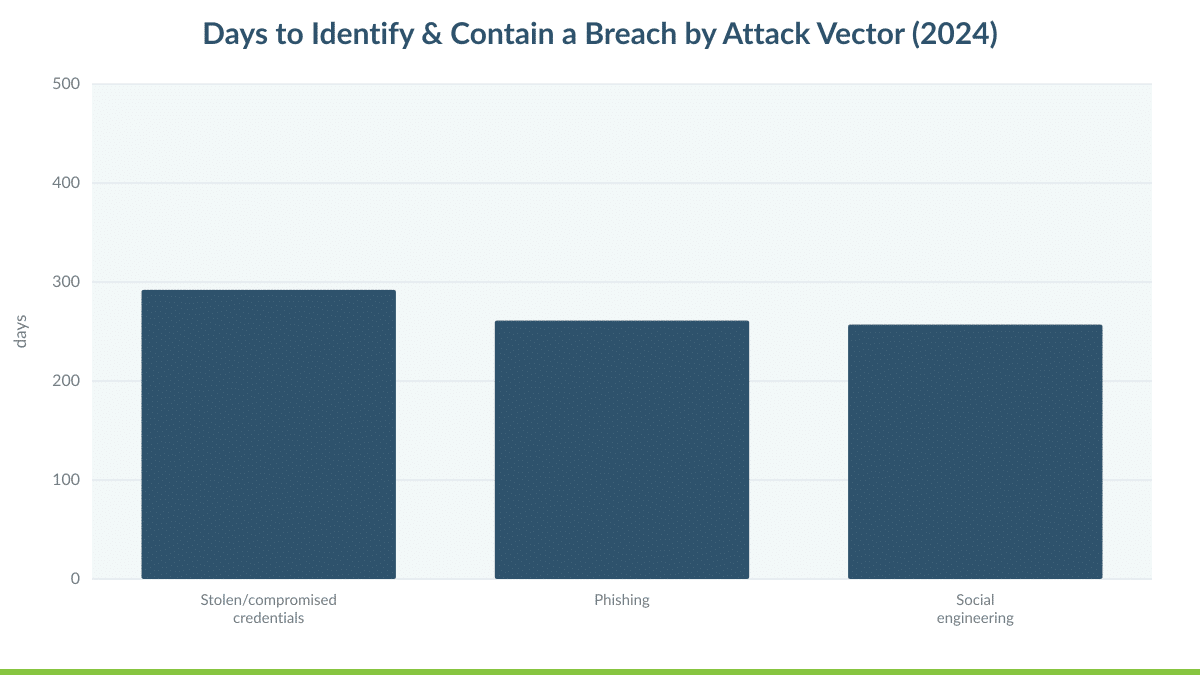
Read that chart as an operations chart, not a security chart. The bars are not abstract statistics. Each additional day represents payroll runs that do not process, patient records that stay inaccessible, and manufacturing lines that idle. The reason credential-driven attacks land at the expensive end is precisely the paradox we opened with: a valid login does not scream, so nobody with authority is summoned until the damage is visible, and by then the window for cheap containment has closed. This is where the Security as a Service (SECaaS) discipline of continuous monitoring earns its place, because detecting the anomalous use of legitimate credentials is a different problem than detecting malware, and it requires people watching who are empowered to act.
The cost curve does not only reward faster detection. It rewards faster decision-making. An organization can have world-class telemetry and still lose days if the analyst who sees the anomaly has to wake three managers to get permission to isolate a subnet. Reducing containment time is therefore not only a monitoring investment but also a decision-rights investment. You are buying visibility and you are buying the pre-authorized ability to act on it. Miss either half and the money you spent on the other half stops working.
What a slow decision actually costs after the ransom question
There is a persistent misconception that the ransom payment is the main financial event in a ransomware incident. It is not. Sophos data on average recovery cost, excluding the ransom itself, tells the story of everything else: forensics, rebuilding systems, overtime, lost business, legal review, customer notification, and the long tail of remediation that follows an intrusion. These are the costs that scale with how long the incident stays uncontained and how thoroughly the attacker moved before someone with authority pulled the plug.
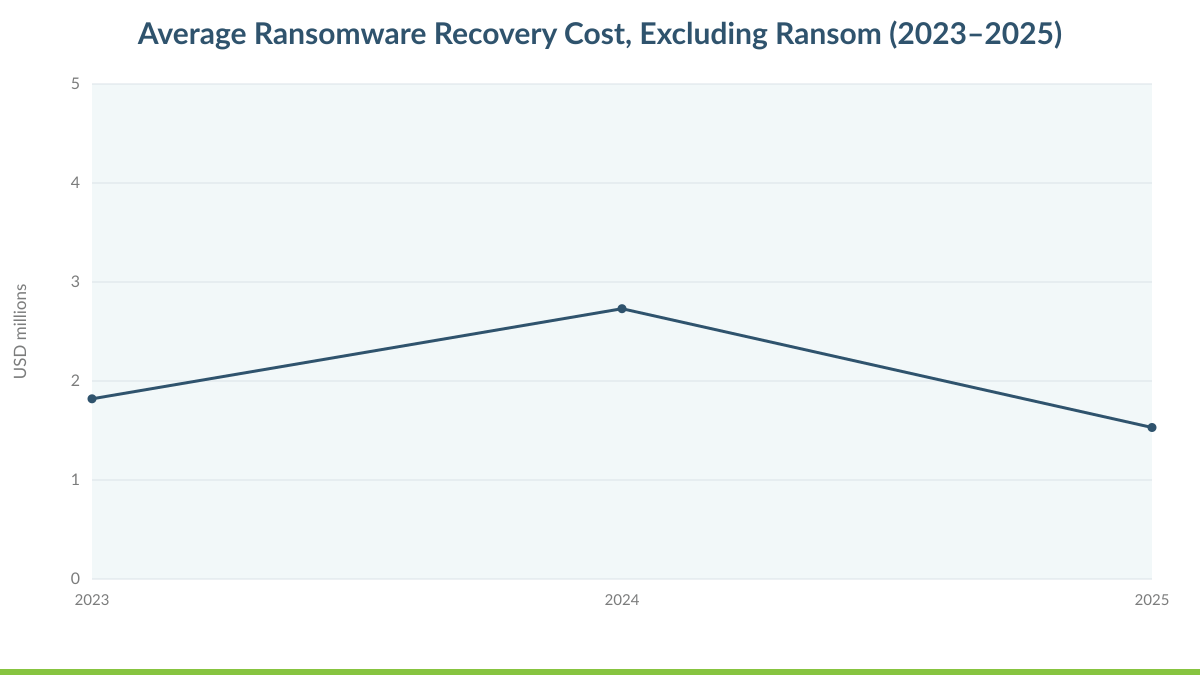
The trend line matters more than any single year’s figure. Recovery cost is not a fixed penalty you pay once and move past. It is a function of blast radius, and blast radius is a function of dwell time, and dwell time is a function of how quickly the right person made the containment call. This is why Disaster Recovery (DRaaS) is not a synonym for backup. Backup answers the question of whether you can restore data. Disaster recovery answers the question of whether you can restore operations, on a defined timeline, with the decision authority already established before the incident. The difference between those two is measured in the same currency as the chart above.
The ransom is rarely the biggest line item. Recovery cost scales with blast radius, blast radius scales with dwell time, and dwell time scales with how long it took the right person to decide.
Who should actually be in charge, and of what
The fix for the containment paradox is not to give technicians more authority or to demand that executives learn to read packet captures. It is to separate the two kinds of decisions a ransomware incident forces, and to assign each to the role built for it, before the incident happens.
Technical containment actions belong to technical staff, pre-authorized
Isolating a host, disabling a compromised service account, blocking an authentication path, or quarantining a subnet are technical actions with technical consequences that a trained responder can evaluate in real time. The playbook error is requiring business approval for each one. The fix is a pre-authorized containment envelope: a defined set of actions the on-call responder is empowered to take immediately, without a phone call, because the organization decided in advance that stopping lateral movement is worth the operational cost of a temporary isolation. Speed here is a resilience investment, and it directly reduces the dwell time that inflates recovery cost.
Business continuity decisions belong to business owners, pre-briefed
Whether to take a revenue-generating platform fully offline, whether to activate a failover that changes customer experience, whether to notify partners early, and whether to invoke contractual force majeure are business decisions with legal and financial weight. These belong to named business leaders, not to the analyst on the console. The playbook error is leaving these decisions unassigned until the incident forces them, which guarantees delay. The fix is naming the decision owner for each scenario in advance, defining the thresholds that trigger their involvement, and rehearsing the call so the first time they make it is not during a live crisis.
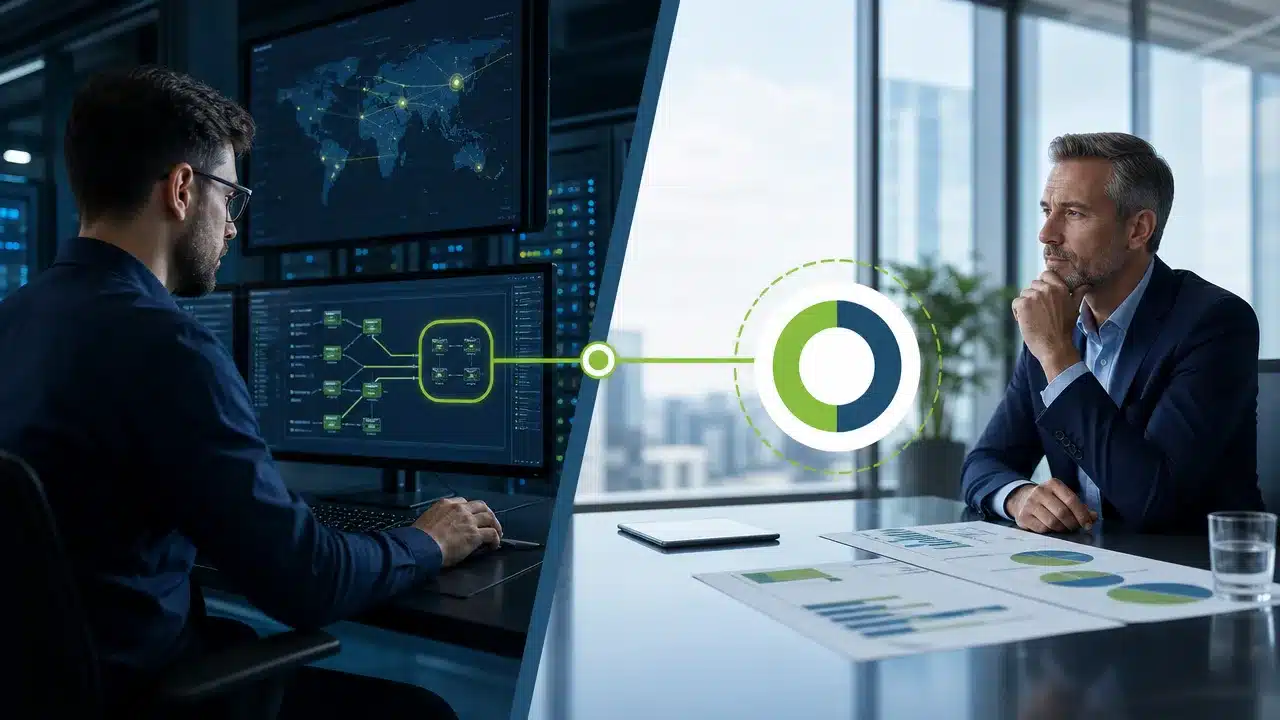
This split is the entire point. Give technical people fast, bounded authority to stop the bleeding, and give business people clear, rehearsed authority over the decisions that carry business consequence. Most playbooks invert this. They ask technicians to make business calls they are not authorized to make, and they leave executives out of the loop until the situation is already expensive. The split-responsibility model that mature managed environments use for day-to-day operations applies directly to incident response: define who owns what before you need to know.
The mid-market version of this problem is worse, and here is why
Large enterprises have dedicated incident commanders, standing crisis teams, and legal counsel on retainer with defined escalation authority. Mid-market organizations usually do not. The same person may be the network administrator, the security analyst, and the de facto incident commander, and that person reports to a business leadership team that has never rehearsed a ransomware decision. When the incident hits, the technical staffer is asked to simultaneously fight the fire and decide whether the building should be evacuated. That is not a personnel failure. It is a structural gap, and it is the gap credential-based attackers exploit most effectively.
The structural gap shows up in three predictable ways. First, detection is present but decision authority is absent, so alerts pile up while approvals lag. Second, containment actions are technically possible but politically fraught, so nobody pulls the trigger without cover. Third, the recovery capability exists on paper but has never been exercised, so the first real failover happens during the worst possible week. Each of these compounds dwell time, and dwell time compounds cost, which returns us to the same charts. The managed services model closes the first gap by putting an accountable, always-on team behind detection and response so the internal generalist is not the only line of defense.
Simplification is the pillar that matters most here, and it is not a marketing word in this context. It means reducing the number of decisions that have to be improvised during an incident. Every decision you can make in advance, document, and pre-authorize is a decision that does not have to be made under pressure by the wrong person. An environment engineered for containment has fewer moving parts, clearer ownership, and a smaller set of live judgment calls. That is what enterprise-grade resilience without enterprise complexity actually looks like in practice.
Every decision you make in advance is a decision that does not have to be improvised, at 2 a.m., by the person least equipped to make it.
Building a playbook that puts the right people in charge
A playbook that resolves the containment paradox is built around decision rights, not just runbooks. The runbook tells you how to isolate a host. The decision rights tell you who is allowed to isolate it, under what conditions, and who has to be informed rather than asked. Here is what that looks like when it is done well.
- A defined containment envelope that lists the technical actions responders may take immediately without approval, so lateral movement is stopped in minutes rather than escalation cycles.
- Named business decision owners for each high-consequence scenario, with a designated alternate, so no critical call waits on a single unreachable person.
- Predefined thresholds that automatically escalate a technical incident to a business decision, removing the guesswork about when leadership must be involved.
- Tested recovery objectives, meaning documented recovery time and recovery point targets that have been validated by an actual failover exercise, not assumed.
- A communication tree that separates who acts, who decides, and who is informed, so the response bridge does not collapse into a debate.
The recovery objectives point deserves emphasis. An organization can only make fast, confident containment decisions if it knows what recovery will cost in time. If a business owner is asked to authorize taking a system offline but has no idea whether it comes back in two hours or two days, they will hesitate, and hesitation is the enemy. Validated recovery targets turn the containment decision from a gamble into a calculation. This is why a failover validation plan is not a compliance formality. It is what makes decisive containment possible, because the decision owner knows the downside is bounded and tested.
Recovery capability also has to live somewhere the attacker cannot reach. Credential-based intruders who have been inside for days often target backups first, because they understand that destroying recovery options is how they force payment. Immutable, isolated recovery infrastructure changes that calculus. When your Backup as a Service (BaaS) and disaster recovery tiers are engineered so that a compromised administrative credential cannot delete or encrypt the recovery copies, the containment decision gets easier, because taking systems offline no longer feels like burning the only bridge home.
Rehearsal is the difference between a plan and a capability
A playbook that has never been exercised is a hypothesis. The first time a business leader makes a containment decision should not be during a live intrusion, any more than the first time a pilot handles an engine failure should be at altitude. Tabletop exercises exist to move the decision-making rehearsal out of the crisis and into a controlled setting, where the wrong answer costs a conversation instead of a quarter’s revenue. For regulated industries, this is increasingly not optional but expected, and the organizations that treat it seriously are the ones whose executives already know their lines when the real event arrives.
The value of rehearsal is not primarily that people memorize the runbook. It is that the friction gets surfaced in advance. During a tabletop, you discover that the named decision owner is unclear on their authority, that two teams both think the other one owns containment, or that the recovery objective everyone assumed was two hours is actually untested. Finding those gaps in a conference room is cheap. Finding them during an active credential-based intrusion is the most expensive discovery an organization can make. IT Vortex builds these exercises around real recovery capability, so the rehearsal maps to the infrastructure that will actually carry the failover, not to a theoretical plan on a shelf.

Flexibility is the pillar that rehearsal reveals. An organization that has practiced its response can adapt when the real incident does not match the script, because it has internalized the decision structure rather than depending on a specific sequence of events. Attackers do not follow your playbook. The value of a well-designed response is that it holds up when the situation is novel, because the decision rights, the containment envelope, and the recovery targets are clear regardless of how the intrusion unfolds.
How IT Vortex closes the containment gap
As a Premier Broadcom VCSP Partner, IT Vortex operates VMware-powered managed cloud where detection, recovery, and decision structure are engineered together rather than assembled from disconnected products. That integration is the point. A containment plan fails when the monitoring vendor, the backup vendor, the recovery target, and the decision owners have never been aligned. IT Vortex acts as integrator, architect, and advisor, which means the containment envelope, the recovery objectives, and the escalation thresholds are designed against the same infrastructure that will run the response.
The technical foundation matters because it removes the excuses that create hesitation. Disaster Recovery (DRaaS) with validated recovery objectives means the business owner authorizing a failover knows the downside. Isolated, immutable backup means containment does not risk the recovery path. Continuous SECaaS monitoring means the anomalous login gets caught while it still matters, not after the encryption starts. And a defined split of responsibility means the technician stops the bleeding while the business leader makes the business call, each acting inside authority that was settled before the incident. For organizations weighing where their current plan is weakest, our case studies show how mid-market teams moved from improvised response to engineered containment.
Performance closes the loop. Fast, decisive containment is only possible on infrastructure that can absorb a failover without degrading, that can isolate a segment without collapsing dependent services, and that can restore operations inside the recovery window the business was promised. Performance is not only a benchmark on a datasheet but also the operational headroom that lets you contain aggressively without fear that the cure is worse than the disease.
Stop asking your technicians to make executive decisions
The uncomfortable truth in the Sophos and IBM data is that most ransomware losses are not caused by a lack of tools. They are caused by a lack of clarity about who decides, compounded by attackers who log in with valid credentials and exploit the silence that a normal-looking login creates. The organizations that recover fast and cheap are not the ones with the most technology. They are the ones where the containment decision had an owner before the incident, where the technical envelope was pre-authorized, and where the recovery path had been tested and put out of the attacker’s reach.
So do not audit your ransomware playbook by asking whether you have a runbook for isolating a host. Audit it by asking a harder question: when a credential-based intrusion is detected at 2 a.m., who is authorized to take the revenue platform offline, do they know it is their decision, and have they ever practiced making it? If the answer is a technician who will spend the first hour trying to reach someone with authority, your playbook has the wrong people in charge, and the charts in this article are a preview of what that costs.
Fixing that is an engineering and governance exercise, and it is exactly the work IT Vortex does with mid-market IT leaders. Schedule time with Lou Corriero, VP Cloud, to map your containment decision rights against your actual recovery capability, and to close the gap between the alert and the person who is allowed to act on it.