
In the summer of 1993, a fictional systems architect named Dennis Nedry brought down an entire island’s infrastructure with a single piece of malicious code, and thirty-plus years later his mistake is still the most honest cybersecurity training film ever made. Jurassic Park was not really a movie about dinosaurs. It was a movie about a control system that its owners believed was total, right up until the moment a disgruntled insider, an unpatched dependency, and a storm proved otherwise. For US mid-market IT leaders staring down 2025 breach data, that plot is not fiction. It is a Tuesday.
Source: Jurassic Park, cybersecurity and the dangerous myth of control, CSO Online.
The park had 3 million dollars of computing, redundant fences, motion sensors, and a raptor paddock rated for animals that should not have been able to open doors. It still fell over in an afternoon. The reason is the same reason enterprise networks fall over today: the people who built the system confused having controls with being in control. Those are not the same thing, and the gap between them is exactly where breaches, ransomware, and outages live.
The cybersecurity myth of control starts with one person holding all the keys
The single most catastrophic design decision in Jurassic Park was not the dinosaurs. It was that one underpaid, under-supervised engineer had root access to every system on the island, from the fences to the phones to the door locks, with no separation of duties and no way to operate the park without him. When Nedry walked out with the embryos and locked everyone else out of the code he alone understood, the park did not have a dinosaur problem. It had an access management problem that dinosaurs then exploited.
This is not a metaphor stretched for a blog post. It is the leading pattern in modern incidents. The 2025 ransomware and breach data shows that attackers rarely need to invent anything exotic. They walk in through the doors we left unlocked: unpatched systems, stolen credentials, and human error. The dinosaurs, in other words, use the front gate.
Consider how concentrated that risk becomes in a lean mid-market shop. A single senior administrator often holds domain admin rights, the hypervisor console, the backup credentials, the firewall password, and the cloud tenant owner role all at once. That is not efficiency. That is Isla Nublar with a smaller payroll. When that one person leaves, gets phished, or simply makes a bad call under pressure, there is no second set of hands and no boundary to stop the blast radius. Separation of duties is not bureaucratic overhead. It is the architectural decision that keeps a single mistake from becoming a single point of collapse.
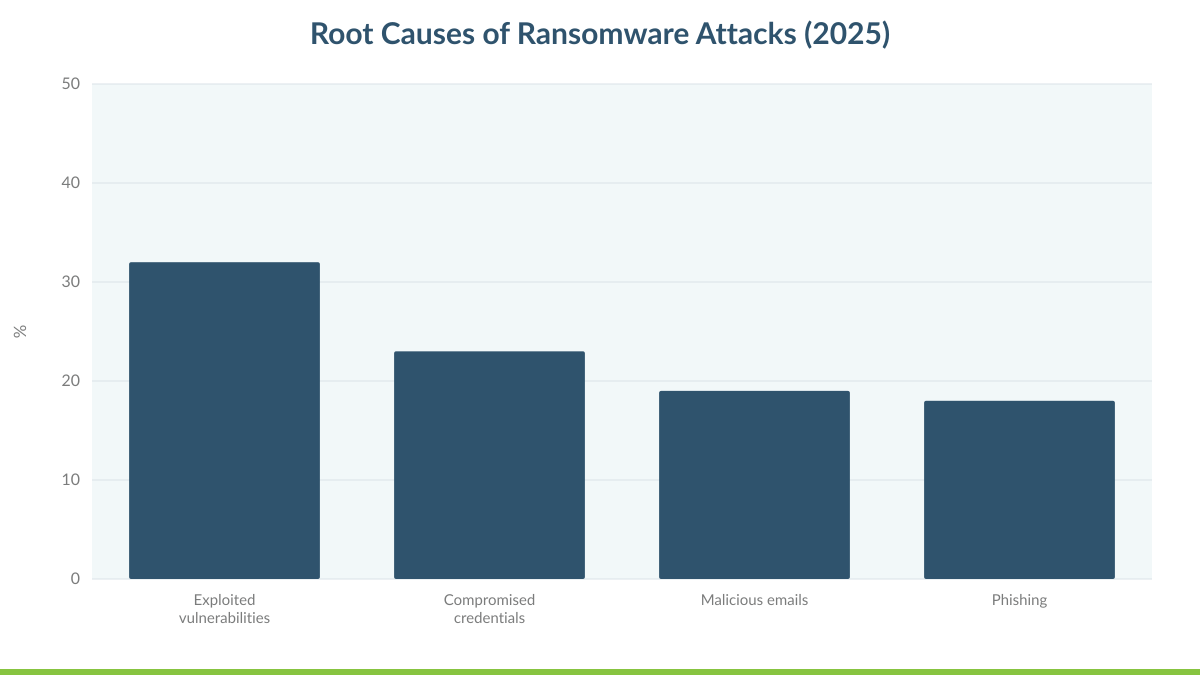
Look at what actually initiates ransomware attacks. According to Sophos and its 2025 State of Ransomware research, the top root causes are not zero-day sorcery. They are exploited vulnerabilities, compromised credentials, and malicious email. Every one of those is a known, addressable category. Every one of those was present in some form on Isla Nublar. Nedry’s credentials were the compromised login. The unpatched security fences were the exposed vulnerability. And the whole thing hinged on a single trusted insider who had been given more access than any one human should hold.
The business consequence of an exploited credential is not abstract. Once an attacker owns a privileged account, they move laterally, disable defenses, locate and delete backups, and only then trigger encryption. That kill chain can take days or weeks, which means the compromise almost always predates the visible damage. A mid-market team that only watches for the ransom note is watching the last act of a play that opened months earlier. The controls that matter are the ones that detect the quiet middle: unusual credential use, privilege escalation, and access from places a real employee would never log in from.
Having controls and being in control are not the same thing, and the gap between them is exactly where breaches, ransomware, and outages live.
The business lesson maps directly onto the Security pillar. You reduce risk not only by buying tools but also by removing the conditions that let a single failure cascade. That means least-privilege access, monitored credentials, and segmentation so that one compromised account does not become the whole island. A layered Security as a Service (SECaaS) posture, built with partners like Fortinet, CrowdStrike, and Proofpoint, exists precisely to make sure that when one control fails, and one always will, it does not take everything else down with it. Fortinet segments the network so lateral movement hits a wall. CrowdStrike watches the endpoints for the quiet middle of the kill chain. Proofpoint intercepts the malicious email that starts the majority of these events. No single layer is perfect. That is the point. The design assumes each one will eventually fail and puts another behind it.
The storm always comes, and the perimeter always assumes it will not
Nedry timed his theft to a tropical storm because he knew the perimeter defenses degraded under stress. The park’s designers had built for the sunny-day scenario. They had not seriously modeled the day when the network was down, the roads were flooded, the phones were dead, and the one person who understood the system was gone. That is not a dinosaur failure. That is a resilience failure, and it is the most common failure in real IT operations.
Most organizations design their security and their infrastructure for the good day. They assume the login page will behave, the patch will apply cleanly, the primary data center will stay powered, and the staff will be available. Reality does not cooperate. The storm always comes. The question is never whether a control will fail. The question is whether your architecture assumes failure as a first-class condition or treats it as an exception to be explained after the fact.
The storm in your environment rarely looks like weather. It looks like a ransomware event that hits at 2 a.m. on a holiday weekend when your one qualified engineer is unreachable. It looks like a cloud region outage that takes down the SaaS tools your recovery plan quietly depended on. It looks like a botched patch that bricks a production host during your busiest quarter. Each of these degrades your ability to respond at exactly the moment you need it most, which is precisely why Nedry chose the storm. Attackers and bad luck both prefer the moment your defenses are already stretched.
This is why the Resilience pillar has to sit next to the Security pillar rather than behind it. Prevention is about keeping the fence up. Resilience is about what happens the moment the fence goes down. Both are necessary. Only one of them has been proven, over and over, to determine whether an incident is a bad afternoon or a business-ending event. An organization with strong Disaster Recovery (DRaaS) and disciplined Backup as a Service can lose a system and keep operating. An organization that spent everything on the perimeter and nothing on recovery loses the system and the business at the same time.
The mechanics matter here, because resilience that exists only on paper is worse than useless. It breeds false confidence. A modern DRaaS design built on Veeam replication maintains a warm copy of your critical workloads at a geographically separate site, with defined recovery time and recovery point objectives that you agree to in advance and then verify. Immutable backups ensure that even if an attacker reaches your backup repository, they cannot alter or delete the restore points. Those two capabilities together mean the storm can take your primary environment and you can still bring the business back online on a clock you control, not one the attacker sets.
What actually causes breaches is boring, human, and preventable
The Hollywood version of a breach is a hooded figure typing furiously against a countdown clock. The real version is a tired employee clicking a convincing invoice, an admin who never rotated a shared password, or a firmware update that never got scheduled. The 2025 data is blunt about this. When you look at what genuinely causes data breaches, the human and process failures dominate, not exotic technical wizardry.
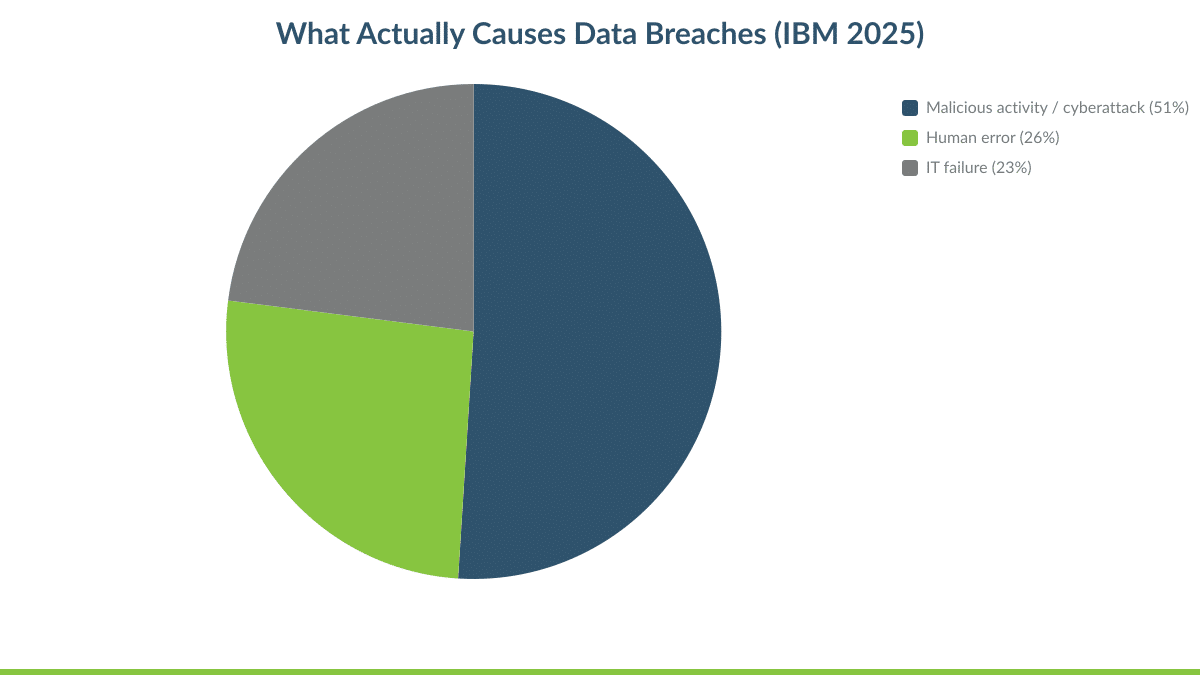
The IBM Cost of a Data Breach Report for 2025, as reported by CyberScoop, breaks breach causes into categories that any IT leader will recognize immediately: malicious attacks, but also plain human error and system or process failures. Those last two categories are not attackers being clever. They are organizations being human. Nedry was human error made flesh, a trusted person who had been given too much and watched too little. The lesson is not to distrust your people. It is to design systems so that a single human mistake cannot end the day.
Human error and process failure are also the categories most amenable to design solutions, which is the encouraging part. You cannot patch human nature, but you can build guardrails that make the safe path the easy path. Multifactor authentication turns a stolen password from a full breach into a blocked login attempt. Automated patch management removes the human step that never gets scheduled. Configuration templates stop the one-off manual setup that quietly opens a hole. Every one of these controls converts a category of unavoidable human fallibility into a handled, monitored condition. The park never did any of this. It relied on one man remembering everything, and the day he stopped cooperating, the design had no answer.
This connects directly to the Simplification pillar, and this is the part most vendors get wrong. Complexity is not security. Complexity is the enemy of security. The more moving parts, the more consoles, the more one-off exceptions and shadow systems, the more places a human mistake can hide until it becomes an incident. When John Hammond spared no expense on spectacle but skimped on operational discipline, he built a system too complicated for anyone but Nedry to run safely. Every mid-market IT team that has inherited a tangle of unmanaged tools knows exactly how that ends.
The dinosaurs did not defeat the park. The park defeated itself, and then the dinosaurs simply walked through the gaps.
Reducing complexity is a security control in its own right. Consolidating workloads onto a well-governed Managed Cloud Hosting platform, built on VMware and operated by a Premier Broadcom VCSP Partner, shrinks the attack surface not only by patching what exists but also by removing the sprawling, half-documented systems that no one fully understands. You cannot secure what you cannot see, and you cannot see a system that grew by accident. Consolidation also solves the knowledge-concentration problem that killed the park. When workloads run on a single governed platform with documented configurations and a partner accountable for the whole environment, the business no longer depends on one irreplaceable person carrying the entire map in their head.
The single point of failure is a design choice, not bad luck
When Samuel L. Jackson’s character utters the immortal line about the whole system rebooting, the audience understands intuitively that everything hinges on one fragile mechanism. Turn it off, turn it back on, and pray. The park had no graceful degradation. It was binary: fully operational or fully compromised, with nothing in between. That is the single point of failure made cinematic, and it is the same architecture that takes down real data centers.
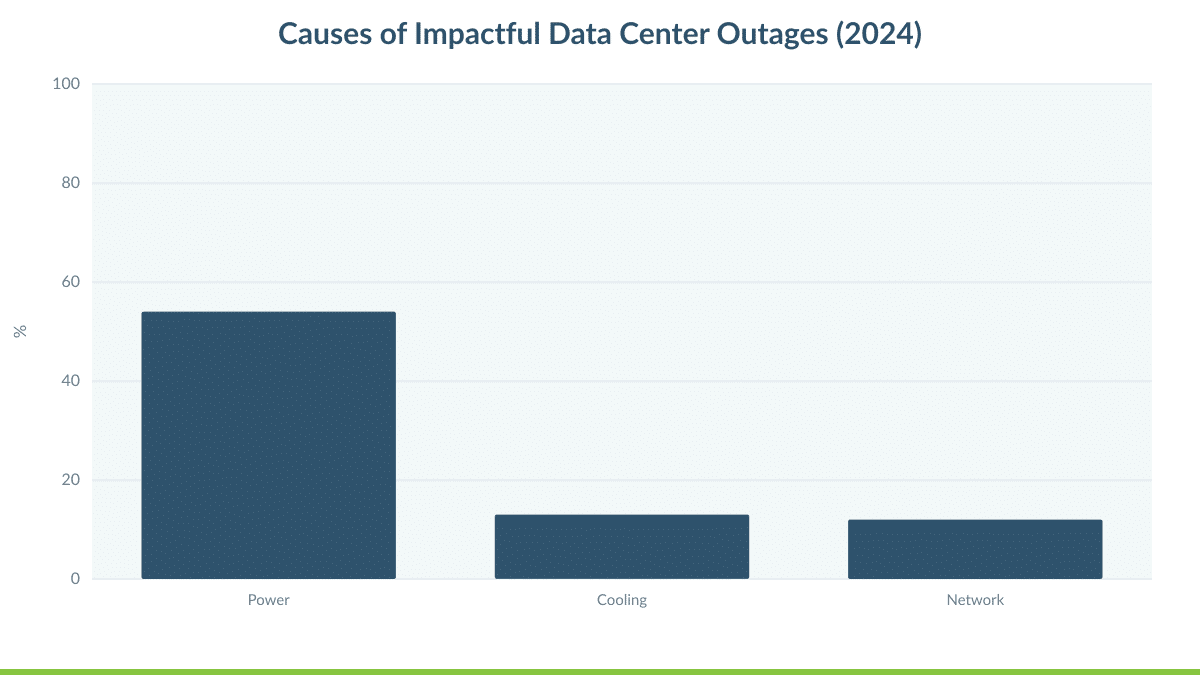
The Uptime Institute’s annual outage analysis, covered by DatacenterDynamics, shows that the causes of impactful data center outages are heavily weighted toward power, cooling, and network failures, the boring physical and configuration issues rather than dramatic cyberattacks. The pattern is the same as the breach data: the things that take you down are usually mundane, predictable, and preventable with redundancy and discipline. What separates a survivable outage from a headline is whether a second path existed when the first one failed.
Single points of failure hide in places teams rarely audit until they fail. One internet circuit into the building. One power feed with a battery that was never load-tested. One virtualization host running workloads that were supposed to be spread across a cluster. One person who knows the undocumented order in which systems must be restarted. Each of these is a rebooting-the-whole-park moment waiting to happen. The discipline of resilience is essentially a hunt for these singularities, followed by the deliberate addition of a second path before circumstance forces the discovery on the worst possible day.
This is the Performance and Resilience pillars working together. A system that has no redundancy performs beautifully until the moment it does not exist at all. A resilient architecture accepts a small, constant cost, running a warm standby, replicating data offsite, validating failover, in exchange for eliminating the cliff. Mid-market leaders often resist that constant cost because the good days make it feel wasteful. The bad day makes it feel like the smartest money they ever spent.
The math is not abstract. Enterprise downtime routinely runs into the hundreds of thousands of dollars per hour once you count lost revenue, idle staff, recovery labor, and reputational damage. A single point of failure is a bet that the storm will never come. The 2024 outage data says it comes for someone every single day. If you want to model your own exposure before it becomes a live event, our interactive IT calculators turn that abstract risk into a number you can bring to a budget conversation. That number is often the moment resilience stops being a technical preference and becomes a board-level decision, because once the cost of an hour of downtime is on paper next to the cost of a warm standby, the tradeoff argues for itself.
Control is a story we tell ourselves; resilience is what we can actually build
The most quoted line in the film is Ian Malcolm’s warning that the park’s scientists were so preoccupied with whether they could that they never stopped to ask whether they should. For IT, the more useful lesson is quieter. It is that the entire enterprise was built on the assumption of control, and that assumption was the vulnerability. The moment you believe your system is fully controlled is the moment you stop planning for the day it is not.
Mid-market organizations feel this pressure acutely because they carry enterprise-grade risk on a fraction of the enterprise budget and headcount. They are the primary target for ransomware precisely because attackers know the controls are thinner and the recovery plans are often untested. The fantasy of control is especially dangerous here, because a lean team that believes its perimeter is solid will not invest in the recovery capability that actually saves it.
There is a psychological trap embedded in every successful year of uptime. Each quiet month reinforces the belief that the current design is sufficient, which makes the next investment in resilience feel harder to justify. This is the survivorship bias that quietly erodes readiness. The organizations that got breached last quarter also had years of quiet uptime right up until they did not. Confidence built on the absence of disaster is not the same as capability proven against one. The only way to know your recovery works is to have executed it, on purpose, before you needed it.
The moment you believe your system is fully controlled is the moment you stop planning for the day it is not.
The healthier posture is to design as though a breach or outage is not a possibility but a certainty on an unknown date. That mindset changes everything. You stop asking only how to keep attackers out and start asking how fast you can recover when one gets in. You stop trusting a single admin and start enforcing separation of duties. You stop treating backups as a checkbox and start testing restores as a scheduled discipline. This is what a mature Disaster Recovery as a Service program delivers: not the promise that nothing will fail, but the proof that you can recover when it does.
What a disciplined mid-market program actually looks like
Translating the Jurassic Park lesson into an operating plan is less dramatic than the movie and far more effective. It comes down to accepting failure as a design input and building for graceful degradation across the five pillars. Here is what that looks like in practice for a mid-market IT team.
- Security: Enforce least privilege so no single Nedry holds the keys to the whole environment. Monitor credentials, require multifactor authentication everywhere, and layer detection so a compromised account is contained, not catastrophic.
- Resilience: Replicate critical workloads offsite, keep immutable backups, and test failover on a schedule rather than assuming it works. A backup you have never restored is a rumor, not a recovery plan.
- Simplification: Consolidate sprawl onto a governed platform. Every orphaned tool and undocumented server is a place for a mistake to hide until it becomes an incident.
- Performance: Build in redundancy so the system degrades gracefully instead of collapsing. Warm standby capacity costs money on the good days and saves the business on the bad one.
- Flexibility: Use hybrid and multi-cloud options so you are never trapped by a single provider, a single site, or a single point of physical failure.
None of these are exotic. All of them address the exact failure categories the 2025 breach data and the 2024 outage data keep surfacing: human error, credential compromise, unpatched vulnerabilities, and physical single points of failure. The reason so many organizations skip them is not ignorance. It is the myth of control, the quiet confidence that the storm will not come on their watch. It came for Isla Nublar in an afternoon.
The sequencing matters as much as the list. A team that tries to do all five at once usually does none of them well. Start where the blast radius is largest: consolidate privileged access and prove your backups restore. Those two moves alone convert the majority of Nedry-class risk into a handled condition. From there, layer in segmentation, redundancy, and hybrid flexibility as budget and maturity allow. This is the difference between a checklist and a program. A checklist gets filed. A program gets tested, revised, and owned by someone whose job depends on it working when the storm arrives.
IT Vortex operates as an integrator, architect, and advisor rather than a box-mover. We design the environment, run it on enterprise-grade VMware infrastructure, and stand behind it with a documented Service Level Agreement. That combination matters because the difference between a park that survives the storm and a park that does not is rarely the fence. It is whether someone was accountable for the whole system when the fence went down.
The gates are already open somewhere on your network
Here is the reframe that should change your next planning meeting. The dinosaurs did not defeat the park. The park defeated itself with an over-trusted insider, an over-complicated system, a perimeter designed for sunny days, and a single point of failure that turned a bad afternoon into a total loss. The dinosaurs simply walked through the gaps that human overconfidence left open. Your network has those same gaps right now. The only question is whether you find them on your schedule or an attacker’s.
Stop asking whether your controls are strong enough to guarantee nothing goes wrong. Nothing guarantees that, and the vendors who imply otherwise are selling you Hammond’s spared-no-expense fantasy. Start asking a better question: when something goes wrong, and the 2025 data says it will, how fast and how completely can you recover? That is a question with a concrete, testable answer, and building that answer is the actual work of security.
Lou Corriero, VP Cloud at IT Vortex, works with mid-market leaders to map their real failure modes and build recovery capability that has been tested rather than assumed. If you want to pressure-test your own environment against the myth of control, schedule a working session with Lou Corriero. Bring your worst-case scenario. We will show you what surviving it actually requires.