
For a decade the answer to “can Nutanix run our most demanding workloads as well as VMware?” came with caveats. That sentence is harder to finish honestly in 2026. Across two flagship .NEXT conferences and a steady cadence of releases, Nutanix has closed most of the feature parity gap with VMware and VMware Cloud Foundation (VCF), the very gaps that once kept it out of mission-critical estates. For any IT leader weighing a platform decision in the post-Broadcom market, that shift changes the math, even though a few real gaps still remain.

This is not a vendor cheer piece. IT Vortex is a Premier Broadcom VMware Cloud Service Provider (VCSP) Partner, and we run an enterprise-grade, VMware-powered managed cloud every day. We also sit across the table from clients who are re-pricing their renewals, re-architecting for AI, and asking whether their next three-year commitment should look like the last one. The honest read on the market matters more than loyalty to any logo. So here is the practitioner’s view of what Nutanix actually shipped, where it now matches VMware, where Broadcom still holds an edge, and how to make the decision without betting the data center on a slide deck.
Why this question got urgent

The trigger was structural, not technical. After Broadcom acquired VMware, customers reported higher prices, forced bundling into VMware Cloud Foundation, and licensing changes that narrowed deployment choice. The result was a wave of evaluations. Nutanix CEO Rajiv Ramaswami told investors that the company now serves roughly 30,000 customers and won more than 700 new logos in a single recent quarter, with the majority migrating off VMware. Nutanix has publicly stated it is targeting about 165,000 of Broadcom’s installed base.

Industry analysts framed the same pressure from the supply side. Gartner has projected that by 2026, disruption in the server virtualization market will drive 50% of enterprises to reevaluate their server virtualization needs. When half the market is rethinking a foundational layer, the credibility of the alternatives stops being academic. The reevaluation only has teeth, though, if the alternative can genuinely do the job. That is exactly the bar Nutanix spent 2025 and 2026 trying to clear.

The capability build-out, 2024 to late 2026

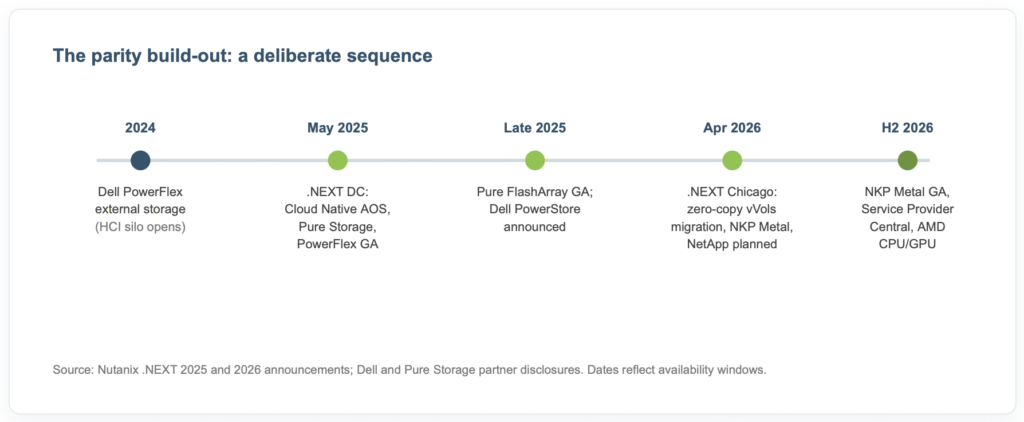
Closing a parity gap is not a single launch. It is a sequence of deliberate releases, each removing a specific objection an enterprise architect could raise. Laid out on a timeline, the pattern is clear: Nutanix attacked the storage constraint first, then migration friction, then the cloud-native and AI fronts where the next decade of spend is heading.
Breaking the storage constraint
The single most important change was architectural. Nutanix built its reputation on hyperconverged infrastructure (HCI), where compute and storage live together in the same nodes. Elegant for greenfield deployments, but a hard sell to an enterprise with millions of dollars of Pure Storage or Dell arrays still under support. Telling that customer to forklift working storage to satisfy HCI purity is a conversation no CFO enjoys.
So Nutanix opened the architecture. It added support for external Dell PowerFlex first, then announced an integration with Pure Storage FlashArray at .NEXT 2025 in Washington, alongside Dell PowerStore (early access in spring 2026) and planned support for NetApp ONTAP. In practice, this lets an organization run AHV compute-only nodes against the SAN it already owns, using NVMe/TCP connectivity that delivers sub-millisecond latency and Pure’s typical 3:1 to 5:1 data reduction. The strict HCI-only boundary, long a reason to stay on vSphere, is effectively gone.

Extending data services beyond the hypervisor
The second move targeted the cloud-native future. Nutanix introduced Cloud Native AOS, which lifts its enterprise storage and data services (snapshots, replication, integrated disaster recovery, application mobility) into Kubernetes and bare-metal environments without requiring a hypervisor at all. For stateful container workloads that normally lean on virtualized infrastructure for data protection, that is a meaningful closing of a long-standing gap.
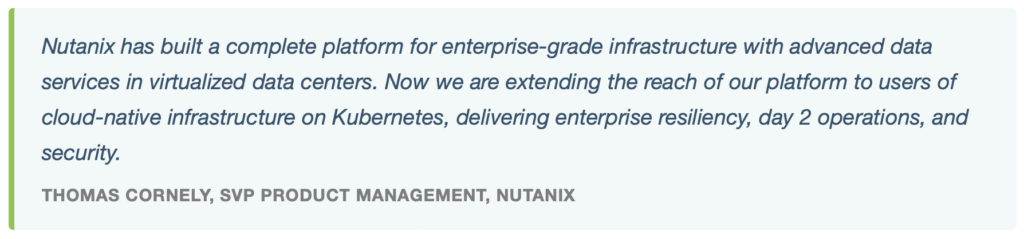
At .NEXT 2026 in Chicago, Nutanix pushed further with NKP Metal, bringing its operating model and Cloud Native AOS data services to bare-metal Kubernetes, in early access with general availability targeted for the second half of 2026. The throughline is consistent: take the enterprise data services that made Nutanix credible for virtual machines and make them available wherever modern applications actually run.
Reach is the other half of that story. Nutanix Cloud Clusters (NC2) extend the same platform into the public cloud, running on AWS and Microsoft Azure with Google Cloud in preview, so a workload can move between an on-premises cluster and a hyperscaler without re-platforming. For organizations that want hybrid flexibility without operating two completely different stacks, that consistency across locations is a direct answer to the multi-cloud sprawl that frustrates most infrastructure teams. It is also why Nutanix has begun courting service providers directly, with Service Provider Central and multitenant capabilities slated for the second half of 2026, a clear signal of where the company expects displaced VMware estates to land.
What “feature parity” actually means here

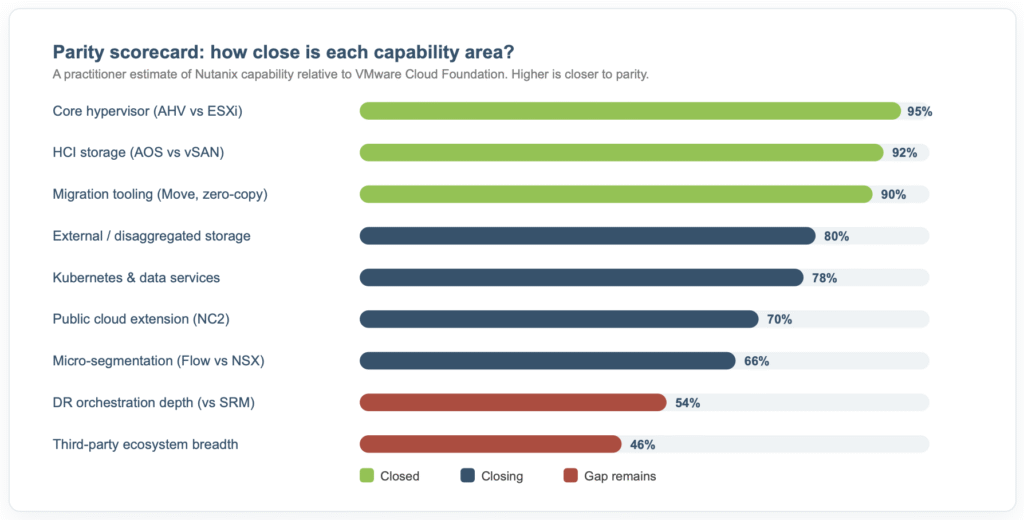
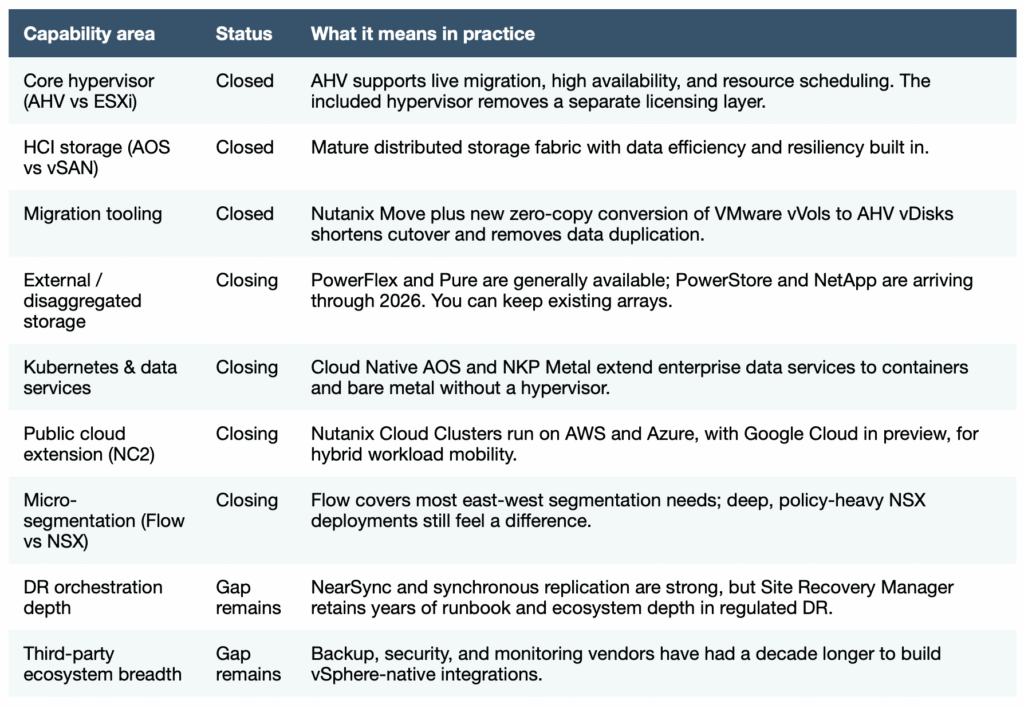
Parity is not a single score. It is a set of capability areas, each with its own honest status. Some areas Nutanix has fully closed. Some it is closing fast with a clear roadmap. A few remain genuine VMware advantages, especially in regulated, deeply customized environments. Reducing this to “Nutanix won” or “VMware won” would be the kind of oversimplification that gets architects in trouble. Here is the more useful picture.
The migration friction problem, largely solved

Capability parity means little if moving is painful. Historically, the migration tax (planning, downtime, data copying, retraining) was enough to keep estates on VMware out of pure inertia. Nutanix has worked that problem directly. Nutanix Move has provided purpose-built VMware-to-AHV migration tooling for years, and at .NEXT 2026 the company added zero-copy migrations that convert vSphere Virtual Volumes (vVols) to AHV vDisks in place, near-instantaneously, without duplicating data.

The reason this matters is not technical bragging rights. It is the business case. When migration is measured in scheduled cutovers rather than multi-weekend data copies, the switching cost that used to anchor renewals starts to evaporate. That removes one of the last non-technical reasons to stay put, and it is why migration tooling sits near the top of the parity scorecard above.
There is a softer factor that enterprise buyers should not discount either: the support relationship. Much of the customer movement Nutanix describes is driven less by a missing feature and more by sentiment about pricing, bundling, and partner treatment after the acquisition. Nutanix has leaned into that opening, pointing to a net promoter score it reports at 90, sustained over years, as evidence that the experience after the sale is part of the product. Whether that holds at the scale of tens of thousands of new customers is a fair open question, and one worth probing in reference calls rather than taking on faith.
Where Broadcom is not standing still

A fair assessment has to account for the other side of the field. Broadcom has invested heavily in VMware Cloud Foundation and argues, with evidence, that an integrated platform is exactly what enterprises need. At VMware Explore 2025, CEO Hock Tan positioned VCF 9.0 as the culmination of post-acquisition engineering work.
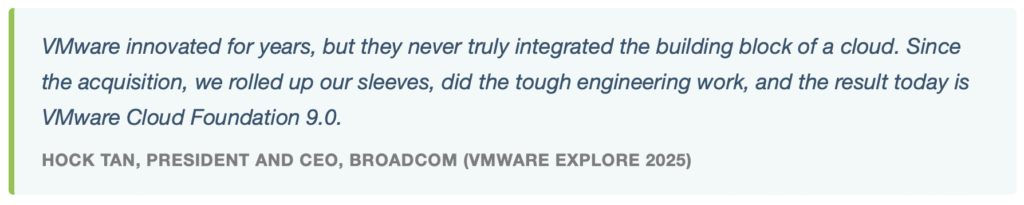
The substance behind the rhetoric is real. Broadcom cites VCF 9.0 delivering up to 38% lower memory total cost of ownership and 34% reduced storage TCO, and points to a survey indicating seven in ten IT professionals are opting for private cloud. VCF 9.1, released in 2026, sharpens the focus on production AI with NVMe memory tiering, native object storage, on-prem ransomware recovery, and multi-accelerator GPU support across AMD and NVIDIA. Large regulated enterprises including ING and Barclays have publicly committed to VCF 9.0 as their strategic private cloud platform.
For organizations with mature NSX micro-segmentation, deep Site Recovery Manager runbooks, or a wide bench of vSphere-native third-party integrations, those are not trivial advantages. The parity story is about the gap narrowing dramatically, not about VMware becoming a weak product. Anyone telling you otherwise is selling, not advising.
The AI front, where the next decision really lives

Both vendors understand that the platform fight is increasingly about AI infrastructure, not just traditional virtualization. Nutanix has repositioned itself as a control plane for virtual machines, containers, and agentic AI workloads alike, with an Enterprise AI stack, early-access Agentic AI infrastructure, and planned AMD CPU and GPU support across major server vendors later in 2026. Broadcom, in parallel, built VCF 9.1 expressly for production AI.

This reframes the decision. If your 2027 roadmap includes private AI inference, GPU-dense clusters, and Kubernetes-based data services, then the platform you choose now is also your AI substrate. Feature parity on yesterday’s virtual machines is table stakes. Readiness for tomorrow’s workloads, with predictable economics, is the differentiator worth modeling.
One platform, many integrated layers

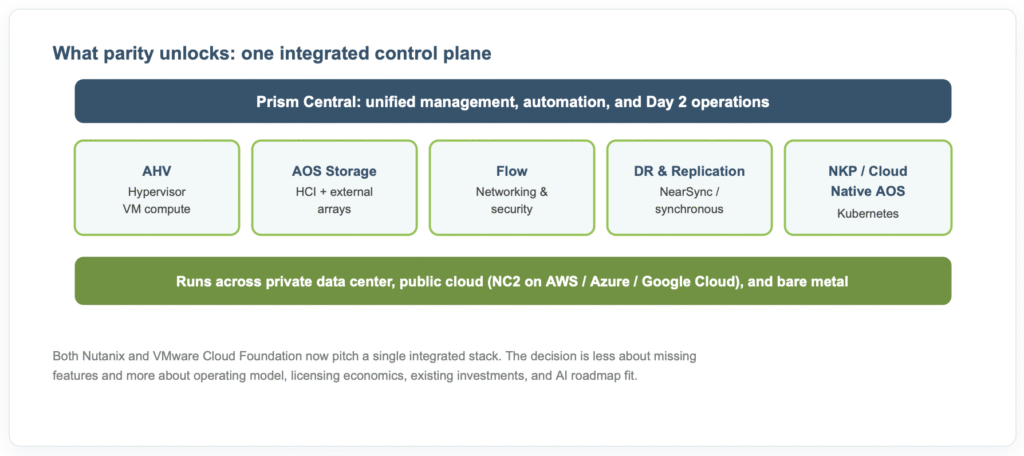
Strip away the marketing and both vendors are racing toward the same destination: a single, integrated control plane that spans compute, storage, networking, disaster recovery, and Kubernetes, managed from one pane of glass. Nutanix unifies these under Prism Central, while VCF unifies vSphere, vSAN, NSX, and management into one platform. The diagram below shows the integrated Nutanix stack that feature parity now makes possible.
What this means for your platform decision

The practical implications fall out cleanly once the parity question is settled. Each of these deserves to be weighed on its own merits rather than averaged into a single gut call.
- Feature gaps are no longer the deciding factor for most estates. For standard enterprise virtual machine and container workloads, both platforms will run them well. The decision moves to economics, operating model, and roadmap.
- Your existing storage investment is now portable. If you own Pure or Dell arrays still under support, you can adopt AHV without writing off that hardware. That alone reshapes many business cases.
- Switching cost has dropped, but it is not zero. Zero-copy migration and mature tooling shrink the project, yet retraining, runbook rebuilds, and ecosystem re-integration are real line items.
- Regulated DR and deep NSX environments still need careful scrutiny. If your compliance posture is built on Site Recovery Manager or policy-heavy micro-segmentation, validate parity against your specific controls, not a generic chart.
- AI readiness should be in the model now. Whatever you choose becomes your AI substrate. Evaluate GPU support, data services, and cost predictability for the workloads you expect in two years, not just the ones you run today.
How IT Vortex helps you decide and execute

IT Vortex sits in a useful position for this exact moment. We are a Premier Broadcom VCSP Partner with deep VMware expertise, and we run enterprise-grade managed cloud for clients in financial services, healthcare, construction, and corporate housing. That means we can model the VMware path honestly and we are not threatened by the alternative. Our job is to get you to the right answer and then de-risk the execution.
Cloud Hosting (IaaS)
Our Cloud Hosting (IaaS) runs your workloads on high-performance private cloud infrastructure with predictable economics. Whether you optimize on a VMware foundation or evaluate an AHV-based estate, we architect for performance and cost, not for a renewal cycle that benefits a vendor more than it benefits you.
Disaster Recovery (DRaaS)
Platform decisions are also continuity decisions. Our Disaster Recovery (DRaaS) protects you through any transition, with tested recovery workflows that keep mission-critical systems available while infrastructure underneath them changes. The DR layer is exactly where the remaining VMware advantages matter most, so we make sure your resilience posture never depends on which way the platform debate breaks.
Migration and platform advisory
We evaluate your estate against the parity scorecard that actually matters for your workloads, compliance controls, and AI roadmap. Then, if a move makes sense, we plan the cutover, validate the data services you depend on, and protect the migration with backup and recovery. Enterprise-grade infrastructure, without enterprise complexity, and without betting the data center on a single assumption.
- Nutanix CEO migration remarks and customer targets: SDxCentral and Ars Technica coverage of .NEXT 2026, Chicago.
- External storage (Dell PowerFlex, Pure Storage, PowerStore, NetApp): Computer Weekly, TechTarget, and Dell/Nutanix partner disclosures, 2025-2026.
- Cloud Native AOS and Thomas Cornely quote: Nutanix press release, .NEXT 2025; SiliconANGLE.
- Zero-copy vVols migration and NKP Metal: Blocks & Files coverage of .NEXT 2026.
- VCF 9.0 / 9.1, Hock Tan quote and TCO figures: Broadcom news releases and VMware Explore 2025 coverage (Channel Futures, StockTitan).
- Gartner server virtualization reevaluation projection: cited in Nutanix announcements (ITOps Times).