
On October 14, 2026, Palo Alto Networks published an advisory for PAN-OS CVE-2026-0322, a code injection flaw that lets an authenticated attacker with network access execute arbitrary code with root privileges on the firewall itself. The same day, CISA added the flaw to its Known Exploited Vulnerabilities catalog and gave US federal agencies until October 17 to fix it and check for compromise, according to CSO Online. Three days. That deadline tells you exactly how seriously the federal government rates the risk.
For mid-market IT leaders, the federal order is not legally binding. It is something more useful: a signal. When CISA compresses a remediation window to 72 hours for a perimeter device, it is saying that the gap between disclosure and damage has shrunk to the point where monthly patch cycles and quarterly firewall upgrades are no longer a defensible posture. This article breaks down what the flaw is, why root access on a firewall is uniquely dangerous, why patching alone does not close the incident, and how to structure a response that protects not only your perimeter but also the business continuity that depends on it.
What PAN-OS CVE-2026-0322 Is and Why the Clock Started on October 14
The facts are short, and every one of them matters. According to the vendor advisory, the vulnerability “enables an authenticated attacker with network access to execute arbitrary code with root privileges on the firewall.” Palo Alto Networks classified it as CWE-94, the code injection weakness category, and scored it 8.6 on the CVSS 4.0 scale. That score lands in the high band rather than critical, but the company also assigned the flaw its highest urgency rating, as CSO Online reported. For anyone deciding how fast to move, the urgency rating is the number that counts.
Palo Alto Networks also stated that “very limited exploitation has been observed targeting the Palo Alto Networks management interface.” Read that sentence carefully. “Very limited” describes what has been observed so far, not what is possible, and it describes the period before a public advisory gave every opportunistic actor the same roadmap. Once an advisory names the component, the weakness class, and the fix, attackers who did not already have the technique know precisely where to look, and defenders lose whatever obscurity they had.
Three details define the risk profile of this flaw:
- Root privileges. This is not access to a restricted shell or a limited administrative role. Root is full control of the operating system that sits beneath the security policy, which means the attacker controls the device that is supposed to control everyone else.
- The management interface. This is the plane administrators use to configure policy, manage VPN settings, and review logs. It should never be reachable from the open internet or from general user networks, yet management access tends to drift wider over time as remote work, vendor support, and convenience accumulate.
- The authentication requirement. The attacker needs valid access to the management interface. That raises the bar for mass exploitation, but as we explain below, it is a hurdle rather than a wall.
We are deliberately not listing affected PAN-OS versions here. The authoritative source for affected releases, fixed releases, and hotfixes is the Palo Alto Networks advisory, and version tables change as hotfixes ship. Pull the current table directly from the vendor and match it against an inventory of every PAN-OS instance you run, including the ones in branch offices, cloud marketplaces, disaster recovery sites, and the lab rack someone forgot to decommission.
Why a Three-Day CISA Deadline Should Reset Your Patch Calendar
The KEV catalog operates under Binding Operational Directive 22-01, which requires federal civilian agencies to remediate listed vulnerabilities by a due date CISA sets. Standard due dates for new entries typically run in weeks. A three-day window signals that CISA believes active exploitation, combined with the value of the targeted device, makes waiting materially dangerous. Just as important, the order for CVE-2026-0322 covers not only patching but also checking for compromise, a step private-sector teams routinely skip.
The KEV catalog is the most practical prioritization list available to a mid-market security team. It filters the enormous annual volume of published CVEs down to the ones attackers are actually using, and it is free. If your vulnerability management program does not already treat a KEV listing as an automatic escalation, this advisory is the moment to change that rule.
Most mid-market organizations run patching on a predictable cadence: a monthly maintenance window, a change advisory board review, a firewall firmware upgrade when the network engineer finds a quiet weekend. That cadence works well for the long tail of vulnerabilities that are disclosed but never weaponized. It fails for KEV-listed perimeter flaws, where the realistic exposure window is measured in days. The data on exploitation timing makes the same point.
The Exploitation Window Closes Before Most Patch Cycles Open
Mandiant’s analysis of 2023 time-to-exploit trends, published by Google Cloud under the title “How Low Can You Go? An Analysis of 2023 Time-to-Exploit Trends,” separated exploited vulnerabilities into two groups: zero-days, exploited before a patch existed, and n-days, exploited after disclosure and a fix were available. The chart below shows that split.
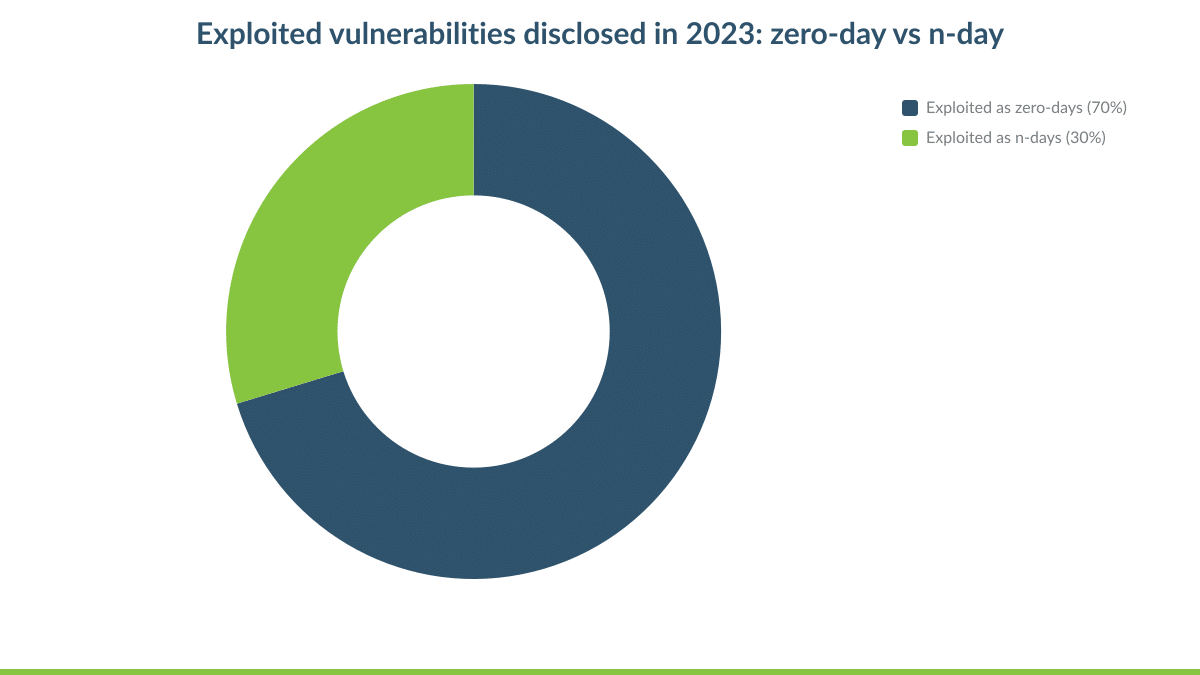
The lesson in that split is uncomfortable. A substantial share of exploitation happens before defenders have any patch to apply, and the remainder happens in the window after disclosure, which is exactly where slow patch cycles leave organizations exposed. CVE-2026-0322 sits in both categories at once. Palo Alto Networks had already observed exploitation when it published the advisory, and now that the advisory is public, the flaw becomes an n-day target for every actor scanning for unpatched management interfaces.
Two planning implications follow. First, the patch is a race you should expect to lose occasionally, which means compensating controls such as restricted management access, enforced multifactor authentication, and monitored administrative sessions must already be in place before an advisory drops. Second, once a patch exists, the cost of delay compounds daily, because the population of attackers who understand the flaw only grows.
“Authenticated” Is Not the Comfort It Sounds Like
Some teams read the phrase “authenticated attacker” and quietly lower the priority. That instinct is wrong, for three reasons.
- Credentials leak constantly. Phishing, infostealer malware on administrator workstations, password reuse across personal and work accounts, and service accounts nobody rotated all put valid credentials in attacker hands.
- Firewall authentication is often weaker than the corporate identity stack. Local admin accounts, shared credentials stored without multifactor protection, and RADIUS or TACACS integrations that sit outside conditional access policies are common on network devices that were configured years ago and rarely revisited.
- Attackers chain vulnerabilities. Edge devices have a history of authentication bypass flaws being paired with privilege escalation or code execution flaws. Palo Alto Networks dealt with exactly this pattern in November 2024, when CVE-2024-0012, an authentication bypass in the PAN-OS management web interface, was exploited together with CVE-2024-9474, a privilege escalation flaw.
Nothing in the current advisory indicates that CVE-2026-0322 is being chained with another bug, and we will not speculate that it is. The point is structural. An authentication requirement is a hurdle, and hurdles fall the moment a second flaw or a stolen password appears. Treat every authenticated remote code execution flaw on an edge device as if the authentication step will eventually be bypassed, and harden accordingly.
Why Root on the Firewall Is Worse Than Root on a Server
A compromised file server is a serious incident. A compromised firewall is a compromised vantage point over every other system you own. The firewall sees traffic between network segments, terminates remote access VPN sessions, holds configuration secrets, and enforces the policy that is supposed to contain everything else. With root access, an attacker can:
- Alter or silently bypass security policy, opening paths into segments that were designed to be isolated, such as finance systems, clinical applications, or backup networks.
- Observe traffic passing through the device, including VPN sessions and flows that are decrypted for inspection.
- Harvest configuration data such as VPN credentials, certificates, API keys, and directory integration secrets.
- Establish persistence below the level where most security tools operate, because firewalls do not run the endpoint detection agents that protect laptops and servers.
- Use the device as a trusted launch point for lateral movement, since traffic originating from network infrastructure is often implicitly trusted.
A compromised firewall is not one more compromised system. It is a compromised vantage point over every other system you own.
That combination explains why edge devices have become a favored target. Firewalls, VPN concentrators, and secure gateways are internet-facing by design, they are difficult to instrument with endpoint detection, and they are often patched less frequently than servers because a reboot interrupts the entire business. PAN-OS has been here before: in April 2024, CVE-2024-3400 in the GlobalProtect feature was exploited as a zero-day before fixes were available. Every major firewall vendor, including the ones IT Vortex partners with, has issued emergency advisories for edge-device flaws. This is not a single-vendor problem. It is a category problem, and it demands a category response rather than a one-time scramble.
Why Mid-Market Organizations Feel This Differently
Large enterprises typically have dedicated network security teams, change processes that can be invoked on short notice, and security operations centers watching perimeter telemetry around the clock. Many mid-market organizations run their entire firewall estate through one or two network engineers who also own the switches, the wireless, the phone system, and a share of help desk escalations. The firewall gets installed, configured, and then left alone, because it works and touching it risks an outage nobody has time to absorb.
That operating reality creates three specific gaps when an advisory like this one lands. The first is awareness: someone has to see the advisory, recognize that it applies, and understand what the urgency rating means. The second is capacity: the engineer who can patch the firewall is already committed to a dozen other tasks this week. The third is authority: taking down the perimeter, even briefly, is a business decision, and in many organizations nobody has pre-approved emergency maintenance for security devices. Each gap adds days. Stack all three and a 72-hour window quietly becomes a three-week one.
None of this reflects a lack of competence. It reflects a staffing model designed for stability rather than speed, operating in a threat environment that now rewards speed above almost everything else.
Patching Closes the Door. It Does Not Tell You Who Already Walked Through It.
The most important word in CISA’s order may be the one most private-sector teams will ignore: compromise. Agencies were directed to fix the flaw and check for compromise by October 17. If exploitation preceded disclosure, then some devices were attacked before anyone knew to patch them, and a firmware upgrade does not evict an attacker who has already planted persistence, harvested credentials, or modified configuration.
Dwell time, the period between initial compromise and detection, is the metric that turns this from a technical concern into a business one. Mandiant has tracked global median dwell time across years of incident response engagements, most recently summarized in coverage of M-Trends 2026 and its analysis of 450,000 hours of incident response work. The trend is shown below.
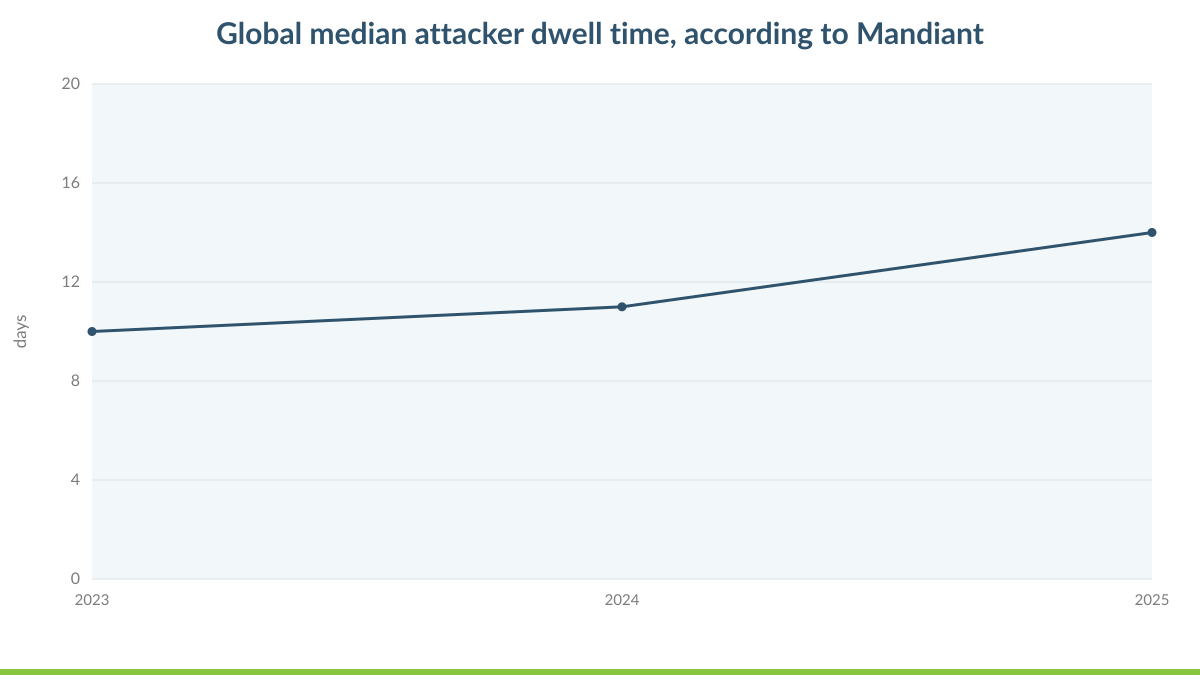
The long-term direction is genuinely good news: organizations detect intrusions far faster than they did a decade ago. But a median is a midpoint, not a guarantee, and it only measures the intrusions defenders eventually found. Edge-device compromises are structurally harder to catch quickly, because the compromised device is often the very system that would normally generate the alert. Every day of dwell time is a day an attacker can study your network, stage data for exfiltration, and position for ransomware deployment or extortion.
In practical terms, checking a PAN-OS device for compromise should include the following steps:
- Review management interface access logs for logins from unexpected source addresses, at unusual times, or from accounts that should be dormant.
- Compare the running configuration against a known-good baseline, looking for new administrative accounts, altered security policies, new NAT rules, or changed logging settings.
- Look for signs of tampering with logging itself. An attacker with root can suppress or alter local logs, so logs already forwarded to a SIEM or managed detection platform are more trustworthy than what remains on the device.
- Apply any indicators of compromise and detection guidance Palo Alto Networks publishes for this CVE, and repeat the check as that guidance is updated.
- If you find evidence of compromise, treat every secret the firewall held as burned. Rotate VPN credentials, certificates, service account passwords, and API keys, and engage incident response before restoring trust in the device.
How an Intrusion Is Detected Decides How Much It Costs
Mandiant’s M-Trends 2025 reporting breaks 2024 dwell time down by detection source, separating intrusions organizations found themselves from those reported by an outside party and those announced by the attacker. The comparison is shown below.
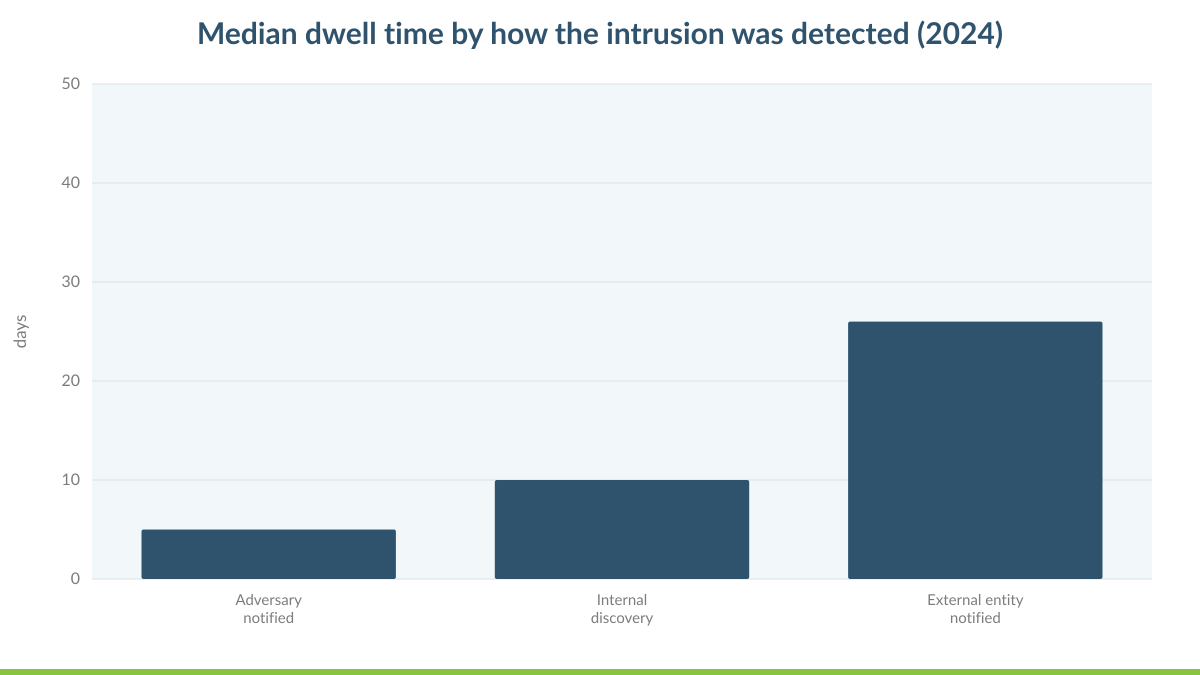
The pattern is consistent and actionable. Intrusions an organization detects internally are caught faster than those it learns about from a third party such as law enforcement, a security researcher, or a business partner who noticed suspicious traffic. The shortest dwell times belong to attacks where the adversary announces themselves, which in practice usually means a ransom note. That is not a detection success. It is the attacker choosing the moment the business finds out, after the damage is already done.
A ransom note is not a detection capability. It is the attacker deciding when you find out.
For a mid-market organization, the goal is to live in the internal detection column. That requires firewall and VPN logs flowing to a monitored platform, someone actually triaging the resulting alerts, and a clear escalation path when an anomaly appears on a perimeter device at 2 a.m. on a Saturday. If your team is weighing how much alert volume it can realistically absorb in-house, our Alert Triage Benchmark Report is a practical starting point for sizing that workload honestly.

A 72-Hour Response Plan for PAN-OS CVE-2026-0322
CISA gave federal agencies three days. That is a reasonable target for any organization running PAN-OS, and it is achievable if the work is sequenced rather than improvised. Here is how we would structure it.
Hours 0 to 24: Contain the Exposure
- Inventory every PAN-OS firewall, physical and virtual, including centrally managed and standalone devices, cloud-deployed instances, and lab or disaster recovery units.
- Confirm management interface exposure. Restrict access to a dedicated management network or a short allow-list of hardened jump hosts, and remove any internet-facing management access immediately.
- Enforce multifactor authentication on every administrative path, and disable or rotate shared and dormant administrator accounts.
- Pull the fixed release and hotfix information from the Palo Alto Networks advisory and map it against your inventory, flagging the most exposed devices first.
Hours 24 to 48: Patch and Validate
- Back up each device configuration before any change, so you have both a rollback point and a forensic baseline.
- Apply the fixed release in a controlled sequence, starting with the most exposed devices. For high availability pairs, follow the vendor’s documented upgrade procedure to preserve failover.
- Validate traffic flow, VPN connectivity, and policy enforcement after each upgrade before moving to the next device.
- Confirm that log forwarding to your SIEM or managed detection platform is intact after every change.
Hours 48 to 72: Hunt and Document
- Execute the compromise checks described above against both current device logs and forwarded historical logs.
- Compare running configurations against your last known-good backup taken well before October 14.
- Document what was found, what was done, and when, in a form that will satisfy insurance carriers, auditors, and the board.
- If anything looks wrong, escalate to incident response immediately rather than continuing to treat the event as a patching task.
Notice that this plan depends on assets you either have before the advisory or do not: an accurate device inventory, a configuration baseline, centralized logs, tested high availability failover, and pre-approved authority to take a firewall offline for maintenance on short notice. None of those can be built in 72 hours. That is where the real conversation begins.
Mapping the Response to the Five Pillars
A single advisory exposes gaps across the entire operating model. Here is how those gaps map to the five pillars IT Vortex uses to architect infrastructure for mid-market organizations.
Security: Watch the Perimeter Like You Watch the Endpoints
Perimeter devices deserve the same continuous scrutiny as laptops and servers, yet they are often the least monitored systems in the environment. IT Vortex Security as a Service (SECaaS) puts firewall, VPN, and identity telemetry in front of analysts who know what an anomalous administrative session looks like, drawing on partner technologies including Fortinet and CrowdStrike. The outcome is not another dashboard. It is a shorter path from suspicious activity to a human decision, which is exactly what the detection-source data rewards.
Resilience: Assume the Perimeter Will Fail Eventually
If a perimeter compromise becomes a ransomware event, the question changes from whether you patched to how quickly you can operate again. Disaster Recovery (DRaaS) and Backup as a Service (BaaS), built on Veeam, give you not only a recovery point but also a rehearsed path back to production. Isolated and immutable backup copies matter in this scenario, because an attacker with a foothold at the network edge will look for backup infrastructure early in the intrusion. Recovery that has been tested is a plan. Recovery that has not been tested is a hope.
Simplification: One Accountable Owner for Every Device
The 72-hour plan breaks down most often on inventory and ownership. Nobody is sure how many firewalls exist, which ones are behind on firmware, or who has authority to schedule an emergency reboot. IT Vortex Managed Services consolidate that responsibility into a single accountable team with documented runbooks, so a KEV advisory triggers a procedure rather than a scramble. Fewer handoffs mean fewer days lost between disclosure and remediation.
Performance: Patch Fast Without Breaking the Business
Emergency patching carries its own risk. An upgrade that breaks VPN connectivity, or a high availability pair that fails to resynchronize, can cause an outage that hurts the business more than a short delay would have. Validated upgrade sequences, pre-change configuration backups, and post-change testing reduce downtime risk, so security fixes ship on the security timeline without trading protection for availability.
Flexibility: Respond Based on Risk, Not Hardware Lead Times
Workloads running in IT Vortex Cloud Hosting (IaaS) sit on VMware-powered infrastructure delivered by a Premier Broadcom VCSP Partner, inside managed and segmented networks. When a perimeter issue forces you to isolate a segment, rebuild a gateway, or shift workloads to a clean environment, that flexibility means the response is driven by risk rather than by hardware lead times or a single overworked engineer’s calendar.
The Governance Questions Leadership Should Ask This Week
Executives do not need to read the advisory to hold the organization accountable for its response. They need to ask the right questions and expect specific answers.
- Do we run PAN-OS anywhere, and can we name every instance, including cloud and disaster recovery deployments?
- Is any firewall management interface reachable from the internet or from general user networks?
- Did we patch within three days of October 14, and if not, what specifically stood in the way?
- Did we check for compromise, or did we only patch?
- If a firewall were compromised tonight, who would detect it, through which system, and how quickly?
- When did we last test recovery from a ransomware event that began at the network perimeter?
These are the same kinds of questions cyber insurance carriers, auditors, and regulators ask after an incident. The answers are far easier to defend when they are documented before one. An organization that can show a dated inventory, a timestamped patch record, and a completed compromise review is in a fundamentally different negotiating position than one reconstructing events from memory.
The Real Deadline Was Set Before October 14
It is tempting to frame CVE-2026-0322 as a patching story with an unusually tight deadline. The more accurate frame is that the deadline revealed which organizations had already done the preparatory work and which had not. The teams that met a three-day window did not suddenly move faster on October 14. They had an inventory, restricted management access, centralized logs, monitored alerts, and tested recovery long before the advisory was published.
The teams that met a three-day window did not move faster on October 14. They had already done the work.
The next edge-device advisory is coming, from this vendor or another. The question for mid-market leadership is not whether you patched this one. It is whether your operating model turns the next 72-hour order into a routine procedure or an emergency, because that difference is what separates a firewall vulnerability from a business incident.
If you want a clear view of where your perimeter, detection, and recovery posture stands against that standard, schedule a working session with Lou Corriero, VP Cloud at IT Vortex. Acting as integrator, architect, and advisor rather than reseller, we will map your current controls against the 72-hour benchmark and build the plan that closes the gaps before the next advisory lands. Book your session with Lou Corriero here.