
On October 12, 2026, CSO Online published an analysis of the seven biggest issues CISOs and security teams face today, and the data behind it should reset how every mid-market executive thinks about security. Citing ISACA’s 2026 State of Cybersecurity survey, the report notes that 68% of security leaders say their roles have become more stressful over the past five years. It also notes that 71% of CISOs name the increasingly complex threat landscape as their main stressor, up from 63% in 2025.
The same report points to a survey from Absolute finding that the introduction of Mythos-class AI models has 50% of CISOs considering leaving the profession entirely. Half of the people charged with protecting revenue, customer data, and operational continuity are weighing whether the job is still worth doing. For a US mid-market organization with a security team of three, five, or ten people, that is not an HR statistic. It is a business continuity exposure.
The biggest issues CISOs face today are not new in kind. Attacks have always evolved, and attack surfaces have always grown. What has changed is the speed, the overlap, and the fact that artificial intelligence now sits on both sides of the fight. This article breaks down seven issues that define the security agenda right now, translates each into cost, risk, performance, and continuity terms, and maps the response to the five pillars that guide how IT Vortex architects infrastructure: Simplification, Security, Performance, Resilience, and Flexibility.
The Biggest Issues CISOs Face Are Converging, Not Queuing Up
Security leaders used to tackle problems in sequence. One budget cycle went to endpoint protection, the next to email security, the one after that to backup modernization. That cadence no longer matches reality. As CSO Online’s reporting puts it, CISOs see the volume, velocity, and sophistication of attacks increase year after year while their attack surfaces expand and grow more complex. At the same time, AI adoption is introducing novel attacks, pulling AI infrastructure into the attack surface, and creating governance problems that grow sharper as agentic systems come online.
Each of those forces amplifies the others. AI-assisted attackers generate more alerts, which overwhelm understaffed teams, which slows response, which raises the cost of a breach, which draws regulatory and insurance scrutiny, which adds more reporting work to the same exhausted team. A mid-market organization cannot fix one link in that chain and expect the rest to hold.
That is why the seven issues below should be read as a system rather than a checklist. The goal is not only to close individual gaps but also to reduce the total load the security function carries, so the people you have can focus on the decisions that actually require their judgment.
Issue 1: Attack Volume and Velocity Are Outpacing Human Triage
Volume and speed come first because they set the tempo for everything else. Phishing campaigns that once required manual effort can now be generated, translated, and personalized at scale. Reconnaissance that took days can be compressed into hours. Exploit attempts begin soon after vulnerabilities become public, a dynamic we examined when looking at how the patch window is collapsing for mid-market teams.
For a security operations function, the practical consequence is alert overload. Every new tool produces its own stream of detections, and each stream needs a human to decide whether it matters. When analysts spend their shifts clearing low-fidelity alerts, two things happen. Real signals get buried, and the analysts burn out. Our Alert Triage Benchmark Report exists because so many mid-market teams cannot answer a simple question: how long does it take us to go from detection to a decision?
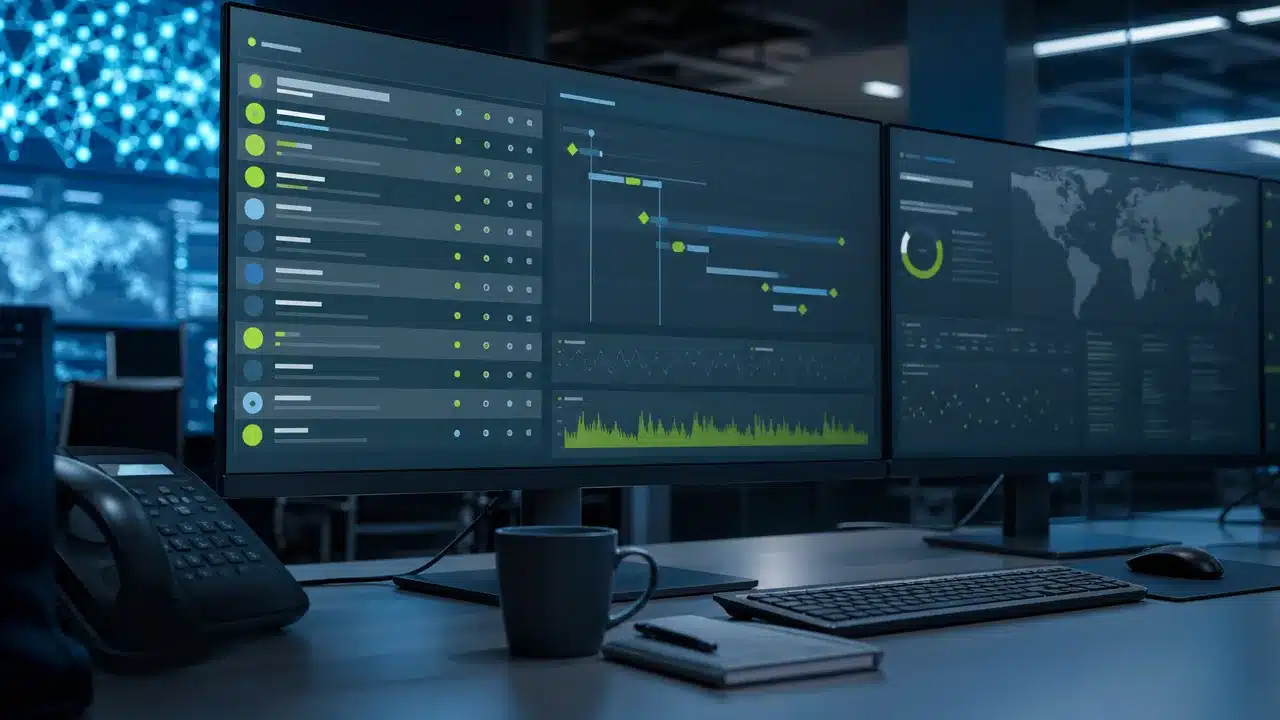
The business impact is direct. Slow triage converts into dwell time, and dwell time converts into cost. An intruder who sits undetected in your environment has time to escalate privileges, locate backups, and stage data for exfiltration. The Performance pillar applies here in a security sense. The performance that matters is not throughput on a server. It is the speed at which your organization detects, decides, and contains.
What works: consolidate detection into fewer, higher-fidelity sources, automate the enrichment and first-pass triage that consumes analyst hours, and establish 24×7 coverage that does not depend on one person’s phone being on at 2 a.m. That last point is where many mid-market teams quietly fail. Ransomware operators routinely time their final stage for nights, weekends, and holidays, precisely because they know who is watching and who is not.
Issue 2: AI Is Both a New Weapon and a New Attack Surface
CSO Online’s analysis identifies AI as a force reshaping the security agenda on three fronts: novel attacks, a broader attack surface that now includes AI infrastructure, and governance and control challenges that intensify as agentic systems come online. Each front lands differently in a mid-market organization.
Novel attacks
Attackers use AI to write more convincing lures, impersonate executives by voice, and automate the grunt work of reconnaissance. Awareness training that teaches employees to spot spelling errors in phishing emails is losing relevance. Verification procedures, such as out-of-band confirmation for payment changes and vendor banking updates, matter more than ever because the message itself can no longer be trusted to look suspicious.
AI infrastructure as attack surface
Every AI deployment introduces new components: model endpoints, vector databases, API keys, and connectors into file shares, CRM platforms, and collaboration suites. Each one is a credential to steal and a data path to abuse. Many of these components are adopted by business units outside the security team’s line of sight, which recreates the shadow IT problem of the early cloud era at much higher speed.
Agentic systems and governance
Agentic AI changes the core governance question. It is no longer only about what data a user can see. It is about what actions an automated agent can take on that user’s behalf. An agent with broad permissions to read email, open tickets, modify files, or call APIs is effectively a privileged identity that never sleeps. Our recent coverage of zero-click remote code execution in AI coding agents showed how quickly a single flaw in an agent can become a supply-chain problem with a wide blast radius.
The business impact includes data leakage, unauthorized actions executed at machine speed, and compliance exposure when regulated data flows into a model without controls. The Security and Simplification pillars apply together. You need guardrails, and you also need fewer moving parts, because every AI integration you cannot inventory is one you cannot govern.
What works: treat AI agents as identities with least-privilege permissions, log their actions the same way you log administrator activity, require human approval for high-impact actions, and build an intake path for new AI tools that is fast enough that business units actually use it instead of working around it.
Issue 3: Identity Has Become the Front Door Attackers Walk Through
Of all the root causes behind real-world intrusions, few are as persistent as stolen or misused credentials. The chart below draws on the Sophos Active Adversary Report 2025, which analyzes the incident response and managed detection and response cases handled by Sophos teams.
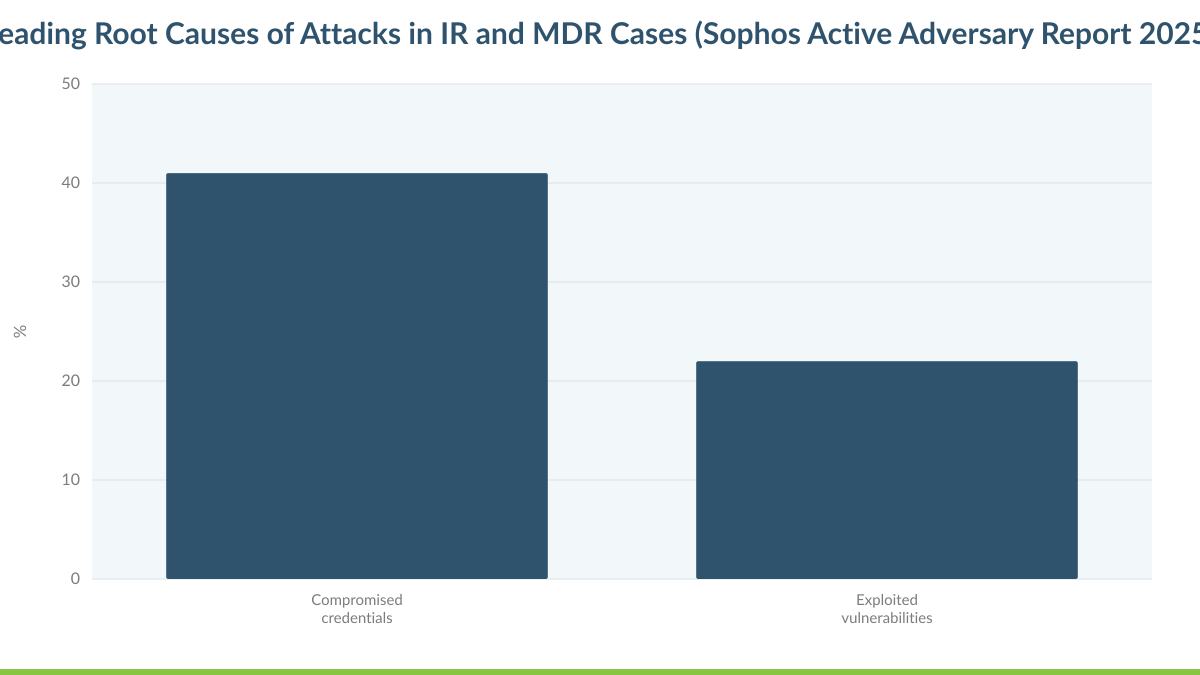
The Sophos data makes the point plainly: compromised credentials lead the list of root causes, ahead of exploited vulnerabilities and the other entry methods tracked in the report. Attackers increasingly log in rather than break in. A valid username and password, an exposed remote access service, or a session token lifted from an infostealer infection gives an adversary access that looks legitimate to most security tools.
When identity fails, perimeter controls become irrelevant. An attacker using a real account can move laterally, reach backup consoles, and access cloud management planes without tripping a single firewall rule. For mid-market firms supporting hybrid workforces, contractors, and remote offices, that exposure is constant rather than occasional.
What works:
- Phishing-resistant multi-factor authentication on every remote access path, administrative console, and email account, not a selected few.
- Conditional access policies that evaluate device health and sign-in context before granting a session.
- Separate privileged accounts for administration, with no email or web browsing from those accounts.
- Continuous monitoring for impossible travel, unusual token use, and new mailbox forwarding rules, which are common indicators of account takeover.
- Removing direct internet exposure of remote desktop services and management interfaces.
This is also where virtual desktops earn a place in the security conversation. Delivering applications through Desktop as a Service (DaaS) keeps data inside a controlled environment rather than on unmanaged endpoints. That narrows what a stolen credential can reach and simplifies policy enforcement across contractors, seasonal staff, and remote employees.
Issue 4: Hybrid Sprawl and Tool Overload Widen the Attack Surface
CSO Online notes that CISOs watch their attack surfaces not only expand but also increase in complexity. In mid-market environments, that complexity usually has a recognizable shape: an on-premises VMware cluster, a handful of workloads in Microsoft Azure or another public cloud, SaaS applications adopted department by department, remote endpoints, and a growing collection of security tools, each with its own console.
The infrastructure layer deserves particular attention. Ransomware groups have targeted VMware ESXi hosts directly for years, because encrypting a hypervisor takes down every virtual machine running on it in a single move. Broadcom continues to publish security advisories for ESXi and vCenter, and every advisory starts a race between your patching cycle and an attacker’s exploitation timeline. Organizations that are also working through Broadcom licensing changes are making infrastructure decisions under cost pressure, which is precisely when security shortcuts creep in.
Tool sprawl compounds the problem. Each additional product adds integration work, licensing cost, training requirements, and another place for a misconfiguration to hide. Security teams end up maintaining tools instead of using them, and the visibility each tool promises fragments across dashboards that nobody has time to correlate.
The business impact is more surface to defend, more cost to sustain, and slower response, because no single person can see the whole environment. This is the Simplification pillar in its purest form. Consolidating workloads onto a managed platform such as Cloud Hosting (IaaS), where hypervisor patching, hardening, and monitoring are part of the service, removes an entire category of risk from the internal team’s plate.
What works: inventory everything, including AI services and SaaS applications, retire overlapping tools, standardize on a smaller set of integrated platforms, and move infrastructure management to a partner with the scale to patch and monitor the virtualization layer continuously.
Issue 5: The Talent Gap Has Turned Into a Burnout Problem
The workforce data explains why every other issue on this list feels heavier than it should. The chart below, based on the ISC2 2024 Cybersecurity Workforce Study as reported by ASIS Security Management, compares the size of the global cybersecurity workforce with the gap between the professionals organizations have and the professionals they need.
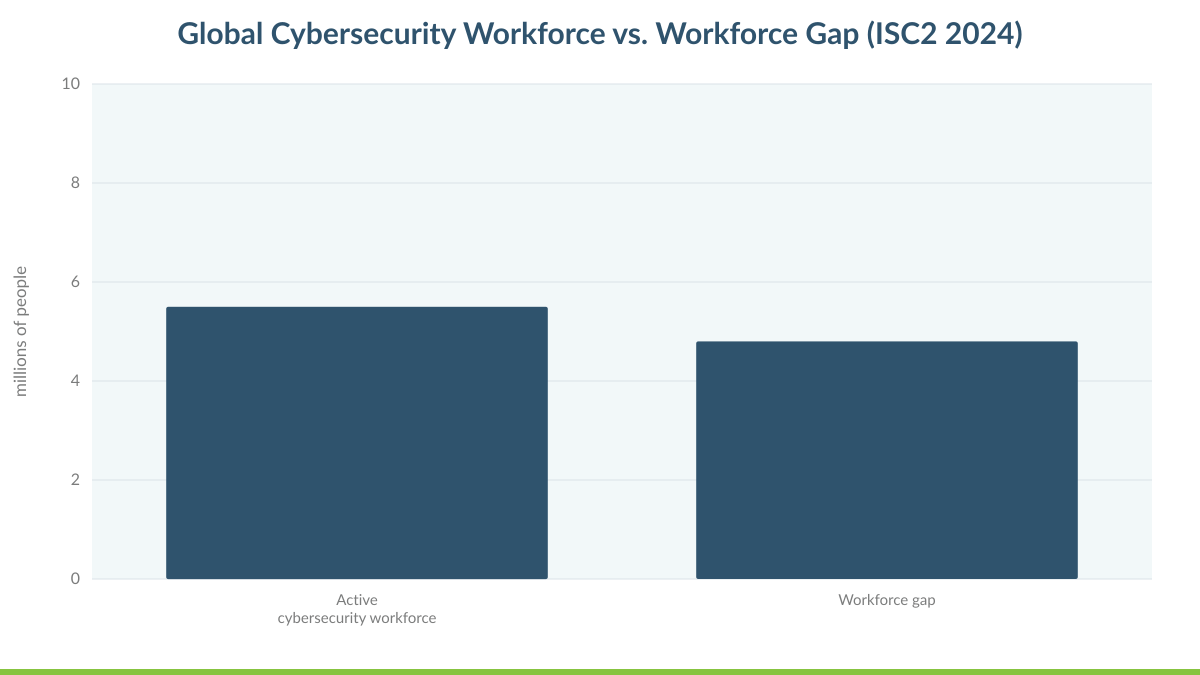
The gap is measured in millions of unfilled roles, and it sits alongside a workforce that is already stretched. ASIS framed the findings as worsening talent and skills shortages. For mid-market organizations competing against large enterprises for the same experienced engineers, that shortage translates directly into longer vacancies, higher salaries, and a constant risk of losing trained staff to better-funded employers.
Now layer in the stress data. ISACA’s 2026 survey, cited by CSO Online, found 68% of security leaders reporting more stressful roles, and Absolute found half of CISOs considering leaving the profession. A shortage of talent combined with potential leadership attrition creates key-person risk that most mid-market risk registers never capture. If your security program lives in the heads of one director and two analysts, the departure of any one of them is a material event.
When half of the people responsible for defending the business are weighing an exit, security stops being a technical line item and becomes a continuity risk.
The business impact is knowledge loss, inconsistent coverage, delayed projects, and, at worst, an incident that unfolds while the only person who understands the environment is on vacation or has just resigned. The Resilience pillar applies to people as much as to infrastructure.
What works: document runbooks so capability does not depend on individuals, define clear split responsibilities between internal staff and external partners, and offload round-the-clock operational work to a provider that staffs for it. Security as a Service (SECaaS) exists for exactly this reason. It gives a mid-market organization continuous monitoring, detection, and response capability, drawing on our partner ecosystem including Fortinet, CrowdStrike, and Proofpoint, without asking a small internal team to carry 24×7 coverage on its own.
Issue 6: Breach Costs Remain Severe, and Recovery Is Where Plans Break
Cost is the language boards understand, and IBM has tracked it for years. The chart below shows the global average cost of a data breach from IBM’s 2025 Cost of a Data Breach Report, subtitled Navigating the AI rush without sidelining security.
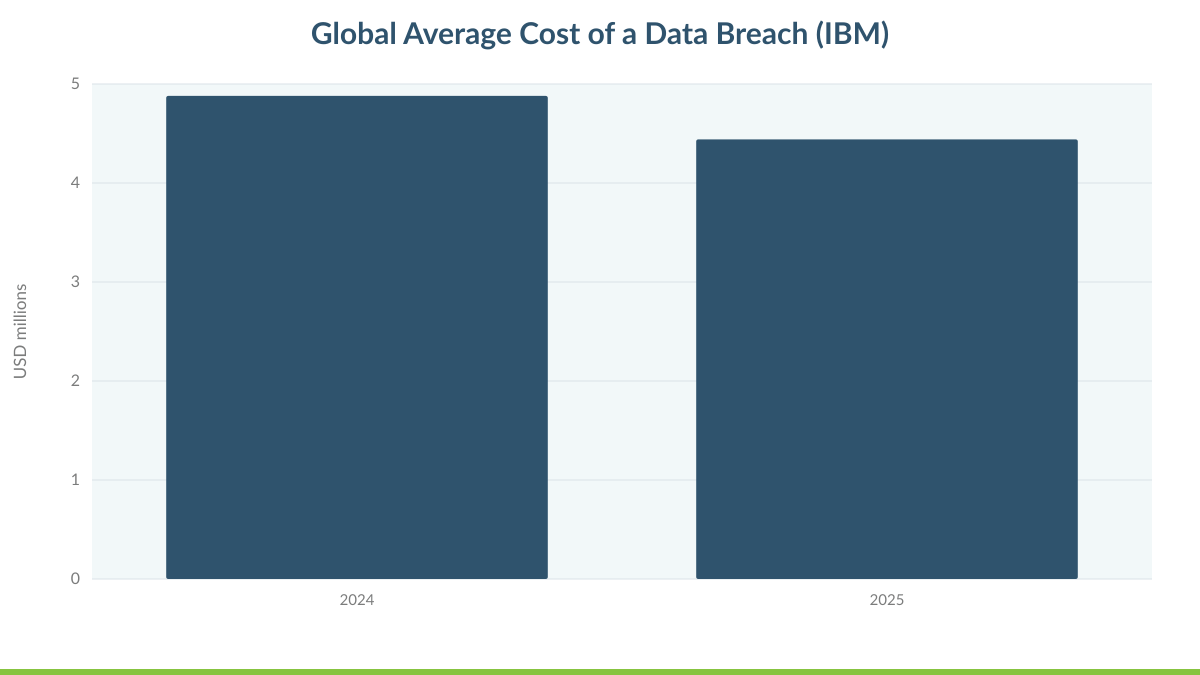
The figure stays firmly in the millions of dollars per incident, and a single average hides how much of that cost comes from disruption rather than from the intrusion itself. Lost business, downtime, customer notification, legal work, and regulatory response accumulate every day systems remain unavailable. The subtitle of IBM’s report is itself a signal: AI adoption is moving faster than the security controls around it, which ties this issue directly back to Issue 2.
For mid-market organizations, the most dangerous assumption is that having backups equals having recovery. Modern ransomware operators actively hunt for backup systems, delete snapshots, and encrypt backup repositories before triggering the main payload. A backup that sits on the same network, uses the same administrator credentials, and has never been restored under pressure offers far less protection than its dashboard suggests.
A backup you have never restored is a hypothesis, not a recovery plan.
The business impact is extended downtime, missed recovery time objectives, and ransom pressure when clean restore points cannot be found. This is the heart of the Resilience pillar, and it is where the gap between documented plans and real capability tends to be widest.
What works:
- Immutable, isolated backup copies that cannot be altered or deleted with compromised administrator credentials, delivered through Backup as a Service (BaaS) built on Veeam.
- Replication of critical workloads to a separate environment with documented, rehearsed failover, delivered through Disaster Recovery (DRaaS).
- Recovery testing on a fixed schedule, with results reported to leadership rather than kept inside IT.
- Clean-room recovery procedures that restore into a verified environment rather than back into a compromised one.
Teams that rehearse recovery not only restore faster but also make better decisions under pressure, because the decision tree has already been walked once in daylight. That rehearsal is what turns a backup investment into reduced downtime risk the board can actually see.
Issue 7: Regulators, Boards, and Insurers Now Expect Proof
The final issue is accountability. Security used to be judged by whether a breach occurred. It is now judged by how well the organization detected, decided, disclosed, and recovered.
For public companies, the SEC’s cybersecurity disclosure rules require a Form 8-K filing under Item 1.05 within four business days after the company determines that a cybersecurity incident is material. That clock starts with a materiality determination, which means the security team, legal counsel, and executives must already know who decides, using what information, and how fast. Our SEC 8-K Disclosure Readiness Checklist walks through the preparation most organizations skip until the moment they need it.
Regulated sectors carry their own obligations. Healthcare organizations answer to HIPAA, broker-dealers to FINRA, and law firms to client confidentiality duties alongside increasingly demanding cyber insurance questionnaires. Insurers now routinely ask about multi-factor authentication, endpoint detection and response, backup isolation, and incident response planning before they will quote or renew a policy.
The business impact is penalties, higher premiums, coverage disputes, and reputational damage that outlasts the technical incident. This is where the Flexibility pillar matters. Your controls and evidence must adapt as regulations, insurer requirements, and board expectations change, without a full re-architecture every time a questionnaire adds a new line.
What works: map each control to the frameworks and policies it satisfies, keep evidence current rather than assembling it at renewal time, and run tabletop exercises that include executives, counsel, and communications staff. The point of a tabletop is not to test whether IT can restore a server. It is to test whether leadership can make a disclosure decision on a deadline with incomplete information.
How Mid-Market Teams Can Address the Biggest Issues CISOs Face
Seven issues, one constrained team. The answer is not to fund seven separate initiatives. It is to restructure where the work lives. A practical roadmap organized by pillar looks like this:
- Simplification: Consolidate infrastructure and security tooling onto fewer, integrated platforms, and move hypervisor and platform management to a partner that patches and monitors it continuously.
- Security: Make identity the control plane, with phishing-resistant MFA, conditional access, least privilege for both humans and AI agents, and 24×7 detection and response.
- Performance: Treat mean time to detect and mean time to contain as business metrics, and reduce them through automation and consolidated telemetry.
- Resilience: Protect backups with immutability and isolation, replicate critical workloads, and rehearse recovery on a schedule leadership can see.
- Flexibility: Build controls and evidence that adapt to new regulations, insurer questionnaires, and AI use cases without rebuilding the program each time.
Mid-market security teams do not need more tools. They need fewer consoles, clearer ownership, and a partner who carries part of the load.
Sequencing matters. Start with the controls that reduce the most risk per hour of effort, which for most mid-market organizations means identity hardening and backup isolation. Those two moves directly address the leading root cause in the Sophos data and the recovery failures that drive breach costs in the IBM data. Then consolidate tooling and shift 24×7 operations to a partner, which relieves the talent and burnout pressure that makes every other issue harder to manage.
The CISO Role Is Shifting From Operator to Risk Executive
The stress figures in ISACA’s survey and the exit intentions in Absolute’s survey describe a role that has outgrown its original definition. A mid-market CISO or IT director who personally manages firewall rules, chases alerts, tests backups, answers insurer questionnaires, and briefs the board is doing five jobs. No amount of individual grit fixes that structure.
The organizations that keep their security leaders, and keep them effective, are the ones that redesign the role. Operational execution moves to platforms and partners built to run it at scale. The internal leader focuses on risk decisions, business alignment, vendor accountability, and executive communication. That shift does not reduce the CISO’s importance. It recognizes that judgment is the scarce resource, and judgment should not be spent resetting passwords or babysitting backup jobs.
This is also where the choice of partner matters. A reseller sells you another console. An integrator, architect, and advisor designs how the pieces work together, takes operational responsibility under a defined service level, and stays accountable when something goes wrong. As a Premier Broadcom VCSP Partner, IT Vortex brings the VMware infrastructure layer, the Veeam data protection layer, and security and workspace technology from partners including Fortinet, CrowdStrike, Proofpoint, Microsoft, and Omnissa together as one managed environment rather than a stack of separate contracts. That is what enterprise-grade infrastructure without enterprise complexity looks like in practice.
Reframe: The Real Risk Is Carrying All Seven Issues Alone
Every issue on this list is real, and none of them is going away. Attacks will keep accelerating. AI will keep expanding the attack surface. Credentials will keep getting stolen. Talent will stay scarce, breaches will stay expensive, and regulators will keep tightening the timelines for proving you were ready.
The question for mid-market leaders is not whether these issues apply to you. It is whether your organization’s structure assumes that a small team can absorb all seven at once. If it does, the most important security decision you make this year is not which tool to buy. It is which work to stop carrying internally, so the people you depend on can stay, focus, and lead.
Start with an honest map of where your load sits today. Identify which of the seven issues your team owns end to end, which are partially covered, and which nobody owns at all. Then decide which of those responsibilities belong with managed services engineered for that work, and which deserve your internal team’s full attention.
If you want an experienced second set of eyes on that map, schedule a working session with Lou Corriero, VP Cloud at IT Vortex. You will leave with a clear view of which of the seven issues create the most exposure for your organization and a practical plan to shift operational burden off your team without losing control of the decisions that matter.