
Citrix is now warning customers about an actively exploited NetScaler flaw just days after it rushed out emergency fixes for a separate zero-day, and the overlap is not a coincidence. When a vendor patches one critical edge-appliance bug and then has to confirm in-the-wild attacks on a second within the same window, the message to mid-market IT leaders is blunt: the NetScaler attack surface is a standing liability, not a one-time incident. If your organization runs Citrix NetScaler ADC or NetScaler Gateway at the network edge, you are inside an exploitation pattern that has repeated for years, and the patch cadence alone is no longer keeping up.
Source: Citrix warns of actively exploited NetScaler flaw days after zero-day patch rush, CSO Online.
This is not a story about a single CVE. It is a story about why internet-facing appliances that terminate remote access, authenticate users, and front your most sensitive applications keep landing on CISA exploitation lists. For the healthcare practice, the law firm, the financial services shop, and the professional-services organization running lean IT teams, the practical question is not whether you will see another NetScaler advisory. It is how fast you can detect, contain, and recover when the next one lands before your maintenance window opens.

Why the actively exploited NetScaler flaw fits a familiar pattern
Citrix NetScaler has become one of the most reliably targeted edge technologies in enterprise IT. The appliances sit directly on the public internet, they handle authentication and session management, and a single memory-disclosure or injection flaw can hand an attacker valid session tokens, credentials, or remote code execution. That combination is irresistible to ransomware affiliates and nation-state actors alike, which is why each new advisory triggers a measurable spike in scanning and exploitation.
Consider what a NetScaler Gateway actually does inside a typical mid-market deployment. It terminates the VPN and ICA sessions for remote staff. It brokers single sign-on against your identity provider. It often publishes internal web applications to the outside world through a reverse proxy. Every one of those functions requires the appliance to hold live credentials and session state in memory, which is exactly why a memory-disclosure bug like the CitrixBleed family is so devastating. The attacker does not need to crack a password. They read a valid, authenticated session straight out of the device and walk through the front door as a trusted user. Multi-factor authentication, which stops credential-stuffing attacks cold, does nothing against a stolen session token that has already cleared the MFA check.
The current round follows the same choreography the industry has watched before. A critical vulnerability gets patched. Proof-of-concept detail circulates. Mass scanning begins almost immediately. Then a second, related flaw is confirmed as actively exploited, catching organizations that patched the first bug but assumed they had bought themselves breathing room. The lesson from prior NetScaler events, from the original CitrixBleed through its successors, is that the gap between disclosure and weaponization is now measured in days, not weeks.
An internet-facing appliance that terminates your remote access is not a device you patch on a quarterly schedule. It is a device attackers test every single day.
What makes this particularly dangerous for mid-market organizations is the asymmetry of resources. A Fortune 100 security operations center can staff a 2 a.m. emergency patch and watch for post-exploitation activity around the clock. A 40-person IT team supporting a regional business cannot, and that is exactly the gap attackers exploit. The appliance that was supposed to secure remote work becomes the single point through which an entire environment is compromised.
The asymmetry runs deeper than headcount. Large enterprises typically run their edge appliances behind layered web application firewalls, dedicated threat-intelligence feeds, and automated virtual-patching platforms that neutralize an exploit signature within minutes of disclosure. A mid-market team frequently runs the appliance with vendor-default logging, no out-of-band monitoring, and a change process that routes every production change through a weekly board. When the exploitation window is measured in hours, a weekly change board is not a safeguard. It is a scheduled delay that attackers are counting on.
The exposure numbers tell the real story
The scale of unpatched exposure is what turns a vendor advisory into a systemic risk. Internet-wide scanning after each NetScaler disclosure consistently finds tens of thousands of instances that remain reachable and vulnerable long after fixes are available. The problem is not that patches do not exist. The problem is that too many instances never get them in time.
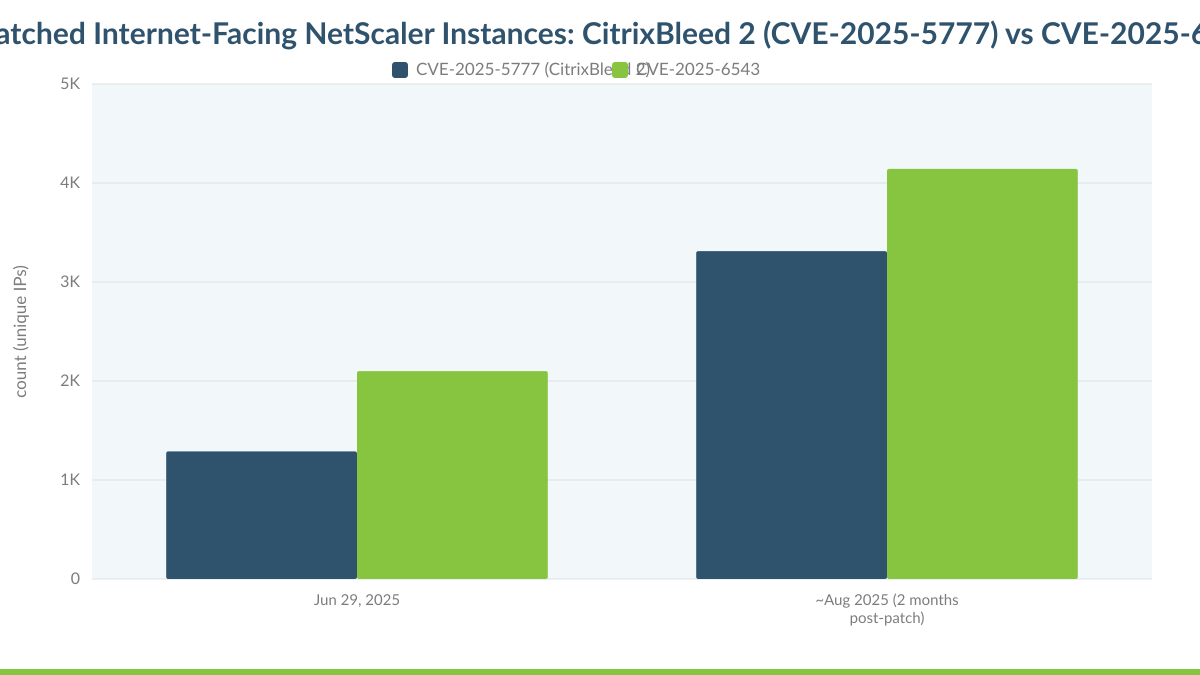
The data on unpatched instances across the CitrixBleed 2 flaw (CVE-2025-5777) and the related CVE-2025-6543 shows how persistent this exposure is. Even as attention concentrated on one vulnerability, large populations of appliances remained unpatched against both, which is precisely how a vendor ends up issuing a second active-exploitation warning so soon after the first. When scanning data from organizations like The Shadowserver Foundation keeps counting vulnerable hosts in the thousands, the exploitation window is not closing fast enough on its own.
Why does the vulnerable population stay so stubbornly high? Part of the answer is appliance sprawl. Organizations acquire other organizations, inherit their edge devices, and lose track of which instances exist and who owns them. Part of it is the appliance lifecycle itself: NetScaler devices often run for years with firmware that is one or two major versions behind, because each upgrade carries reboot risk and a maintenance window nobody wants to own. And part of it is simply that a reachable, forgotten gateway does not announce itself. It sits quietly, fully patched against last year’s threats and fully exposed to this week’s, until an attacker’s scanner finds it before your inventory does.
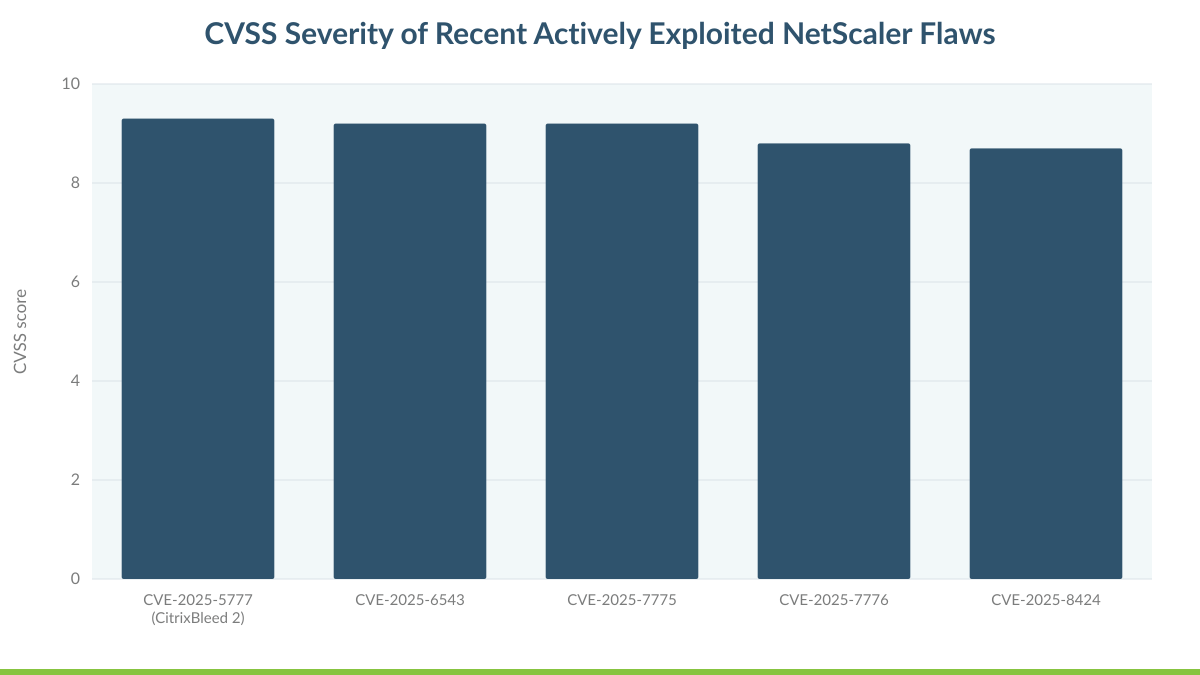
Severity compounds the problem. The recent actively exploited NetScaler flaws carry CVSS scores in the critical and high ranges, meaning they are not theoretical edge cases but direct paths to compromise. A high CVSS score on an authentication or session-management component of an internet-facing device is the worst possible combination: maximum impact, maximum reachability. These are the flaws that get chained into full network intrusions, and the severity ratings reflect that reality.
This is where the business translation matters. A critical CVSS score on a NetScaler Gateway is not an IT metric. It is a continuity risk, a compliance exposure, and a potential cyber-insurance claim trigger all at once. For regulated organizations, an actively exploited flaw on a device that handles protected data moves the conversation from patch management to breach notification in a matter of hours. Our Security as a Service (SECaaS) approach exists precisely to shrink the distance between disclosure and defensive action for teams that cannot staff that response alone.
Translate the severity into dollars and the stakes get concrete. A ransomware event that enters through a compromised NetScaler Gateway does not cost you a patch. It costs you downtime measured in days, incident-response retainers billed by the hour, legal and notification expenses, regulatory penalties where protected data is involved, and the harder-to-quantify erosion of client trust that follows a public breach disclosure. For a regional firm, a single week of operational standstill can exceed the entire annual IT budget. The appliance you declined to monitor because monitoring felt like overhead becomes the most expensive line item of the year.
The patch window is collapsing and the edge is where it breaks first
The structural issue is timing. Industry telemetry has shown time-to-exploit falling to a matter of days across many classes of vulnerability, while real-world patch cycles for appliances that require reboots, session draining, and change-control approvals still stretch to weeks. Edge appliances are the worst-case intersection of these two trends. They are the first thing attackers scan, the first thing they weaponize, and often the hardest thing to patch quickly because taking them offline interrupts remote access for the whole organization.
When time-to-exploit is measured in days and your change-control cycle is measured in weeks, the math does not work. The answer is not faster patching alone. It is containment that does not depend on the patch landing first.
This is why the operating model has to shift from patch-first to contain-first. Network-level containment, segmentation, and continuous monitoring of the edge give you defensive coverage during the hours and days when a known-exploited flaw is live but not yet patched in your environment. That coverage is the difference between an attacker probing a vulnerable gateway and an attacker moving laterally into your application and data tiers. Pairing that containment with resilient infrastructure in our Managed Cloud Hosting and Cloud Hosting (IaaS) environments means the blast radius of a compromised edge device stays contained rather than cascading across your estate.
Contain-first is not a slogan. It is a specific set of controls that keep a compromised edge device from becoming a compromised business. Microsegmentation ensures that an attacker who lands on the gateway cannot pivot freely into the database tier, because east-west traffic between workload segments is explicitly denied by default rather than implicitly allowed. Continuous monitoring of authentication events surfaces the anomaly of a session originating from an unexpected geography or a credential being used from two places at once. Virtual patching at the network layer blocks the exploit pattern itself, buying you the hours you need to schedule the real firmware update without leaving the window wide open. Each of these controls operates independently of whether the vendor patch has landed yet, which is exactly the point.
What the 2026 mass-exploitation event confirms
The pattern did not stop with the 2025 advisories. The subsequent mass-exploitation event showed the same dynamic at even larger scale, with internet-exposed NetScaler instances numbering in ranges that make clear just how much of this technology sits directly reachable from the public internet.
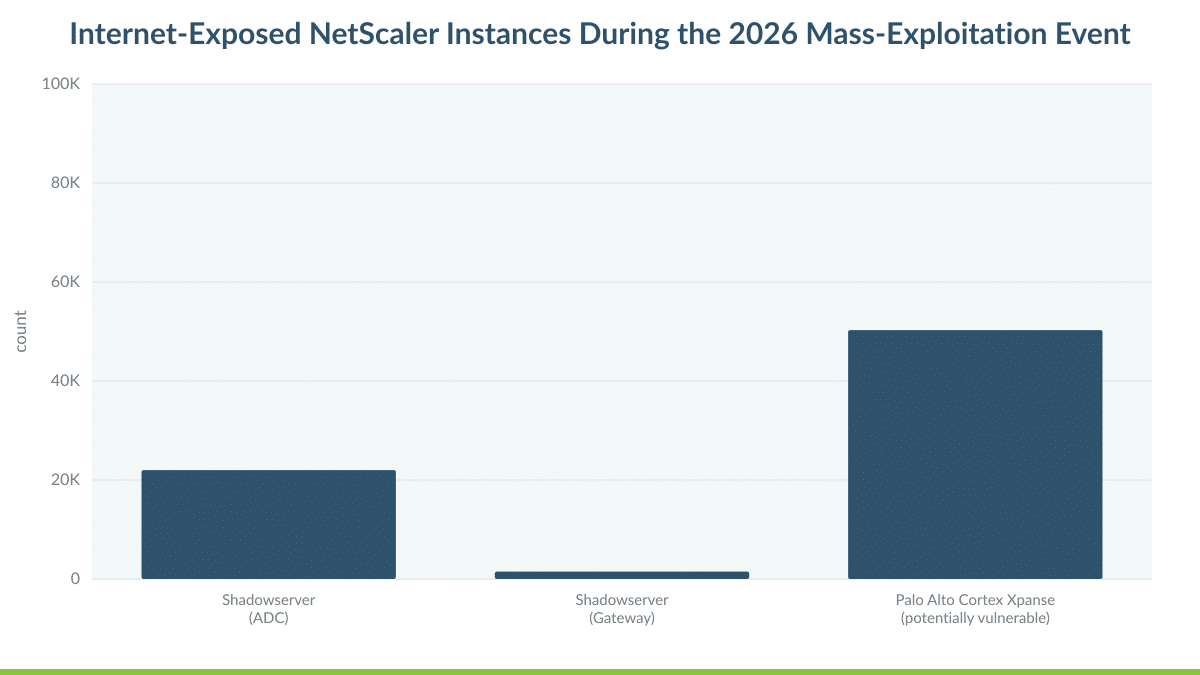
Scanning data compiled during that event, drawing on sources such as Palo Alto’s Cortex Xpanse and Shadowserver, quantifies the exposed population and underscores a hard truth: the attack surface is not shrinking. Every new NetScaler deployment that terminates remote access adds to the count of devices attackers will probe the moment the next flaw is disclosed. For mid-market leaders, the implication is strategic, not tactical. If the edge appliance will keep producing critical advisories, your architecture has to assume compromise of that device and be designed to survive it.
Surviving it means two things working together. First, you need the ability to detect post-exploitation activity fast, because a session-hijacking flaw leaves behind valid credentials and active sessions that signature-based tools may miss. Second, you need the ability to recover cleanly if detection comes too late, which is where tested recovery becomes the backstop for every edge-security assumption.
The repetition across 2025 and 2026 is the single most important data point in this entire story. It tells you that betting your security posture on perfect, instantaneous patching of edge appliances is a losing bet, not because your team is negligent but because the structure of the problem guarantees a gap. The appliances will keep producing critical flaws. The exploitation window will keep shrinking. The only variable you fully control is whether your architecture treats the inevitable edge compromise as a contained, recoverable event or as the first domino in a total-environment breach. Design for the former and the advisories lose their power to end your week.
Mapping the response to the five pillars
Security: shorten the distance from disclosure to defense
The first pillar is the most obvious and the most commonly underfunded. When an actively exploited NetScaler flaw is announced, the organizations that fare best are the ones with continuous monitoring already watching the edge, with the ability to apply virtual patching or access restrictions within hours, and with a team that treats a CISA known-exploited entry as an immediate action item rather than a ticket in a backlog. Managed detection and response, delivered through Managed Services, turns the vendor advisory into a monitored, acted-upon event instead of an email someone sees Monday morning.
Resilience: assume the edge will be breached and plan to recover
No defensive layer is perfect, and NetScaler history proves that session-token theft can succeed before a patch is applied. That is why resilience is not optional. Disaster Recovery (DRaaS) and Backup as a Service (BaaS) give you the ability to roll back to a known-good state if an edge compromise turns into data destruction or ransomware deployment. The value is not only the backup copy but also the tested, validated ability to bring systems back inside a recovery time objective your business can actually tolerate. A backup you have never restored is a hypothesis, not a plan.
Immutable backups matter enormously here. Modern ransomware operators specifically hunt for and delete backup repositories before they detonate, because they understand that a company with clean, recoverable copies does not pay the ransom. Backup as a Service built on immutable, air-gapped storage means the attacker who entered through your NetScaler Gateway cannot reach back and poison the very copies you need to recover. That is not only a security control. It is leverage, because it changes the economics of the attack from the attacker’s side. An organization that can demonstrably recover in hours has removed the primary reason the extortion works at all.

Simplification: reduce the number of exposed appliances you have to defend
Every internet-facing appliance you run is an attack surface you own forever. Consolidating remote access, retiring redundant edge devices, and shifting workloads into managed cloud environments reduces the count of things that can appear on the next exploitation list. Simplification is a security strategy in disguise. The organization with two managed edge gateways under continuous monitoring is in a fundamentally stronger position than the one with a dozen appliances patched on different schedules by different people.
Simplification also compounds over time. Every appliance you retire is a device you will never have to emergency-patch again, a firmware lifecycle you no longer track, and an entry in your attack-surface inventory that disappears for good. Mid-market teams that have consolidated remote access into a single managed, monitored path report that their advisory-response workload drops sharply, not because the advisories stop coming but because there are fewer places each one applies. Reducing the fleet is the one move that makes every future response faster and cheaper, which is why it belongs at the center of edge strategy rather than at the margins.
Performance and flexibility: do not trade security for uptime
The reason organizations delay NetScaler patches is that patching interrupts access, and access is what the business depends on. The way out of that trap is an architecture where remote access can be maintained through alternate paths during a patch window, where Desktop as a Service (DaaS) provides a controlled, managed access layer that does not hinge on a single vulnerable appliance, and where failover is designed in from the start. Flexibility here means you can take an edge device offline to patch it without taking the business offline with it.
Desktop as a Service deserves a closer look in this context, because it quietly removes the forcing function that makes edge patching so painful. When users reach their desktops and applications through a managed, redundant DaaS layer rather than a single on-premises gateway, taking one access path offline for emergency maintenance no longer strands the workforce. You gain the operational freedom to patch aggressively, on your schedule, the moment a flaw is confirmed exploited, because the business keeps running on the alternate path. That freedom is the practical mechanism that turns contain-first from a principle into daily operations, and it is exactly the kind of architecture an integrator designs rather than a product you buy off a shelf.
A backup you have never restored is a hypothesis. A disaster recovery plan you have never tested is a wish. The next NetScaler advisory will not wait for you to find out which one you have.
The compliance and insurance dimension
For regulated mid-market organizations, an actively exploited edge flaw is not only a technical problem but also a documentation and liability problem. Cyber-insurance carriers increasingly require evidence of timely patching, continuous monitoring, and tested recovery as conditions of coverage. A known-exploited NetScaler flaw that sits unpatched past a reasonable window is exactly the kind of detail that can jeopardize a claim or trigger a coverage dispute after an incident.
Healthcare organizations operating under HIPAA face breach-notification clocks that start ticking the moment protected data is accessed through a compromised gateway. Financial and legal firms face their own regulatory scrutiny and client-trust consequences. The ability to demonstrate that you detected, contained, and recovered quickly is what separates a managed incident from a reportable catastrophe. Resources like our HIPAA Recovery Readiness Checklist exist to help regulated teams document that readiness before an auditor or a carrier asks for it.
The insurance angle has sharpened considerably. Carriers now send detailed security questionnaires at renewal that ask pointed questions about edge-appliance patch cadence, log retention, and recovery testing, and they price premiums against the answers. Some have begun denying claims outright where the insured could not demonstrate that a known-exploited vulnerability was remediated within the carrier’s stated window. The documentation you build around your NetScaler response is therefore doing double duty: it shortens your real-world incident timeline and it protects the financial backstop you are paying for. A response capability you cannot evidence on paper is a response capability your carrier may decline to credit.
The through-line across every regulated vertical is the same: you are judged not on whether you were targeted, because everyone running NetScaler is targeted, but on how fast and how completely you responded. That response capability is an operational asset you build before the incident, not a document you draft during one.
A practical action plan for the next advisory
Because the next NetScaler advisory is a matter of when, not if, the right move is to build a repeatable response you can execute in hours. Here is the shape of that plan for a mid-market team.
- Inventory every internet-facing NetScaler ADC and Gateway instance you run, including shadow deployments and devices managed by third parties, so no vulnerable appliance is invisible when an advisory drops.
- Subscribe to and triage vendor and CISA known-exploited notifications as priority-one events, with a named owner responsible for assessing applicability within hours.
- Pre-authorize emergency change windows for edge appliances so patching a known-exploited flaw does not wait on a weekly change-advisory-board meeting.
- Deploy network-level containment and continuous monitoring so you have defensive coverage during the gap between disclosure and patch.
- Rotate credentials and invalidate active sessions after patching a session-hijacking or memory-disclosure flaw, because the patch stops new theft but does not expel an attacker who already has valid tokens.
- Test your recovery path on a schedule, not just after an incident, using a documented validation plan so you know your recovery time objective is real.
That last point deserves emphasis. Patching a session-token flaw does not log out the attacker who already captured a session. Teams that patched prior CitrixBleed-class flaws and skipped session invalidation discovered intruders already inside, operating with legitimate credentials, long after the device was marked remediated. The patch is necessary and insufficient. The full response includes session termination, credential rotation, and a hunt for post-exploitation activity. Our DR Failover Validation Plan Template helps teams turn that recovery step from an improvised scramble into a rehearsed procedure.
Run the plan as a drill before you need it live. The organizations that execute cleanly during a real advisory are the ones that rehearsed the sequence when nothing was on fire: they already know who owns the inventory, who authorizes the emergency window, which runbook invalidates sessions, and how long a full recovery actually takes when the clock is running. A tabletop exercise against the next hypothetical NetScaler zero-day will surface the broken assumptions, the stale contact lists, and the untested restore paths while they are still cheap to fix. The first time you run the playbook should never be the time it matters most.
Where IT Vortex fits
IT Vortex is a Premier Broadcom VCSP Partner, and we build managed cloud environments designed around the assumption that edge devices and internet-facing services will be targeted. We are an integrator, architect, and advisor, not a box reseller, which means our job is to design the containment, monitoring, and recovery capability that makes a NetScaler advisory a managed event rather than a crisis. We bring together VMware-powered infrastructure, Veeam data protection, and layered security partners to give mid-market organizations enterprise-grade resilience without enterprise complexity.
The integrator role is the distinction that matters when a zero-day lands. A reseller hands you a license and a support number. An integrator has already mapped how your edge access, your workload tiers, your identity provider, and your recovery targets fit together, so that when an advisory drops there is a single architecture and a single team accountable for the response rather than a scramble across four vendors who each own one piece. That is the difference between calling for help after the breach and having the containment already engineered before the flaw was ever disclosed.
Lou Corriero, VP Cloud at IT Vortex, works directly with IT leaders to map their edge exposure, design the containment and recovery architecture, and establish the response playbook that executes in hours rather than days. If your organization runs NetScaler or any internet-facing appliance that terminates remote access, that conversation is worth having before the next advisory, not after.
The actively exploited NetScaler flaw making headlines this week is not an anomaly to wait out. It is a preview of every advisory that follows, and the organizations that treat it as a one-time patch will keep getting caught by the second flaw, the third, and the next mass-exploitation event. The ones that treat it as a signal to build contain-first, recover-always architecture will stop reading these advisories as emergencies and start reading them as confirmation their design works. Reframe the NetScaler problem from a patching problem into a resilience problem, and you change who is in control when the next zero-day lands.
Schedule a working session with Lou Corriero to assess your NetScaler and edge-appliance exposure and build a response that executes before the exploitation window opens.