
On its July 2026 Patch Tuesday, Microsoft shipped fixes for 569 CVEs in a single day, one of the largest monthly batches the industry has ever tracked. In the same window, security researchers reported that the average time between a vulnerability becoming public and being exploited in the wild has fallen to roughly five days, down from around 32 days just a few years earlier. Those two numbers, read together, describe a math problem that most mid-market IT teams cannot solve with patching alone.
The message coming out of Redmond and the wider defensive community is blunt: the patch window, the comfortable stretch of days or weeks you used to have between disclosure and attack, has effectively closed. When attackers weaponize a flaw in five days and your organization takes weeks to test, schedule, and deploy fixes across servers, endpoints, and network gear, you lose the race by default. The strategic response is not to patch faster in some heroic sense. It is to change what a missed patch means by moving to network-level containment so that an unpatched vulnerability is contained rather than catastrophic.
Why Network-Level Containment Beats the Patch Race
Patching has always been a race against an adversary, but for most of the last two decades defenders had a structural advantage: time. A vulnerability was disclosed, a proof-of-concept eventually appeared, and somewhere in the following weeks attackers built reliable exploits and folded them into their toolkits. That gap gave IT teams room to test patches, avoid breaking production, and roll changes out in an orderly way. That gap is gone.
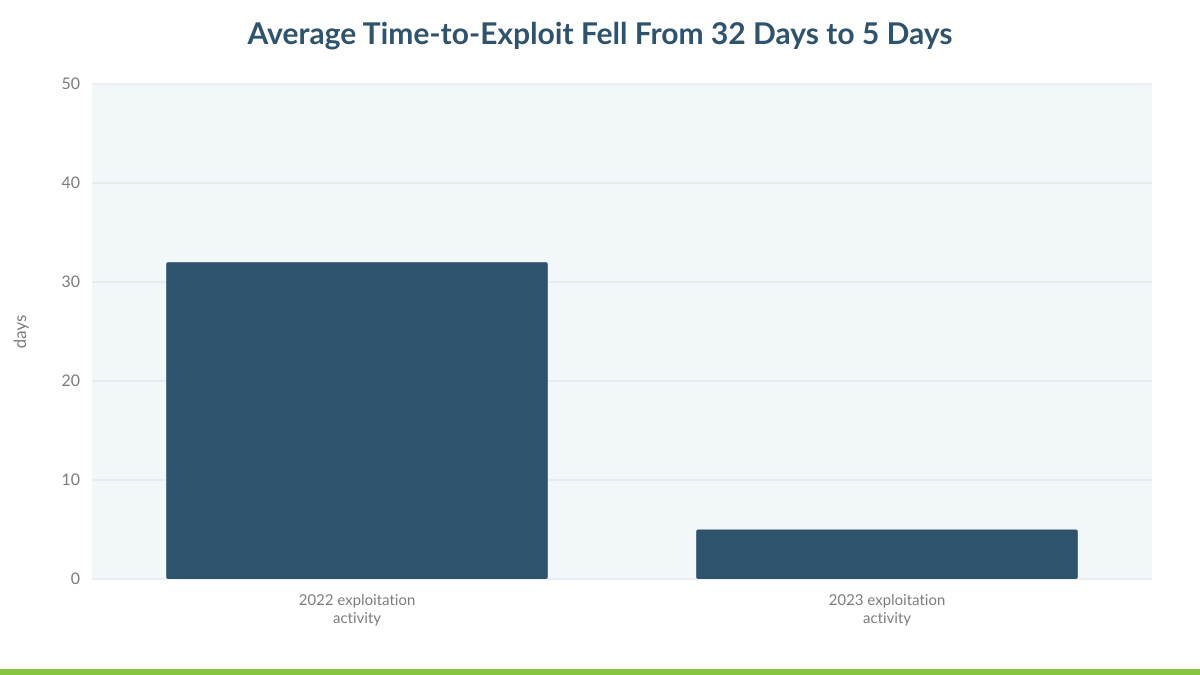
The collapse in time-to-exploit is the single most important trend for mid-market defenders to internalize. When Mandiant and Google Cloud data, summarized by researchers at Zafran, show the average time-to-exploit falling from 32 days to 5 days, that is not a marginal efficiency gain for attackers. It is a phase change. Five days is shorter than most change-control cycles. It is shorter than the interval between many organizations’ maintenance windows. For any environment where a single missed patch can be reached from the internet or from a compromised endpoint, the assumption that you will patch in time is now the exception, not the rule.
Consider the mechanics behind that five-day figure. Exploit development has been industrialized. Vulnerability brokers, ransomware affiliates, and access-as-a-service operators now compete to weaponize disclosures, and automated tooling turns a proof-of-concept into a mass-deployable payload in hours. When a critical flaw in an edge device or an authentication service lands, scanning infrastructure that already maps the internet begins probing for it almost immediately. The defender who waits for the next scheduled maintenance window is not being cautious. In this threat model, that defender is simply arriving late to a fight that started the day the CVE went public.
When attackers weaponize a flaw in five days and you patch in weeks, you do not have a patching problem. You have a containment problem.
Network-level containment reframes the entire exercise. Instead of betting your security posture on winning a race you are structurally positioned to lose, you design the network so that an unpatched, exploited system cannot become a business-ending event. Microsegmentation, east-west firewalling, identity-aware access controls, and isolated recovery environments turn a breach of one asset into a contained incident rather than a lateral rampage. This is the difference between a compromised web server and a company-wide ransomware detonation. The vulnerability may be identical. The blast radius is not.
The economics of a modern intrusion make this concrete. Attackers rarely monetize the first machine they compromise. Their value comes from what that foothold lets them reach: domain controllers, file servers, backup systems, and the data that funds the ransom demand. Every one of those objectives requires lateral movement. When containment denies that movement, you are not just slowing the attacker down. You are removing the path between an initial foothold and the assets that make an attack profitable. An adversary who lands on an isolated segment with no route to the crown jewels often finds the intrusion is not worth continuing.
For IT Vortex, this maps directly to the Security and Resilience pillars. A network built for containment is not only harder to move through laterally but also faster to recover, because the attacker’s reach is bounded by design. When we architect managed cloud hosting for mid-market clients, containment is not an add-on. It is the shape of the platform.
The Volume Problem: 569 CVEs in a Single Patch Tuesday
The other half of the math is sheer volume. Microsoft’s July 2026 Patch Tuesday addressed 569 CVEs, a figure Tenable flagged as a dramatic surge over historical monthly totals. For years, a heavy Patch Tuesday meant 100 to 150 CVEs. A month with more than 500 is a different operational reality, and it is not an anomaly to be waited out. It reflects a growing attack surface across Windows, Office, Azure services, developer tooling, and the broader Microsoft ecosystem that mid-market IT teams depend on every day.
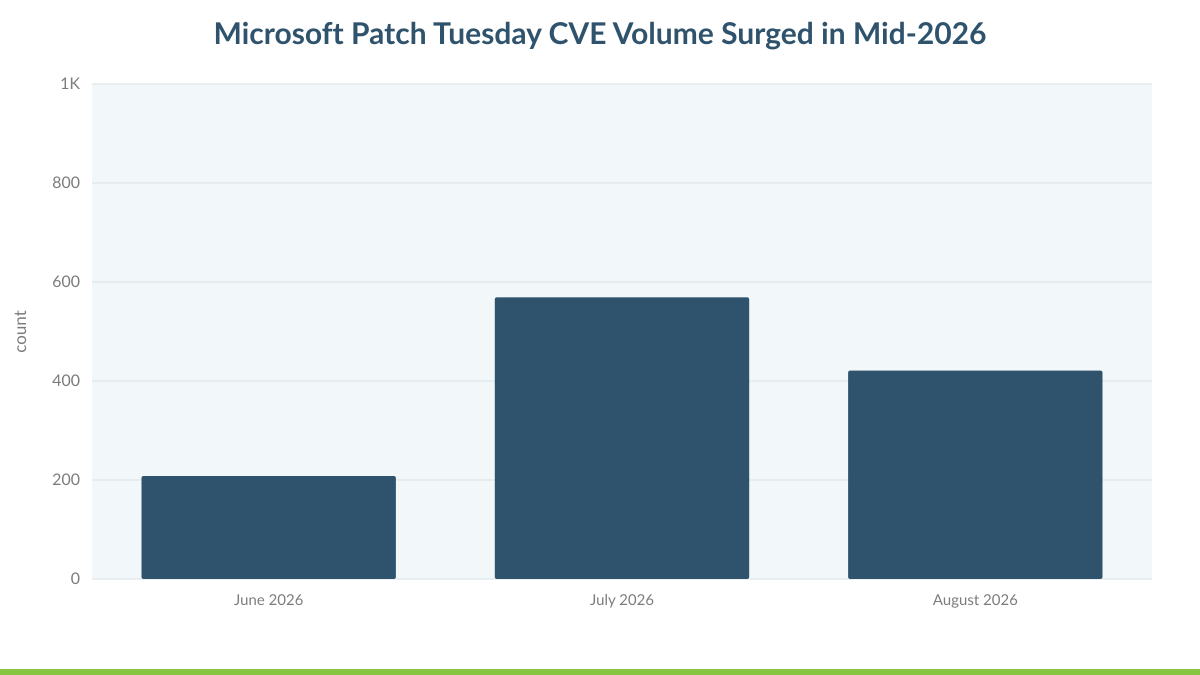
Consider what 569 CVEs in a month demands of a lean IT team. Each one must be evaluated for relevance to your environment, prioritized by severity and exploitability, tested against production workloads, scheduled into a maintenance window, and verified after deployment. Multiply that by the reality that not every vendor releases on the same cadence, and you are staring at a continuous, never-ending triage exercise. Now add the five-day exploit clock. The moment you triage one wave, the next is already being weaponized.
The volume also distorts prioritization in ways that quietly raise risk. When a team faces hundreds of advisories, the instinct is to sort by CVSS score and start at the top. But CVSS severity and real-world exploitability are not the same thing. A medium-rated flaw in an internet-facing appliance can be exploited within days, while a critical-rated bug in an isolated internal component may never be touched. Triage built purely on severity scores burns scarce hours on vulnerabilities attackers ignore while leaving genuinely dangerous ones in the queue. Effective prioritization now requires exploit-prediction intelligence and asset-exposure context, capabilities that most mid-market teams do not have time to operate, let alone tune, at 569 CVEs a month.
A month with more than 500 CVEs is not an anomaly to wait out. It is the new operating baseline, and it will not shrink to fit your maintenance window.
This volume is precisely why Simplification is a security pillar and not just an efficiency one. Every additional system a mid-market firm manages directly is another patch queue, another test matrix, another window to schedule. When you consolidate workloads onto a professionally managed platform, you are not only reducing operational overhead but also shrinking the number of independent patch races your team has to run. Fewer places to lose the race means fewer opportunities for a single missed CVE to become an incident. Our managed services and Cloud Hosting (IaaS) exist to absorb that operational burden so your internal team can focus on the business, not on chasing a number that grows every month.
Where the Time Actually Goes: Patch Latency by Asset Type
It would be convenient to blame slow patching on negligence, but the data tells a more honest story. Organizations patch different asset types at very different speeds, and the gaps are structural. Public-facing servers get attention quickly because the risk is obvious. Internal systems, network appliances, and specialized workloads lag, sometimes badly, because patching them carries operational risk, requires downtime, or depends on a vendor’s own release schedule.
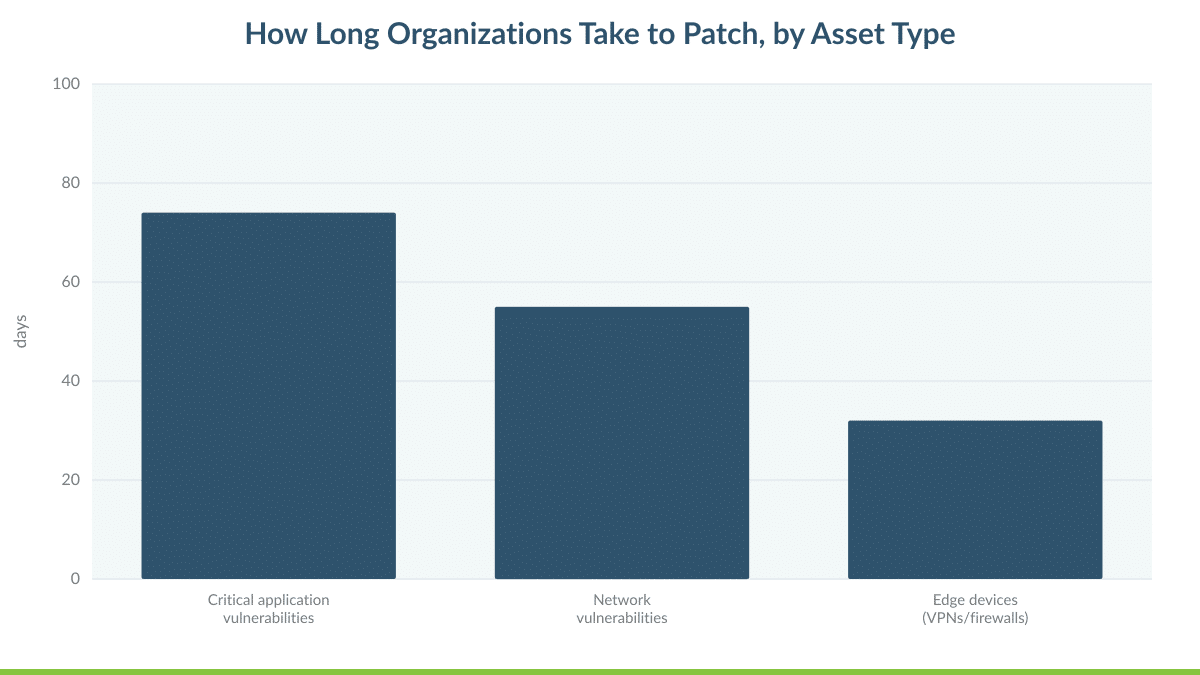
Research summarized by CybelAngel, noting that time-to-exploit is now roughly five days while organizations routinely take far longer to patch certain asset classes, exposes the true nature of the gap. The problem is not that IT teams are lazy. It is that the safe, careful, tested patching process the industry spent twenty years perfecting was built for a threat model that no longer exists. When exploitation happens in five days and your network gear or line-of-business application takes weeks to patch safely, the delta is not a scheduling inconvenience. It is your exposure window, and attackers are living inside it.
The hardest cases are the ones IT leaders know best. A manufacturing execution system tied to plant equipment cannot be rebooted mid-shift. An ERP platform certified against a specific vendor build cannot take an out-of-band patch without breaking support. A network appliance that terminates every branch VPN cannot be updated without a coordinated outage window that touches every remote site. These are not edge cases. They are the load-bearing systems of a mid-market business, and they are precisely the assets that patch slowest. Telling the people who run them to simply move faster ignores why they are careful. Containment is what lets that caution stay safe instead of becoming the single point through which a breach spreads.
This is where the business impact becomes concrete. Every day an exploitable asset sits unpatched is a day of accumulated risk, and that risk compounds because attackers automate. Mass scanning identifies vulnerable systems within hours of a disclosure. If your slowest-to-patch asset is reachable, it will be found. The pillars of Performance and Resilience meet here: a contained network lets you patch slow-moving assets on a safe, tested schedule without turning that necessary caution into a critical liability.
What Network-Level Containment Actually Looks Like
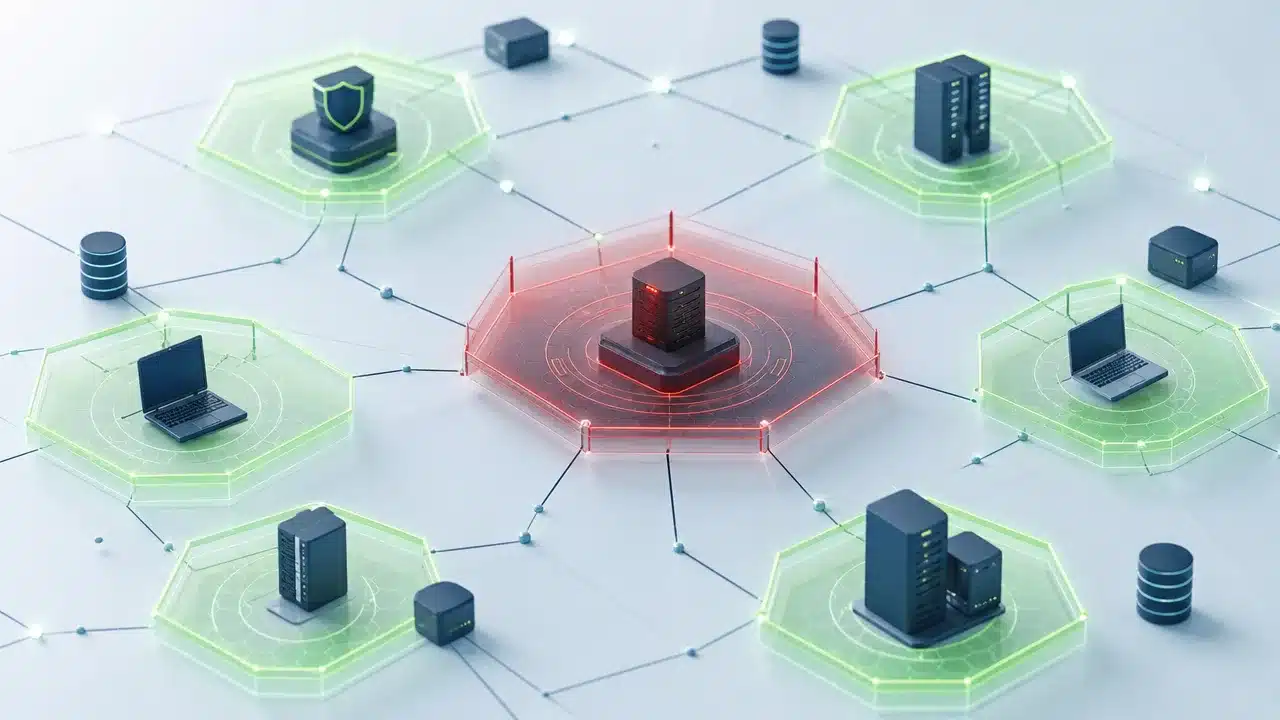
Containment is not a single product you buy. It is an architecture and a discipline. For mid-market organizations, it comes down to a handful of practical, achievable moves that together change what a missed patch means.
- Microsegmentation. Divide the network into small, policy-controlled zones so that a compromised system can only reach what it legitimately needs. Lateral movement, the mechanism that turns one infected machine into an enterprise-wide ransomware event, is denied by default.
- Identity-aware access. Tie access to verified identity and device posture rather than network location. A stolen credential or a foothold on one machine no longer grants the run of the environment.
- East-west inspection. Inspect traffic between internal systems, not just at the perimeter. Most damage in a modern breach happens after the attacker is already inside, moving sideways.
- Isolated recovery. Keep backups and recovery environments logically and physically separated from production so that an attacker who reaches your data cannot also destroy your ability to recover it.
- Continuous monitoring. Detect the behaviors of exploitation and lateral movement early, so containment actions trigger before a foothold becomes a full compromise.
We build these controls with partners the mid-market already trusts. Fortinet provides the segmentation and next-generation firewall backbone. CrowdStrike delivers endpoint detection and response that catches exploitation behavior on the host. Proofpoint hardens the email channel where so many intrusions begin. VMware, now under Broadcom, supplies the virtualization and networking fabric that makes software-defined segmentation practical at mid-market scale. As a Premier Broadcom VCSP Partner, IT Vortex integrates these into a coherent platform rather than leaving you to stitch point products together. You can see how we align these vendors on our partners page.
The mechanism that makes this practical at mid-market scale is software-defined networking. In a traditional network, segmentation meant physical VLANs, hardware firewalls, and a change process so painful that most organizations gave up and ran flat. VMware’s software-defined fabric lets segmentation policy follow the workload, so a virtual machine carries its access rules wherever it runs. That turns microsegmentation from a multi-quarter cabling project into a policy exercise a small team can actually execute and maintain. When a new workload spins up, it inherits its containment posture automatically instead of waiting on a network engineer to provision a zone. This is how a lean team achieves segmentation depth that used to require a dedicated network security group.
The point of naming specific vendors is not to sell a product list. It is to make clear that containment is achievable today with mature, proven technology. What most mid-market organizations lack is not the tools but the integration and the operating discipline to run them as a system. That is the gap we exist to close, as architect and integrator, never as a reseller handing you boxes.
The Business Case: Containment as Downtime Insurance
Executives do not fund CVE counts. They fund outcomes. So the argument for network-level containment has to be made in the language of continuity, cost, and risk, and it is a strong one. When a vulnerability is exploited in a flat, unsegmented network, the likely outcome is enterprise-wide encryption, a multi-day or multi-week outage, and a recovery bill that dwarfs the cost of the controls that would have contained it. When the same vulnerability is exploited inside a segmented, monitored, containment-first architecture, the likely outcome is an isolated incident that never reaches the balance sheet.
Quantify what a flat-network outage actually costs a mid-market firm and the case makes itself. The direct expenses are only the beginning: incident response retainers, forensic investigation, legal counsel, and often a ransom decision made under duress. Around them sits the larger loss: revenue that stops when order entry, production, and fulfillment go dark for days, contractual penalties for missed delivery, customer attrition that outlasts the outage, and the internal cost of an entire team pulled off its roadmap to rebuild from bare metal. A single flat-network ransomware event can consume a year of IT budget and a quarter of operating margin. Containment does not just reduce the probability of that event. It caps the magnitude when the probability materializes.
That is the trade the data supports. You cannot guarantee you will patch every one of 569 monthly CVEs before the five-day exploit clock runs out. You can guarantee that when one gets through, it stays small. Containment is downtime insurance, and unlike most insurance it also improves your day-to-day security posture. For mid-market firms in regulated sectors, it is increasingly a compliance and cyber-insurance requirement as well. Underwriters now ask about segmentation, EDR coverage, and tested recovery before they write a policy, and the gaps in those areas drive premiums and denials.
You cannot promise to patch every CVE before the exploit clock runs out. You can promise that when one gets through, it stays small.
This is where containment and recovery become two sides of the same strategy. Even the best-segmented network should assume some incidents will succeed, which is why Disaster Recovery (DRaaS) and Backup as a Service (BaaS) sit alongside network controls in any serious posture. Isolated, immutable backups and tested failover mean that containment failures have a floor. The Resilience pillar is not just about preventing incidents. It is about guaranteeing recovery when prevention is imperfect, which it always will be.
Immutability is the specific control that has changed the calculus. Modern ransomware operators no longer just encrypt production. They hunt for backup infrastructure and destroy it first, because a victim with clean restores does not pay. Veeam-based immutable backups, written so they cannot be altered or deleted for a defined retention period even by a compromised administrator account, remove that leverage. When an attacker who has taken the domain still cannot touch the recovery copies, the ransom conversation ends. Pairing that immutability with tested DRaaS failover means the honest answer to a breach is a restore timeline, not a negotiation.
Why the Mid-Market Is Most Exposed
Large enterprises have security operations centers, dedicated vulnerability management teams, and the headcount to run continuous triage. The smallest businesses are often too simple to be worth a targeted campaign. The mid-market sits in the dangerous middle: complex enough to have a real attack surface, valuable enough to be a worthwhile target, but rarely staffed to run a modern, always-on patch and containment operation. That is the segment where the collapsing patch window bites hardest.
A mid-market IT team of a handful of people cannot realistically evaluate, test, and deploy hundreds of CVEs a month across a heterogeneous environment while also keeping the business running. Asking them to win a five-day race against automated adversaries is asking them to fail. The honest strategic answer is to change the game: consolidate and simplify the environment, shift the operational burden of patching and monitoring to a managed platform, and build containment so that the inevitable missed patch is survivable.
The staffing reality compounds the exposure. Mid-market security work is often carried by generalists who also run help desk, manage identity, and keep the network alive. Continuous vulnerability triage and 24-hour threat monitoring are not tasks you fit around those duties. They demand dedicated attention at the exact hours, nights and weekends, when attackers prefer to operate. Building that capability in-house means hiring specialists who are scarce and expensive, and who are hard to retain at mid-market pay bands. A managed platform delivers the outcome, round-the-clock monitoring and disciplined containment, without asking a five-person team to become a security operations center.
This is the Flexibility pillar in practice. A managed, containment-first cloud platform lets a lean team punch far above its weight, accessing enterprise-grade segmentation, detection, and recovery without enterprise headcount or enterprise complexity. When we help a client with cloud migration, containment is designed in from the first workload moved, not retrofitted after an incident. That is enterprise-grade infrastructure without enterprise complexity, which is the entire reason IT Vortex exists.
What to Do in the Next 90 Days
The collapsing patch window is not a future problem. The 569-CVE Patch Tuesday and the five-day exploit clock are current facts, and the exposure is accumulating right now. Mid-market IT leaders who want to get ahead of it should treat the next quarter as a containment sprint.
- Map your slowest-to-patch assets. Identify the systems that take weeks to patch safely, then determine which are reachable from the internet or from a compromised endpoint. Those are your priority containment targets.
- Segment the crown jewels first. You do not have to microsegment everything at once. Start by isolating the data and systems whose compromise would be existential, then expand.
- Verify your recovery is isolated. Confirm that your backups cannot be reached and destroyed from production. Test a restore. An untested backup is a hope, not a plan.
- Add behavioral detection. Ensure you can see lateral movement and exploitation behavior, not just perimeter events, so containment triggers early.
- Codify who decides. Containment actions such as isolating a segment have business consequences. Decide in advance who has the authority to pull the trigger, before the incident, not during it.
Sequence matters as much as the list itself. Start with the asset map, because you cannot segment intelligently without knowing which systems are both slow to patch and exposed. That inventory usually surprises leadership: the reachable, hard-to-patch systems are rarely the ones anyone worried about. From there, isolating the crown jewels delivers the largest risk reduction per hour of effort, which is what earns budget for the next phase. Verifying isolated recovery comes before broad detection tuning because it is your floor, the guarantee that a worst-case day still ends in a restore. Each step compounds the last, and none of them requires the multi-quarter project that leaders often assume containment demands.
Every one of these moves shrinks the blast radius of the next exploited CVE. None of them requires you to win the five-day race. That is the strategic pivot: stop optimizing a process the threat landscape has already broken, and start building the architecture that makes losing that process survivable. You can review how other mid-market firms have made this shift in our case studies.
The Reframe: You Were Never Going to Win the Patch Race
For twenty years, the industry told IT teams that good security meant patching fast. That advice was correct for its era, and it is now a trap. When exploitation happens in five days and Microsoft alone ships 569 CVEs in a month, faster patching is a treadmill that speeds up every year while you stay in place. The teams that thrive in this environment are not the ones patching fastest. They are the ones who accepted that some patches will always be late and built networks where that truth does not end the company.
Network-level containment is not a retreat from good security hygiene. It is the recognition that hygiene alone stopped being sufficient the moment the patch window collapsed. Patch what you can, as fast as you safely can, and architect so that the rest cannot hurt you. That is a strategy you can actually win with, because it does not depend on beating an adversary at a race they have already rigged.
Lou Corriero, VP Cloud at IT Vortex, works with mid-market leaders to design containment-first platforms that turn missed patches into contained incidents instead of company-ending events. To map your exposure and build a plan for the next 90 days, schedule a working session with Lou Corriero. Bring your slowest-to-patch asset list. We will show you how to make it survivable.