
In late 2025, security researchers disclosed a zero-click remote code execution flaw, nicknamed Plugin4Shell, that affected four major AI coding agents at once. According to Help Net Security, two of those agents remained unpatched at the time of public disclosure, which means the exposure window did not close when the story broke. It stayed open. For any mid-market organization that has quietly let developers and operations staff adopt AI coding assistants, that single sentence should change how you think about your attack surface this quarter.
The reason this matters is not the acronym. Remote code execution flaws surface every week. The reason this one matters is the word “zero-click.” A zero-click flaw requires no phishing, no malicious download opened by a careless employee, no credential reuse. The agent processes attacker-controlled content as part of its normal work, and code executes on the developer machine or the connected environment without a human ever making a mistake. When the vulnerable software is an AI agent wired into repositories, package registries, CI/CD pipelines, cloud credentials, and internal APIs, the blast radius is not one laptop. It is everything that agent can reach.
Consider how AI coding agents actually entered your environment. They rarely arrived through a procurement review, a security questionnaire, or a vendor risk assessment. A developer installed one to move faster on a sprint, told a colleague, and within a quarter a dozen engineers were running the same tool against your production repositories. That adoption pattern, bottom-up and invisible to IT, is exactly what makes a zero-click RCE in AI coding agents so dangerous. The tools that create the exposure are the same tools your governance process never touched.
Why a zero-click RCE in AI coding agents is a different class of problem
Traditional software vulnerabilities assume a fairly contained set of privileges. A flaw in a PDF reader compromises what the PDF reader can touch. A flaw in a browser plugin is bounded by the browser sandbox. AI coding agents shattered that assumption because their entire value proposition is broad, standing access. They read your source code. They write to your filesystem. They execute shell commands. They call external tools, pull third-party packages, and increasingly hold long-lived tokens to cloud services, ticketing systems, and databases. An agent is, by design, a highly privileged automation endpoint that also ingests untrusted external content.
Compare that to the privilege model IT has spent two decades hardening everywhere else. Service accounts are scoped. Admin rights are gated behind approval. Production access is logged and time-boxed. Then an AI coding agent walks in with the effective privileges of the engineer running it, plus the ability to act autonomously on external instructions, and none of the guardrails apply because nobody classified the agent as the privileged system it actually is. The mismatch between how these tools are governed and how much they can reach is the core of the problem.
Plugin4Shell exploited exactly that combination. The zero-click RCE in AI coding agents worked because the agent treated data it fetched, plugin definitions, tool descriptions, or model context, as if it were trustworthy instruction. Feed the agent a poisoned artifact, and the agent turns your own automation against you. No click required. That is why the disclosure across four agents simultaneously should be read as a structural warning rather than a one-off bug. The design pattern is the risk, and the pattern is now everywhere in enterprise development.
The distinction between data and instruction is where this class of flaw lives. A well-designed system treats external content as data to be parsed, never as commands to be executed. AI agents, by architecture, blur that line. They are built to interpret natural-language descriptions of tools and act on them, which means a description crafted by an attacker becomes an instruction the agent follows. Until that boundary is enforced at the platform level, every agent that loads external skills carries the same latent exposure Plugin4Shell demonstrated, regardless of which vendor ships it.
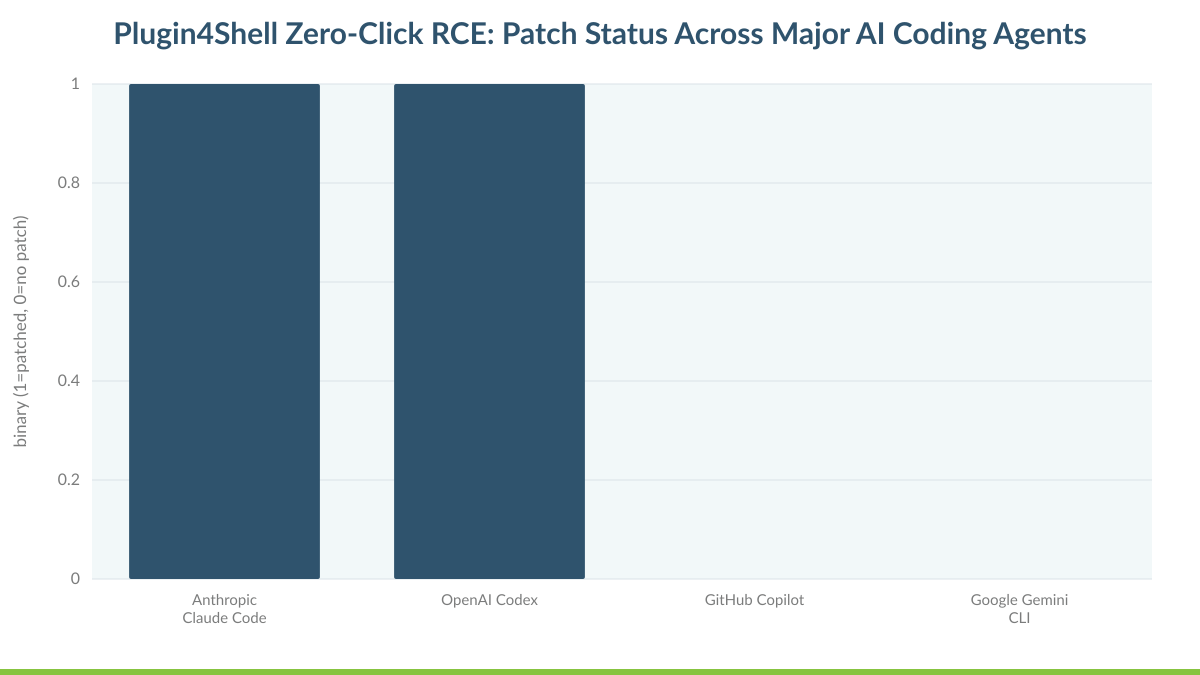
The patch-status data from Help Net Security tells the operational story. Four major AI coding agents were affected, and at disclosure two had shipped fixes while two had not. For an IT leader, that gap is the entire game. You cannot assume a vendor advisory equals a resolved risk. You have to know which agents your teams run, which versions they are on, whether a patch exists, and whether it has actually been deployed across every developer and every build runner. Most mid-market organizations cannot answer those questions today, because AI coding tools entered through the developer side door, not through procurement.
Now translate that visibility gap into a dollar figure. A mid-market firm with fifty developers, each running an AI agent with repository and cloud access, has fifty potential entry points into the crown jewels of the business. If a compromise leads to source-code theft, the cost is competitive advantage and years of engineering investment. If it leads to a production breach, the cost includes incident response, regulatory notification, customer churn, and cyber-insurance implications that can raise premiums or void coverage when the insurer learns unmanaged AI tooling was the vector. The unpatched agent is not an abstract IT concern. It is a line item that lands on the CFO’s desk after the fact.
A zero-click flaw in an AI coding agent does not compromise a laptop. It compromises everything that agent was trusted to reach, which is usually your source, your pipeline, and your cloud credentials.
SkillJacking and the supply-chain takeover problem
Plugin4Shell did not arrive alone. The same body of research described a companion technique that turns the AI agent ecosystem into a supply-chain attack surface. The idea is simple and ugly. Agents load skills, plugins, and tools from external sources. If an attacker can control or impersonate one of those sources, they can hijack the agent across every organization that installs it. One poisoned skill can propagate to thousands of downstream environments, the same way a single compromised npm package or a single malicious VS Code extension has done in prior incidents.
The economics favor the attacker in a way that should concentrate the mind. Compromising a single laptop yields one victim. Compromising a popular skill or plugin yields every organization that installs it, with no additional effort per target. That leverage is why supply-chain attacks have become the preferred entry point for sophisticated actors, and why the AI agent ecosystem, with its automatic installs and rapid update cadence, is such an attractive target. Attackers do not have to breach your perimeter. They wait for you to invite the compromise in through a trusted channel.
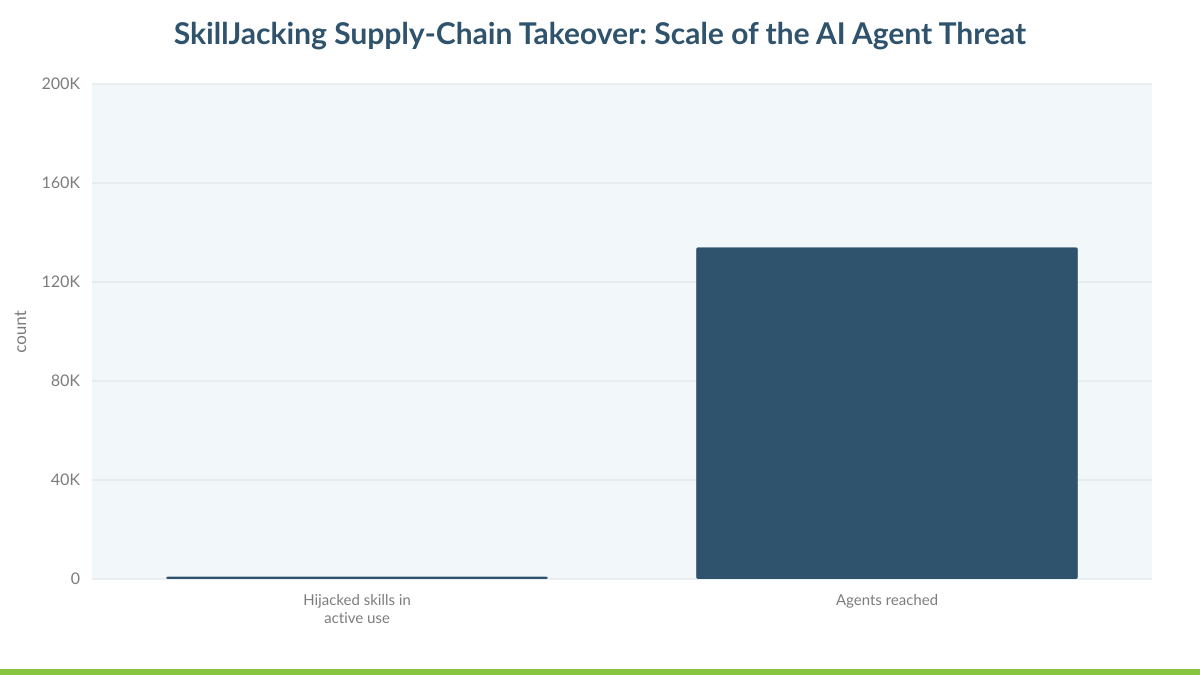
The scale data reported by Help Net Security reframes this from a developer inconvenience into a board-level continuity risk. A supply-chain takeover does not respect your firewall, because the malicious code arrives through a channel you deliberately opened and trust. This is the same lesson mid-market IT learned from SolarWinds, from Log4Shell, and from the steady drip of compromised open-source packages. The difference now is velocity. AI agents install and update capabilities automatically, often without a human in the review loop, which collapses the time between a poisoned upstream component and live execution in your environment.
Velocity is the variable that has changed most. When Log4Shell hit in December 2021, defenders had a fighting chance because deployment required someone to build and ship the vulnerable library into an application. AI agents remove that human step. A skill updates in the background, the agent reloads it, and the poisoned capability is live before the next standup. Your mean time to exposure is now measured in the interval between an attacker publishing a malicious update and your agent’s next automatic sync, which for many tools is minutes. No patch cycle moves that fast.
Map that to the pillars and the business impact becomes concrete. This is a Security problem because the trust boundary moved inside your toolchain. It is a Resilience problem because a single upstream compromise can hit many systems at once, and recovery depends on clean, isolated copies of your data and configuration. It is a Simplification problem because sprawling, unmanaged AI tooling is impossible to defend, and the fix starts with reducing the number of places these agents can run unsupervised.
The uncomfortable truth about the code these agents produce
Even a perfectly patched agent introduces a second, quieter risk: the security quality of the code it writes. The Veracode 2026 GenAI Code Security Report found that large language models are getting smarter at producing functional code but are not getting safer, and that security outcomes vary sharply by programming language. That finding matters because AI-generated code is now shipping to production across the mid-market, frequently reviewed lightly or not at all when deadlines press.
The gap between functional and secure is easy to underestimate. A model that produces code which compiles, passes the unit tests, and satisfies the ticket looks like success to a rushed team. But functional correctness and security correctness are different properties. Code can work perfectly and still ship a SQL injection, a hardcoded secret, or a missing authorization check. The model optimizes for the goal it was given, which is usually “make this work,” not “make this safe against a determined adversary.” That mismatch is the quiet risk compounding in your codebase with every accepted suggestion.
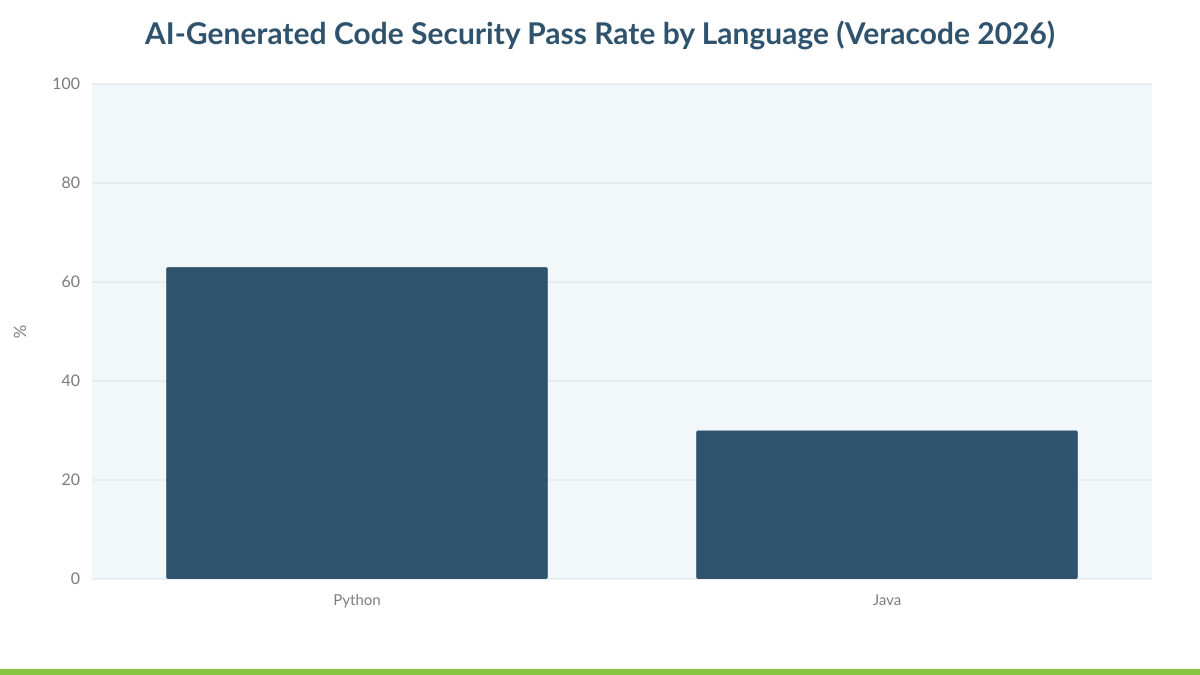
The pass-rate-by-language data from Veracode should reset expectations for anyone treating AI output as trustworthy by default. When the security pass rate for generated code varies significantly depending on the language, your risk is not uniform. A team standardized on one stack may be shipping materially more vulnerable code than a team on another, and neither team may know it. Combine that with a zero-click RCE in AI coding agents and you get a compounding exposure: a compromised agent could not only exfiltrate your existing code but also inject or generate insecure code that becomes tomorrow’s breach.
That compounding is worth sitting with. An attacker who controls your agent has two paths, and they are not mutually exclusive. The loud path is exfiltration: steal the source, harvest the tokens, move laterally. The quiet path is corruption: introduce a subtle flaw into generated code that reviewers wave through because it came from a trusted tool, then exploit that flaw weeks later after the incident response has wound down. The quiet path is arguably worse, because it survives your cleanup and turns your own development pipeline into a delivery mechanism for the next breach.
The models are getting smarter, not safer. Treating AI-generated code as trustworthy by default is a decision, and right now the data says it is the wrong one.
For a mid-market IT leader, the takeaway is not to ban AI coding tools. That ship has sailed, and the productivity gains are real. The takeaway is that AI-assisted development changes what your security and recovery posture has to cover. You now have a fast-moving, privileged, externally-influenced software layer sitting on top of your existing infrastructure, and it needs the same containment discipline you already apply to your servers and your network.
Why the patch window will not save you
We have written before about how the patch window is collapsing, with time-to-exploit falling faster than most organizations can deploy fixes. The Plugin4Shell disclosure makes the point again in a sharper form. Two of the four affected agents were still unpatched at disclosure. Even for the two that were patched, deployment lag is the norm, not the exception, because AI tools update on individual machines and in build environments that IT often does not centrally manage.
Patching remains necessary. It is no longer sufficient. When the vulnerable component is a highly privileged agent with reach into your source and your cloud, the only durable protection is to assume the agent can be compromised and to limit what a compromised agent can do. That is a containment strategy, and containment lives in the architecture, not in the patch cycle. This is precisely where a managed cloud model earns its keep. When your workloads run in a properly segmented environment with managed cloud hosting, a compromised developer tool does not get a free path to your production systems, your customer data, or your backups.
Think of it as blast-radius engineering. You cannot prevent every compromise, and pretending otherwise is how organizations end up with a single flat network where one foothold becomes total access. What you can control is what a foothold reaches. A development environment that is network-isolated from production, that holds no standing credentials to your customer database, and that cannot write to your backup repository turns a breach from an extinction event into a contained cleanup. The Fortinet and CrowdStrike layers in that architecture add detection and response, but the isolation is what buys you the time for those layers to work.
Segmentation, least privilege, and isolation are not glamorous, but they are what turn a catastrophic breach into a contained incident. An AI agent that can only reach a sandboxed development environment, that authenticates with short-lived scoped credentials, and that cannot touch backup repositories is an agent whose compromise you can survive. Building that separation into the foundation is the entire point of Cloud Hosting (IaaS) delivered on a VMware-powered platform, where network and workload isolation are architectural defaults rather than bolt-on afterthoughts.
The VMware distinction matters here in practical terms. Micro-segmentation at the hypervisor level means the isolation between a development workload and a production workload does not depend on a developer remembering to configure a firewall rule. The policy is enforced by the platform, follows the workload if it moves, and does not evaporate when someone spins up a new instance in a hurry. For a mid-market team without a large network security staff, that architectural default does the heavy lifting that a bigger organization would assign to a dedicated segmentation project.
The recovery question nobody asks until it is too late
Assume the worst case for a moment. A poisoned skill reaches an unpatched AI coding agent inside your environment. It executes, harvests credentials, and moves laterally before anyone notices, because zero-click means there was no user action to flag. What is your path back to a known-good state, and how fast is it?
This is where Disaster Recovery (DRaaS) stops being an insurance policy you hope never to use and becomes an operational capability you test on a schedule. A supply-chain compromise is not a fire or a flood. It is a logical disaster that may sit dormant, which means your recovery plan has to account for the possibility that recent backups are already tainted. Immutable, isolated backups delivered through Backup as a Service (BaaS) give you restore points that an attacker inside your environment cannot alter or delete, and that distinction is the difference between recovery and ransom.
The dormancy problem deserves more attention than it usually gets. Most recovery plans are built around the assumption that you know when the disaster happened. A server dies at a specific moment. A flood arrives on a specific date. You restore to the point just before. A logical compromise breaks that assumption because the attacker may have been present for weeks, quietly present in every backup you took during that window. Recovery then requires forensic clarity about when the compromise began, and immutable backups spanning a long enough retention window to reach a genuinely clean point. A seven-day retention policy is useless against an intruder who arrived a month ago.
The organizations that recover fastest are not the ones with the most backups. They are the ones that have already validated their recovery workflow, know their clean restore points, and can fail over without improvising under pressure. That is a rehearsal problem, not a technology problem, and it is why we push clients to treat failover validation as a recurring exercise rather than a one-time deployment checkbox. A recovery plan that has never been tested is a hypothesis, and an incident is a poor time to discover it was wrong.
A supply-chain compromise is a logical disaster. It can sit dormant in your backups, which means your recovery plan is only as good as your last validated, immutable restore point.
What mid-market IT leaders should do in the next 30 days
Panic is not a plan, and neither is a blanket ban. The path forward is deliberate and mostly consists of things good IT organizations already know how to do, applied to a new layer. Start with visibility, then containment, then recovery.
- Inventory every AI coding agent and assistant in use across development and operations, including the versions installed and the plugins or skills each one loads. You cannot defend what you have not counted.
- Confirm patch status against the Plugin4Shell disclosure and treat any unpatched agent as an active risk to be isolated or disabled until a fix is verified in place, not merely announced by the vendor.
- Scope the credentials these agents hold. Replace long-lived tokens with short-lived, least-privilege credentials, and cut any standing access to production, backups, or secrets that a development tool does not need.
- Segment where agents run. Keep them in isolated development environments that cannot reach production data or backup repositories without an explicit, monitored, human-approved path.
- Treat AI-generated code as untrusted input. Require security scanning and human review proportional to the risk of the language and the system, informed by findings like the Veracode 2026 report.
- Validate recovery. Confirm you hold immutable backups, know your clean restore points, and have rehearsed a failover that assumes recent backups may be compromised.
Sequence matters as much as the list itself. Visibility comes first because every subsequent control depends on knowing what you have. Containment comes second because it limits damage while you work through the slower governance questions. Recovery validation comes last in order but first in importance, because it is the control that saves you when the others fail. Attempting all six at once tends to stall; running them in order gives a mid-market team a defensible posture within a single quarter rather than a stalled initiative that never ships.
None of these steps require you to abandon AI-assisted development. They require you to stop treating a highly privileged, externally-influenced automation layer as if it were a harmless productivity plugin. The organizations that get this right will not only keep the productivity gains but also close the exposure that Plugin4Shell exposed for everyone else.
Where does a mid-market team without a dedicated security engineering bench get that discipline? This is the work IT Vortex does as an integrator, architect, and advisor rather than a box-mover. We help clients build the segmentation, the least-privilege credential model, and the immutable recovery posture that make a compromised AI agent survivable. Our VMware-powered platform, backed by partners including Veeam, Fortinet, and CrowdStrike, gives you enterprise-grade containment without enterprise complexity, and our service level agreement puts commitments in writing. If you are not sure where your AI tooling can reach today, that uncertainty is the first thing to fix.
The reframe: your AI agents are infrastructure now
The instinct after a disclosure like Plugin4Shell is to ask which agent is safe. That is the wrong question, because the answer changes with every patch cycle and every new skill an attacker manages to poison. The right question is whether your architecture assumes any given agent can be compromised, and whether a compromise stays contained when it happens.
AI coding agents crossed a line in 2025. They stopped being tools that sit beside your infrastructure and became privileged participants inside it, with standing access to your most sensitive systems and a design that ingests untrusted external content. Once you accept that, the response is the same discipline that has always separated the organizations that survive incidents from the ones that make headlines: know your surface, contain the blast radius, and rehearse your recovery. The zero-click RCE in AI coding agents did not create a new category of risk so much as it accelerated one you were already accountable for.
Governing AI agents as infrastructure is not a temporary response to one disclosure. It is the posture that will hold as the next flaw, the next SkillJacking variant, and the next model that ships insecure code arrive, because they will. The specifics change quarterly. The discipline does not. Organizations that build containment and validated recovery into the foundation stop reacting to each new headline and start absorbing them, which is the difference between an IT function that fights fires and one that runs a business.
If your AI tooling grew faster than your ability to govern it, close that gap now, before an attacker does it for you. Book a working session with Lou Corriero, VP Cloud at IT Vortex, to map where your AI agents can reach, tighten the credentials they hold, and validate a recovery posture that survives a supply-chain compromise: schedule a conversation here.