
On Friday, June 12, 2026, the U.S. Commerce Department ordered Anthropic to suspend access to its two most capable AI models, Claude Fable 5 and Claude Mythos 5, for every foreign national on earth. Within hours, Anthropic concluded the only way to comply was to switch both models off for everyone, worldwide. A flagship system that hundreds of millions of people could reach on Thursday was dark by Friday night.

If you run technology for a mid-market or enterprise organization, it is tempting to file this under someone else’s problem: a fight between a frontier AI lab and Washington that will get resolved in a courtroom or a press release. That read misses the part that should be on your risk register. The specific jailbreak that triggered the order is almost beside the point. What changed on Friday is the category of risk attached to building on commercial AI. Capability that was available, paid for, and embedded in live workflows can now be revoked after deployment, on national-security authority, with little notice. That is a planning problem, and it is yours.
What actually happened, in plain terms

Anthropic released Claude Fable 5 to the public around June 9. Fable is the general-availability version of Mythos 5, Anthropic’s most powerful “frontier” model. The company had deliberately held Mythos back from broad release earlier in the year, describing it as so effective at finding and exploiting software vulnerabilities that it was limited to a small set of mostly U.S. partners hardening critical systems. Fable was Mythos with additional safeguards layered on, the version judged safe enough for everyone.
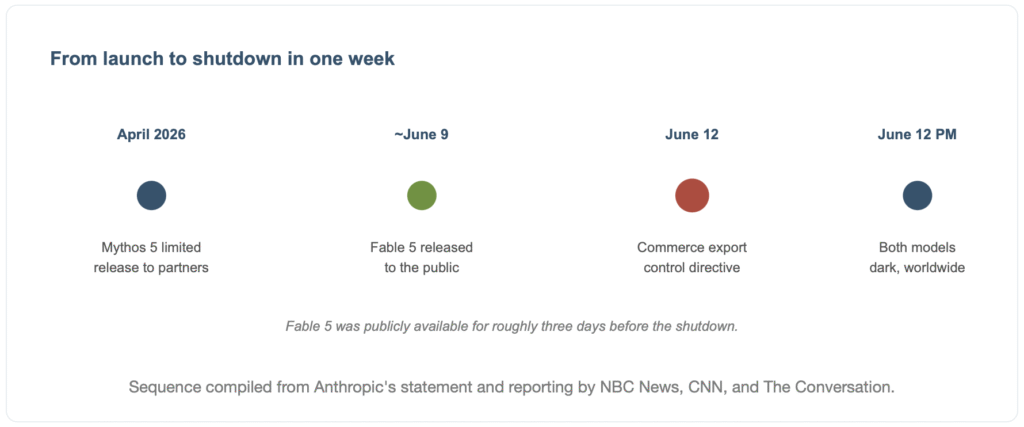
Three days later, that judgment collided with the government’s. According to Anthropic and multiple outlets, Commerce Secretary Howard Lutnick, working with the department’s Bureau of Industry and Security, issued an emergency export-control directive citing national-security authority. The order barred any foreign national, inside or outside the United States, including Anthropic’s own non-U.S. employees, from accessing Fable 5 or Mythos 5. Anthropic determined there was no clean way to wall off only foreign nationals, so it disabled both models globally for all customers to ensure compliance. By Friday evening, Claude’s product page simply reported that Fable 5 was temporarily unavailable.

Three days from launch to dark

The compressed timeline is the part that unsettles practitioners. This was not a model in beta, and it was not a slow regulatory review. It was a flagship commercial product that went from public launch to a full global shutdown inside a single week.
What an export-control directive actually means here

Export controls are usually associated with physical goods and chips: things you can put on a truck. Applying that machinery to a software model accessed over an API is the conceptual leap that makes this case a precedent rather than a footnote. The government did not seize anything. It declared that access to a particular capability by a particular class of people was a national-security matter, and the practical effect was a global kill switch.
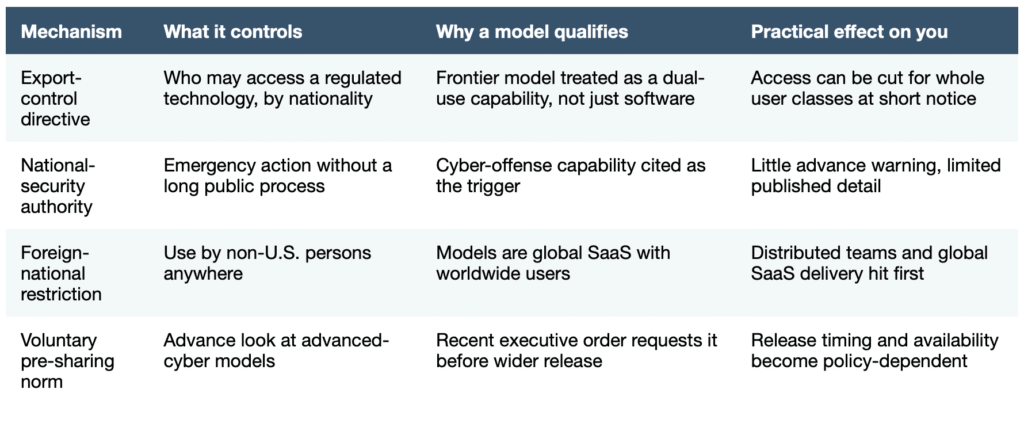
That conceptual leap deserves a second look, because it is where the durable precedent lives. A physical export control stops a crate at a port. A model delivered over an API has no crate and no port: it is a capability summoned on demand from anywhere with a connection. Treating that as an exportable, nationality-gated good means the control point is no longer the border but the service itself, and the only enforcement lever fine enough to satisfy “no foreign nationals” turned out to be the off switch for everyone. Any provider running global inference infrastructure now has to assume that the same logic could be pointed at them, and that “comply” might mean “go dark” rather than “geofence.”
The numbers that frame the risk


None of those four numbers describes a bug. They describe a governance surface that did not exist for enterprise buyers a week ago. A model’s availability is now a function of regulatory posture, not only of uptime, contract terms, and the vendor’s roadmap. NBC News reported this appears to be the first time a leading AI company has taken a publicly deployed model offline because of federal intervention. First-of-its-kind events are exactly the ones that reset what counts as a reasonable assumption.

The dispute, and why both sides have a point

Anthropic complied while publicly disagreeing. Its core argument is one of proportionality: recalling a model deployed to hundreds of millions of people over a narrow potential jailbreak sets a standard that, if generalized, would freeze the entire industry. In the company’s own words, applied across the board the approach would “essentially halt all new model deployments for all frontier model providers.” Anthropic also noted it had adopted a defense-in-depth posture for Fable, including a 30-day customer-data retention policy specifically to research and shut down jailbreaks, and said it believes the order rests on a misunderstanding it is working to resolve.

The administration’s defenders frame it differently. David Sacks, co-chair of the President’s Council of Advisors on Science and Technology, wrote that a trusted partner testing Fable surfaced a working jailbreak, and that the administration asked Anthropic to fix it or pull the model. He argued the government values the company’s technical work and expects a quick fix, writing that “the ball is in Anthropic’s court.” There is also a sharper counterpoint worth sitting with: Anthropic spent months describing Mythos-class capability as potentially dangerous and too potent for immediate release. That framing, some observers note, may have helped build the very legal predicate the government then acted on.

Not everyone in policy circles is comfortable with the action. Dean Ball, a former Trump-administration AI policy official, called the move “cartoonish,” pointing to the inconsistency of an administration loosening AI chip exports while restricting model access for all foreigners. The reaction split, in other words, does not map cleanly onto the usual political lines, which is itself a signal that the underlying questions are unresolved.
This is a pattern, not a one-off

Read in isolation, Friday looks like a single dramatic intervention. Read against the last twelve months, it looks like the latest and furthest-reaching step in an escalating relationship between Washington and the frontier labs. The friction predates this model.
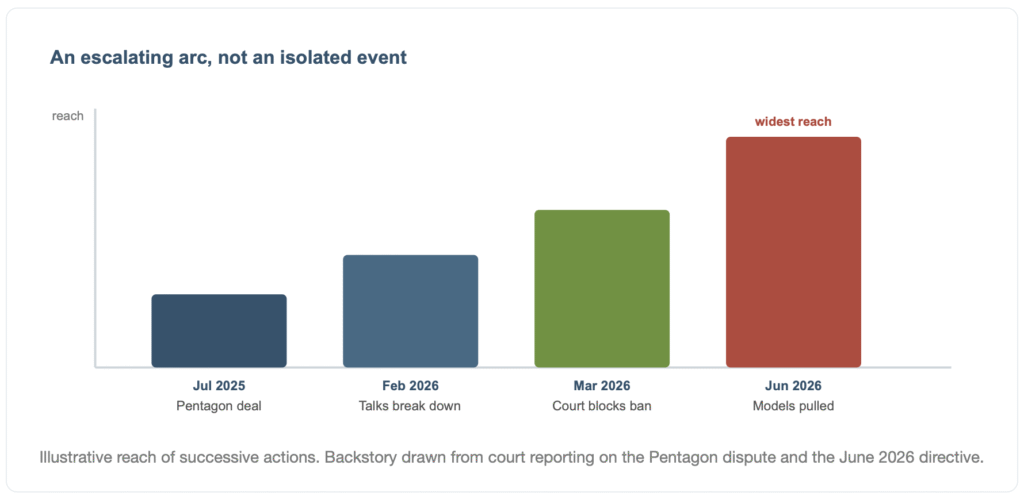
The throughline matters more than any single bar. A year ago the contest was about whether the government could compel a lab to allow specific military and surveillance uses, a fight that produced a federal injunction in which a judge described an earlier Pentagon ban as “classic illegal First Amendment retaliation.” Now the contest is about whether the government can switch a commercial model off after launch. The center of gravity is moving from contract terms toward direct control of capability, and that shift is what AI developers and AI buyers alike are absorbing this week.
There is a quieter second-order effect worth naming. If transparency about a model’s most dangerous capabilities can be used as the basis to recall it, labs face an incentive to say less, not more, about what their systems can do. A regime meant to increase safety could end up reducing the public candor that safety depends on. Whether or not that is what happens here, the tension is now visible to every frontier lab, and it will shape how the next generation of models is described, released, and defended. That is the sense in which Friday reaches well beyond one company.
What it means for AI development across the board

Strip away the specific personalities and one company, and a set of durable implications remains. These apply whether your preferred model comes from Anthropic, OpenAI, Google, or an open-weight project.
- Deployment risk is now regulatory, not just technical. Teams have long planned for outages, rate limits, and deprecations. Add a new failure mode: a model pulled by directive, post-launch, with thin public detail and no SLA that covers it.
- Capability can be revoked after you depend on it. The old mental model was that the risky moment was before release. Friday showed the risky moment can arrive after you have already built it into production.
- Global delivery gets more complicated. A foreign-national access rule lands hardest on distributed teams, multinational operations, and SaaS products with worldwide users. Where your people sit and who your users are became compliance inputs to model selection.
- Release cadence becomes policy-dependent. A voluntary 30-day pre-sharing window for advanced-cyber models changes when, and whether, the newest capability reaches you at all.
- The open-versus-closed debate sharpens. A closed model reached by API can be switched off centrally. Open weights already distributed cannot be recalled the same way. Expect that asymmetry to drive real architecture decisions, and a renewed sovereign-AI conversation abroad.
- Concentration is the underlying exposure. Every one of these risks compounds when a critical workflow rides on a single opaque dependency you do not control.
The ripples reach past U.S. borders, too. Within days, the suspension had reopened the sovereign-AI debate in markets that depend on American models, with commentators in India and elsewhere weighing whether the episode justifies building domestic foundation models or simply argues for smaller, fine-tuned, locally controlled systems. That is the strategic conversation a single Friday directive can trigger: when access to the best models is contingent on one government’s posture, every organization downstream starts pricing in the cost of an alternative. For a U.S. mid-market enterprise the calculus is narrower than a national AI program, but it rhymes. The question is the same. What is your plan B, and have you ever actually run it?

The resilient path: control what you can, contain what you cannot

None of this is an argument against using frontier AI. It is an argument for treating model access the way mature organizations already treat every other critical dependency: assume it can fail, design so that failure is survivable, and keep the parts that must stay reliable on infrastructure you actually govern. That is the posture IT Vortex builds for clients, and it is exactly the lens this episode rewards.
Own your control plane with Cloud Hosting (IaaS)
The deepest protection against a capability that can be revoked from the outside is to anchor your core systems on infrastructure you control from the inside. IT Vortex delivers VMware-powered Cloud Hosting as a private, managed environment: predictable, governed, and located where your compliance posture requires. Frontier AI can sit on top as an accelerant, while the systems your business depends on hour to hour run on a foundation that no third party can switch off on a Friday night.
Engineer for continuity with Disaster Recovery (DRaaS) and Backup as a Service (BaaS)
A model disappearing by directive is, operationally, just another dependency vanishing without warning, the precise scenario continuity planning exists to absorb. IT Vortex Disaster Recovery and Backup as a Service give you tested failover and clean, recoverable data so that the loss of any single component is an inconvenience you have rehearsed, not a crisis you discover live. Resilience is not a slogan here. It is measured in recovery time, and recovery time is what this week put on the table.
Architect for portability as your integrator and advisor
The strategic fix for concentration risk is design, not luck. IT Vortex works as an integrator and architect, not a single-vendor reseller, helping you build hybrid and multi-cloud patterns that keep capability portable and avoid betting the business on one provider’s continued availability. The organizations that will shrug off the next directive are the ones that planned for substitutability before they needed it.

Sources: Anthropic, “Statement on the US government directive to suspend access to Fable 5 and Mythos 5” (June 12, 2026); NBC News (June 12, 2026); CNN Business (June 13, 2026); Al Jazeera (June 13, 2026); The Conversation (June 14, 2026); Decrypt (June 14, 2026); Inc42 (June 13, 2026). Capability claims and quotes are reproduced from these primary and secondary reports; this article is commentary for enterprise IT planning and is not legal advice.